Is your bank still spending two to four hours on a single KYC review?
This is the norm at most banks, and the same work could take an AI agent UNDER FIVE MINUTES…
Which is why compliance queues keep piling up faster than staff can clear them.
Meaning most bank automation breaks down the moment a case leaves the script.
This guide explains how agentic AI moves banking from answering to acting, with full audit trails and human sign-off where it counts.
Using AI agents turns your back office from a cost burden into a real growth asset.
This holds true even more since the global AI agents in financial services market is set to reach $6.7 billion by 2033 (growing at a 31.5% CAGR from its 2025 value of $691.3 million).
What Is Agentic AI in Banking?
Agentic AI in banking is a type of AI that runs on large language models (LLMs) and carries out banking work on its own.
AI agents reason through a goal, plan the steps, call in-house tools, and finish multi-step workflows within limits the bank sets. No human has to prompt each step.
- The LLM is the reasoning engine inside each agent. The model reads the task and makes sense of messy inputs like emails and tax forms. Then the model works out what should happen next. In doing so, the agent turns raw inputs into a clear plan.
- Here's where agentic AI and generative AI split. Generative AI makes content, such as a recap, a draft reply, or an answer.
- Agentic AI uses the same model to take action. With this, an agent can block a card, build a KYC file, or sort out a payment exception. Banking automation is shifting from talk to action. Meaning, agentic AI picks up where conversational AI in financial services leaves off.
- The scale is now clear. Per nCino, JPMorgan Chase is aiming for over $1.5 billion in output gains and risk value from generative and agentic AI. Meanwhile, Wells Fargo's Fargo assistant has handled more than 200 million customer interactions.

How Do AI Agents Work in Banking?
Banking agents seldom work alone. Most banks set them up as a multi-agent system (MAS). A lead agent breaks a request down into sub-tasks. On top of that, the lead agent hands each one off to an expert agent.
1. Agents Reason and Retrieve
Take an address-change request. The request kicks off an ID-check agent, which confirms who the customer is. At the same time, a retrieval agent looks up the bank's policy. Meaning, two agents work on one request side by side.
The retrieval agent relies on retrieval-augmented generation (RAG). With this, answers come only from trusted in-house files. The model can't fall back on guesswork. But how does an agent reach the systems where the real work happens?
2. MCP and APIs Connect Agents to Banking Systems
The Model Context Protocol (MCP) is an open standard. Some call MCP the USB-C port for AI. MCP lets agents reach CRMs, data stores, and the bank's central systems through one governed gateway.
IBM's guide to MCP covers the protocol in detail. Without MCP, teams end up with a tangle of custom APIs. But by doing this through MCP, every tool call runs through one logged link. That makes audits far quicker to carry out.
3. Human-in-the-Loop Controls Gate Risky Actions
AI agent orchestration handles task hand-offs and API limits. The orchestration layer also decides when to call in a human.
Some actions change state. Think of changing an address, sending a refund, or moving money. For these, the orchestration layer holds the action for human sign-off. Meaning, nothing reaches the ledger until a person signs off.
The loop runs in four steps:
- The agent reasons and asks for an action.
- The orchestration layer checks rights. For state-changing actions, the layer waits for human sign-off before making the API call.
- The result comes back to the agent as fresh context.
- The loop repeats until the task is done or a human steps in.
7 Use Cases of Agentic AI in Banking
The best use cases share three traits. They run at high volume, carry lots of forms, and follow clear rules. The seven below cover back-office work, customer service, KYC, AML and fraud, credit risk, payments, and personal banking.
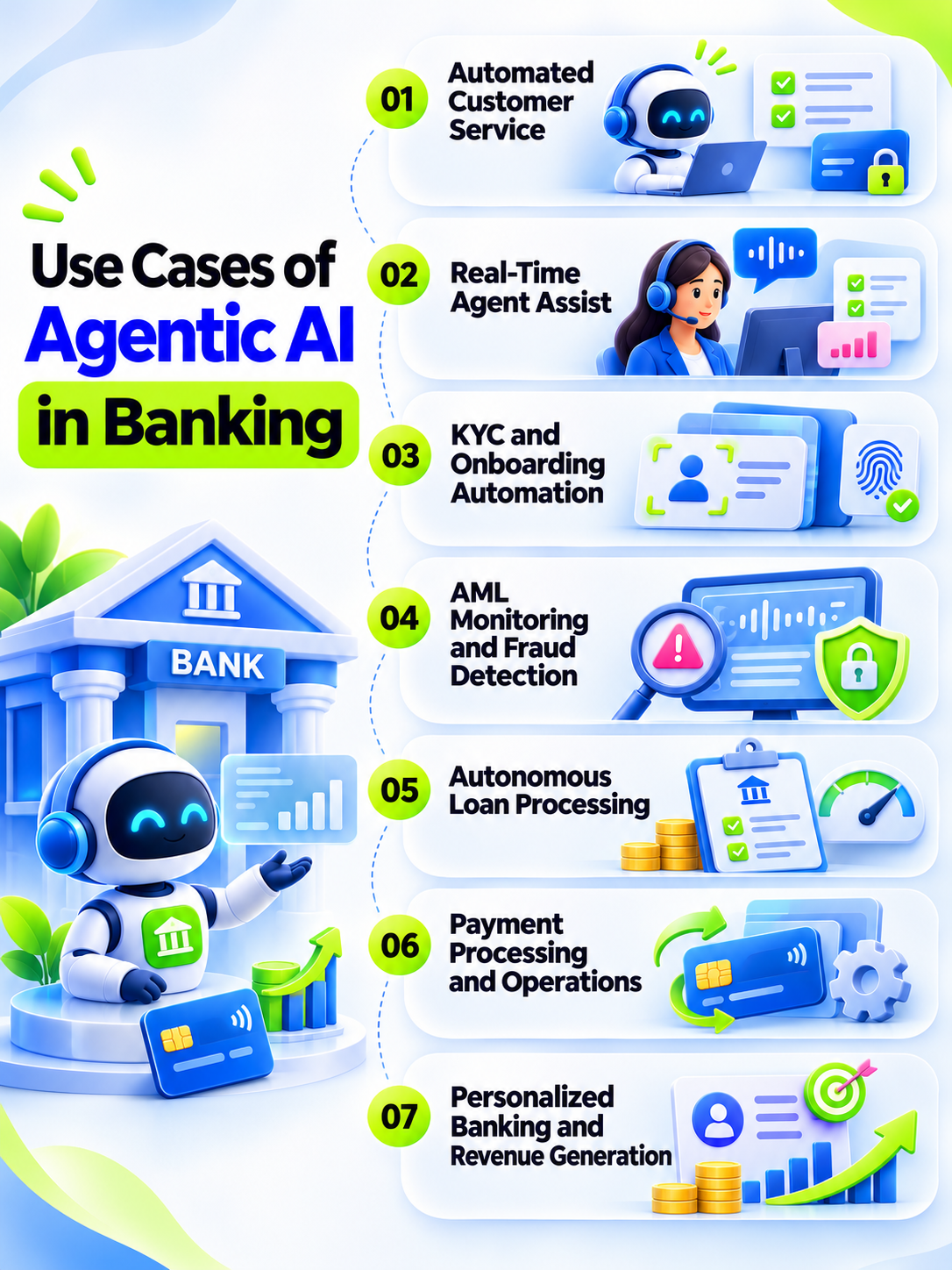
1. Automated Customer Service and L1 Resolution
AI banking agents close L1 tickets from start to finish. Card blocks, password resets, and onboarding questions all fall into this group. The agent reads the CRM and the bank's knowledge base to sort each one out. This is AI-powered banking support automation at work, where tickets get closed, not just answered. With this, low-risk actions like card blocks run under rules the bank has signed off in advance.
Blits.ai reports a median 85% containment rate for service agents hooked up to the bank's central systems. Disputes still go to humans, though. Why? A bot that gets a deadline wrong can close a valid claim by mistake.
2. Real-Time Agent Assist and Call Intelligence
Here the agent backs up the staff member. The agent does not take their place. In AI-powered contact centers, speech analytics write up the call as it happens. Sentiment analysis flags an upset customer. As a result, next-best-action prompts pop up in the CRM.
Call recaps and compliance checks follow on their own. Reports point to a 26% median gain in output for live agents.
3. KYC and Customer Onboarding Automation
Agents run many checks side by side. These include ID checks, file reviews, customer due diligence (CDD), risk profiling, and sanctions screening.
JPMorgan Chase cut KYC unit costs by nearly 40%. On top of that, machine checks on files can shrink a hand review from two to four hours to under five minutes.
4. AML Monitoring and Fraud Detection
Agents act as Tier-1 analysts. They look into alerts, pull up transaction logs, and draft reports for human sign-off. Lyzr reports false positives falling by more than 60%. Meaning, analysts chase far fewer dead ends. Time spent per case drops by 50 to 60%.
Santander runs 100,000 AML alerts a year through AI models. And what do missed checks cost? FinCEN's $1.2 billion fine against Bank of America in October 2026 spells out the answer.
5. Autonomous Loan Processing and Credit Assessment
Borrower checks, data pulls from statements, credit rating, and compliance checks run side by side. They no longer have to wait on each other.
Dextralabs reports delays of 10 to 27 days shrinking to hours. Underwriter admin work drops by 50 to 70%. With this, the final credit call still stays with a human. The reasons behind each call stay clear and easy to explain.
6. Payment Processing and Banking Operations
Agents match up transactions, handle payment exceptions, and service accounts through the bank's main APIs. JPMorgan Chase reports more than 50% fewer manual payment exceptions.
Work also wraps up roughly 75% faster. Still, no agent gets sole say over moving unchecked funds.
7. Personalized Banking and Outbound Revenue Generation
Agents sort customers into segments and use predictive analytics. That lets them time credit card cross-sells, loan tips, and deals that keep customers loyal.
JPMorgan's Connect Coach gives 12,000 advisors one million custom insights. Looking ahead, nCino's research found that 70% of finance leaders plan to use agentic AI for personal advice.
What ROI Can Banks Expect from Agentic AI?
Returns show up once agents move past the pilot phase. Lyzr's 2026 guide cites IDC on this point. Frontier firms earn a 2.84x return on AI spend. Laggards earn just 0.84x. Meaning, the gap between leaders and laggards is wide.
- The banks out in front are sharing hard numbers. Santander reported €84 million in proven AI business value in the first half of 2026. Santander is also handing AI access to all 185,000 of its staff. BNP Paribas is rolling out AI at scale and aims for €1 billion in yearly savings by 2030.
- So what should a sound ROI model count? Start with cost savings and KYC handling time. Then add fraud losses, average handling time (AHT), first contact resolution (FCR), staff output, and sales growth.
- With this, a sound model also counts the costs that slide decks leave out. These include API setup work and LLM inference compute. They also include the governance load of ongoing checks.
What Are the Risks of Agentic AI in Banking?
The same freedom that makes agents useful also makes them risky. Deloitte warns that an agent with API keys can drift away from its workflow.
- From there, the agent could move money no one signed off on. The agent could also change customer data. On top of that, hackers can use prompt injection and tool poisoning to push agents past safety checks.
- Hallucinations add a second layer. Picture an agent that makes up a policy or gets a sum wrong. That agent can harm a customer before anyone notices. Meaning, one bad answer can do real damage. Bias in credit calls, data privacy gaps, and cyber gaps pile on top.
- Model risk management is shifting too. In April 2026, the US SR 26-2 guidance left generative and agentic AI out of older model risk frameworks. With this, banks are pushed toward third-party and ops risk controls instead.
- Vendor risk is the silent threat. The Financial Stability Board issued 12 sound practices for AI in October 2026. A central worry is concentration risk, meaning banks lean too hard on a few AI and cloud vendors. Citigroup has now blocked third-party AI agents from reaching customer accounts.
- Human checks are the backstop. Fed Governor Christopher Waller has asked where the right balance lies between ease and planned speed bumps in agent sign-off. So what does that balance look like in practice? Banks can set up guardian agents that watch runtime telemetry. They can apply role-based access control at the tool-call level. On the whole, they can require human sign-off for every state-changing money action.
Is Agentic AI in Banking Compliant with RBI, PCI DSS and SOX?
Agentic AI can be compliant. But compliance comes from the bank's design, not from the model. Each agent needs the same controls, records, and clear owner as any staff member or system doing the same job.
RBI Guidelines, KYC Directions and PMLA
RBI's KYC Directions and the Prevention of Money Laundering Act (PMLA) set the baseline. They cover due diligence, record keeping, and suspicious transaction reporting. With this, an onboarding or AML agent must follow that logic. The agent must also log the proof behind every step. A human officer stays on the hook for filings.
RBI's Digital Payment Security Controls call for strong authentication and access control. Any agent that touches payment channels must carry these over. Meaning, the agent plays by the same rules as any banking app. RBI's FREE-AI framework adds guiding rules for sound AI governance.
PCI DSS and Card Data
Where agents touch cardholder data, PCI DSS applies, just as it does to any system in scope. Mask card numbers. Wall off the card setup. Lock down access. And never pass raw card data into model prompts.
SOX Internal Controls and Audit Trails
Banks with US listings or US parents fall under SOX. SOX calls for sound internal controls over financial reporting. Agents that post entries or match up accounts need written-down controls. On top of that, they need segregation of duties and logs that no one can change.
Outside India, the ECB has put AI governance near the top of its watch list for 2026 to 2028. With this, audit-ready AI lists are fast turning into a global must. Rules change often, so check against current circulars with your compliance team.
Agentic AI vs. Traditional AI and Banking Chatbots
Conventional chatbots run on rigid decision trees. When a customer’s query strays from the script, the bot loops, and the customer ends up stranded. Rule-based automation and robotic process automation (RPA) share the flaw: they follow “if this, then that” and break on unstructured data.
Traditional AI can score a transaction for fraud but can’t act on the result. Generative AI can write the response but can’t execute it. Agentic AI closes the gap by combining LLM reasoning with orchestrated API calls, turning insight into resolution.
How to Roll Out Agentic AI in Your Bank
A phased rollout keeps you from over-building. On top of that, the phases keep you from leaving gaps.
- Map Out Bank Workflows: Look for work with heavy volume and lots of forms. Good places to start are L1 support, KYC data pulls, and payment exceptions.
- Rank Use Cases: Start where volume is high and risk is low. L1 support is a common first pick. A guide to AI tools for banking customer support can help you size up vendors. Then move up to credit and payments.
- Design the Setup and Connect Data: Combine LLMs, RAG, and MCP. Clean up the bank's main APIs first. Meaning, agents need one clear source of truth. Agents can't work when the data clashes with itself.
- Build Orchestration and Safety Controls: Log every tool call. Then box in each one with role-based rights and transaction limits.
- Run Pilots in Shadow Mode: Let agents work without state-changing rights. Human experts check every output and sign off on every action.
- Track Results: Keep an eye on AHT, FCR, false-positive rates, and drift. With this data in hand, scale up under strict money limits and an audit-ready system list.
Using Thunai AI to Bring Agentic AI Into Banking Workflows
Building this stack from scratch takes months. Teams have to work out orchestration, context storage, checks, and links to every system. Then they have to keep all of it running as models change.
Why build from zero when the parts exist? Thunai AI, for one, ships ready-made AI agents for banking and finance, along with the stack beneath them. In doing so, banking teams can put their time into results.
Thunai handles up to 80% of routine interactions on its own and cuts human handle time by 66%. Thunai runs inside custom compliance guardrails. Thunai also plugs straight into CRM and ERP systems.
Want to see how Thunai can bring agentic AI to your bank? Book a free demo call!
FAQs About Agentic AI in Banking
What is the difference between agentic AI and generative AI in banking?
Generative AI writes content such as recaps and draft replies. Agentic AI adds reasoning and workflow orchestration. As a result, agents can carry out tasks on their own within set limits. Say an agent needs to check a customer's ID or sort out a payment exception. The agent can do both on its own.
What are the most common applications of agentic AI in banking?
The most common uses are customer service, KYC, AML, fraud checks, loan work, and payment ops. These workflows run at high volume and carry lots of forms. Meaning, side-by-side work and automation pay off fastest there.
Can AI agents make financial decisions independently?
Agents can handle routine calls within set limits. But credit sign-offs, risk checks, and fund moves should stay with humans. Regulators expect a clear owner for each call. On top of that, they expect clear reasons behind calls like a turned-down loan.
Is agentic AI safe for banks to use?
Yes, as long as the bank governs agentic AI well. Safety rests on data privacy controls, cyber defense, and AI governance. Model risk management, role-based access controls, and full audit trails for every agent action matter just as much.
What is the future of agentic AI in banking?
Expect multi-agent systems to run smart workflows across onboarding, compliance, and payments. Predictive banking and AI-powered customer service will sit on top. With this, banks will move toward self-running finance ops. Humans will watch over edge cases instead of grinding through routine work.