
Pressure from executives to implement AI in customer service is standard, not an exception.
That's why this guide discusses what AI customer service means in 2026. The deployment of autonomous AI agents grew from 39% to 66% in just one year, reflecting 1.7x growth.
It also deals with how it works, where it earns real ROI, and how platforms can turn strategy into execution.
But most importantly, how YOU and your team can use AI customer service without ripping out your existing stack!
What Is AI Customer Service?
AI-powered customer service systems involve natural language understanding, generative modeling, and autonomous agents for handling chat, voice, email, and social interactions through a single unified platform.
How is it different from legacy systems? Well, legacy systems catch problems after the fact, or even days later (well after customers have already formed an opinion about your brand!).
And to back this up, 85% of retail organizations now agree that AI is fundamentally changing how they operate.
The fact is that there is a gap between pressure and readiness. And what some of the smarter companies see is that this is where most of the opportunity sits!

How AI Customer Service Works
Natural Language Understanding
NLU helps teams read typos, slang, and emotional tone. These tools work the moment a customer speaks or types.
And to do this, uses models like Gemini 2.5 Flash and Claude Sonnet to spot intent in real time. Sentiment tracking runs under the conversation, too. If a customer gets upset, it triggers a warm transfer to a human.
Knowledge Retrieval and RAG
RAG help make sure that your AI cannot fabricate. To do this, the enterprise data, policies, manuals, and tickets are all converted to vector embeddings.
These exist within databases such as MongoDB VectorDB and Pinecone. This is because the model gives responses only on the basis of the grounded context (meaning no guesswork!).
Agentic Actions and Workflow Automation
Explaining a refund policy is not the same as issuing a refund. Using the Model Context Protocol and multi-agent systems, AI can do the whole job.
AI agents verify identity, call the billing API, calculate the refund, and update the CRM. All of this happens end to end, with no human needed. If an API call fails, the AI flags a human instead of failing silently.
Types of AI in Customer Service
I. AI Chatbots and Virtual Agents
These agents work across the web, apps, and WhatsApp. And now, are capable enough to handle multi-step conversations and not just rigid decision trees!
In terms of AI customer service, this means password resets, order tracking, and account changes get solved without a human touching the ticket.
And better yet, when a query is too complex, it alerts the agent with the full conversation history attached. So that way, nobody has to repeat themselves.
II. AI Voice Agents
Voice remains the medium when there is something that needs immediate attention.
These days, the newer AI voice agents handle such phone calls with proper intonation and not through IVR technology.
Real-time translation in customer service enables companies to communicate with their worldwide audience without having to employ translators for each language.
These calls also turn into structured tickets, using AI voice agents with screen-share available for live technical help to customers.
III. Agent Assist and Copilots
Some interactions will always need a human. Which is why real-time agent assist sits beside your reps during live calls.
This is a feature for AI customer service that surfaces knowledge articles, tips, and the best next steps before the rep even has to search.
Support reps can stop switching tabs and typing the same things over and over. Some companies even report that reps who use an AI copilot report feeling 20% more confident doing their job.
IV. AI-Powered Analytics and QA
Manual QA can only check a small sample of calls. AI-powered call auditing and analytics check all of them. Every voice and text interaction gets transcribed and scored against your scorecard.
This includes factors like script compliance, first call resolution, compliance risk, and sentiment analysis.
With this information, call ratings go directly to your CRM, and leaders get real-time access to performance data rather than monthly snapshots.
Key Use Cases for AI in Customer Service
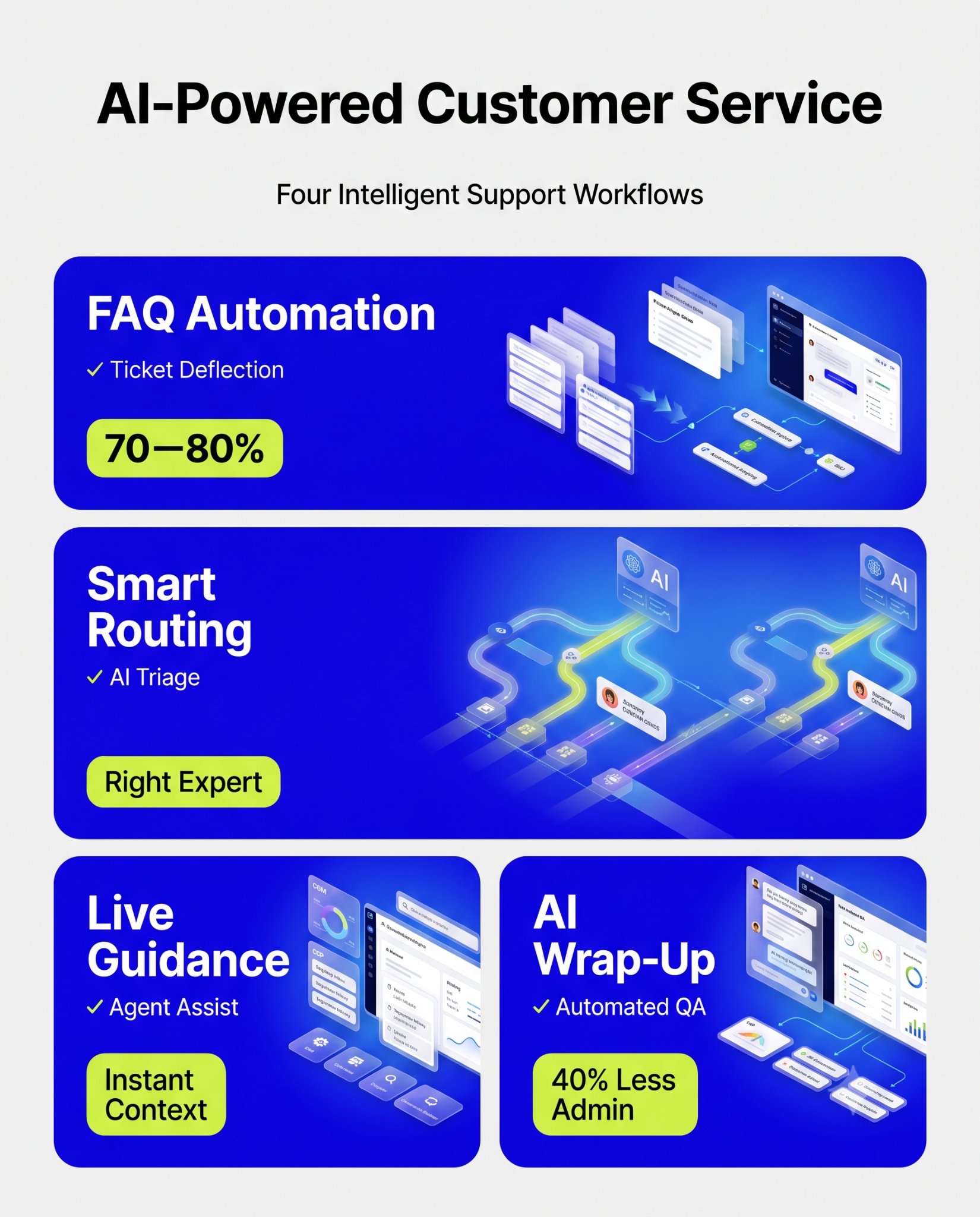
1. FAQ and Ticket Deflection
Password resets and invoice requests can drain hundreds of tickets per day, even reaching as much as 40% of all tickets received.
Intent recognition and automation take care of them end-to-end, achieving up to 70%-80% deflection from Level 1 questions.
Using these tools for AI customer service, your best people get freed up for interactions that actually need judgment and empathy.
2. Routing and Triage
Rather than using FIFO (first in, first out) queues, AI looks at intent, sentiment, purchase history, and problem complexity for ticket routing.
The high-value client with a terrible issue or outage will automatically be handed off to a Level 3 engineer along with an AI summary of what has been attempted so far.
This is how AI is revolutionizing customer service!
3. Real-Time Agent Guidance
While a rep is live on a call, AI pulls shipping data, transaction history, or ERP records straight into their screen and drafts a response for review.
Average handle time drops, human error drops, and every interaction stays compliant, all without a rep hunting through five different tabs.
4. Post-Interaction Summaries and QA
Wrap-up work eats up to 40% of an agent's day. AI customer service software ends that. Case summaries get written, CRM records get updated, sentiment gets logged, and follow-ups get assigned the second the call ends.
Agents move to the next customer instead of typing notes nobody reads.
Benefits of AI Customer Service
- Faster Resolution, Higher FCR: Instant data retrieval and API-driven actions resolve issues up to 5x faster, dropping resolution from days to minutes, with FCR climbing up to 40%.
- 24/7 Availability and Scalability: AI in customer service doesn't sleep, take breaks, or burn out. Volume spikes from an outage or viral campaign get absorbed without the wait times that damage brand trust.
- Higher CSAT and Consistency: Good automation earns trust rather than losing it. Companies using AI customer service agents rank CSAT as their most improved metric, with some deployments reporting up to a 95% lift.
- Lower Cost per Contact: Deflecting 80% of Level 1 tickets and automating 40% of admin work cuts cost fast, though the real payoff is value creation, not just cost-cutting (see the compute-cost ceiling below).
Real-World Examples of AI Customer Service
These are not pilot programs anymore. Enterprises across regulated and high-volume industries already run agentic AI in production.
- Utilities: Oracle's connected AI platform guides utility customers through billing and low-income assistance eligibility, and manages complex cases like residential solar credits, all from one operating model.
- Healthcare: Neuberg Diagnostics resolved 70% of Level 1 tickets without a human touching them, cutting patient wait times in half, all inside strict healthcare compliance rules.
- Financial Services and Public Sector: Thrivent Financial uses real-time data streaming for workflow automation. Palmerston North City Council relies on the same streaming backbone to power its smart city AI agents.
- The New Threat, AI vs AI: Customers now deploy their own bots to dispute bills and sit on hold. Forrester forecasts spikes in calls 100 times higher than usual, compelling companies to employ bot management solutions even to bargain with their clients’ AI systems.
Challenges and Risks (and How to Mitigate Them)
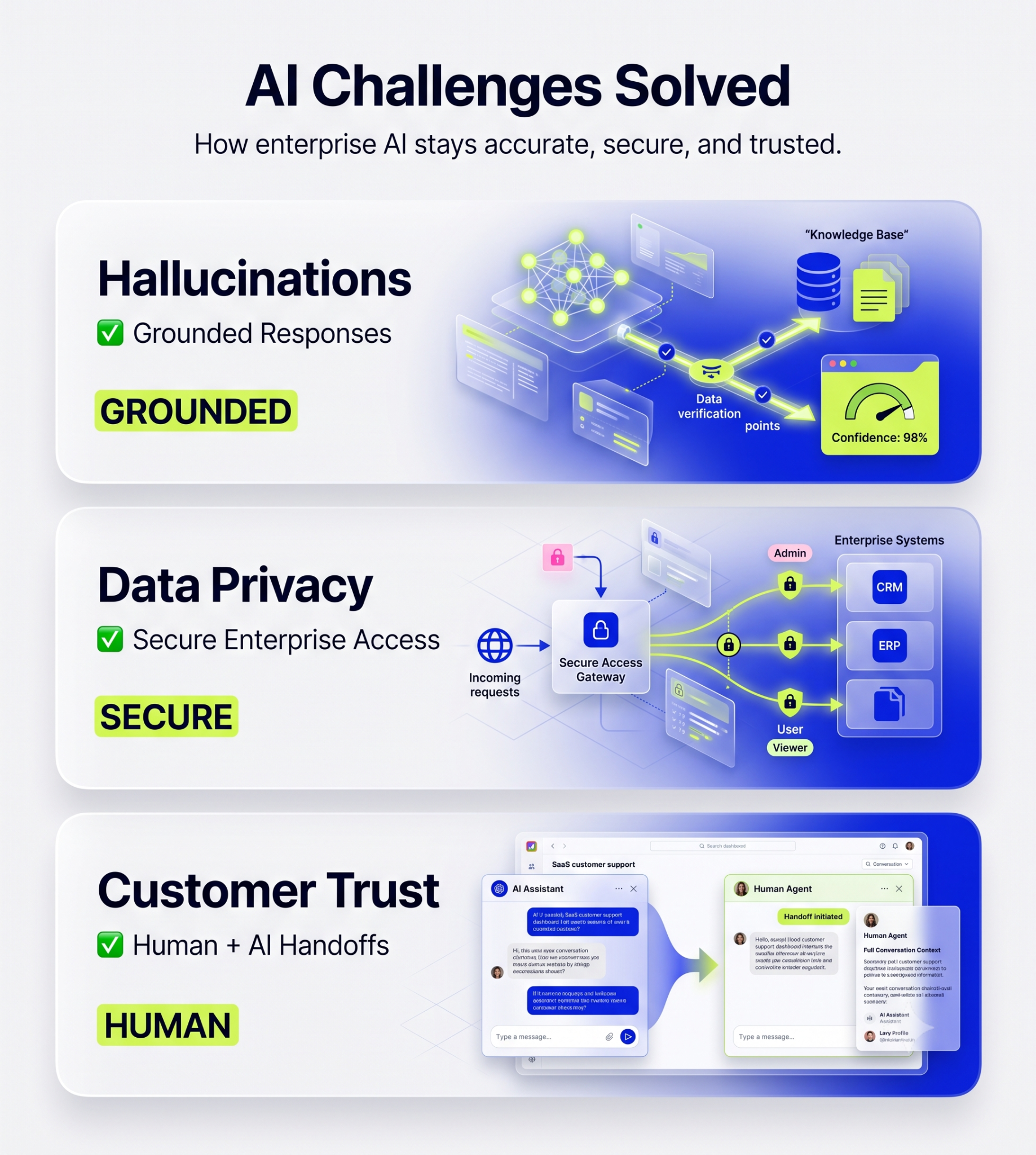
- Accuracy and Hallucination Control: An ungrounded AI customer support will confidently invent a refund policy that doesn't exist which is a compliance liability! (Not just a bad experience). Strict RAG, contradiction detection, and a hard confidence threshold that hands off to a human keep this in check.
- Data Privacy and Compliance: AI customer service platforms need enterprise data to work, raising the stakes on exposure. In fact, over half of IT security leaders doubt they can deploy AI agents while staying compliant. Role-based access, full data lineage, and open standards like MCP connect systems securely.
- Maintaining the Human Touch: Customers don't trust customer service AI the way vendors assume! This means adoption optimism sits at 49% among businesses versus just 19% among customers.
How to Measure AI Customer Service Success
Average handle time was built for human throughput, and that measure breaks in an AI-first model, because AI customer service tools absorb the easy tickets and leave humans with the hard, emotional ones, which naturally take longer. Track these instead.
CSAT, First Contact Resolution, Self-Service Resolution Rate
- CSAT: measure it scross for both AI and humans, to make sure that cost savings from automation do not slowly deteriorate customer satisfaction.
- Self-Service Resolution Rate: proportion of tickets that are resolved by the AI, without human assistance. Aim for 70%-80% in case of routine queries.
- First Contact Resolution: a high FCR means the AI has real API access to fix things, not just links to hand out.
- AI ROI and Cost of Resolution: factor in total token cost, compute cost, and labor cost versus lifetime value gain and reduction in workforce.
How to Implement AI Customer Service (Step by Step)
- Make your tech stack simpler and clean your data: AI customer service tools are only as good as its source of information. Consolidate your CRM, update your knowledge base, and bring legacy systems into real-time before implementing any customer-facing technologies.
- Start with simple processes: do not launch with your toughest challenges. Historical data from tickets will highlight repetitive requests such as order statuses and password reset requests; document exactly what is required to address them.
- Evolve roles, do not remove them: applying AI technology for customer service transforms your business; it does not make your team obsolete. Almost one-third of companies will create parallel AI departments by 2026, while 84% of service directors are looking to expand traditional agent tasks and not reduce them.
- Give it real backend access: A bot unable to write or modify documentation is nothing but a description of an agent. Read and write permission for CRM, billing, and inventory systems enables AI customer service to resolve problems, rather than simply describe them.
- Build governance and feedback loops: Define your policy of human intervention upfront. Continuous quality assurance of 100% of conversations will help feed all failures and hallucinations directly to the knowledge management system.
The Future of AI Customer Service: Agentic AI
Text chat isn't the ceiling. Two AI customer service shifts are already reshaping what's next:
- The Agentic Shopper: Customers are starting to deploy their own AI to compare options, negotiate, and resolve support issues - but this has its own clear drawbacks.
- Generative Engine Optimization (GEO): Your brand now needs to be discoverable and trustworthy to an algorithm, not just a person. Content and support quality are judged by AI first.
- The SaaSpocalypse (Agentic Arbitrage): As AI agents get capable enough to operate across multiple software systems at once, the software itself becomes invisible to the end user.
- The Money Shift: Gartner estimates $234 billion in enterprise software spend is exposed to this shift. Stating that by 2030, businesses will stop paying for dashboards and start paying for outcomes.
How Thunai Powers AI Customer Service
Everything above is the theory. Thunai is how you actually run it without tearing out what you already have.
Thunai connects natively to more than 50+ of the top CCaaS tools, CRM, and helpdesk platforms, including Salesforce, Genesys, and Amazon Connect, typically in under two days. No rip and replace, no six-month migration.
Thunai Omni Suite for AI Customer Service works seamlessly on all channels:
- Chat and Digital Agents: support thousands of concurrent chats and achieve 70% - 80% deflection on Level 1 volume.
- Voice Agents: multi-language real-time support, converting all inbound calls into tickets.
- Real-Time Agent Assist: live co-pilot powered by the Thunai Brain, increasing agent productivity up to 3x.
- Automated QA & Workflows: full coverage of conversations and scoring according to your own rules of compliance and sentiment.
Enterprises running the full Thunai stack report up to a 95% lift in CSAT.
Want to see what this looks like for your company? Book a free demo!
Frequently Asked Questions in AI Customer Service
Will AI replace human customer service agents?
No. AI tools in customer support handles up to 80% of routine Tier-1 queries, however, there is an increasing need for people in more complex and emotional situations. In most companies, people are taking on new tasks and developing new job positions such as that of AI Operations Lead.
How do you stop AI from hallucinating?
The ideal customer service AI always uses RAG to respond to queries, along with constantly monitoring for contradictions, and there should be a strict fall-back policy whereby once confidence drops to a certain level, the query is handed over to a human.
Why do customers get so frustrated with chatbots?
The legacy bots are capable of diagnosing the problem but are unable to solve it. This technology will help in generating a help article rather than solving the problem, thus creating a dead-end. The solution lies in the use of an agentic AI that has the capability of accessing the backend API.
What is the biggest blocker to AI implementation in 2026?
Data readiness. 72% of service operations professionals cite fragmented and siloed data as the number one obstacle. For AI to work, it needs access to information. Thus, integration of the knowledge base and getting real-time data flowing in must come first.


.png)