



Are you spending too much time dealing with FAQs rather than addressing actual customer issues?
FAQs and static bots do not always give customers the answers they need, and that slow, off-target experience drags down CSAT.
Deflecting questions with AI delivers answers that understand intent and stay reliable, so customers get resolved faster and leave more satisfied.
Find out in this guide how to cut down on tickets, lift CSAT, and improve the support experience using AI.
What Is FAQ Deflection?
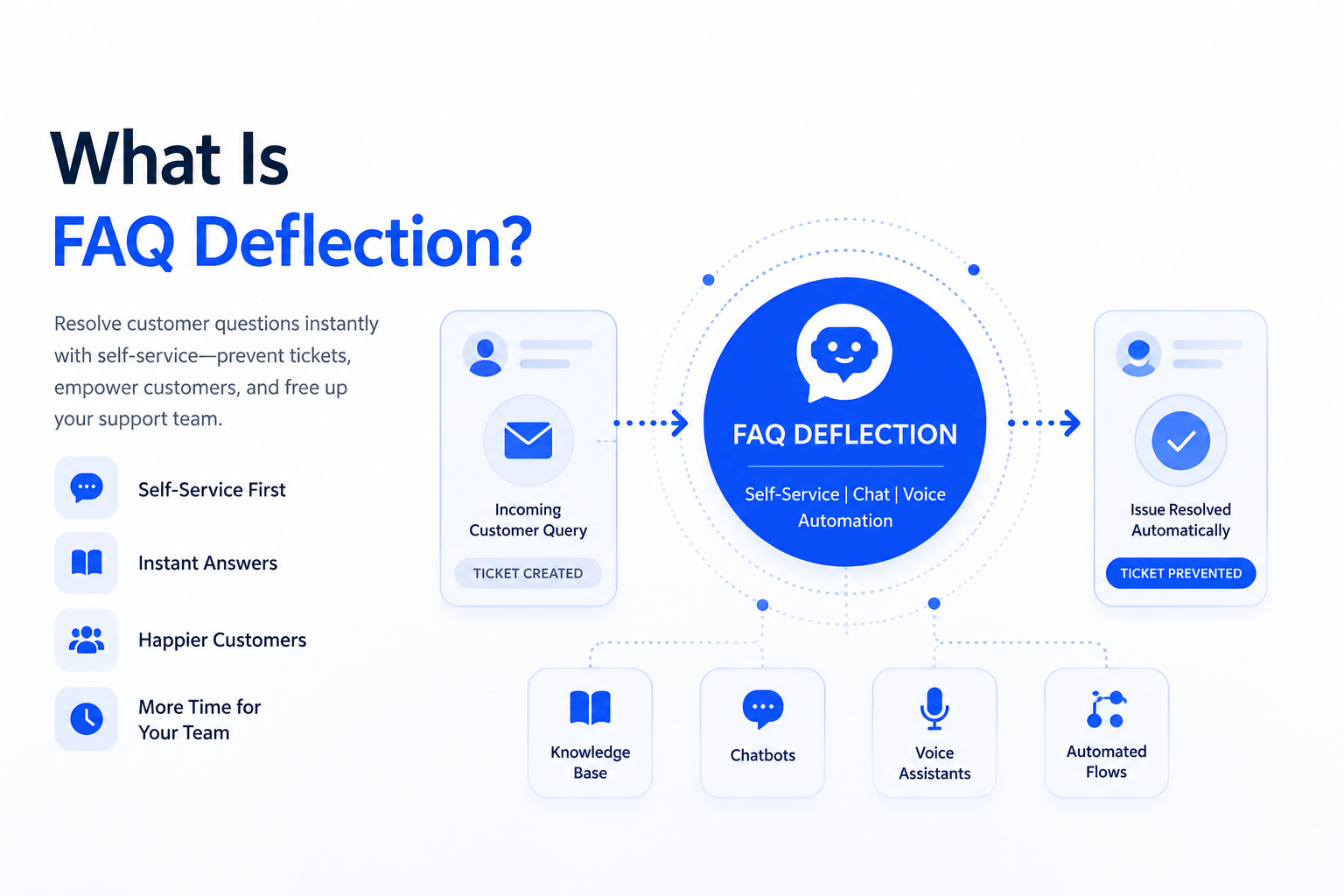
FAQ deflection involves preventing repeat inquiries from becoming tickets by resolving the issues using self service initially. Simply put, FAQ deflection involves preempting customers’ inquiries by providing them with information using content, chat, voice, or automation.
Indeed, this method has been one of the simplest techniques in decreasing the number of questions asked by customers without affecting the customer service process.
Your customers will feel fast service, and your staff will have extra time since they will be able to solve their problems using the knowledge base, chatbots, and interactive flows. This is the reason for the rise of deflection strategies in support.
FAQ Deflection vs. Ticket Deflection vs. Call Deflection
- FAQ deflection: Deflects tickets by providing knowledge base answers to commonly asked questions.
- Ticket deflection: The more general concept concerned with decreasing the number of help desk tickets generated through any self service approach.
- Call deflection: Reduces the volume of phone calls or IVR calls by redirecting the call towards an automated response or self service process.
Although all the three techniques aim to decrease the burden of the support team, the deflection using FAQ makes use of good knowledge and AI to find the matching articles or tasks.

Why Traditional FAQ Pages and Rule Based Bots Fail at Deflection
Keyword dependent: Questions can be asked by customers in many different ways; keyword matched FAQs don’t capture the intent and provide irrelevant answers.
Outdated content: FAQ page is quickly outdated unless updated to include any changes to the product or drivers of contact.
Unanswerable questions: In some cases, there could be answers, but they are difficult to find or poorly indexed, thus customers become frustrated and create a ticket.
Brittle policies: The question is not asked in a particular way and the bot is not able to find an answer.
Result: Self service is possible, but deflect rate remains low and CSAT is also low.
How AI Improves FAQ Deflection
AI makes deflection better because AI recognizes intent rather than text alone. This is important.
Humans don’t ask questions in neat categories, and support staff cannot assume they do. The use of AI will enable the deflection model based on the knowledge base to recognize intent and provide the answer.
1. Natural Language Understanding vs. Keyword Matching
- Natural language understanding looks for meaning. That is a major difference in ai faq deflection and AI ticket deflection.
- The user might express this problem differently, however, the technology will recognize the problem and give the corresponding response.
- That is important since users never ask questions in the same manner twice. AI reduces that gap.
- It can understand “How do I stop the email alerts?” and connect it to a notification settings article without forcing the customer to search like an agent. That is how faq deflection becomes more reliable.
2. Retrieval Augmented Answers from Your Knowledge Base
- This is the heart of knowledge base deflection. The AI should take data from the approved sources, present them in a relevant form, and point the user to the next move.
- This strategy is extremely efficient since it unites the quickness of response and reliability of information. The customers receive a quick answer, but it is an approved one.
- That is especially useful for self service deflection because it keeps the experience consistent across articles, bots, and support channels.
3. Agentic Resolution (Going Beyond Answers to Actions)
- Sometimes an answer is not enough. The customer needs action.
- That is where advanced AI creates real value in call deflection and support deflection.
- Instead of just pointing to a help article, AI can help reset a password, check order status, or trigger the right workflow.
- A good system reduces repetitive tickets by solving the task, not just describing the task. That is the future of AI for FAQ Deflection.
4. Smart Escalation When AI Can't Resolve
- No AI tool must ever give the impression that they know it all. Escalation needs to be done smartly.
- If the confidence level is not high enough, the AI solution should escalate to a human agent and not have to start the process all over again.
- It is particularly crucial in cases of ticket deflection since the goal here is not to frustrate customers; the goal is to solve simple problems and escalate complex problems.
- Good deflection respects customer time and avoids dead ends.
FAQ Deflection Across Channels
Deflection works best when it appears where customers already are. That includes web, in-app, voice, and email. A single answer strategy across all channels creates a better experience and helps you manage volume more effectively.
Web Chat and In-App
- Integrate AI with your in-app chat to intercept common queries and show KB answers or complete actions.
- Use proactive suggestions based on page context (cart page => shipping FAQs).
- Keep a “was this helpful?” micro feedback loop to tune models.
Voice and IVR
- Use speech recognition and NLU to get the intent of the user and map it to the most appropriate FAQ.
- Give the option of “I can read an article for you or I can transfer you to an agent.” Give the response based on the confidence score and provide the complete article through SMS/Email.
- Track deflection from calls routed to self service vs. transferred to agents.
- Pre-process incoming emails with AI to suggest KB articles to customers automatically or include suggested answers in agent reply drafts to speed resolution.
- Use auto response with KB for clearly repetitive inquiries, with an easy path to reply if the customer needs a human.
How to Measure FAQ Deflection
The most important metrics are not vanity metrics. They are resolution metrics. If your numbers look good but customers are still unhappy, the strategy is failing.
What Is the Deflection Rate?
Deflection rate is the percentage of potential support contacts resolved through self service instead of becoming tickets.
A simple formula is:
Deflection rate = self service resolutions ÷ total potential contacts × 100.
A better version is to track this by intent, channel, and content type. That tells you what is actually working. It also shows where your ai faq deflection program needs tuning.
Self Service Resolution Rate
- Self service resolution rate shows how many users solved the issue without coming back for the same problem.
- This is important because a click on an article does not always mean success. True self service deflection should reduce repeat contact.
- This metric is stronger than simple views or bot interactions. It reflects actual outcomes and that is what leadership should care about.
Deflection vs. Abandonment (Avoiding Vanity Metrics)
- Deflection is good only when the customer is truly helped. Abandonment looks similar on a dashboard, but it is not the same.
- If a user leaves because the bot was confusing, that is not deflection. That is a broken experience.
- So always pair deflection numbers with CSAT, repeat contact rate, and escalation quality and that gives you the real picture.
- It helps you scale support deflection without damaging trust.
What Is a Good FAQ Deflection Rate?
Benchmarks vary based on product complexity, but standard industry tiers help us measure success.
The baseline technology industry average is around 23% when relying on traditional help centers. Standard, keyword based chatbots typically yield an ai faq deflection rate between 20% and 40%.
- However, if you deploy advanced AI for FAQ Deflection, your deflection rate can scale significantly. AI agents grounded in verified knowledge bases hit 40% to 60% deflection rates.
- Best in class agentic AI setups, like Thunai, consistently achieve deflection rates of 70% to 80%.
How to Set Up AI FAQ Deflection (Step by Step)
This is not the way to go, but to begin with the most frequent questions, and to develop the clean content from there. This is where AI for FAQ Deflection goes from a one-off project to a process that can be repeated again and again.
Audit Your Top Contact Drivers
- Start with your top ten or twenty repeated issues. Look at tickets, chats, emails, calls, and search terms.
- Find the questions that show up most often. Those are your best opportunities for ticket deflection and call deflection.
- This step gives you focus. Without it, teams waste time on edge cases. With it, you solve the problems that matter most.
Structure Your Knowledge Base for AI
- Knowledge base deflection is rooted in a well informed knowledge base. Maintain focus on each issue by having one problem per article.
- Write simply and clearly, providing steps, and use good formatting.
- If the content is not easily understood by people, AI will understand even less.
- This structure makes content retrieval more efficient, improves answers, and increases certainty.
Deploy, Test, and Tune
- Roll out in stages. Test one channel first. Review the answers.
- Check where the AI is strong and where it misses. Then tune it. That is the only responsible way to launch chatbot deflection at scale.
- The best teams treat this as an operating system, not a feature.
- They measure, adjust, and improve continuously. That is how support gets better every month.
Common Mistakes That Kill Deflection (and Erode Trust)
- The biggest mistake is overpromising.
- If you tell customers the bot can solve everything, they will notice when it cannot.
- Another mistake is using outdated content. A third is hiding the agent option. These mistakes damage confidence quickly.
- The other trap is measuring the wrong thing. A high deflection number means little if CSAT falls.
Real success comes from accurate answers, smooth handoffs, and lower repeat contacts. That is the balance every support leader should protect.
AI FAQ Deflection with Thunai
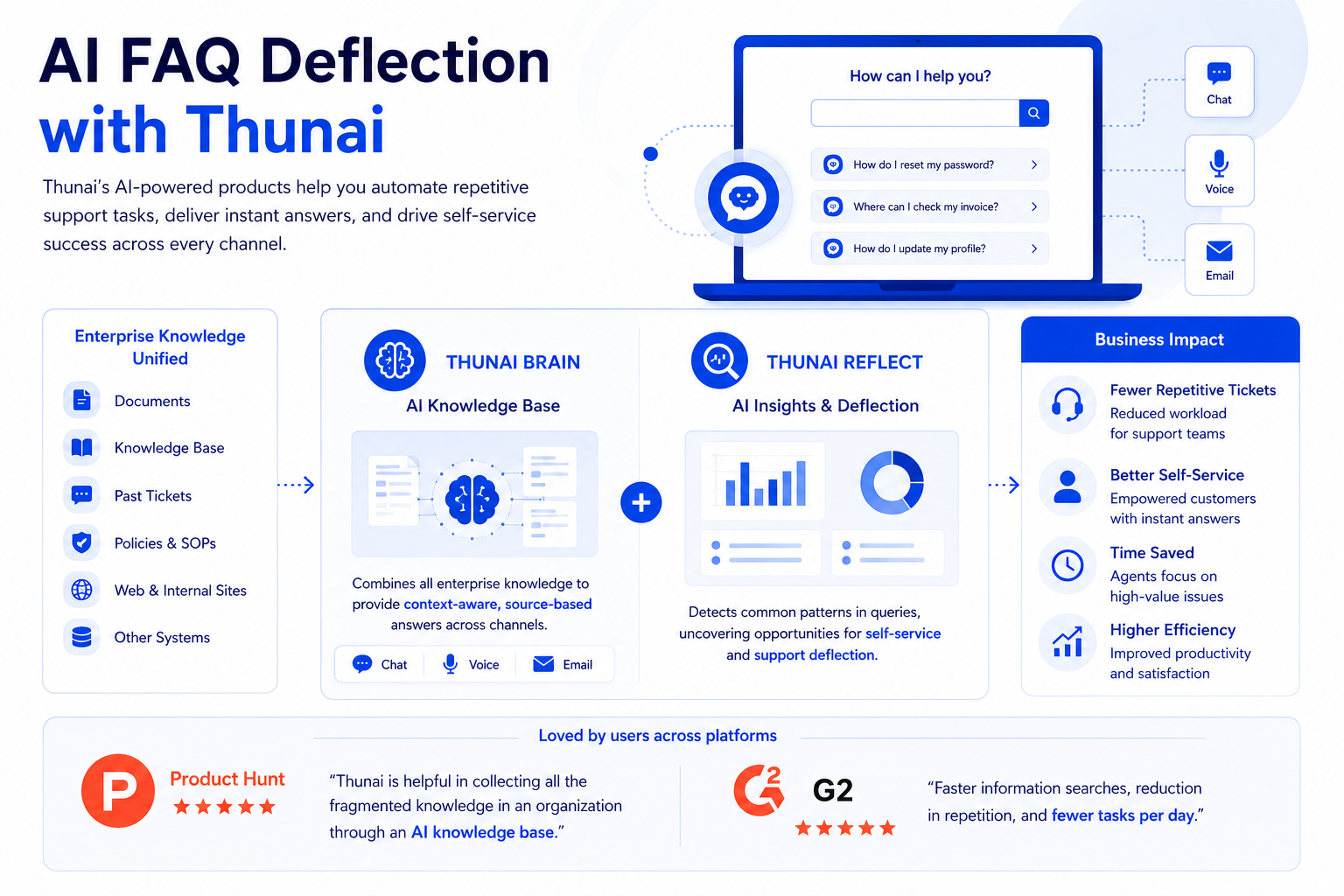
Thunai supports AI-driven FAQs with the help of its products called Thunai Brain and Thunai Reflect, which help in automating repetitive support tasks.
The company’s Thunai Brain combines all enterprise knowledge in an AI knowledge base that helps to provide context aware and source based answers through chat, voice, and email channels, while the Thunai Reflect detects common patterns of queries for self service and support deflection.
Public opinions back up the above features.
- The users at Product Hunt highlight that Thunai is helpful in collecting all the fragmented knowledge in an organization through an AI knowledge base.
- while the G2 users mention faster information searches, reduction in repetition, and fewer tasks per day.
FAQs on AI for FAQ Deflection
Is AI for FAQ Deflection only for large teams?
No, smaller groups sometimes even have the advantage as some repeatable questions might end up taking up quite a lot of time.
Is FAQ deflection a cause of lowering CSAT?
No, when performed correctly, FAQ deflection will actually improve speed, precision, and confidence, all which support CSAT.
What is the difference between chatbot deflection and self service deflection?
Chatbot deflection utilizes a conversation interface. The scope of self service deflection is wider and includes such tools as articles, voice flows, and even email automation.
How does support deflection help operations?
It reduces redundancy and also helps to route cases to the right people. This also leaves room for the agents to handle complicated cases.



.png)

