
Do you continue your investment in AI without reaping its benefits in terms of business returns?
Most life insurers face challenges such as scattered data, old systems, high costs, strict regulations, and AI projects that fail to reach production.
The point is not more investment in AI but rather understanding how you can derive the most value from AI.
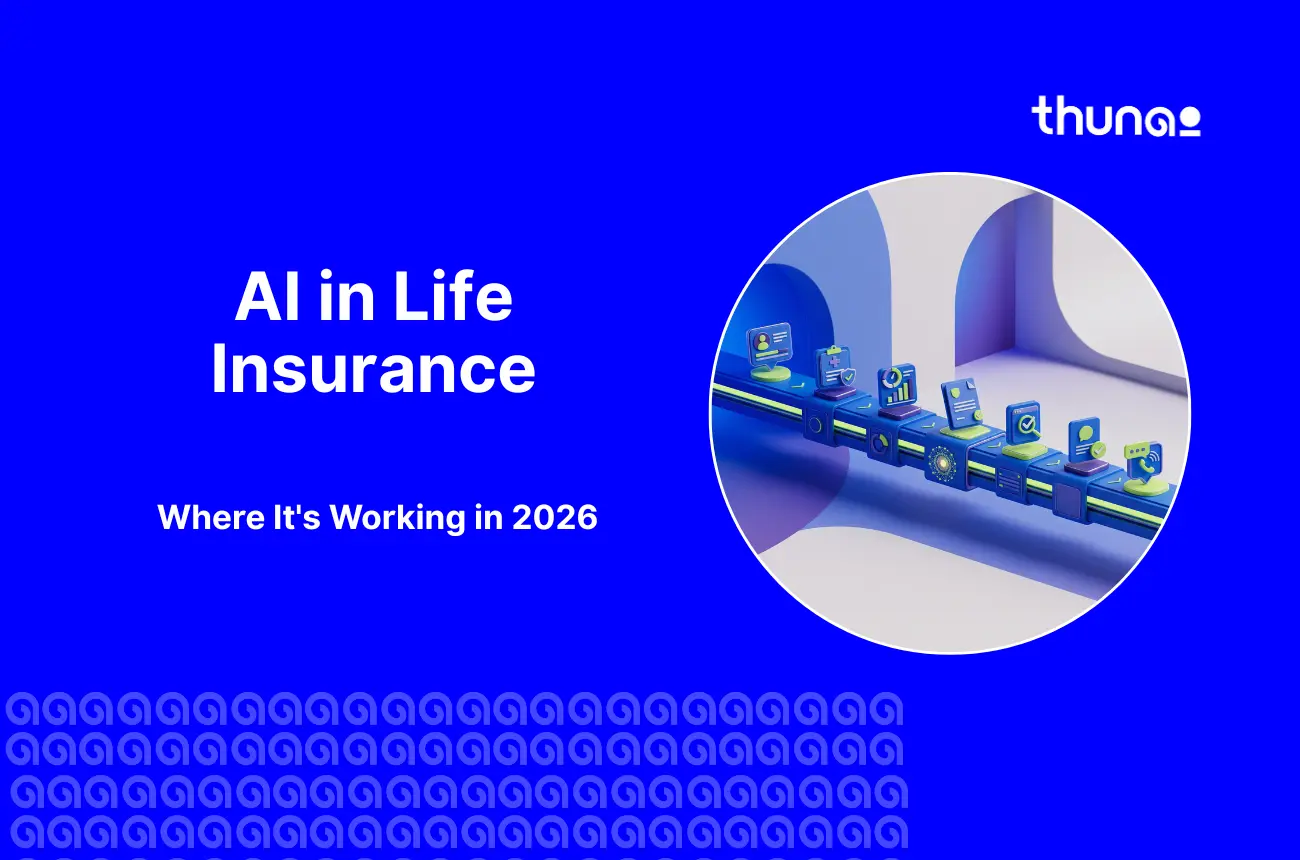
From underwriting and claims to customer service and sales, this article shows where AI is already making an impact.
This also explains how insurers can use AI to speed up work, improve customer service, and get more value from their AI investments.
The State of AI Adoption in Life Insurance
The life insurance value chain has a natural fit for facts, numbers, and risk analysis, thus being an ideal choice for applying AI technology.
Adopting an integrated AI platform allows insurance carriers to streamline underwriting, claims, and customer service without juggling disconnected point solutions.
Insurers should not adopt individual AI solutions that cannot work together.
Adoption Rates Among Underwriting and Insurance Executives
Life insurance companies are adopting AI quickly, but they are at different stages.
Some leading insurers use AI in their daily work and are changing how they operate. Others are just starting to see results.
Insurers who invest heavily in AI don’t get the necessary return on investment through AI.
The most prominent insurers implement AI in various sectors, including risk evaluation, claim processing, and customer service.

Projected Profit Impact
Scaling AI is vital to make significant gains in the profitability of life insurance. Applying AI in different areas of the business will boost revenue and cut costs.
AI with agentic capabilities can be used for task completion, customization, and sales. AI-powered distribution can also increase new life insurance sales and premiums.
Where Spend is Concentrating vs. Where Returns are Showing
A key gap in insurance AI adoption is that investments do not always go where they create the most value.
In the past, insurers spent a lot on AI pricing tools. Today, leading insurers are investing more in people and change management and less in complex AI technology.
Future-ready insurers focus on high-volume, lower-risk areas such as customer service, customer retention, and AI-powered sales.
AI in Underwriting
Underwriting is a key part of life insurance and one of the fastest-growing areas for AI.
The shift from manual medical tests to data-driven risk assessment is changing how insurers assess and price health risks.
Additionally, as insurers rely more on phone interactions to gather this crucial data, ensuring strict compliance with CMS call recording requirements has never been more critical.
Accelerated and No-Exam Underwriting
Accelerated and no-exam life insurance uses advanced data and AI to assess customer risk without medical exams.
The insurance company obtains details about the health and risk of the applicant from various sources.
As a result, the whole procedure becomes quicker and easier for the customer. A simple procedure can decrease the number of customer drop-outs and increase the sale of policies by the insurer.
Data Enrichment and Risk Scoring
Modern AI underwriting uses data from many sources. This includes personal details, health records, prescription history, driving records, and medical information.
AI can study this data to better understand a person’s health and risk, and it can also help insurers learn more about their customers through phone calls.
This helps insurers assess risk more accurately and set fair prices, and it can also help them offer coverage to people who may not have qualified before.
Compressing the Underwriting Lifecycle
AI and faster data processing can reduce the underwriting process from weeks to minutes.
AI-assisted systems can quickly collect and fill in application data. This helps insurers provide quotes faster and assess risks more accurately.
Studies show that nearly half of insurance executives already use AI in underwriting. About 20% say AI is fully integrated into their work.
For less complicated and moderate-risk cases, AI will decrease the necessity for manual review. This will allow for faster decision-making by the company.
Where Humans Stay in the Loop
Human actuaries and underwriters are still essential, even as AI automates standard applications.
The future of underwriting lies in the amalgamation of AI with human expertise. However, human experts should also ensure the correctness of AI decisions.
AI can analyze large amounts of data, while underwriters handle complex cases and difficult medical histories.
AI in Claims
Life insurance claims are less common than property and casualty (P&C) claims, but they can have a greater emotional and financial impact.
AI helps make the claims process faster and easier, helping beneficiaries receive funds sooner while also protecting insurers from fraud.
FNOL Intake and Document Extraction
AI can automate the First Notice of Loss (FNOL) process, which was once handled manually.
AI can read key information from death certificates, doctor’s statements, and beneficiary documents using NLP and OCR.
It will minimize entry errors, keep the information correct, and route the claim into the correct process.
Fraud Detection in Real Time
Insurance fraud is a major challenge, but AI can help detect it and compare claims with past fraud cases and unusual behavior to identify suspicious claims.
Beneficiary Verification and Payout Acceleration
AI can verify beneficiaries and check policy information in the Policy Administration System (PAS).
It reduces stress for beneficiaries, improves customer experience, and lowers claim processing costs.
Accenture report highlights that poor claims experiences can put up to $170 billion in global insurance premiums at risk. This shows why faster, AI-powered claims processing is important for keeping customers.
AI in Policyholder Servicing: The Under-Covered Opportunity
While insurers focus heavily on AI for underwriting, policy servicing is another important area that is often overlooked.
AI can help insurers lower operating costs while also improving customer satisfaction.
Why Life Insurance Servicing Volume is Deceptively Heavy
Despite its nature as a one-and-done product, customers will always need support for many years after that.
Insurance companies take care of tasks including beneficiary changes, address updates, queries about billing, calculation of policy renewal, and valuation of policies.
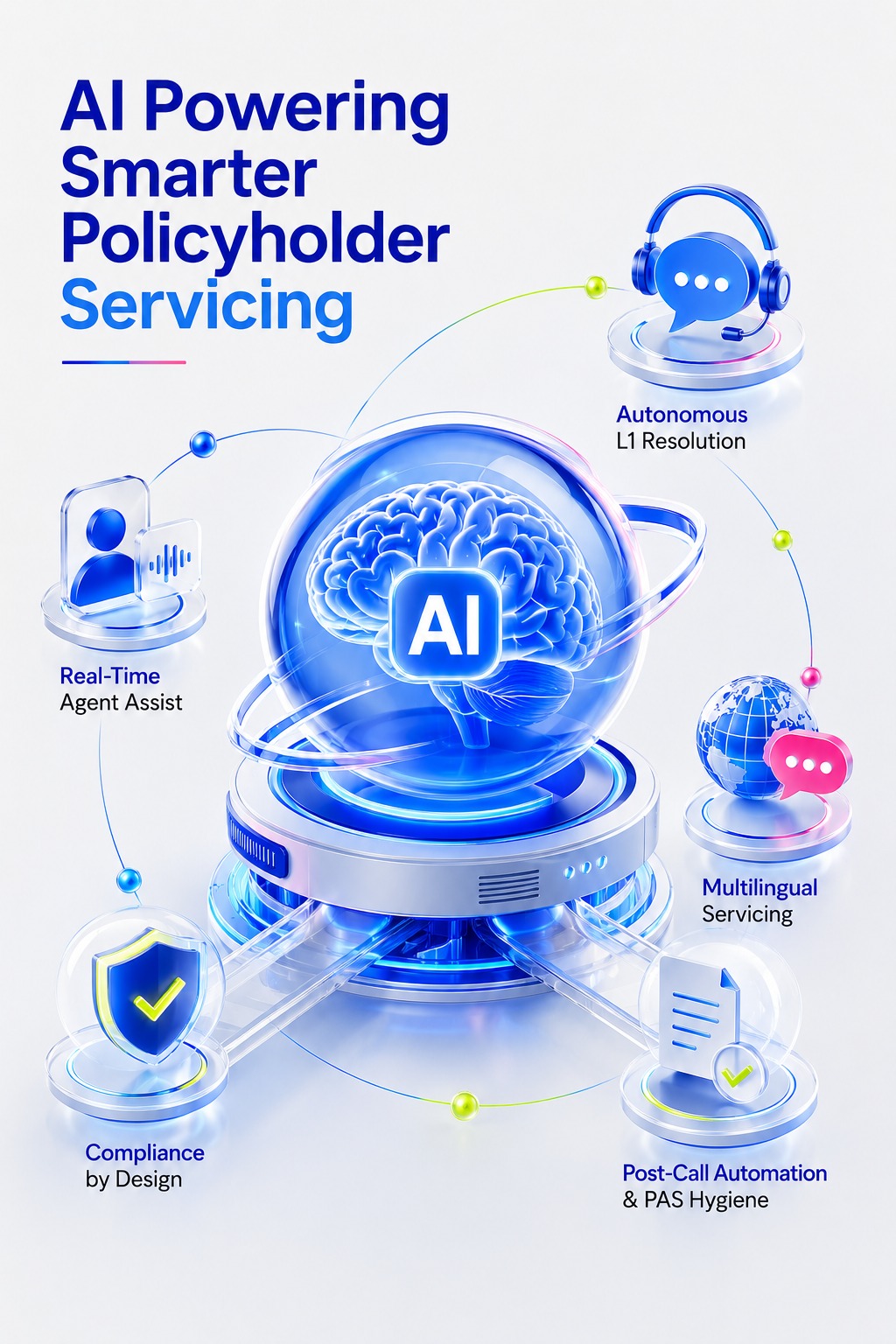
Autonomous Resolution of L1 Policyholder Requests
AI can handle basic L1 policyholder requests using company information and secure connections to internal systems.
This makes it possible for AI agents to quickly answer routine questions and complete basic tasks without human intervention.
Gartner predicts that by 2028, at least 70% of customers will utilize conversational AI as their first point of contact during customer service.
Real-Time Agent Assist
In complex cases, AI supports the agent instead of replacing them.
AI can listen to live calls and provide policy details, important information, and next steps. This helps agents solve problems faster, learn more quickly, and follow the rules.
According to McKinsey, the potential savings from the use of AI in customer services worldwide may total as much as $80 billion by 2026.
Multilingual Servicing at Scale
As global markets become more diverse, language barriers can make customer service harder
Modern voice AI platforms support many languages, helping life insurers provide voice and chat support to customers from different regions.
Insurers should start with quick wins, such as automating customer service, collections, and claims. They can then expand AI into complex underwriting and other high-risk areas.
Post-Call Workflow Automation and PAS Hygiene
AI can do more than answer customer questions and complete tasks after a call.
AI can summarize calls, understand customer needs, and update company systems automatically.
This keeps customer information accurate, speeds up updates, and saves agents from paperwork.
AI in Retention, Renewals, and Premium Collections
AI will ensure that customers do not forget to pay their premiums on account of having expired cards, outstanding bills, and other related problems.
AI will monitor the payment status and issue reminders through SMS and email.
This helps customers keep their policies active and helps insurers retain them.
AI in Distribution of Life Insurance
Selling life insurance has always been hard. Finding new customers is expensive, and choosing the right policy can be complex.
Advanced AI is changing this process. Turns slow, back-and-forth sales into a faster process that is tailored to each customer’s needs.
Agent/Advisor Enablement
AI enables advisers to provide customized and timely guidance rather than only answering questions.
This same approach is transforming banking and finance, as AI-driven insights allow relationship managers to identify critical moments in their customers’ lives and deliver timely, personalized advice.
They can detect significant changes in their customers’ lives or financial situations, and AI offers them valuable insights and pre-written messages.
Narrowing the Coverage Gap Through Agentic Outreach
AI can talk to many people who don't have enough insurance all at once, and it can explain simple options and gather basic information at a much lower cost.
This helps insurance companies reach more customers and sell more policies. Ultimately, it helps solve a major global problem: millions of people do not have the life insurance coverage they need.
Lead Qualification and Needs Analysis
Before the prospect talks to the licensed agent, AI can gather details on the client’s needs, finances, and risk level.
It can evaluate the client, provide basic cover suggestions, and even fill out parts of the application form.
This gives the advisor useful information before the conversation, makes the discussion more focused, and helps speed up the sales process.
What Blocks Life Insurers from Scaling AI?
Old Policy Administration Systems (PAS) are a major barrier. Many insurers still use systems that do not connect easily with modern AI tools.
Poor and scattered data is another challenge. Insurers also face a lack of AI skills and staff shortages.
Trust is also important. Insurance companies need to be clear with employees about how they use AI.
An AI Adoption Sequence for Life Insurers
To solve these problems, successful insurance companies use a step-by-step plan. They start with high-volume tasks that have lower risks.
- Phase 1: The servicing and contact center layer answers the most common questions through chatbot AI technology and helps customer service representatives over the phone.
- Phase 2: Collections/renewals uses artificial intelligence for predicting non-payments and keeping coverage alive for customers.
- Phase 3: Claims intake (FNOL): Use AI to understand the newly submitted claims and direct the claims to the proper departments.
- Phase 4: Underwriting support: Use AI to make data more accurate and quick risk assessments. But let experts deal with complex decisions and fairness considerations.

How Specialized Platforms Fit?
Specialized and best AI tools help life insurance companies improve their customer service. They are built specifically to handle the strict rules of the insurance industry.
These tools answer common questions and guide agents while they speak with customers. They can support multiple languages and check calls to make sure staff follow the rules.
Learn more about Thunai, which automates L1 servicing for insurers and provides better service to their customers. Book a demo today.
FAQs on AI in Life Insurance
Is AI used in life insurance today?
Yes. Companies use AI right now. It speeds up approvals. It gathers facts fast. It checks your risk. Companies can approve basic plans without medical tests.
Can AI deny a claim?
No. AI does not make the final choice to deny complex claims. It just helps read new ones. It catches fake claims. It pays simple claims fast.
How is AI controlled in life insurance?
Old laws and new rules control AI. Companies must plan how they use and watch it. They must test their AI. This stops the AI from treating any group unfairly.
Does AI make life insurance cheaper?
Yes. AI helps companies do work faster. This saves money. It speeds up approvals and cuts service costs. Companies pass these savings to you. You pay lower prices or get better plans.
What is accelerated underwriting?
It is a quick way to check your risk. You do not need blood or urine tests. Instead, AI looks at your digital facts. It reads your past health records and personal details.