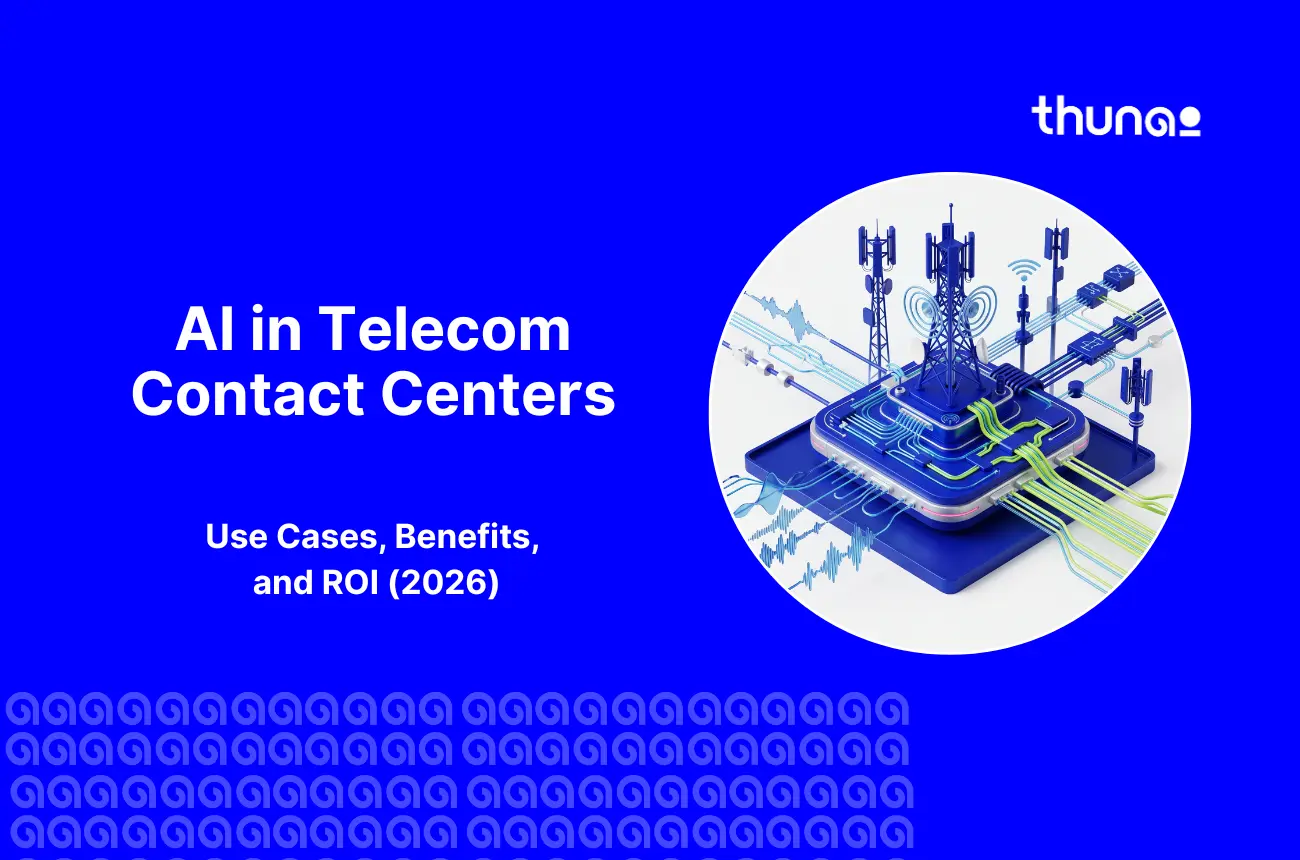

What occurs when thousands of telecom clients reach out all at once?
AI allows the call center to deal with sudden peaks, resolve common issues, and reduce waiting times.
Whether it’s billing, network outages, SIM card replacements, or language proficiency, AI is transforming telecommunications customer service.
This article looks into the important use cases, return on investment, and necessary considerations for implementing AI in telecom contact centers in 2026.
Why telecom contact centers are a prime fit for AI
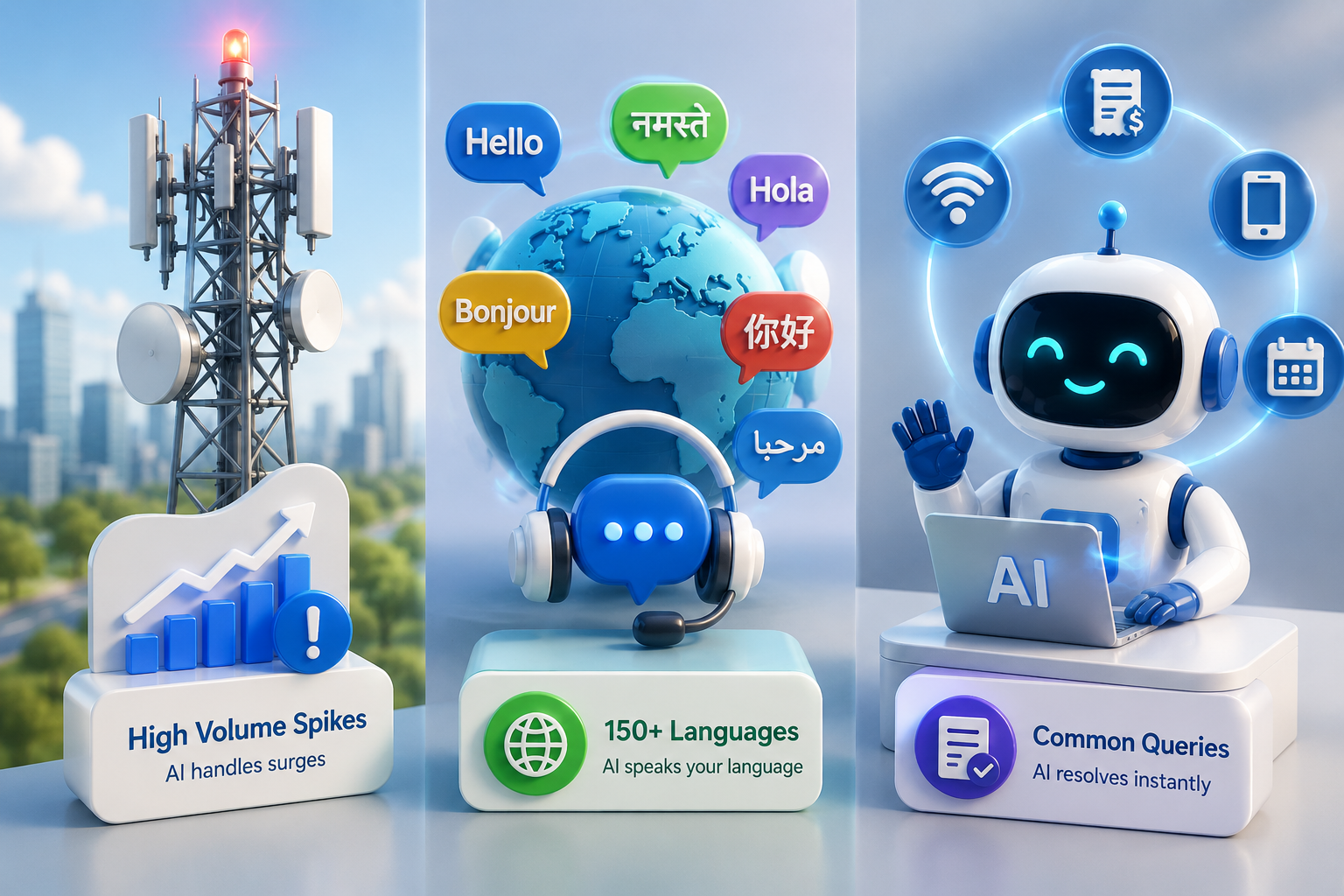
Telecom operators run at a scale few industries match. Millions of subscribers. Dozens of languages.
Constant queries about billing, plans, outages, and porting. When a network issue hits, call volumes spike within minutes. Staffing cannot scale that fast. That is why deployments deliver outsized ROI. They beat other sectors.
Three factors make telecom a natural fit for contact center AI:
- Excessive volume scaling and seasonally/outage related spikes: One regional outage could potentially generate several thousands of calls in less than an hour. AI absorbs these surges without emergency hiring. In mature programs, automation handles 60 to 70% of surge volume. Humans focus on complex cases.
- A multilingual and multi-regional customer base: The company caters to customers from different regions. Voice and chat AI currently cover more than 150 languages. This includes vernacular variants. Leading platforms let you launch new language support in days. Not months.
- Recurring, high-frequency query types: The top ten telecom queries make up 70 to 80% of all contacts. They include billing, payment, plan modifications, usage of data, outage issues, device issues, account issues, activations, and appointments. They can be automated easily. Every deployment starts by automating these high-volume flows.
Key telecom contact center AI use cases
Generic contact center AI guides list broad use cases. AI in telecom contact centers needs more. The highest value flows map directly to daily operational pain points. When evaluating vendors, ask for proof on these five scenarios.
Billing dispute resolution and plan change self-service
- Billing questions dominate telecom contacts.
- AI agents pull real-time data from billing systems. They explain charges in plain language.
- They process plan changes or payments without human handoff.
- This cuts average handle time by 30 to 35% in live deployments.
- In programs focused on billing, automation often delivers the fastest payback.
Outage and network issue handling at scale
- Outage triage is the hardest surge test.
- AI voice agents and chatbots detect affected regions.
- They push proactive notifications.These tools help the customer troubleshoot.
- In critical situations, the AI handles between 60 to 70% of the inbound calls.
- They prioritize any safety-related accounts or very important accounts to a human.
- This is where solutions prove their worth.
SIM swap/number porting workflows
- SIM swaps and porting requests carry fraud risk and regulatory requirements.
- AI layers add identity verification, document capture, and status tracking.
- They integrate with legacy provisioning systems.
- This reduces manual review time. It speeds up fulfillment.
- Advanced platforms embed fraud detection directly into these flows.
Churn prediction and proactive retention outreach
- AI in telecom contact center analyzes usage patterns, payment history, and support interactions.
- It identifies at-risk subscribers. Automated outreach offers plan adjustments, loyalty credits, or device upgrades.
- This happens before the customer calls to cancel.
- This proactive layer is a hallmark of mature strategies.
Multilingual voice support for diverse subscriber bases
- Many operators serve customers who prefer local languages.
- Some code-switch between languages.
- Modern voice AI handles multilingual conversations.
- This includes Hindi to English or Spanish to English mixes. It does not force customers into English-only queues.
- This lifts pickup rates and comprehension scores.
- For global operators, multilingual voice is a core requirement. It belongs in any shortlist.
Real-world ROI in telecom
The financial return of AI in telecom contact centers is clear across Tier-1 telecom deployments. Moving high-volume, routine calls from human agents to automated systems lowers support expenses while raising service quality.
A proven industry benchmark for conversational automation is Vodafone's TOBi virtual assistant. Public reports show that TOBi handles tens of millions of customer interactions every month across multiple countries.
These results include first contact resolutions of up to 70%, and savings of €680 million per year from customer service costs. Vodafone also enjoyed a 12-point increase in its customer Net Promoter Score, which proves that intelligent automation can improve user experience.
Other measurable savings in telecom contact centers include reduced post-call handle time. Call summary automation, ticket labeling, and instant CRM updates help agents reduce two to four minutes of paperwork per call.
Architecture considerations unique to telecom
Most telecom AI content skips the hard part: integration. Operators operate multiple fragmented OSS/BSS systems in addition to the current CCaaS system.
The example includes Genesys, NICE, or Amazon Connect. Fragmented systems result in a lack of context required by AI. This is the single biggest reason pilots fail to scale.
Winning architectures share three traits:
- Hybrid Integration: AI modules work with both legacy OSS and BSS as well as new CCaaS. No need for a complete change in infrastructure. The best companies provide out-of-the-box connectors for typical telecom stacks.
- Real-time Data Access: AI agents pull live data from subscribers, billing, and network systems. They solve problems in a single session. Without real-time data access, deployments create more friction than they eliminate.
- Regional compliance: Data privacy rules vary by market. GDPR applies in Europe. Local data residency laws apply in Asia and the Middle East. AI platforms must support region-specific data handling and audit trails. Compliance is non-negotiable in any rollout.
How to choose a telecom-ready contact center AI platform
Choosing the right solution for AI in telecom contact centers comes down to multi-channel reach and enterprise integration flexibility. Operations leaders should assess vendors using three core criteria:
- Natural Conversation Across Voice, SMS, WhatsApp and Web: The system should enable natural conversation on voice, SMS, WhatsApp, and web channels in more than 100 languages with minimal speech latency and maximum intent recognition.
- Flexibility without Major Changes in the Existing Infrastructure: Replacing the existing telephony infrastructure and the billing system is costly and takes long periods of time. The AI overlay should be compatible with the existing CCaaS systems and legacy BSS and OSS databases via modular APIs.
- Handling Peaks and Real-Time Escalation: The system should continue to perform during unexpected peaks. The system should analyze the customers' sentiment in real time and escalate the calls from irritated customers to experts with full transcript prepared.
Where Thunai fits
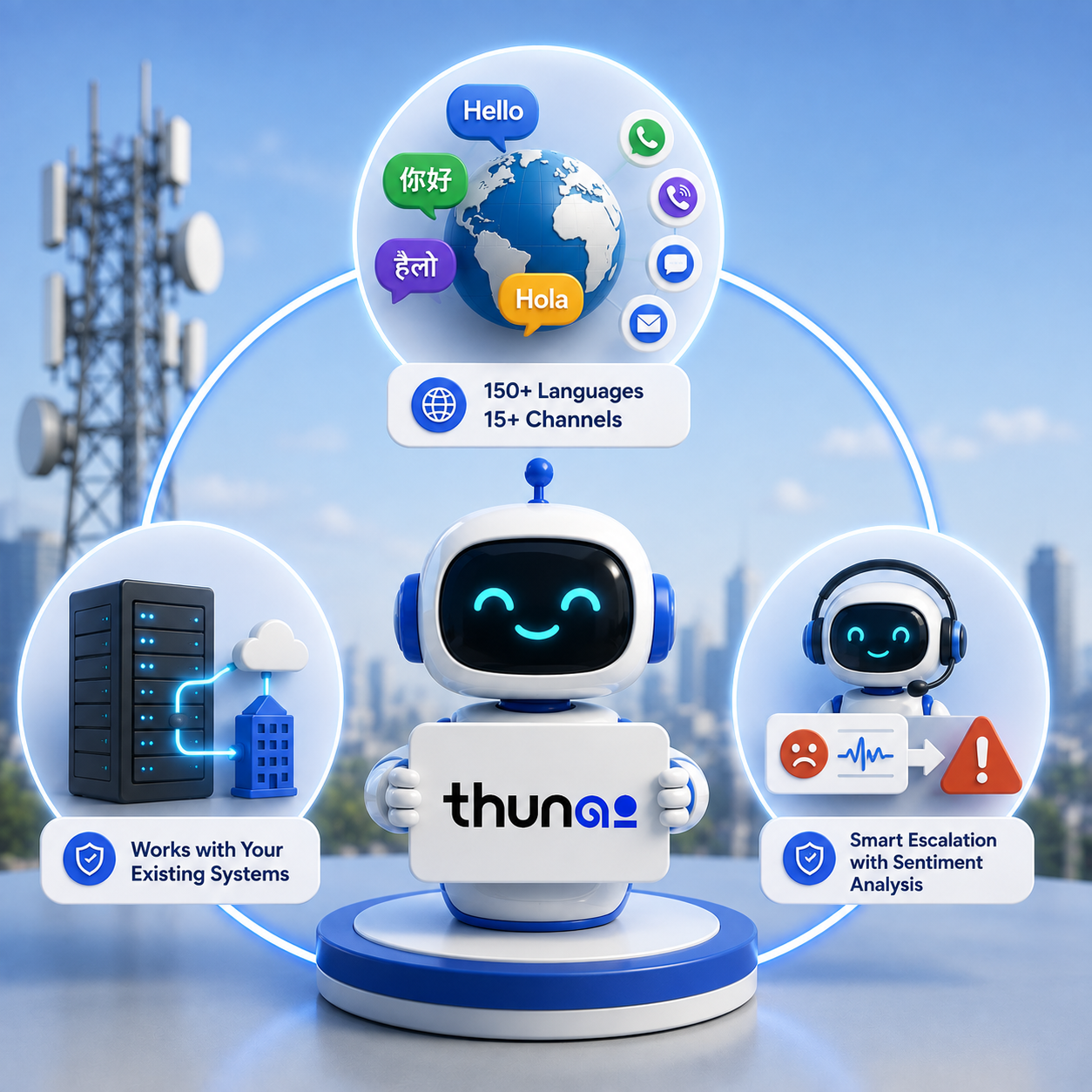
Thunai was built for exactly these telecom requirements. Customers highlight three strengths:
- 150+ languages across 15+ channels: One global telecom CVP noted, Thunai let us launch multilingual voice support in six markets without adding a single vendor. This breadth is rare in offerings.
- Works with enterprise systems, on-prem or cloud, without requiring a complete overhaul: A CTO in Southeast Asia shared, We connected Thunai to our legacy billing and provisioning systems in weeks, not months. That speed is critical for success.
- Automatic urgent issue escalation with sentiment analysis during outage surges: A contact center director in Europe said, During a regional outage, Thunai handled 68% of inbound calls and escalated only the critical cases. Our CSAT actually went up. This is the kind of result leaders expect.
How Thunai supports telecom contact centers
Thunai helps telecom operators turn contact centers from cost centers into competitive advantages. The platform combines deep language coverage, flexible integration, and surge-ready automation. For teams evaluating solutions, Thunai checks every box.
- 150+ languages across 15+ channels: Support subscribers in their preferred language. Support them on their preferred channel. Do not stitch together multiple vendors. This is the gold standard for language support.
- No overhaul required when using enterprise systems, whether cloud or on-premises: Works seamlessly with old OSS/BSS systems as well as new CCaaS systems using APIs and connectors. That is why Thunai triumphs in complicated scenarios.
- Escalation of critical issues automatically with sentiment analysis during outages: Identify frustration, safety concerns, or any critical issue in real time and forward to human agents right away. This differentiates production-ready platforms from pilot versions.
Feedback from customers indicates that Thunai is one of the best foundations for implementing AI in telecom contact centers, praised for its consolidated knowledge brain and fast implementation.
Reviews on Product Hunt, where Thunai boasts a 4.9-star rating, speak to how well Thunai can consolidate disparate tech guides, rate cards, and interactions into one repository of knowledge.
One telecom CX leader summarized the impact: "Thunai didn't just cut our queue times. It changed how we handle crises. During outages, we now control the narrative instead of reacting to it." That is the promise done right.
Turn every telecom customer interaction into a faster, smarter experience - See how Thunai can transform your contact center. Book a demo now
FAQs on AI in Telecom Contact Centers
What are the most prominent AI applications in telecom call centers?
The most frequent use cases include billing disputes management, troubleshooting, SIM/porting processes, churn detection, and multilingual voice assistants for varied customer segments. These five use cases represent the bulk of AI applications.
Can AI cope with increased call volume in case of network outage?
AI-based self-service and voice assistants can manage unexpected increases in the number of calls during outages without any need to increase human staff, only identifying critical calls to escalate them immediately.
Does telecom contact center AI need to integrate with legacy systems?
Yes, most telecom operators run a mix of legacy OSS/BSS systems and modern CCaaS platforms, so an AI layer needs to integrate with both rather than requiring a full infrastructure replacement. Integration flexibility is the top requirement in vendor selection.