



Do you still switch between Slack, Teams, emails, CRM, and many more just to get through one single task?
This continuous process of switching between contexts ends up costing you a lot of time and leads to critical data being lost.
An artificial intelligence-powered collaboration tool can change this.
This guide will tell you everything about how AI integrates communication, knowledge, and workflow.
What is an AI-powered collaboration platform?

An AI-driven collaboration tool allows a team to collaborate while the AI performs all day-to-day activities for the team.
The system can perform searches in the knowledge base of the company, summarize meetings, prepare documentation, and do workflows.
Not all platforms function in a similar manner. Some integrate AI with an existing collaboration platform.
While others are designed with the AI functionality at their core.
The key difference is not whether a platform has AI. It is how much work the AI can actually do and how much time it saves your team.
AI features versus AI agents
Almost all of the tools in this category provide AI capabilities, not AI agents. AI capabilities help an individual working on the task by, for example, summarizing a meeting, searching documents, or proposing an action step. AI agents do more; they perform multistep actions that span systems and complete the task.
The key test here is: Does the product draft, or does it complete?
If it creates text to be edited by a human, then it is a feature. If it can actually perform a workflow, update records, or route the output to the right system, it operates more like an agentic platform.
That matters, because often buyers will compare products that aren't even substitutes for each other. For example, a messaging workspace, a whiteboard, an enterprise search layer, and a support agent copilot could all claim to be ai powered collaboration platforms, but serve different purposes.

How We Evaluated These Platforms
The best AI collaboration platforms were evaluated in July 2026 by our team. They were assessed based on usability, pricing, security, integration, and actual user benefits.
These seven assessment factors have been used for evaluating each and every platform:
- AI capabilities: Assessing the ability of the artificial intelligence to perform automation and workflow.
- Integration: Examining the connection to business applications such as CRM, helpdesk, database, and chat applications.
- Security: Tested Single Sign-On (SSO), Role Based Access Control (RBAC), Security Information and Management (SCIM), and Data Loss Prevention (DLP).
- Pricing: Comparison of Software Costs, Setup Costs, and Support Costs.
- Ease of deployment: Measured setup time and implementation effort.
- Results: Reviewed improvements in ticket resolution, response time, and business performance.
Every review includes a clear look at product drawbacks alongside main functions. This makes sure buyers understand where each ai powered collaboration platform may struggle under specific business conditions.
AI-Powered Collaboration Platforms by Category
Enterprise Search and Knowledge Platforms
Glean

Glean functions as a knowledge discovery engine built to connect scattered company information across SaaS apps. Built around continuous data indexing, Glean maps permissions to build a single knowledge graph across Slack, Google Workspace, Jira, and databases.
- What It Does: It consolidates all the documentation, conversations, and tickets for the company in one knowledge graph.
- Best AI Capabilities: Contextual Retrieval Augmented Generation (RAG) that produces search results optimized based on the user’s role, organization, and past projects.
- Weaknesses: Index based approach involves constant duplication of the data and hence computing power. Non-transparent pricing is also a challenge.
- Who It Fits: Large enterprise companies with static document stores seeking a search layer across broad software stacks.
- How It Is Priced: Quote based pricing starting at $50 to $75 per user per month, with a mandatory 100-seat contract minimum ($60,000 annual minimum). Fully loaded annual spend often reaches $350,000 to $480,000 when factoring in cloud hosting and dedicated admin management.
Human and AI-Agent Collaboration for Customer Facing Teams
Thunai
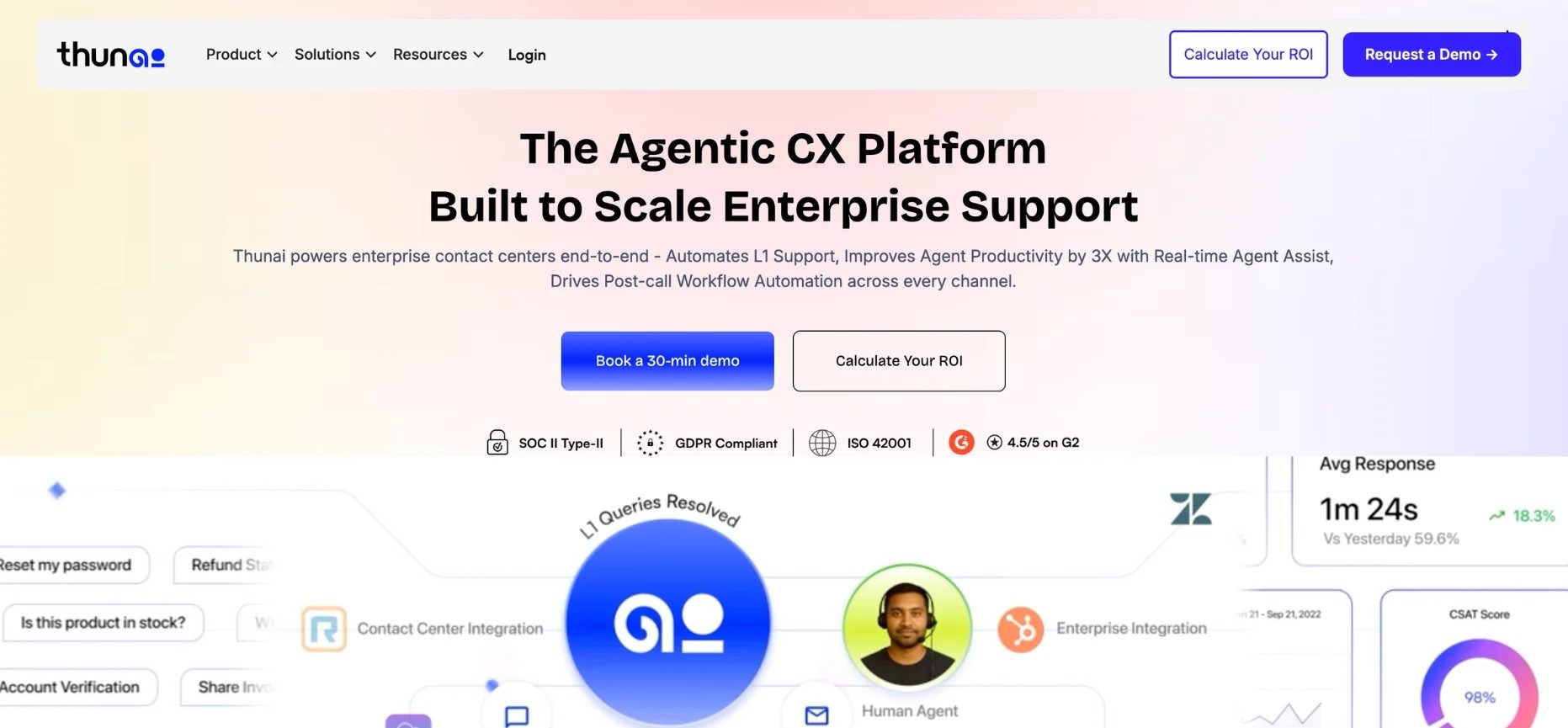
Thunai is an AI-driven service that supports customer support, sales, and revenue teams. The software enables cooperation between AI and human agents using voice, chat, and emails. It takes advantage of the capabilities of the Thunai Brain to utilize real-time business data for giving responses and executing actions, including issuing refunds, returns, and CRM updates.
- Features: Allows management of AI and human agent engagement with the customers on the same platform.
- AI Features: Automation of 80% of Level 1 tickets along with real-time advice to human agents.
- Cons: Works better in case of recent cloud architecture; limited number of connectors for legacy mainframe architecture.
- Good for: Businesses in the mid and large range working in retail, ecommerce, banking, and customer service.
- Price: Starts from $99 per month (unlimited seats) and custom pricing.
GoSearch

GoSearch is an AI-powered enterprise search platform. Instead of storing copies of your company data, it searches connected apps in real time. This keeps results up to date and respects user permissions.
- What It Does: Searches company apps and gives AI-powered answers without copying data.
- Best AI Feature: Pulls live information from connected tools while keeping existing access permissions.
- Limitations: Focuses on search and knowledge retrieval. It cannot automate tasks or update third party systems.
- Best For: Enterprises that require a faster and safer enterprise search.
- Pricing: Features a free plan, a Pro plan for $20/user/month, and Enterprise plans with custom pricing.
Visual and Whiteboard Collaboration
Miro

Miro provides an enterprise level canvas platform which is useful in collaborative activities of ideation, design, and agile project management. The AI capabilities of Miro relate to visual organization, diagrams, and synthesis.
- Functionality: Enables distributed teams to carry out visual brainstorming, mapping, and workshops.
- Best AI Capability: Generation of visual diagrams using textual prompts in the form of mind maps, user stories, and Kanban boards.
- Limitations: Quick expansion of the software's capabilities has added to menu clutter, and seat-based pricing models add high costs to large scale implementation.
- Who Uses It: Product management, engineering architecture, and UX design teams in need of live visual whiteboarding.
- How It Is Priced: Free tier with basic boards; paid plans start at $8 to $16 per seat monthly, and include custom enterprise plans.
Mural

Mural is a visual ai collaboration tool that is useful for brainstorming sessions and planning workshops.
- Features: Allows users to hold design workshops, planning sessions, and brainstorming sessions in a virtual environment.
- Best AI Feature: Can arrange sticky notes, summarise discussions and generate action items.
- Drawbacks: The AI capabilities work within the canvas and cannot automate processes or integrate into external processes.
- Good Fit For: Enterprises and design firms.
- Pricing: Offers free plan, while paid plans range from $9.99 to $17.99/user/month.
Work and Project Management
Asana

Asana offers intelligent capabilities that aid in structured workflow automation and portfolio management in order to speed up delivery and allocate resources efficiently.
- What It Does: Organizes projects, workflows, and tasks of various departments.
- Best AI Feature: Identifies delays, predicts task duration, and proposes actions that ensure efficient completion of the project.
- Limitations: AI is helpful in planning but can’t make decisions and manage complex work flows.
- Best For: Marketing departments, project managers, operations departments.
- Pricing: Free plan offered. Other paid plans cost $10.99 and $24.99/user/month; Enterprise pricing available for advanced AI capabilities.
ClickUp

ClickUp is a productivity tool that combines task management, document management, goal management, and team chat in one application.
- What it does: Task management, document management, goal management, and team chat in one application.
- Best AI feature: ClickUp Brain summarizes tasks, writes project updates, and even writes full documents.
- Shortcomings: Can be a little overwhelming and cannot automate workflows outside of ClickUp.
- Useful for: Those who need to consolidate all productivity applications into one.
- Pricing: Free version is available. Pricing starts from $7 to $12 per month/user. ClickUp Brain costs an additional $7/month/user.
Monday.com and Smartsheet
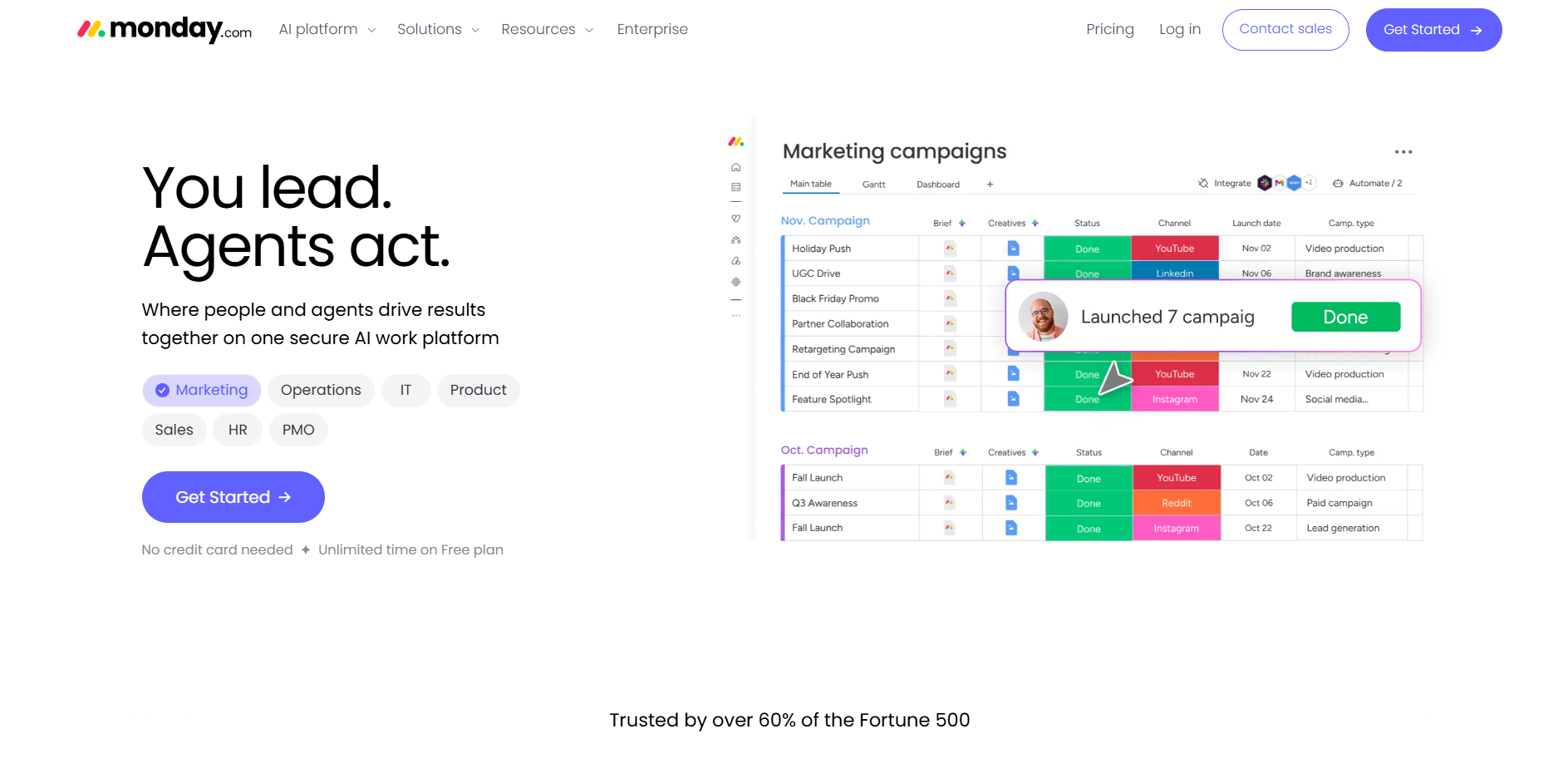
Monday.com and Smartsheet offer platforms to manage project and task tracking using customizable, spreadsheet type boards.
- What It Does: Tracks projects, processes, inventory, and team activities from one interface.
- Best AI Feature: Automatically generating formulas, summarizing data, and organizing information.
- Limitations: AI works mainly inside boards and spreadsheets. It has limited understanding of external documents.
- Best For: Operations teams, project managers, and supply chain teams.
- Pricing: Free plans are available. Paid plans start at $9 to $19 per user/month, with custom enterprise pricing.
Communication and Meetings
Slack
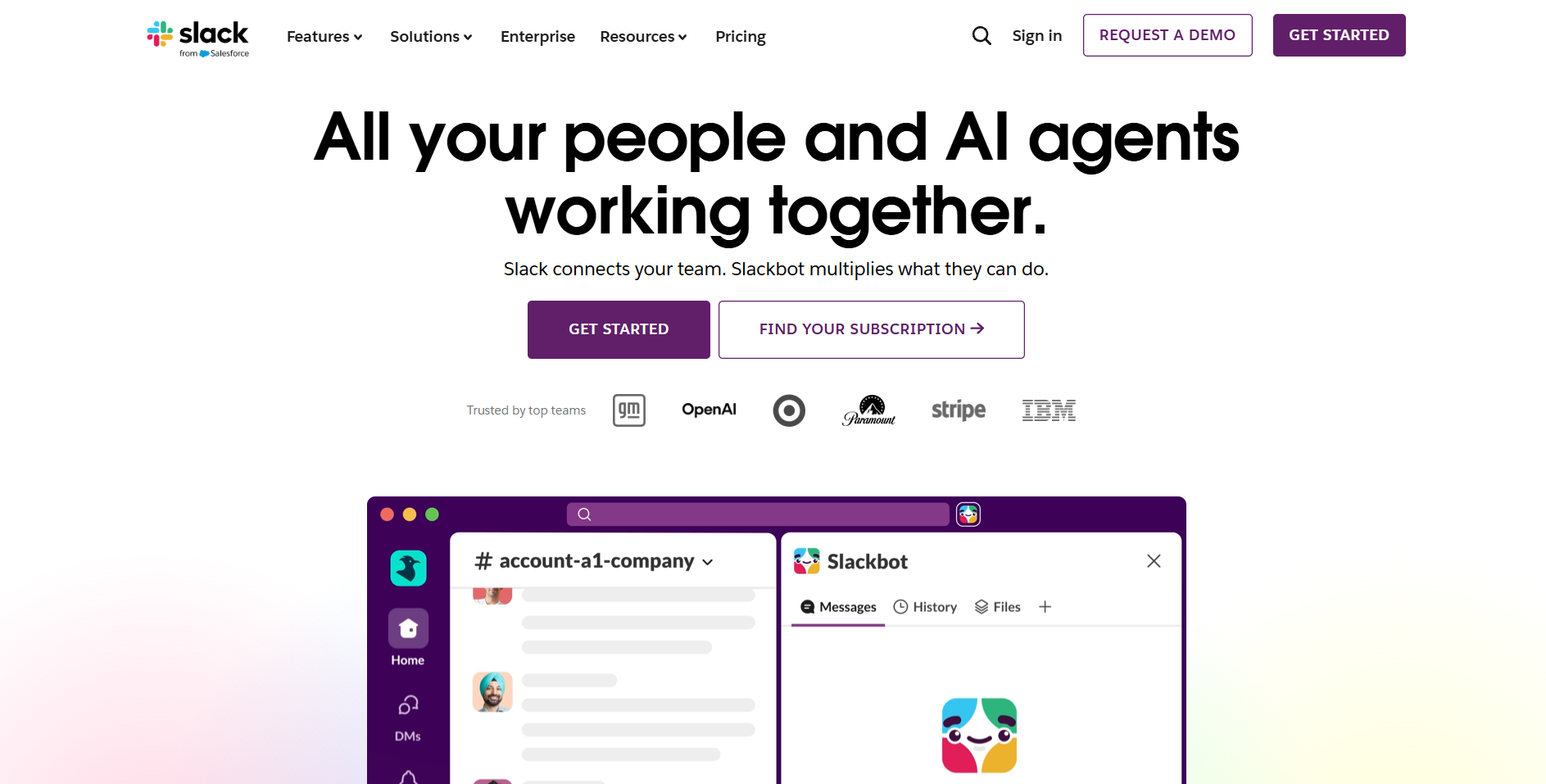
Slack is the messaging center for distributed corporate teams that comes with an integrated search and conversation summarization functionality.
- What It Does: Offers live messaging channels, asynchronous huddles, and collaboration with partners.
- Best AI Functionality: Slack AI thread summaries, channel summaries, and natural language searches in message histories.
- What It Lacks: In-house AI solutions come with expensive add-on licensing fees, whereas external API integrations need additional automation tools.
- Best for: Software developers, product managers, and operations teams who use live chat functionality.
- Pricing model: Free plan with a limited 90-day history, Pro and Business+ plans priced at $7.25 - $15/user/month, and Slack AI is available as an add-on.
Microsoft Teams and Zoom Workplace

Microsoft Teams and Zoom Workplace enables users to interact using video calling, voice calling, chat, and collaboration.
- Functionality: Video calling, voice calling, chat, and collaboration.
- Best AI feature: Transcription, discussion summary, highlighting tasks, and analysis of discussion.
- Limitations: AI function is mostly within meetings. AI function is very limited in automating outside of meetings.
- Best For: Companies using Microsoft 365 or Zoom for communication on a regular basis.
- Price: Mostly included in business packages. Microsoft 365 Copilot is $30/user/month extra.
Webex
Webex provides telephony services and video conferencing and contact center communication services architecture that is built for the highest level of network reliability and administration compliance.
- Functionality: Provides voice, video, and CCaaS software solutions to facilitate business communication.
- Best Feature: AI voice noise filter, automatic multi-language translation, and meeting summarization.
- Drawbacks: Traditional interface does not allow creating dynamic workflow using modern cloud technology.
- Target Market: Compliance oriented firms, hospitals, and banks around the world.
- Price: The pricing for regular business plans starts at $14.50 per user per month while premium CCaaS software is available for a separate cost.
Content and Document Collaboration
Box, Dropbox, and Google Workspace
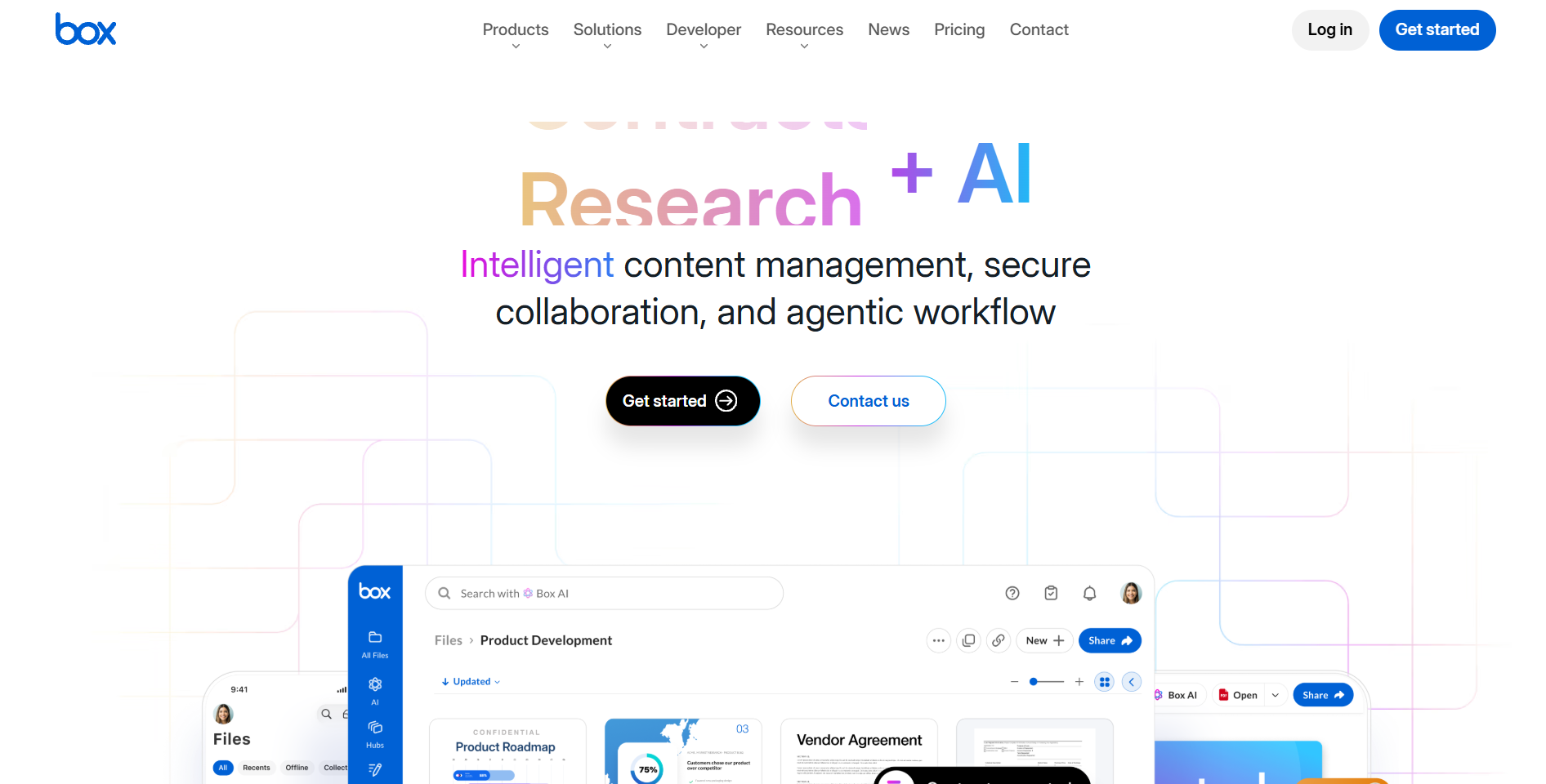
Box, Dropbox and Google Workspaces allow teams to store, share and edit files in the cloud.
- Functionality: Facility for storing files, ability to share files and real-time editing of files by team members.
- Best Feature Involving AI: Answering questions about files, organizing files, extracting data and writing content.
- Limitations: AI mainly works with stored files. It cannot automate business workflows or complete actions in other systems.
- Best For: Legal, HR, procurement, and business teams that manage large numbers of documents.
- Pricing: Paid plans start at $6 to $25 per user/month, with advanced AI features available in enterprise plans.
Comparison Matrix
The following matrix compares leading choices across the ai powered collaboration platform market.
Technology assessors should look closely at the Genuinely Agentic column, which separates software restricted to text generation from systems capable of autonomous system actions.
The Collaboration Problem Nobody Is Solving: AI Agents and Humans on the Same Work
- Most collaboration AI helps people work with people faster. Very little helps people work alongside AI agents that are doing the work.
- Customer facing teams are the clearest example. The queue is shared, the handoff is constant, and context has to move cleanly from one interaction to the next. If the platform cannot preserve that context, collaboration breaks down even if the AI looks smart in a demo.
- A practical human and agent collaboration system needs four things. First, a shared knowledge layer that both humans and agents can read from. Second, real-time assist during live interactions. Third, handoff that carries full context. Fourth, quality review across both human and agent work.
- That is why Thunai’s pattern is notable. Brain acts as the shared knowledge layer, Common Agent handles orchestration, and Reflect AI supports quality review across human and AI work. In other words, the platform is built less like a general productivity tool and more like an operating layer for customer work.
How to choose
- Start with the collaboration failure you are actually trying to solve. If knowledge is scattered, start with enterprise search.
- If teams need better visual thinking, choose a whiteboard tool. If the problem is support or CX work that mixes humans and AI agents, use an agentic platform.
- Next, shortlist three tools and reject anything whose AI value cannot be explained in one sentence.
- That keeps the evaluation focused on real outcomes instead of marketing language.
- Then run a scoped pilot with one team and pre-agreed success metrics.
- Finally, validate security and cost at full scale before committing.
- That last step is where many teams save themselves from expensive rework.
Where these platforms still fail
Adoption is the first failure mode. Many teams buy licenses, but the AI features go unused because the workflow never changed.
Knowledge hygiene is another problem. If the source content is outdated, AI search will surface old answers with too much confidence. That can make a tool look smarter than it is.
Over consolidation also hurts. A team may choose one suite for simplicity, only to find that it is weak at the specific job they actually needed. Tool sprawl is bad, but so is forcing everything into the wrong platform.
Turn AI collaboration into measurable business results - book a personalized Thunai demo today.
FAQs on AI-powered collaboration platform
What is an AI-powered collaboration platform?
An AI powered collaboration platform is software where teams work together and AI actively assists that work through search, summaries, workflow automation, or agents that complete tasks across connected systems.
Which is the best collaboration platform?
There is no single best option. The right choice depends on the collaboration problem you are solving, such as knowledge search, visual planning, project tracking, communication, or agentic support work.
What are the 5 main AI platforms?
In collaboration specifically, buyers often shortlist Slack, Microsoft Teams, Google Workspace, Miro or Mural, and Glean. If you mean underlying AI providers, that is a different list entirely.
Are there free AI-powered collaboration platforms?
Yes, but free plans usually limit the AI features. Free tiers are useful for testing usability, not for fully evaluating enterprise value.


