
Why AI Matters in the Modern Contact Center
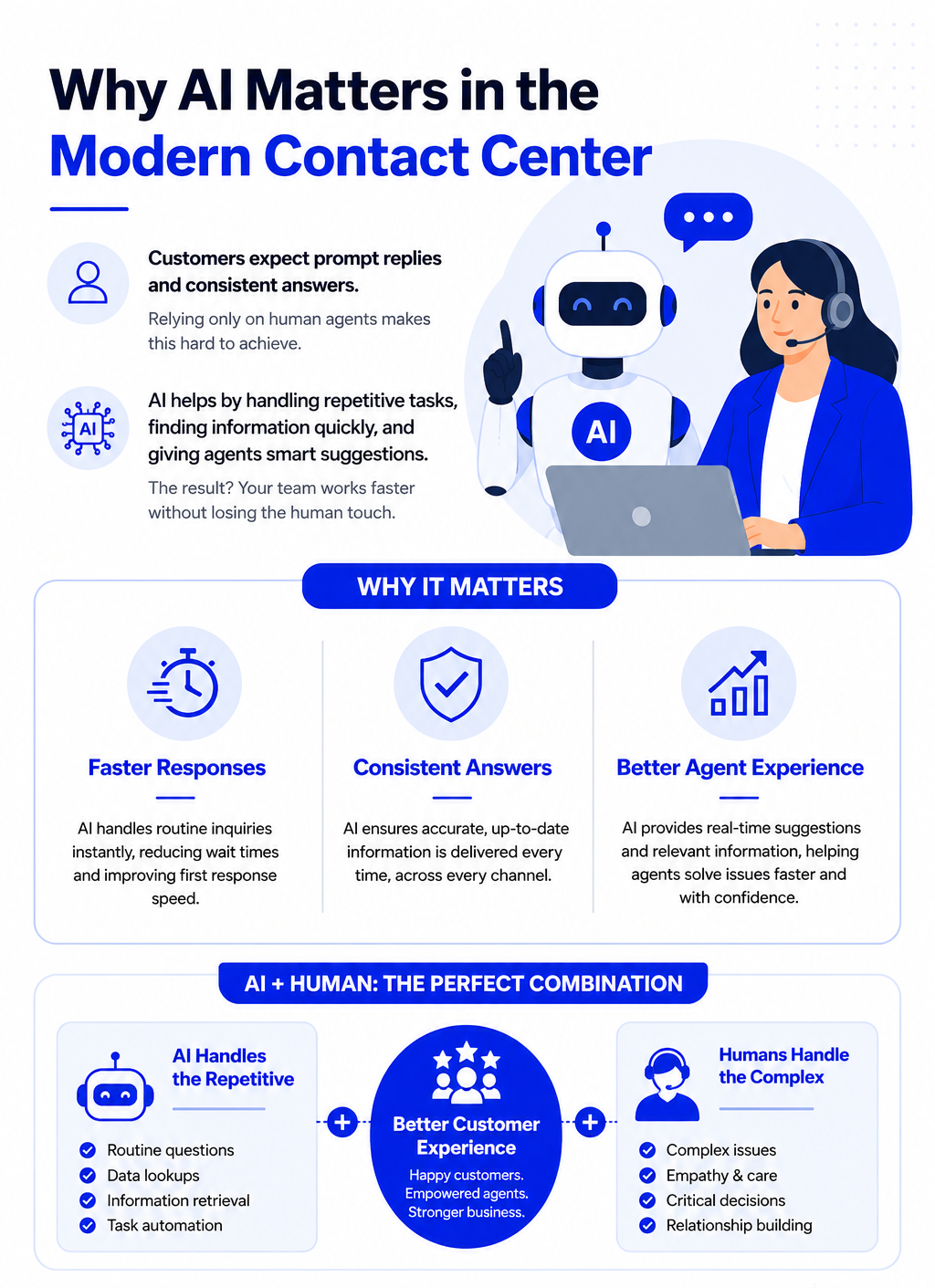
Clients expect prompt replies. Clients also require that their answers should be consistent. It is hard to accomplish such a goal only through human staff members.
AI can help because it can take care of tasks that repeat, find the information quickly, and assist the agent with suggestions. In other words, it can help your team work faster without losing the human aspect.

The shift from scripted bots to agentic AI
Older bots followed fixed scripts. They worked only when the customer used the exact right words.
Today’s AI is more flexible. It can understand intent, hold context, and support more natural conversations.
That matters because contact center work is rarely simple. Customers change topics, ask follow up questions, and need help that feels personal. Agentic AI is better suited for that reality.
Where AI drives the most value
AI creates value in three main ways:
- Better CX, because customers get faster and more accurate help.
- Lower cost, because routine work can be automated.
- Better agent experience, because agents get support while they work.
The following table compares legacy infrastructure with AI-native contact center architectures:
Customer Facing AI Use Cases
Modern digital leads implement self service tools to resolve customer queries immediately. These solutions decrease queue volumes and lower handling costs. The following section details the most critical customer facing AI use cases in contact center ecosystems.
1. Conversational Voice and Chat Virtual Agents
- Conversational virtual assistants engage in conversation through the telephone, website, or messaging applications.
- They employ speech recognition as well as natural language processing to comprehend queries from customers.
- Thunai offers automated voice and chat virtual assistants with 99.9% accuracy of voices.
- They resolve common support queries naturally without complex script training.
2. Intelligent Self Service and IVR Deflection
- Traditional phone menus frustrate customers with long delays.
- Intelligent deflection replaces rigid buttons with natural voice recognition.
- The AI interprets the spoken problem immediately and guides the caller to the correct resolution path.
- Shifting basic tickets to self service portals remains one of the easiest AI use cases in contact center setups.
3. 24/7 Multilingual Support
- Scale customer support globally without hiring local representatives.
- Multilingual automation is classified as one of the highly scalable AI use cases in contact center platforms.
- Advanced platforms understand and translate over 150 languages instantly.
- A Japanese customer calling a US office receives fluent support in Japanese, standardizing international service.
4. Personalization and Next Best Action
- The application of AI requires gathering information on customers' profiles, purchasing behavior, and sentiments in order to recommend relevant products.
- This capability represents a highly profitable segment among AI use cases in contact center programs.
- These personalized recommendations help agents identify upsell opportunities, increasing company revenue.
5. Proactive Outreach and Notifications
- Instead of having to wait for customer complaints, preemptive alerts keep problems from becoming worse.
- AI voice and email agents notify customers about billing issues, package updates, or flight delays.
- These proactive alerts represent advanced AI use cases in contact center channels, allowing customers to resolve scheduling issues immediately during the call.
- Thunai supports these workflows via customized outbound enterprise agents that require no code to deploy.
Agent Facing AI Use Cases
Sponsoring front line workers is vital to increase the quality of support and decrease attrition rates. Applying these agent-facing AI use cases in contact center settings helps to deliver immediate support and automate repetitive processes.
6. Real-Time Agent Assist and Guidance
- New customer service agents often struggle to find answers during live phone calls.
- Thunai Real-Time Agent Assist acts as an on-screen desktop copilot.
- The system transcribes the conversation, analyzes the customer's question, and displays the correct troubleshooting script.
- This utility cuts agent training times by 50% and helps new agents solve issues like experts on day one.
7. Automated Call Summaries and Wrap Up
- Manually drafting notes after a customer hangs up slows down support queues.
- This post call logging still forms one of the most practical AI use cases in contact centers.
- Generative AI is capable of summarizing calls, identifying tasks, and updating CRMs within seconds, this is useful in AI use cases in contact centers.
- This automation reduces after call work to zero, saving agents minutes per ticket.
8. Knowledge Retrieval and Answer Suggestions
- Customer service representatives lose hours daily searching across disconnected folders and manuals.
- AI unifies scattered PDFs, manuals, and videos into a central index.
- The Thunai Brain retrieves exact, contradiction-free answer suggestions instantly, which prevents AI hallucinations and builds agent confidence.
9. Sentiment and Emotional Analysis
- Emotional analysis can be based on the tone of voice, the intensity of the voice and the vocabulary.
- If the customer becomes angry, then the system gives a signal about that and advises using another wording to the operator.
- The system may alert supervisors when needed too.
10. Real-Time Translation
- Instantaneous translation gets rid of language barriers in real time between agents and clients.
- An agent using English can communicate without hitches with a client using French since AI is translating their conversations.
- Real-time translation is an example showing that translation is one of the many uses of AI in contact centres.
Operations and Quality Use Cases
Operational excellence depends on objective oversight and clean data analytics. These operational AI use cases in contact center architectures allow managers to streamline compliance and quality audits.
11. Automated Quality Assurance (Auto QA)
- Conventional QA departments sample between 1% and 2% of recorded calls, resulting in bias.
- Auto QA analyzes 100% of customer interactions according to company policies.
- For companies searching for reliable CallMiner alternatives, Thunai call scoring evaluates every interaction on 15 to 20 custom parameters, ensuring objective and fair grading.
12. Conversation and Interaction Analytics
- Interaction analytics process voice and chat transcripts to find hidden customer patterns.
- If a specific software error triggers a spike in calls, the system flags the pattern and alerts the product team.
- These interaction analytics are crucial AI use cases in contact center data management.
13. Agent Coaching and Performance Insights
- Managers do not have to listen to call recordings during long periods of time anymore.
- Artificial Intelligence identifies agents' performance trends, indicates areas requiring training and offers coaching metrics.
- Linking auto QA with modern agent coaching software allows supervisors to spend 60% more time on mentoring.
14. Forecasting and Workforce Management
- Inbound ticket forecasting remains a challenging problem for operators.
- AI studies call patterns from the past as well as marketing schedules to make accurate forecasts of staff requirements.
- Workforce forecasting remains one of the most valuable applications of AI use cases in contact centers.
15. Fraud Detection and Voice Biometrics
- AI-driven voice biometrics identify callers through distinctive patterns in their voices.
- In case the voice biometrics test fails, the contact is identified as a potential scam call.
- Customer identification is really important in making sure that customers get satisfied.
How to Prioritize AI Use Cases (A Simple Framework)
The mistake people make is that they juggle too many things at once. Instead, it would be better to begin with those things which are both realistic and relevant.
- Map use cases to business goals
- Define the goal.
- It can be reducing costs, improving CSAT, reducing handling time, or avoiding regulatory risks. Each of these goals has a different use case.
- Check data readiness
- AI will work best for you when your data is clean and integrated.
- You should check your transcripts, customer records, knowledge base, and authentication data before going forward.
- Start with low risk pilots
- The best first pilots are usually agent assist, auto QA, or a virtual agent for a narrow set of tasks.
- These are easier to control and easier to measure.
- The best way to do this is through one principle: Start where the pain for the business is high, but the risk is low.
- Track the right KPIs
- Use a small set of clear metrics:
- Average handle time.
- First contact resolution.
- CSAT.
- Deflection rate.
- QA score.
- After call work time.
If the pilot improves those numbers, you have a strong case to scale.
Benefits of AI in the Contact Center
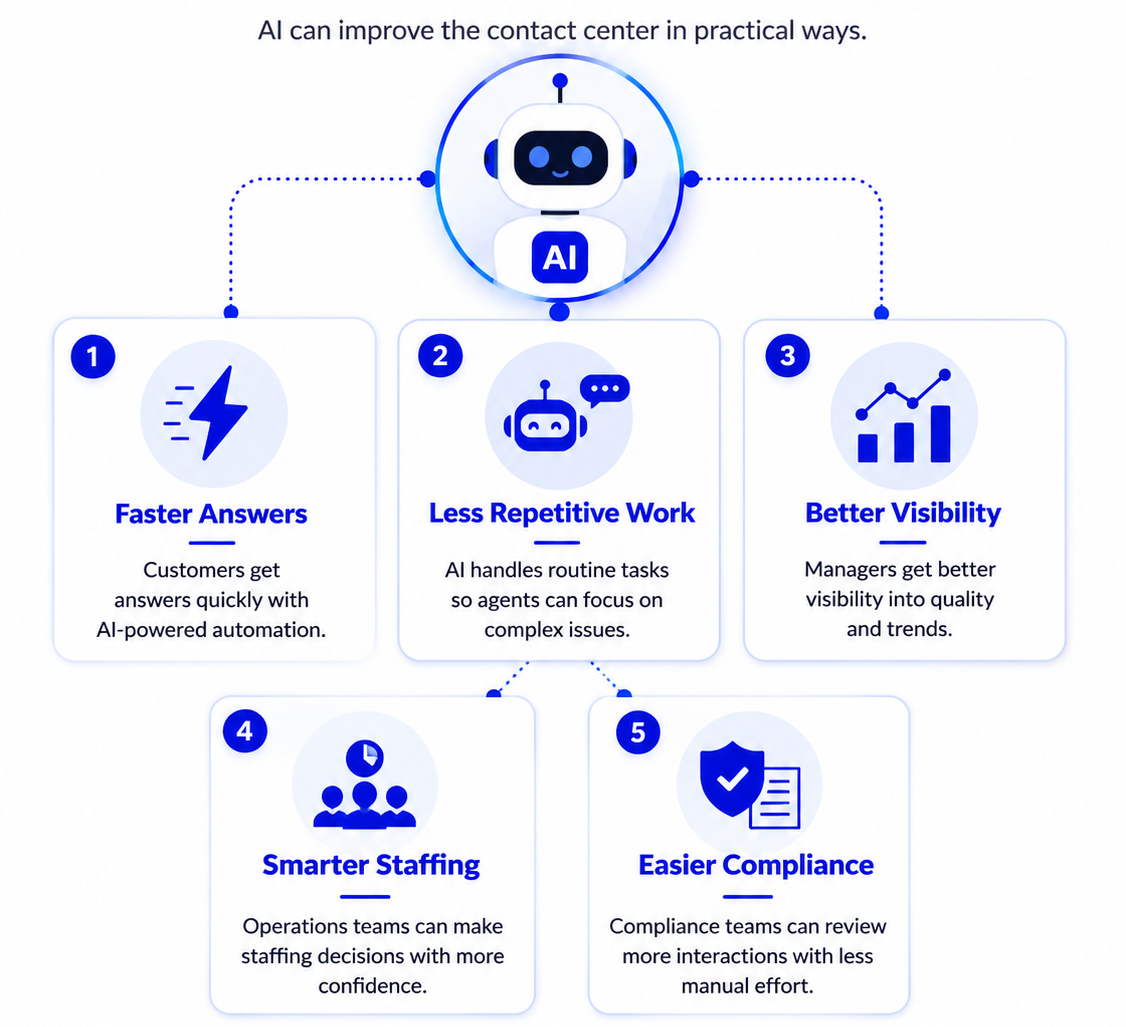
AI can improve the contact center in practical ways.
- Customers get faster answers.
- Agents spend less time on repetitive work.
- Managers get better visibility into quality and trends.
- Operations teams can make staffing decisions with more confidence.
- Compliance teams can review more interactions with less manual effort.
The biggest win is balance. AI assists you in enhancing your service without requiring your employees to sacrifice speed for quality.
Challenges and Considerations
Although AI is extremely powerful, there must be limits to it.
Data privacy and compliance
- Customer data must be protected.
- Use access controls, redaction, and secure deployment methods where needed.
- In regulated industries, compliance should shape the design from the start.
Agent adoption and change management
- Artificial Intelligence would be quicker in being accepted among agents who view it as an aid instead of surveillance.
- Introduce them right from the beginning; educate them on its merits and explain to them how technology simplifies things for them.
Accuracy and hallucination
- Sometimes AI systems will generate incorrect responses because they aren’t grounded in accurate information.
- The solution is straightforward, just tie it into accurate information sources and perform a check on the accuracy.
Adding AI to Your Contact Center
Making use of practical AI use cases in contact center operations is the fastest way to drive customer loyalty and cut costs.
As a leading enterprise CX platform, Thunai delivers these AI use cases in contact centers seamlessly. By combining voice and chat agents with real-time agent assist and automated quality assurance, Thunai helps scale support without growing headcount.
Platform users like Ram Prasad Rengan in producthunt noted that Thunai's Brain feature is a complete game changer for information retrieval.
Ready to transform your contact center?
Schedule a live demo with Thunai to see how much you can save on operations.
FAQs
What is the most common AI use case in contact centers?
The most frequent AI application is the automatic summarizing of calls and post call wrap-ups. It makes the amount of after call work zero and saves a few minutes for the agents after each call.
How is generative AI used in call centers?
Generative AI creates customized answers for customers, gives real-time advice to agents, and creates voice assistants like humans.
Will AI replace contact center agents?
Not at all. AI is specifically made for automation of repetitive L1 tasks. This way, the agents can concentrate on the complicated and emotionally charged cases.