
CEO : "We invested heavily in AI this year."
COO : "Then why are employees still searching for answers?"
CEO : "Because AI gives information."
COO : "What they need is augmented intelligence. It gives people the right answer, at the right time, so they can make the right decision."
This is what is happening in all the boardrooms of the Fortune 500 companies. The leading-edge companies are not eliminating human decision-making, but rather they use augmented intelligence such that every single worker becomes fast, smart, and sure-footed.
What is Augmented Intelligence?
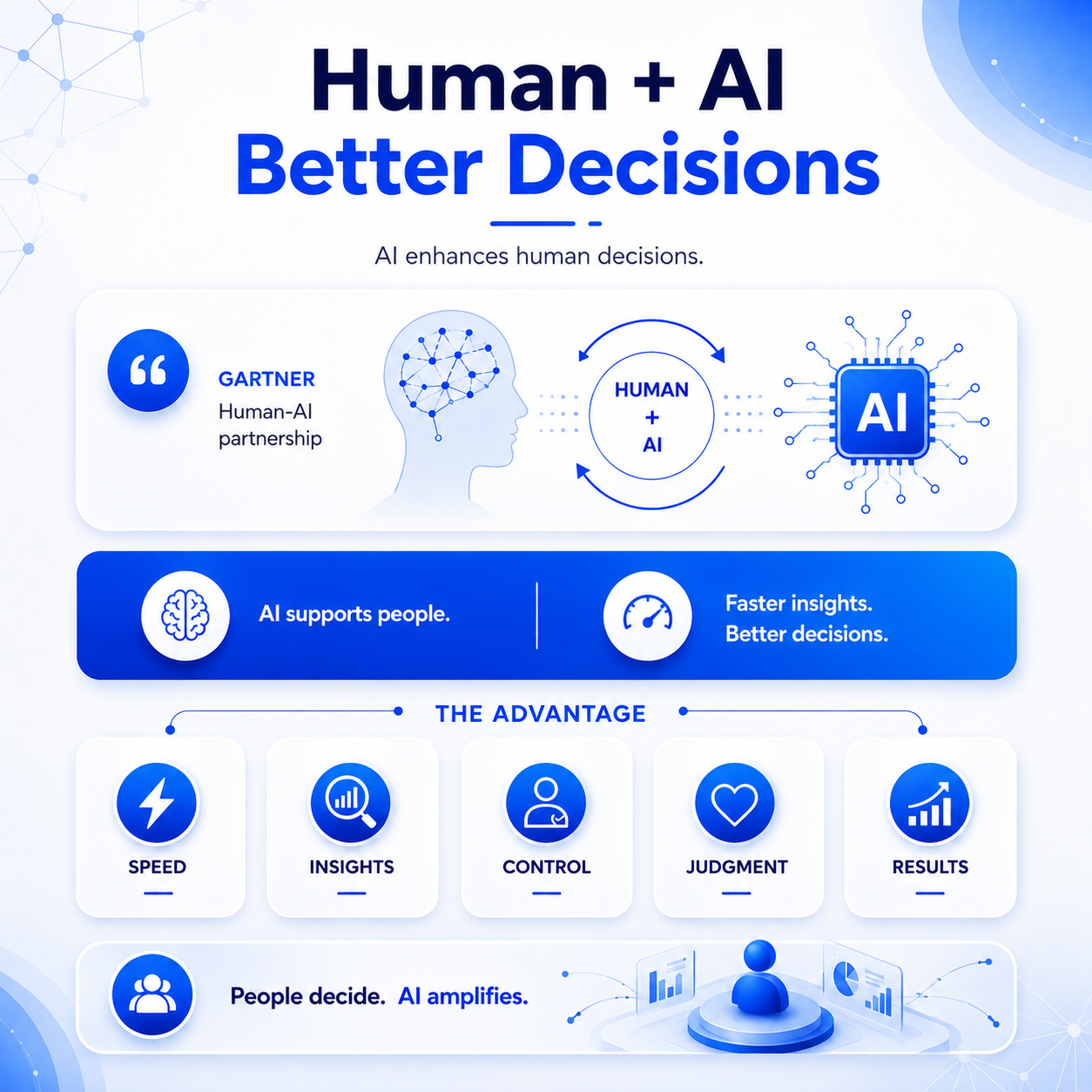
Gartner defines augmented intelligence as "a design pattern for a human-centered partnership model of people and artificial intelligence (AI) working together to enhance cognitive performance, including learning, decision making and new experiences".
This system acts as a cognitive tool rather than a job replacement. Modern software can analyze big datasets, spot subtle patterns, and deliver live guidance. Yet, the human worker keeps complete control over final choices. This strategy will ensure that teams get machine speed without compromising on human empathy, context, and ethics.
Augmented intelligence vs. artificial intelligence vs. automation
To select the right technology, enterprise leaders must evaluate how different software models distribute operational authority:
What Makes Augmented Intelligence Work?
Modern platforms rely on connected software models to deliver fast insights:
- The machine learning algorithm uses past data to forecast future trends and identify errors.
- The deep neural network deals with unstructured data like audio and video.
- The NLP is used by machines to understand dialogues and interpret the user’s intention.
- Machine vision analyzes visuals from images or video streams and enables field engineers to examine tangible items.
- NVIDIA RAG explained that retrieval-augmented generation connects generative models to internal company databases. This link ensures recommendations match verified company facts.
- Large language models summarize complex data points into clear text.

The Four Augmented Intelligence Categories Every Buyer Should Know
1. Augmented Analytics:
- This is the one that is considered to be the most popular in terms of targeting through search engines.
- Augmented analytics technology makes use of artificial intelligence in order to carry out generation of insights, explanations, and natural language inquiries.
- Some of the examples of these kinds of software include Pyramid Analytics, Domo, Power BI, Oracle Analytics Cloud, Tellius, and ThoughtSpot.
- The use of such technologies is very appropriate for companies and data teams that need quick reports and analysis.
2. Augmented Operations:
- This is the category most competitors miss.
- Augmented operations tools help people during live work, not after the fact, by surfacing the right answer inside the workflow.
- In customer service, this means real-time agent assist; in healthcare, it may mean live documentation support; in field service, it may mean instant troubleshooting help.
3. Augmented Decision Support:
- These augmented intelligence tools are helpful for assessing risk, giving recommendations, making forecasts, and determining the next best action.
- These augmented intelligence tools don't make decisions on their own but provide a better set of options to help people make decisions.
4. Augmented Creation:
- Such processes include drafting, summarization, rewriting, and code writing.
- The augmented intelligence tool drafts or provides an idea for further development and then waits for a human to edit or reject that idea.
- The benefit lies in combining speed with human wisdom.
Which Augmented Intelligence Tools Are Worth Your Time?
The analytics tools are strong where the question is “what does the data say?”
The operational tools are stronger where the question is “what should I do right now?”
Where Augmented Intelligence Delivers the Biggest ROI
1. Customer service
- One of the best wins of augmented intelligence is achieved by real-time agent assist because this feature can help cut ramp time, increase consistency, and help the agents deal with the calls more efficiently because all the required information becomes available while the call is taking place.
- Thunai is the best example of such assistance.
2. Healthcare
- In healthcare, augmented intelligence is used for documentation, triage, and clinical decision support.
- The objective is not to replace the clinician but to minimize the cognitive burden.
3. Financial services
- AI in finance can be used to assist in advisory processes, risk assessment, and next best action suggestions.
- In this field, however, human supervision is necessary because of the high risks involved.
4. Analytics teams
- With analytics professionals, they save them time from manually searching for insights.
- In that case, the augmented intelligence tools will give them time to take action on the findings rather than waste time navigating through dashboards.
How to Evaluate Augmented Intelligence Tools?
Use this checklist before buying:
- Does it show its reasoning or source context?
- Does the human retain the final decision?
- Does it work inside the existing workflow?
- Does it handle uncertainty well?
- Can human corrections improve the system over time?
- Is data governed, secure, and residency aware?
- How fast will it show value?
A good augmented intelligence tool should reduce friction, not add another layer of software to manage.
The Most Common Reasons Augmented Intelligence Fails
Even top augmented intelligence tools fail when software sits outside normal employee workflows. Organizations must avoid these four common failure modes:
- Insight Without Action: Software provides detailed stats but no clear next steps for workers.
- Workflow Interference: Systems make workers tab switch, making live customer interactions slow.
- Human Reliance on Systems: Workers take what systems say without verification, resulting in mistakes that can be avoided.
- No Feedback Cycle: Systems miss out on the opportunity for learning as it doesn’t consider human input changes.
Augmented Intelligence in the Contact Center: a Worked Example
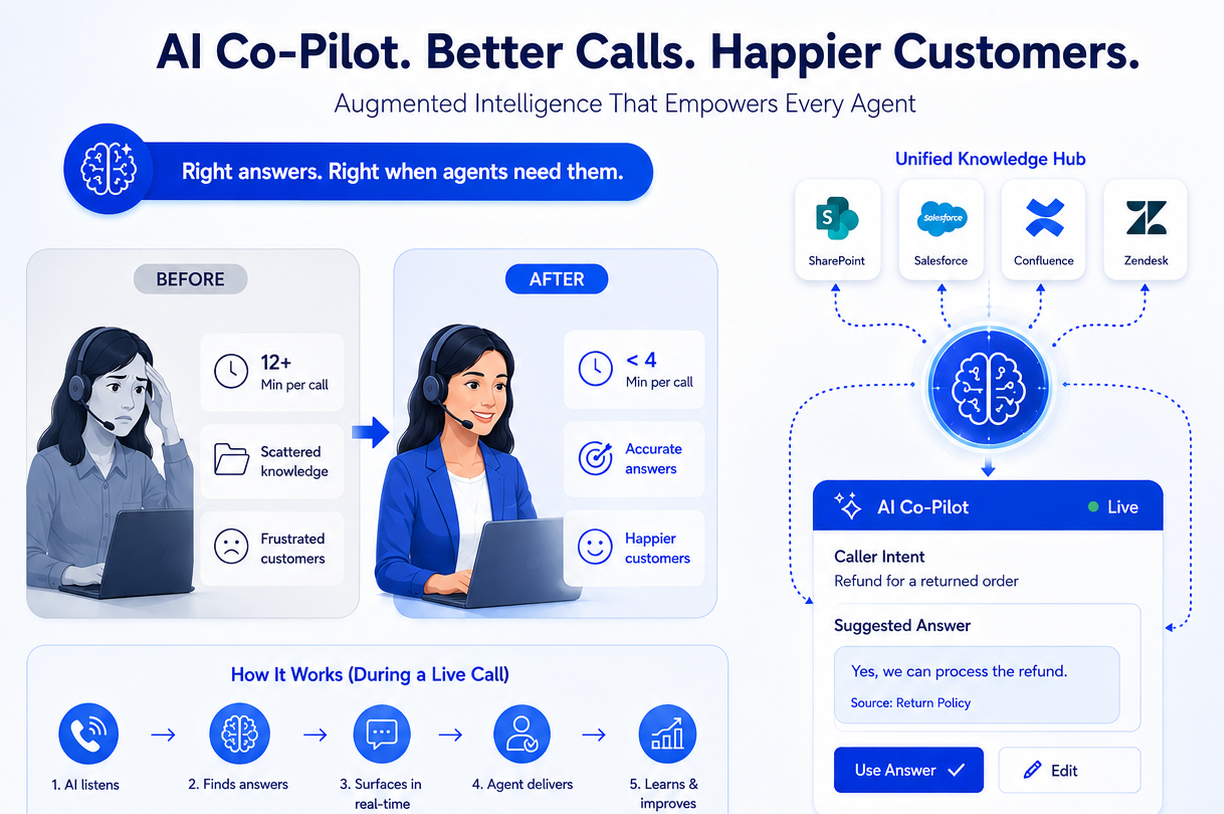
Looking at contact centers shows how augmented intelligence tools can transform live work. In busy support centers, agents used to spend over 12 minutes per call searching across separate systems. This delay caused customer frustration and agent stress.
Deploying Thunai Brain connects scattered files across SharePoint, Salesforce, Confluence, and Zendesk into one central knowledge hub. By using effective augmented intelligence tools, teams eliminate data silos without migrating files.
During live customer calls, Thunai listens in real time, understands caller intent, and surfaces accurate answers directly to the agent. The agent checks the prompt, selects the best answer, and delivers helpful service. The platform learns from every accepted suggestion to improve future prompts.
When the co-pilot is added to the enterprise contact centre, we can see some of the following benefits:
- Average handle time reduces by 66% from 12 minutes to less than 4 minutes.
- First contact resolution climbs to 85%.
- New agent onboarding drops from six weeks down to two weeks.
- Automated call notes cut after-call work, creating a 3x boost in agent productivity.
- Tier-1 support deflection reaches 70% to 80% using automated voice and chat agents.
Client stories in this Thunai use case show strong praise from support teams. One customer support leader noted that direct answers removed daily search stress, raised CSAT scores by 30%, and lowered agent turnover.
Don't just automate work. Augment every employee with AI that thinks alongside them. Book your personalized demo today.
FAQs on Augmented Intelligence Tools
Difference between AI and augmented intelligence?
AI stands for artificial intelligence and is related to the execution of activities by machines independently. On the other hand, augmented intelligence can be defined as AI that assists in human decision-making.
Is augmented intelligence simply another name for AI?
No, as it is a design principle with its own philosophy. It focuses on intelligence augmentation, making it clear that the technology is working as an aide to people.
What are examples of augmented intelligence in everyday business?
Common augmented intelligence tools include real-time agent assist platforms, clinical diagnostic guides, financial risk scoring systems, and natural language analytics tools.
Does augmented intelligence take over jobs?
No. Augmented intelligence undertakes repetitive activities such as searching of data and administration, and it helps employees to focus on problem-solving.
What is human in the loop AI?
Human in the loop AI is an operational framework where artificial intelligence suggests actions or answers, but human operators evaluate and approve final outputs. Human in the loop AI forms the structural baseline for effective augmented intelligence tools across enterprises.