How will banks be able to quicken the process of client validation while ensuring that compliance and security are not compromised?
The current KYC processes are all governed by a strict set of regulations, which make it very difficult to deal with complex documentation, false positives, and changes to customer data.
Agentic AI is the better solution as it works with exceptions, automation, and risk management in real time.
In this guide, we look at how to select AI agents for KYC and compliance, how to calculate the ROI, and how to build secure processes.
What agentic AI means for KYC and compliance in banks
- So let’s start with what happened before. Most of the banks attempted Robotic Process Automation (RPA).
- Bots were moving papers from one database to another, and in easy situations, it worked just fine.
- Then a passport photo had glare. Or a customer had a hyphenated surname. The script froze, and a person had to step in.
- Deploying Agentic AI for KYC and Compliance in Banks takes a very different path.
- Instead of going by the process of instructions, Agentic AI for KYC and Compliance in Banks aims for a target.
Thunaï’s Guide to Conversational AI in Financial Services talks about the process where purpose-built agents interact with bank APIs straightaway and accomplish multi-step tasks securely.
In case the first image fails, the AI requests the client to provide an alternative. They review the public records, gather data from the documents, and figure out whether it is a fraud or just an error.
The risk management people are paying attention. With Agentic AI for KYC and Compliance in Banks, scripting goes into a more flexible workflow mode.
How an AI agent for KYC verification works at onboarding
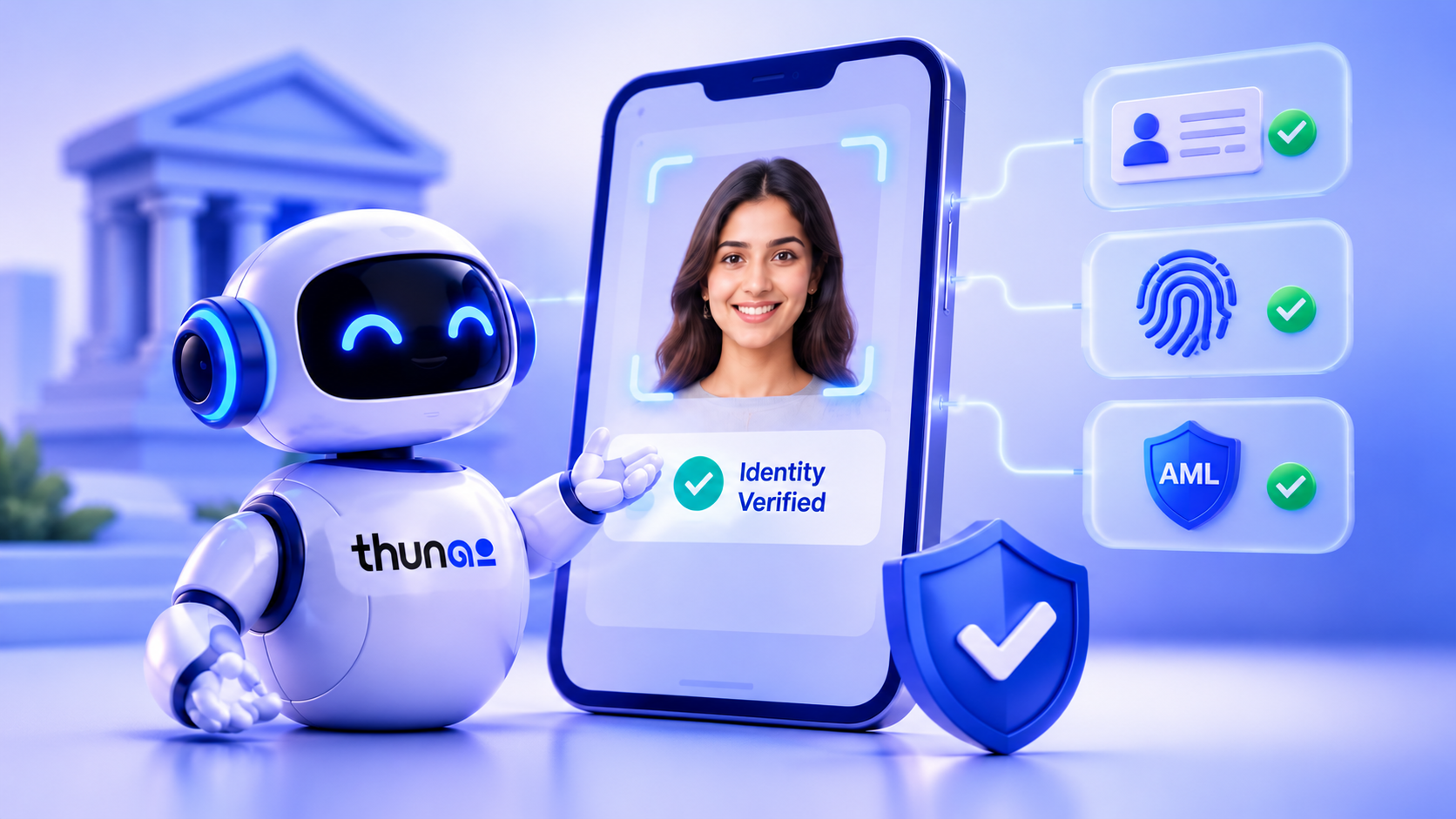
- Consider the time when the customer starts applying. AI for Agency for KYC & Compliance in Banks is responsible for the document verification, biometrics verification, and risk score.
- It will also be responsible for guiding the user through the mobile capture process.
- This will include recommendations on how to avoid blurry pictures or bad lighting.
- Thunai's Breakdown of AI Chatbots in Banking covers how chat agents speed up ID collection and live AML registry tests without loosening the guardrails.
- Next up: liveness. These checks are done silently in the background and aid in identifying deepfakes and print images.
- The agent scans the IDs of citizens from many countries and compares the ID numbers with the civil registers.
- Then the system runs the candidate through sanctions, PEPs, and adverse media databases.
- The old system produces 95% to 99% of false positives for common names, which is a total waste of time.
- Agentic AI for KYC & Compliance in Banks takes into account the date of birth, middle name, and place of residence, and the benign hits are cleared automatically.
- And then there’s the remediation gap, where all the clients are lost.
- Around 40% of applications have a tiny glitch maybe it’s a fuzzy picture or an error in the address. 80% of these walk away.
According to Thunai KYC Automation Guide, Agentic AI for KYC and Compliance in Banks provides a solution by conversing with the client to fix the issue within seconds.
Beyond onboarding: periodic review and event-driven refresh
Day one is just the start. The agentic AI for KYC & Compliance in Banks continues even after opening the account.
Customers are typically assessed by banks once, thrice, or every five years. That schedule builds backlogs, and it leaves banks blind to anything that changes in between.
A growing number of banks use Agentic AI for KYC and Compliance in Banks to run Perpetual KYC (pKYC).
Thunai's Analysis of Perpetual KYC Systems explains the shift: check risk the moment customer data changes, instead of waiting for the next audit. The agent tracks live signals from inside and outside the bank. A director resigns. A company changes address. Bad news hits the press. Any of these starts a focused refresh straight away.
Other compliance workflows agents can support
- Retail accounts are just one use. Agentic AI for KYC and Compliance in Banks also tackles corporate onboarding, known as Know Your Business (KYB). It's slow work.
- Tracing beneficial ownership across registries in different countries can swallow dozens of analyst hours.
- Here, Agentic AI for KYC and Compliance in Banks untangles multi-layer holding structures.
- It traces who controls what, down to the 25% beneficial ownership threshold, screens directors against sanctions, and points out where registries don't agree.
- It assists with Anti-Money Laundering (AML) monitoring as well. Agentic AI for KYC and Compliance in Banks classifies transaction alerts in real time.
- Whenever a rules-based system triggers an alert, the agent collects account history, profiles of counterparties, and reported income.
- As Thunai explains in his Overview of AI Banking Compliance, it is imperative for bank examiners to understand each automatic decision made.
- Hence, the agent prepares disposition notes and SAR files. Filing of the reports is decided by the human compliance officer.
Guardrails to set before agents touch customer data
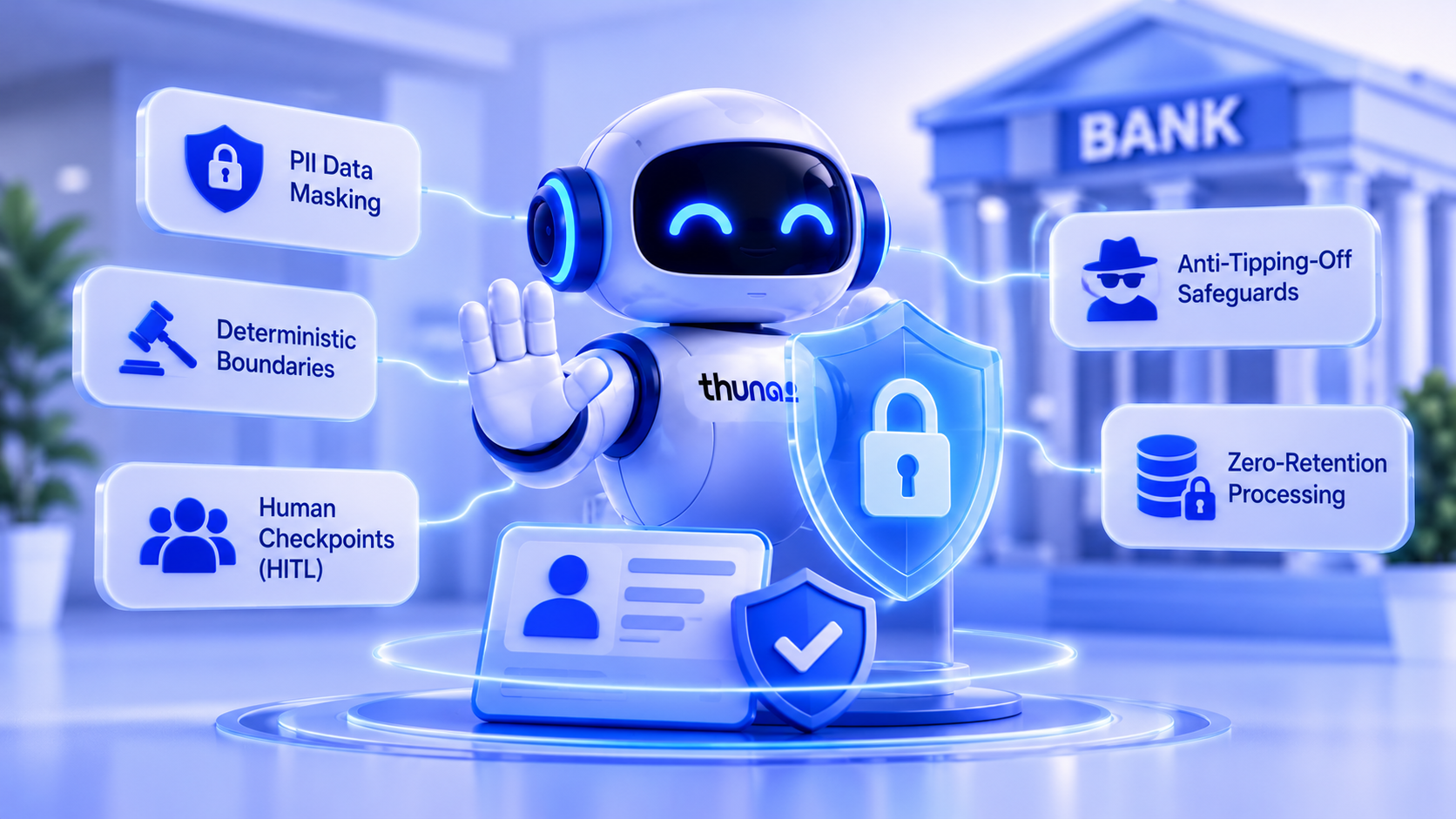
Set up the guardrails before the agent touches any customer information.
Technical guardrails must be set up for Agentic AI for KYC & Compliance in Banks since unbridled AI models can lead to problems.
In Thunai's Best AI Tools for Customer Support in Banks, experts explain that AI should work from pre-approved templates with live guardrails so it avoids regulatory and UDAAP violations.
For enterprise use, Agentic AI for KYC and Compliance in Banks needs hard boundaries.
The model's reasoning can't override mandatory policy. Say an applicant matches a verified sanctions record. The agent hands that case to human investigators, full stop.
Regulations and supervisory expectations to map
- Regulators want to see inside the machine. Agentic AI for KYC and Compliance in Banks has to be fully transparent, and black-box models don't survive in financial crime work.
- As Thunai's AI Banking Architecture Insights explains, compliance officers need clear rationale logs on hand whenever an auditor asks.
- In the U.S., banks need to ensure that their systems are in conformity with the regulatory standards set by the regulatory frameworks like SR 11-7 and the newly revised SR 26-2.
- The teams need to catalog each application, place strict limitations on its usage, and run extreme-case scenarios.
- An implementation based on Agentic AI technology in order to achieve KYC and Compliance at banks should also satisfy FinCEN guidelines and therefore be auditable with timestamps.
- More layers come from the UK and Europe: the FCA Consumer Duty, the EU AI Act, and the DORA Resilience Requirements.
- The Thunai’s Guide to Financial AI Compliance considers data sovereignty and audit trail as necessities.
- In addition, banks sometimes inquire whether the AI providers have ISO 42001 certification, which is described in the Thunai ISO 42001 Certification Report.
How to evaluate an AI agent platform for bank KYC
Demos look great. They also hide a lot. Buyers of Agentic AI for KYC and Compliance in Banks should dig into architecture, security, and core banking integration.
Thunai's Vendor Evaluation Checklist for Banks shows technical teams testing core connectivity, hallucination controls, and audit logs well before they sign a contract.
In comparing Agentic AI Vendors of KYC and Compliance in the Banking Industry, ensure that they integrate with legacy ledgers and CRMs via protocols such as the Model Context Protocol (MCP).
Inquire whether they provide either cloud-based or in-house solutions as well. Keep your data safe and within your reach.
How to measure whether it's working
Numbers make the case. To justify Agentic AI for KYC and Compliance in Banks, risk leaders should track results closely.
A strong rollout of Agentic AI for KYC and Compliance in Banks brings sign-up time down from several days to under two minutes. Automated case files cut staff review time by 42% to 70%. They also take away up to 80% of routine data entry.
Where Thunai fits
- Thunai is a workflow orchestration platform designed for Agentic AI for KYC & Compliance in Banks. There's no need to rip-and-replace anything.
- Your core banking system and your ID verification vendors stay put.
- Thunai plugs into the ecosystem, sitting between customer channels, verification APIs, and core systems, and takes away the friction.
- Customer drop-off is what Thunai addresses. Thunai's voice, chat, and email agents speak over 200 languages.
- With Thunai AI Agents for Banking, you can find out how the agents link up through CCaaS and help customers with their document re-uploads on the fly.
- Thunai AI Knowledge Management comes with automatic contradiction detection that eliminates 95% of AI hallucinations in bank policies and compliance SOPs.
- Business customers who browse through Thunai Customer Support Tools for Banks find themselves attracted by the existing financial connectors that come ready to use.
As per user reviews on G2 and Product Hunt platforms, Thunai is adept at turning raw notes into automated workflows, instant meeting summaries, and one common knowledge base.
Using Agentic AI in KYC and Compliance in Banks by Thunai has led to 70% reduction in escalations, 42% reduction in handling time on average and tickets being processed in 0.8 seconds. Thunai is certified ISO 42001, SOC 2 Type II, and GDPR.
Looking for an automated system to do KYC and compliance without compromising on security at all? Schedule a Thunai demo now and know about our AI agents.
FAQ
What is agentic AI in relation to KYC and compliance?
In banks, Agentic AI for KYC and Compliance is an AI that plans, reasons, and executes compliance actions on its own. It's not just some simple script. The agents can link to the bank's APIs, read the complex ID files, deal with intake errors with the customer, and put together the full audit file for the compliance officer.
How is an AI agent any different from RPA in the context of KYC?
RPA follows fixed, pre-coded instructions. Glare, an odd layout or a typo will just stop it dead. AI agents, on the other hand, look at the context, can make sense of the messy data, can query the various public registries, and can go out and ask the applicant for the information that's missing.
Can AI agents fully automate KYC verification?
No. AI agents cannot make the final high-risk decision. They can deal with 65-85% of the clean, low-risk personal accounts. It is still the case that the SAR must be approved by a certified human officer who will determine the actual sanctions compliance and corporate ownership.
What KYC tasks should banks automate first?
Start with document remediation. The time spent chasing around unreadable ID cards and missing utility bills is 35%-45% of compliance working hours and is a major driver of customer churn. Then move on to sanctions false positive triage and KYB ownership mapping.
How do banks ensure that their AI agents are auditable?
By logging everything. Every model prompt, every API call, every retrieval source and every human decision goes into an immutable ledger. Systems that are compliant with frameworks such as SR 26-2 and ISO 42001 will allow regulators to rebuild and audit the entire verification process.