Create custom scorecards for every type of call: Create unique QA criteria for FNOL, claim status, policy service, sales, and Medicare calls.
Determine criteria for scores: Create a 100-point scoring criteria with 85% as pass point and no tolerance for auto-fails on the account of compliance violation.
Score calls through AI and human: Use AI to record disclosure and verification processes and scripted responses, while using humans to make decisions on coverage.
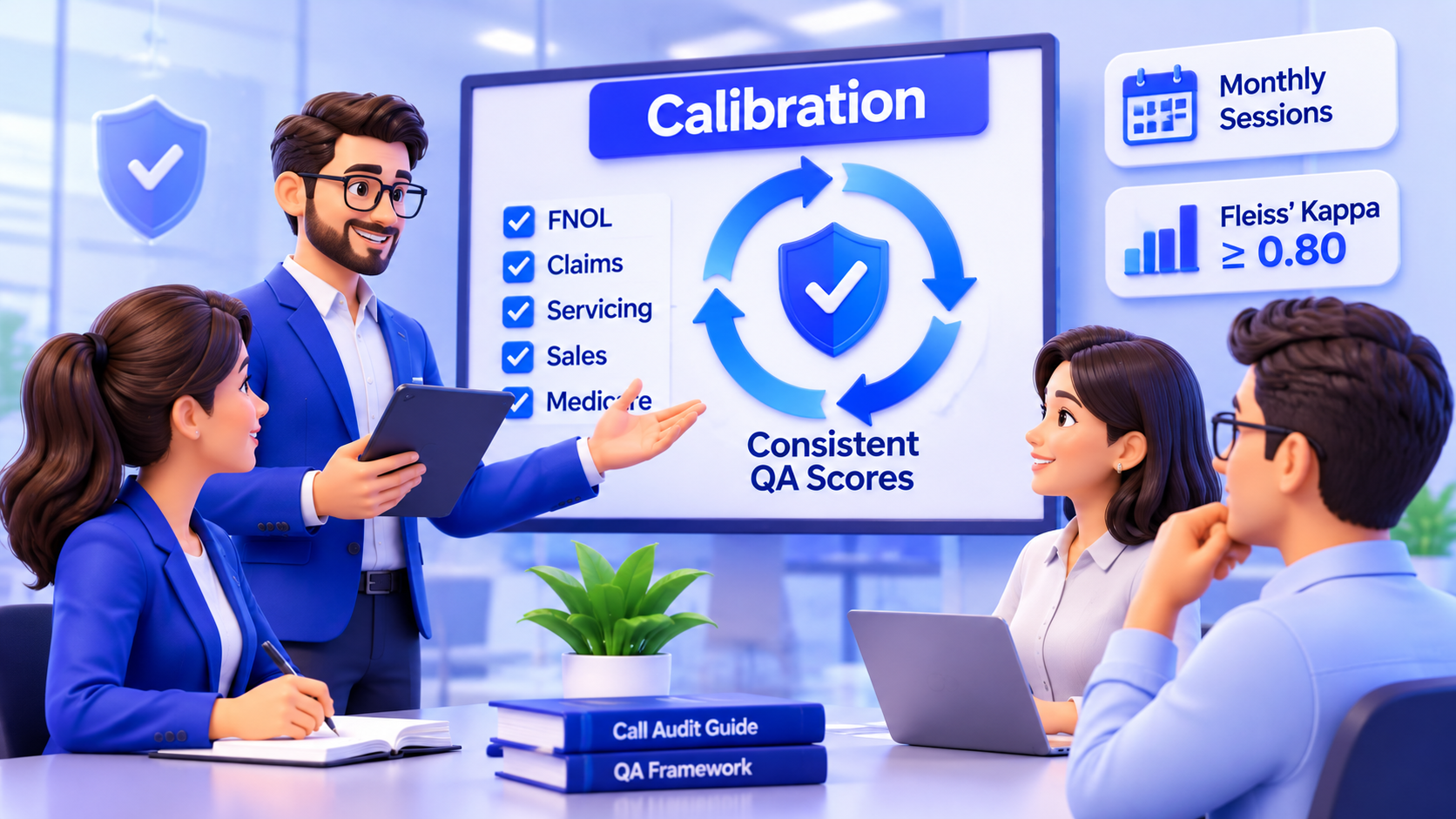
Calibrate once per month: Conduct calibration once per month to make sure that calls are scored equally for agents.
Cover all calls: Utilize AI technology and automatic scorecards to uncover compliance problems and coach effectively.
Would your call center be able to manage the situation in such a way that no compliance issue will result in a costly mistake?
Any mistake made in non-disclosure, incorrect insurance coverage forms, or verification would be a costly one for the company.
Insurance QA scorecards will assist you and your team in testing claims, services, sales, and Medicare calls according to the required compliance standards.
Here you will find all QA criteria, weights, auto-fails, and some free insurance QA scorecard templates.
What an insurance QA scorecard needs that a generic one does not
Most contact centers start with a generic customer service qa scorecard. Those forms score greetings, manners, and handle time.
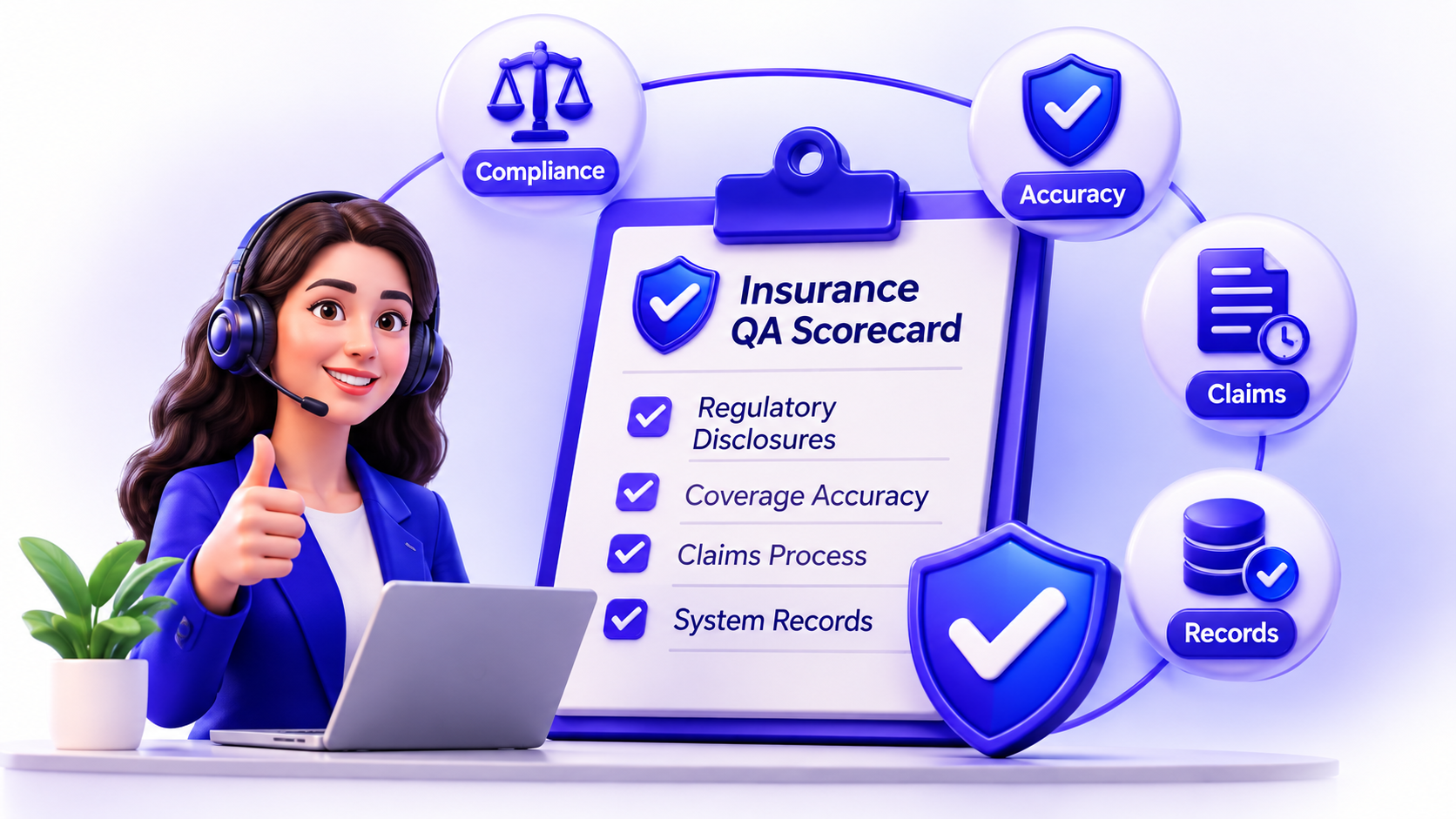
Insurance asks for more. A strong insurance QA scorecard covers four areas that generic forms skip:
Regulatory disclosures: In two-party consent states, agents must state the recording notice. They must also give health plan disclaimers before talking about coverage.
Coverage accuracy: The deductibles, endorsements, and limits need to comply with the system. There will be no payment until the case is reviewed by someone.
Steps to be considered in claim/policy: The client needs to be informed about the time bar, proof of loss, and the letter of reservation of rights.
Core system documents: Whatever the agent says should be recorded on Guidewire, Duck Creek, or Applied Epic.
Scorecard structure: sections, weights, and auto-fails
A well-built insurance QA scorecard scores each call out of 100 points. The pass mark is 85%.
Auto-fail rules matter because a happy customer shouldn’t hide a serious violation.
If an agent skips a required disclosure or shares data with an unverified caller, the insurance QA scorecard zeros the call right away.
Recommended weight split by call type
Every call type has its own goal. FNOL calls need accuracy and warmth. Servicing calls lean on identity checks.
Here’s the weight split for an insurance QA scorecard:
Evaluation Category
FNOL & New Claims
Claims Status & Follow-Up
Policy Servicing
Sales & Renewals
Medicare Advantage & Part D
Authentication & Identity Verification
10%
15%
20%
10%
10%
Regulatory Disclosures & Compliance
15%
10%
15%
25%
35%
Coverage & File Accuracy
30%
35%
30%
30%
30%
Customer Experience & Empathy
25%
20%
15%
20%
10%
Systems Documentation & Next Steps
20%
20%
20%
15%
15%
Total Baseline Points
100%
100%
100%
100%
100%
Authentication & Identity Verification
FNOL & New Claims
10%
Claims Status & Follow-Up
15%
Policy Servicing
20%
Sales & Renewals
10%
Medicare Advantage & Part D
10%
Regulatory Disclosures & Compliance
FNOL & New Claims
15%
Claims Status & Follow-Up
10%
Policy Servicing
15%
Sales & Renewals
25%
Medicare Advantage & Part D
35%
Coverage & File Accuracy
FNOL & New Claims
30%
Claims Status & Follow-Up
35%
Policy Servicing
30%
Sales & Renewals
30%
Medicare Advantage & Part D
30%
Customer Experience & Empathy
FNOL & New Claims
25%
Claims Status & Follow-Up
20%
Policy Servicing
15%
Sales & Renewals
20%
Medicare Advantage & Part D
10%
Systems Documentation & Next Steps
FNOL & New Claims
20%
Claims Status & Follow-Up
20%
Policy Servicing
20%
Sales & Renewals
15%
Medicare Advantage & Part D
15%
Total Baseline Points
FNOL & New Claims
100%
Claims Status & Follow-Up
100%
Policy Servicing
100%
Sales & Renewals
100%
Medicare Advantage & Part D
100%
Auto-fail items and the rule behind each
Automated failure is either a violation or a potential one. This guarantees that by ensuring such controls are present in your insurance QA scorecard, your company will not have any audits or legal issues.
Auto-Fail Parameter
Governing Rule or Operational Risk
Applicable Call Types
Missing recorded-line notice
State wiretap laws requiring two-party consent, for instance, those of California, Florida, and Pennsylvania
42 CFR § 422.2267(e)(41) and § 423.2267(e)(41), CMS marketing rules
Applicable Call Types
Medicare Advantage and Part D sales calls
Unsubstantiated or deceptive comparison claims
Governing Rule or Operational Risk
State unfair trade practices laws; blocks misleading policy comparisons
Applicable Call Types
Sales, renewals, and servicing calls
Marketing products outside authorized scope
Governing Rule or Operational Risk
CMS Scope of Appointment (SOA) limits
Applicable Call Types
Medicare Advantage and prescription drug calls
Template 1: FNOL and new claim calls
On an FNOL call, the agent has two jobs.
Get the facts of the loss, and calm a policyholder who just had a bad day.
Intake agents should never decide liability or promise a settlement. That’s the adjuster’s call.
Our breakdown of claims quality assurance shows why you should check spoken statements against the claim file. It stops costly errors.
Use these criteria in your insurance QA scorecard for first notice calls:
Criterion
Scoring Weight
Evaluation Mode
Operational Purpose
1. Safety check and emergency triage
5 points
AI can score
Confirms caller safety and emergency contact.
2. Call recording notification
Auto-fail
AI can score
Gives the required recording notice when the line connects.
3. Caller identity and policy verification
10 points
AI can score
Confirms identity, policy number, and active coverage.
4. Incident data capture
20 points
AI can score
Records date, time, exact location, and a clear loss description.
5. Third-party and injury tracking
10 points
AI can score
Logs injuries, third parties, witnesses, and police reports.
6. Premature coverage restraint
Auto-fail
Human review
Stops agents from promising payouts or conceding liability.
7. Claim number and adjuster hand-off
15 points
AI can score
Issues a claim number and states adjuster assignment timelines.
8. Empathetic and active listening
15 points
Human review
Shows real empathy without dismissive language.
9. Statutory next steps explanation
10 points
AI can score
Explains proof of loss timelines and property mitigation duties.
10. Core system file entry
15 points
AI can score
Enters loss data into the claims database with no gaps.
1. Safety check and emergency triage
Scoring Weight
5 points
Evaluation Mode
AI can score
Operational Purpose
Confirms caller safety and emergency contact.
2. Call recording notification
Scoring Weight
Auto-fail
Evaluation Mode
AI can score
Operational Purpose
Gives the required recording notice when the line connects.
3. Caller identity and policy verification
Scoring Weight
10 points
Evaluation Mode
AI can score
Operational Purpose
Confirms identity, policy number, and active coverage.
4. Incident data capture
Scoring Weight
20 points
Evaluation Mode
AI can score
Operational Purpose
Records date, time, exact location, and a clear loss description.
5. Third-party and injury tracking
Scoring Weight
10 points
Evaluation Mode
AI can score
Operational Purpose
Logs injuries, third parties, witnesses, and police reports.
6. Premature coverage restraint
Scoring Weight
Auto-fail
Evaluation Mode
Human review
Operational Purpose
Stops agents from promising payouts or conceding liability.
7. Claim number and adjuster hand-off
Scoring Weight
15 points
Evaluation Mode
AI can score
Operational Purpose
Issues a claim number and states adjuster assignment timelines.
8. Empathetic and active listening
Scoring Weight
15 points
Evaluation Mode
Human review
Operational Purpose
Shows real empathy without dismissive language.
9. Statutory next steps explanation
Scoring Weight
10 points
Evaluation Mode
AI can score
Operational Purpose
Explains proof of loss timelines and property mitigation duties.
10. Core system file entry
Scoring Weight
15 points
Evaluation Mode
AI can score
Operational Purpose
Enters loss data into the claims database with no gaps.
Template 2: Claims status and follow-up calls
People who call for claim updates are often confused. Timelines slip.
Repair approvals sit in a queue.
An insurance QA scorecard for status calls makes sure agents give accurate reserve and payment details.
This should cover how to reach the claims adjuster, which forms must be completed, and the full escalation process.
Criterion
Scoring Weight
Evaluation Mode
Operational Purpose
1. Two-party recording notice
Auto-fail
AI can score
Confirms the recording notice as soon as the call connects.
2. Policyholder authentication
10 points
AI can score
Verifies claim number, named insured, and a second identifier.
3. Accurate status from file
25 points
AI can score
Spoken status matches reserve flags, payouts, and adjuster notes.
4. Adjuster contact provided
15 points
AI can score
Gives the adjuster’s direct extension and working hours.
5. Documents requested clearly
15 points
AI can score
Names missing forms, repair invoices, or medical releases.
6. Statutory delay notice compliance
Auto-fail
Human review
Exemplifies delays on account of the 30-day notice period.
7. Escalation path offered
15 points
Human review
Sends complaints not settled to the manager or claims examiner.
8. Core system file documentation
20 points
AI can score
Records call notes and follow-up dates in the claim file.
1. Two-party recording notice
Scoring Weight
Auto-fail
Evaluation Mode
AI can score
Operational Purpose
Confirms the recording notice as soon as the call connects.
2. Policyholder authentication
Scoring Weight
10 points
Evaluation Mode
AI can score
Operational Purpose
Verifies claim number, named insured, and a second identifier.
3. Accurate status from file
Scoring Weight
25 points
Evaluation Mode
AI can score
Operational Purpose
Spoken status matches reserve flags, payouts, and adjuster notes.
4. Adjuster contact provided
Scoring Weight
15 points
Evaluation Mode
AI can score
Operational Purpose
Gives the adjuster’s direct extension and working hours.
5. Documents requested clearly
Scoring Weight
15 points
Evaluation Mode
AI can score
Operational Purpose
Names missing forms, repair invoices, or medical releases.
6. Statutory delay notice compliance
Scoring Weight
Auto-fail
Evaluation Mode
Human review
Operational Purpose
Exemplifies delays on account of the 30-day notice period.
7. Escalation path offered
Scoring Weight
15 points
Evaluation Mode
Human review
Operational Purpose
Sends complaints not settled to the manager or claims examiner.
8. Core system file documentation
Scoring Weight
20 points
Evaluation Mode
AI can score
Operational Purpose
Records call notes and follow-up dates in the claim file.
Template 3: Policy servicing calls
Service Calls are common activities.
The problems that may come up include those of billing, new drivers, address changes, and endorsements.
The Service Insurance QA Scorecard is used for validating identity, change, date, and document evidence.
Criterion
Scoring Weight
Evaluation Mode
Operational Purpose
1. Recording disclosure delivery
Auto-fail
AI can score
Gives the recording notice before policy records are opened.
2. Caller identity verification
Auto-fail
AI can score
Validates the caller with at least two primary data points.
3. Correct endorsement or billing change
30 points
AI can score
Update the vehicles, mortgagees, deductibles, or payment dates.
4. Effective date confirmed
20 points
AI can score
States the exact effective date and prorated premium change.
5. Written confirmation offered
15 points
AI can score
Sends updated declarations or binders by secure email or mail.
6. Core policy system entry
20 points
AI can score
Writes changes straight to the policy administration database.
7. Professional tone and etiquette
15 points
Human review
Uses clear, polite language without jargon.
1. Recording disclosure delivery
Scoring Weight
Auto-fail
Evaluation Mode
AI can score
Operational Purpose
Gives the recording notice before policy records are opened.
2. Caller identity verification
Scoring Weight
Auto-fail
Evaluation Mode
AI can score
Operational Purpose
Validates the caller with at least two primary data points.
3. Correct endorsement or billing change
Scoring Weight
30 points
Evaluation Mode
AI can score
Operational Purpose
Update the vehicles, mortgagees, deductibles, or payment dates.
4. Effective date confirmed
Scoring Weight
20 points
Evaluation Mode
AI can score
Operational Purpose
States the exact effective date and prorated premium change.
5. Written confirmation offered
Scoring Weight
15 points
Evaluation Mode
AI can score
Operational Purpose
Sends updated declarations or binders by secure email or mail.
6. Core policy system entry
Scoring Weight
20 points
Evaluation Mode
AI can score
Operational Purpose
Writes changes straight to the policy administration database.
7. Professional tone and etiquette
Scoring Weight
15 points
Evaluation Mode
Human review
Operational Purpose
Uses clear, polite language without jargon.
Template 4: Sales and renewal calls
The sales and renewal calls require proper suitability tests and binding disclosures.
Include these tests in your insurance QA scorecard.
The agents will be in a position to understand the needs of the client, carry out the suitability test, inform on the major exclusions, and get the binding agreement.
Criterion
Scoring Weight
Evaluation Mode
Operational Purpose
1. Recording consent notice
Auto-fail
AI can score
Gives the recording notice before collecting personal risk data.
2. Needs discovery
20 points
AI can score
Asks full risk, property, and budget questions.
3. Policy suitability
20 points
Human review
Checks that limits and options fit customer needs.
4. Required disclosures
20 points
AI can score
States deductibles, major exclusions, and cancellation terms.
5. Consent capture
Auto-fail
AI can score
Gets clear verbal or digital consent before binding.
6. No misleading comparisons
Auto-fail
Human review
Avoids unproven superlatives and false comparisons.
7. Policy issuance documentation
20 points
AI can score
Submits quote records and binder details to the underwriting engine.
1. Recording consent notice
Scoring Weight
Auto-fail
Evaluation Mode
AI can score
Operational Purpose
Gives the recording notice before collecting personal risk data.
2. Needs discovery
Scoring Weight
20 points
Evaluation Mode
AI can score
Operational Purpose
Asks full risk, property, and budget questions.
3. Policy suitability
Scoring Weight
20 points
Evaluation Mode
Human review
Operational Purpose
Checks that limits and options fit customer needs.
4. Required disclosures
Scoring Weight
20 points
Evaluation Mode
AI can score
Operational Purpose
States deductibles, major exclusions, and cancellation terms.
5. Consent capture
Scoring Weight
Auto-fail
Evaluation Mode
AI can score
Operational Purpose
Gets clear verbal or digital consent before binding.
6. No misleading comparisons
Scoring Weight
Auto-fail
Evaluation Mode
Human review
Operational Purpose
Avoids unproven superlatives and false comparisons.
7. Policy issuance documentation
Scoring Weight
20 points
Evaluation Mode
AI can score
Operational Purpose
Submits quote records and binder details to the underwriting engine.
Template 5: Medicare Advantage and Part D sales calls (CY2027)
Medicare sales are heavily regulated.
In regard to marketing for Contract Year 2027, the agent needs to read the TPMO disclaimer out loud prior to any discussion about benefits.
CMS further requires you to retain the call recordings for six years.
Delivers the standard TPMO disclaimer before benefit talk.
2. SOA scope respected
Auto-fail
AI can score
Confirms Scope of Appointment and covers only approved plan types.
3. Plan details accurate
25 points
Human review
Explains copays, coinsurance, and deductibles without deception.
4. Provider and formulary check
25 points
AI can score
Checks network status and drug formularies.
5. Pre-enrollment checklist reviewed
20 points
AI can score
Reviews coverage gaps, provider limits, and plan rules.
6. Express enrollment consent
Auto-fail
AI can score
Records clear consent before submitting enrollment.
7. Six-year retention archiving
10 points
AI can score
Stores call audio securely to meet federal retention rules.
1. Disclaimer before benefits
Scoring Weight
Auto-fail
Evaluation Mode
AI can score
Operational Purpose
Delivers the standard TPMO disclaimer before benefit talk.
2. SOA scope respected
Scoring Weight
Auto-fail
Evaluation Mode
AI can score
Operational Purpose
Confirms Scope of Appointment and covers only approved plan types.
3. Plan details accurate
Scoring Weight
25 points
Evaluation Mode
Human review
Operational Purpose
Explains copays, coinsurance, and deductibles without deception.
4. Provider and formulary check
Scoring Weight
25 points
Evaluation Mode
AI can score
Operational Purpose
Checks network status and drug formularies.
5. Pre-enrollment checklist reviewed
Scoring Weight
20 points
Evaluation Mode
AI can score
Operational Purpose
Reviews coverage gaps, provider limits, and plan rules.
6. Express enrollment consent
Scoring Weight
Auto-fail
Evaluation Mode
AI can score
Operational Purpose
Records clear consent before submitting enrollment.
7. Six-year retention archiving
Scoring Weight
10 points
Evaluation Mode
AI can score
Operational Purpose
Stores call audio securely to meet federal retention rules.
Which criteria AI can score reliably, and which need a human
Speech analytics is great at rule-based checks. Nuance becomes another matter. The automation process in your QA insurance scorecard frees your QA department to coach where nuance comes into play.
Our guide on contact center optimization explains how AI agents speed up quality management and back up human auditors.
The table shows how to split scoring duties across an insurance QA scorecard:
Evaluation Criterion
AI Reliability Tier
Technical Capability and Limits
Recording notice delivery
High
AI finds the required phrases in the first seconds of the call.
Caller authentication
High
AI checks names, policy numbers, and birth dates against policy files.
Mandatory script adherence
High
Speech models confirm word-for-word TPMO and state disclosures.
System note entry
High
AI compares transcripts with post-call notes in the claims platform.
Tone on emotional claims calls
Medium
AI tracks volume and sentiment words, but humans must judge real comfort on traumatic loss calls.
Humans must check whether an agent gave away legal fault.
Calibrating insurance QA scores across teams
Calibration will make sure that there is standardization during the scoring process for any supervisor, quality analysts, or compliance officers.
Without it, raters will vary. Two people score the same call and land far apart.
A well-governed insurance QA scorecard depends on monthly calibration sessions.
Use the frameworks in our call center audit guide to plan them. Pick five to ten anchor calls.
Mix in simple endorsements, upset claimants, and complex claims intake. Each reviewer scores every call alone with the insurance QA scorecard.
Then the group meets, compares findings, and calculates agreement using Fleiss’ Kappa statistic. Ideally, achieve at least a 0.80 value.
Scores don’t match? Fix the wording in the insurance QA scorecard.
Don’t force subjective changes. Keep an agent dispute process, too.
Agents may contest docked points within five days by providing call timestamp details.
From 2% sampling to 100% coverage: rollout in four steps
Examining only 1% to 3% of calls creates huge blind spots. To increase your insurance QA scorecard to 100% of calls, you will need four things:
Step 1: Implement Auto-Fail Surveillance. Utilize speech analytics to monitor compliance in relation to required checks for each and every call. Identify any lack of recording notice or TPMO disclaimer.
Step 2: Automate process accuracy audit. Use speech recognition to check caller verification, claim number validation, and changes in records.
Step 3: Behaviour analytics implementation. Sentiment analysis, hold time, and dead air analysis will provide an understanding of the quality of the services provided.
Step 4: Close-loop coaching. Tie the scorecard findings to the dashboard of the agents. Coaching should be done if performance lags.
Enterprise contact centers rate Thunai 4.8/5. It has 100% accuracy in voice and chat interactions with the help of custom scorecards and standard operating procedures.
Call logging, identification of escalations and compliance issues, and CRM logging are performed.
Utilize your insurance QA scorecard every time and allow Thunai to eliminate your audit blind spots. Managers get objective data to coach agents.
Are you ready to enhance your company’s compliance and remove QA blind spots? Schedule your Thunai demo now and use AI scorecards for insurance call automation.
FAQs
What should an insurance QA scorecard include?
The insurance QA scorecard should consider ID verification, notice documentation, coverage accuracy, empathy, and core system notes. Every legal mandate must be a zero-tolerance point on the QA scorecard.
What is the number of points that a call center QA scorecard should have?
Aim for 8 to 12. Twenty or more tires out reviewers and weakens coaching talks. Group criteria under clear sections like compliance, accuracy, and customer experience.
What is a good QA score in an insurance call center?
An 85% score is the standard pass mark. Strong teams average 90% to 94%. Report compliance scores on their own so soft skills never hide fatal legal errors.
Should Medicare sales calls use a separate QA form?
Yes. Medicare calls need their own insurance QA scorecard built on CMS rules. Standard servicing forms lack checks for Scope of Appointment, TPMO disclaimer timing, and six-year recording retention.
Can AI score insurance calls accurately?
For script adherence, authentication steps, and required disclosures, yes. For hard cases like unclear policy language or severe claims losses, the tools flag the call for human review.
Jegan Selvaraj
Author
Jegan Selvaraj is the CEO of Thunai AI, Entrans Inc, and Infisign Inc, with a career spanning enterprise AI, agentic AI, and workforce identity. A tech serial entrepreneur and angel investor, he brings product engineering depth and a founder's instinct for solving real enterprise problems at scale.