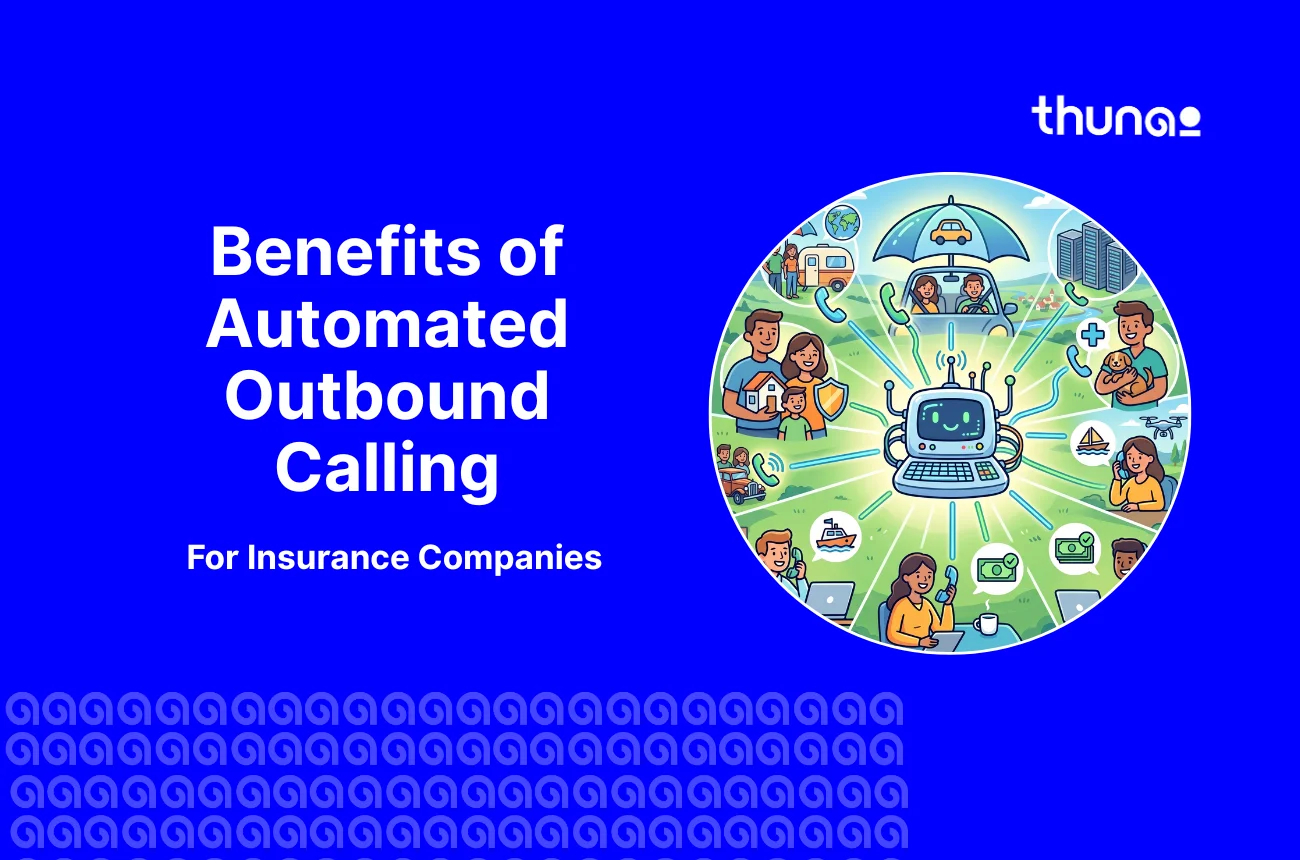

With automated outbound calling for insurance, companies can actually hit 500% ROI within 30 days!
The problem? With compliance and regulations in place, there are fines for non-compliant outbound calls that range from $500 to $1500 per individual call ( just 20 can cost you $10,000 - $30,000!)
So the question now is, are the benefits of AI outbound calls worth the risk?
Since most companies are moving towards automation, in this article, we’ll cover what AI outbound calling in insurance achieves and what the risks actually look like.
Where Manual Outbound Calling Breaks in Insurance
While human connection is the best way to connect and drive sales, for most newer companies, this is not enough.
For those looking to grow their business aggressively, automated outbound calling is usually the answer. Alternatively, not using outbound calling for insurance leads you to run into several limitations we’ve listed below:
- Low Conversion Due to Delayed Response: The stats from MIT show that teams are 100 times more likely to connect with a prospect if they connect within five minutes of the form submission. This is almost impossible to do manually for a growing company.
- Agents Need Time to Cross-Check Policy Details: When it comes to policy renewals and upselling existing customers, there can be a huge disconnect manually. This goes especially since agents can take time to check policy details.
- High Value Customers May Not Be Prioritized: According to McKinsey, an insurance agent spends around 40% of their time on administrative tasks. This means they may not even have the bandwidth to prioritize existing or potential new high-value customers.
- Inability to Scale RevOps Due to Cost: Hiring ONE insurance agent can cost a company anywhere from $3,500 to $6000 a month. This goes for a beginner (meaning they might not even be skilled) for most companies. So while conversions may be low or minimal, scaling manual outbound insurance calls for profitability is a huge and expensive gamble.
- Late FNOL Follow-Ups: According to JD Power, quicker, digital FNOL for claims processing drives customer satisfaction. Meaning, using an AI voice agent for insurance, you get quicker responses. And aside from this also brings better FNOL follow-ups and updates that avoid putting customers on hold.
- Slow Handling of Escalations and Time-Sensitive Issues: A lot of the time, limited customer support leads to tickets or call-backs happening after 4 hours. Or in many cases, even the following day. An Accenture customer experience in insurance report states that customers expect a quick and liquid response.
Key Benefits of Automated Outbound Calling for Insurance Teams
While there are several advantages when it comes to CX automation, we’ve covered the main outbound dialing software benefits for insurance companies below:
1. Higher Policyholder Reach Rates and Lower Idle Time
The truth is that automated or AI outbound calls help insurance companies ramp up their outbound calls a lot better than manual calling.
In fact, there are AI tools that enable 400+ outbound calls for an insurance agency, along with several other automated flows that drive value.
When working with AI voice agents for insurance, the question is what type of workflows and development support your team needs.
- Predictive and parallel dialers in insurance can generate a 300% increase in direct connect volume - something only possible with automated outbound calling in insurance.
- Aside from this, manual outbound workflows can create up to 80% dead time, with only 20 out of 100 prospects being reached.
- One of the major benefits of automated outbound calling for insurance using AI and other tools removes by ensuring a higher volume of callers are reached out to simultaneously and without the cost overhead.
2. Better Policy Renewal and Retention Performance
Most of the profitability in the insurance industry comes from policy renewals and upselling. One of the benefits of automated outbound calling for insurance is that it helps ramp up insurance policy renewal calls:
- In fact, according to companies like Strada, the ideal industry benchmark for policy retention is around 85-90% in the case of personal policies, but is even higher for commercial policies.
- Why does this matter? Well, a 5% annual improvement in retention can actually double an insurance agency’s profitability over five years.
- AI renewal automation using outbound calls and omnichannel outreach can lead to an improvement in retention rates of around 35-45%.
3. Complete Visibility and Compliance Tracking
One of the additional benefits of automated outbound calling in insurance is that they come with 100% visibility. This means you can stay compliant with policies, claims processing, and make sure the right SOPs are followed by both human and AI agents.
With better compliance and insurance workflow automation, companies can retain $70 million and $100 million in annual revenue.
This is often lost due to blocked outreach and customer churn.
Aside from this, there are AI voice agents for insurance that can scrub outbound lists against DNC registries and reassigned number databases. With this, you can make sure calls are made to the right or newer numbers of policyholders and customers.
4. Higher Collection and Payment Records
With automated collection and payment, outbound calls, and omnichannel outreach in insurance teams, you see higher collection. This goes specifically for payments for insurance policy renewal calls and collection calls.
The reality is that using AI tools in insurance companies can result in an increase in recovery rates and recovered revenue.
- There are also other metrics, for example, Rootle AI, which mentions that by using AI, contact coverage for overdue accounts can increase from 30% to 95% of policyholders.
- In doing this, the benefit of automated outbound calling was also a 55% reduced cost per recovered account. This was seen when compared to manual outbound outreach.
5. Consistent Outbound Call Quality in Line With Documentation
With automated outbound calling for insurance or ANY customer support, your NPS (Net Promoter Score) is a metric to monitor quite closely.
For companies like Matic Insurance, using AI for automated outbound insurance calls saw a NPS score of 90 and an automated outreach of 8000 calls per quarter.
Aside from this, AI-powered outbound calls in insurance come with complete recorded transcripts and 100% QA. This means you avoid the typical oversights that come with manual outbound call QA (which has over 98% oversight).
6. Lower Operational Costs and Time Wastage
Human agents create irreplaceable value and brand trust. But adding AI agents to your workforce can add to profitability in your insurance contact center. More importantly, it also reduces insurance operational costs.
- In fact, adding AI to insurance or any contact centers for that matter helps see turnover rates range between 47% and 61 annually.
- While a typical insurance agent's costs start at around $3,500 monthly. But, with automated outbound calling using AI can cost as low as $0.50 per call.
- When augmented with your existing teams, companies like O’Connor Insurance suggest they claim back 58 hours of staff productivity per month. And, with this reduce insurance operational costs.
7. Better Campaign Targeting and Outreach During Peak Hours
When it comes to statistics, reports show that the best outbound call response times are between 10:00 AM and 11:30 AM during morning hours.
And after this, between 4:00 PM and 6:00 PM, in the evenings. One of the benefits of automated outbound calling is that it can help ramp this up:
- But the reality is that improving outbound calls for the highest engagement during these hours can be a lot more expensive when done manually.
- To handle this, using automated outbound calling tools in insurance that call multiple prospects in one go. Moreover, it does this within that time frame, which can actually bring the best results. This goes especially for dynamic predictive calling systems that stay compliant with FTC abandonment thresholds.
What the ROI Looks Like in the First 90 Days
The ROI of automated outbound calling for insurance companies varies based on volume and the number of calls being automated. For companies that want to hit this mark, following the best practices for insurance AI voice agents helps get you there.
That said, in terms of reducing manual dialing, idle time, administrative time wastage, and overhead costs that come with increasing the headcount of insurance agents. With insurance outbound telemarketing, the ROI can be broken down as follows:
- Days 1 to 30: During this period, you typically remove the inbound coverage gaps and the time wasted in manually updating CRMs. The same goes for information, and even automating FNOL claims. Companies like Big Pickering Insurance claim 600% ROI in the first 30 days.
- Days 30 to 60: The timeframe you see an increase in premium recovery rates, with some insurance companies seeing 42%. There are also insurance companies that improve outbound coverage, increasing it from 30% to around 90%.
- Days 60 to 90: After three months, some insurance companies, with automated policy renewal workflows, saw a 34-45% increase in policy retention rates.
How Thunai Is Built for Insurance Outbound Workflows
Thunai is an enterprise AI automation tool that improves productivity with insurance CX. Thunai does this by creating automation and AI-powered customer experiences.
The benefits of outbound calling for insurance companies and numerous. But for those using Thunai AI agents for insurance, the tool integrates with all CCaaS and VoIP software. In doing, so, it also automates outbound calls based on your SOPs.
Moreover, Thunai MCP helps make sure that you do not run into the typical insurance system integration challenges that come when adding AI to your insurance tech stack:
- Thunai Brain (Knowledgebase): For insurance support teams that have to deal with many detailed policies. Thunai Brain helps with an accurate knowledge base that pulls the latest information from the files, videos, URLs, and call transcripts you add to it.
- Thunai Omni: Using Thunai Omni, you can engage with customers with AI voice agents for insurance, chat, and email. Moving past this, AI agent workflows can also vary based on your requirements and needs. Thunai Omni also integrates with your VoIP or CCaaS to answer customer queries with human-like responses.
- Real-Time Live Translation: Thunai allows you to deal with global barriers with real-time translation in over 200+ languages - this means customers can choose the language they’re most comfortable with.
- 100% QA and Call Scoring Using AI: Thunai helps you track customer sentiment on 100% of calls (with transcripts). This can even be based on your own SOPs and benchmarks. Meaning, you can map your insurance digital transformation customer service to what matters most to your company.
Want to know how to automate customer support and outbound calling for your insurance company? Book a free demo with our team!
FAQs on Automated Outbound Calling for Insurance Companies
Can AI really handle insurance conversations, or will customers know it's a bot?
A lot of AI agents are very human-like, with some conversational AI in insurance being no different from human agents on calls. For automated outbound calling for insurance, some teams only use AI agents for L1 support, FNOL notification, and triage.
Will customers know they are talking to an AI, and will it damage trust?
In cases of escalations, using AI agents is not advisable, as it can result in customers losing trust. That said, for automated outbound calling for insurance policy renewals or collection calls, there is no evidence that it destroys customer trust.
How long does it take to set up automated outbound calling for an insurance company?
The timeline for setting up automated outbound calling for an insurance company depends on the existing system you have in place. Aside from this, it also depends on the AI you opt to use. For enterprise AI platforms like Thunai, automated outbound calling for insurance can be set up in under 48 hours.