Still losing customers even after investing in better call center tools? The problem may not be your people, it is how your entire call center operates.
From disconnected systems and inefficient workflows to rising costs and inconsistent service, optimization can feel like solving a puzzle with missing pieces.
That’s where call center optimization comes in. In this guide, we’ll break down practical strategies to connect your people, processes, technology, and data, helping you reduce costs, improve service, and turn every customer interaction into an opportunity for growth.
What Is Call Center Optimization?
Definition and Scope
Call center optimization means improving your support team by aligning technology, agents, workflows, and data.
In addition, it will streamline the queueing process, enhance the technology used, and track vital metrics to ensure that issues are sorted quickly.
The main objective is to ensure that many calls are managed, enhance the customer experience, maintain agent productivity, and eliminate slow manual processes.
Why Optimization Is a Growth Strategy, Not Just Cost Control
Many leaders think of call center optimization as just a way to slash budgets. Pure call center cost optimization often leads to bad service. Instead, you must turn your support hub into a profit engine.
When you fix processes, agents have time to cross-sell. Happy customers stay longer and spend more.
The 4 Pillars of Call Center Optimization
To win with call center optimization you must focus on four main areas. If you ignore one, the whole system breaks down.
Pillar 1: Workforce Optimization (People)
Your agents are the bedrock of your call center operation. Workforce optimization guarantees that you have the right people working at the right times.
Management will accurately predict demand, create flexible schedules, and manage workloads.
This type of call center optimization lessens stress, increases productivity, enhances retention, and improves customer service.
Pillar 2: Process Optimization (Workflows)
Poor workflows create delays for customers and agents. Call center process improvement identifies and removes these barriers.
Managers map the customer journey, improve routing rules, and simplify escalation paths. Clear processes connect customers with the right experts faster.
They also reduce transfers, repeat interactions, customer effort, and confusion during complex cases.
Pillar 3: Technology Optimization (Tools and Infrastructure)
Outdated systems slow down call center operations. Technology optimization connects voice, chat, email, CRM, and knowledge systems into a unified environment.
Agents will have access to customer information and answers without switching from application to application.
Cloud-based tools also support automation and remote work. Connected technology creates faster, smoother, and more consistent service.
McKinsey’s report says that Gen AI-enabled agents increase issue resolution by 14% per hour and reduce handle time by 9%.
Pillar 4: Data and Analytics Optimization (Insights)
Data helps managers understand call center performance. Optimization must be done using criteria that measure the effectiveness of the service, its efficiency, and customer requirements.
Analytic tools and speech analysis can uncover performance patterns and emerging issues.
The right data turns daily interactions into actionable business insights.
The 3-Phase Optimization Framework
Teams often struggle when they change too much at once. A clear three-phase approach helps you identify problems, apply targeted solutions, and improve results over time.

- Phase 1: Diagnose - Analyze metrics, map bottlenecks, uncover root cause: Examine current metrics and map out the customer journey to discover the root cause of any problems with service.
- Phase 2: Implement - Apply fixes on a controlled basis in various pillars: Improved routing, improved knowledge base, agent tool improvements.
- Phase 3: Measure and Iterate - Track KPIs and Refine Continuously: Track KPIs after every change, gather feedback, and scale what works best.
PwC’s research shows that 90% of executives think customer loyalty is growing, but only 40% of consumers agree.
Key Metrics to Track for Call Center Optimization
You cannot manage what you do not measure. Focus on these core metrics to track your progress.
- First Contact Resolution (FCR): Indicates how many of the problems are solved in one attempt, with no repeat calls required.
- Average Handle Time (AHT): Includes the entire duration of each phone call, which consists of the talk time, hold time, and wrap-up.
- Customer Satisfaction (CSAT) and Net Promoter Score (NPS): Post-contact metrics indicating customer satisfaction and customer loyalty.
- Agent Utilization and Occupancy Rate: Monitors the amount of active time of agents when they are logged in and available.
- Service Level and Abandonment Rate: Tracks call answer speed and the share of callers who hang up first.
10 Call Center Optimization Strategies That Drive Results
Use these proven strategies to improve call center efficiency, service quality, and business performance.
Implement AI-Powered Workforce Forecasting and Scheduling
Use automation software for forecasting. The software will be able to use past trends, seasonality, and other aspects of the company’s operations to forecast the number of calls and staff that will be required. Proper forecasting will help you manage labor costs.
Deploy Self-Service Options (IVR, Chatbots, Knowledge Base)
Provide your customers with quicker means of solving simple queries through the use of things like IVR, chatbots, and a knowledge base, which will help you solve routine queries without requiring any agent's intervention.
Adopt Omnichannel Routing for Seamless CX
Omnichannel routing enables customer engagement in voice, chat, email, and other forms of channels. Agents can view previous conversations and customer history without making customers repeat themselves.
The intelligent routing feature, is minimal effort call center optimization strategy that makes sure that each conversation is routed to the right agent.
Automate Quality Assurance with AI-Driven Call Scoring
AI-powered QA can evaluate customer interactions using consistent AI-driven call scoring criteria. Automated analysis identifies compliance issues, service gaps, and coaching opportunities across calls. Managers gain broader visibility into performance and can use these insights to improve agent training and service quality.
McKinsey’s study shows that AI can automate Quality Assurance (QA) to over 90% accuracy, cutting QA costs by 50%.
Consolidate the Agent Desktop into a Unified Platform
Multiple applications slow agents down and increase the risk of errors. A unified desktop integrates customer data, means of communication, sources of knowledge, and processes in one place.
Availability of data facilitates issue resolution and improves the consistency of the services provided by the agents.
Invest in Continuous Agent Training and Upskilling
Effective optimization requires ongoing agent development. Coaching ensures that employees become more knowledgeable about products, learn how to communicate well, solve problems, and be empathetic.
The manager can then use actual calls to give feedback on areas in which the employees need improvement.
Use Real-Time Analytics Dashboards for Supervisors
Real-time dashboards provide managers instant visibility of the status of queues, staffing, service levels, and agent performance.
Managers get to see the problems immediately and make adjustments where necessary if there is an increase in demand for their services.
Reduce After-Call Work with Automation
Automate the tedious tasks after the call, including creating summaries, tagging, and updating the CRM. Machine learning will be able to extract the important points from the conversation and use the information in your business. This leaves enough time for dealing with the customers by the agents.
Personalize Customer Interactions with CRM Integration
Make sure that your call center is integrated with the CRM to give your agents information about the history of customers and their requests. This information will help your agents to provide personal and effective service as well as find possible ways for cross-selling and upselling.
Build a Continuous Feedback Loop
Make use of performance metrics for continual improvements. QA pinpoints the areas where there are issues, management gives focused coaching to the employees, and the agents implement what they have learned from this process. Feedback from agents also highlights tool and process issues.
How AI Is Transforming Call Center Optimization in 2026
AI handles the heavy lifting so humans can focus on complex care. AI call center optimization is the new gold standard.
According to Gartner, 91% of customer service leaders face pressure from executives to implement AI in 2026.
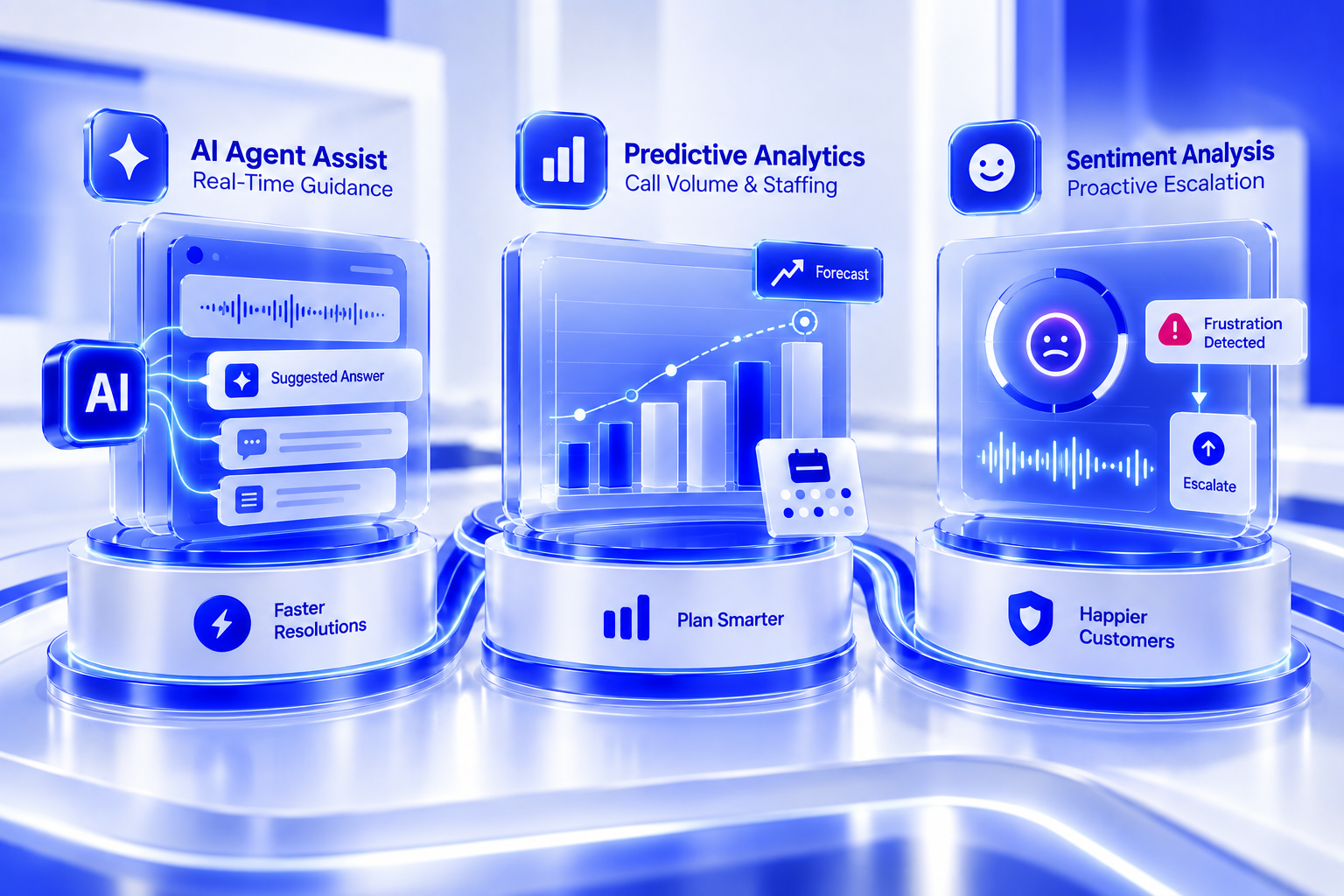
AI Real-Time Assist and Guidance for Agents
AI is listening through the phone conversations and giving real-time help to the agents by showing relevant information.
This kind of assistance can speed up the resolution process for agents, decrease their stress, and provide more consistency.
Predictive Analytics to Anticipate Future Call Volumes
Predictive analytics uses past data to anticipate future call volumes. This way, managers can plan their staff based on seasonality, holidays, and company events.
Such forecasting will help avoid understaffing and agent burnout.
Sentiment Analysis and Proactive Escalations
Sentiment analysis is used to detect the emotions of customers based on both voice and text. As soon as there is a spike in frustration, AI can inform the supervisors about it.
Call Center Optimization Checklist
Use this simple tracker to guide your daily strategy.
See how Thunai turns your call center from a cost center into a 24/7 growth engine - book a demo today!
FAQs About Call Center Optimization
What is the first step in optimization?
The first step in call center optimization is a full audit. Review baseline data and identify your biggest bottlenecks before buying new tools. Understand why customers call and where they get stuck.
How does optimization lower costs?
Smart call center optimization lowers costs by reducing repeat calls, cutting handle times, and keeping agents longer. You do more work with the same-size team. Smart tech also deflects basic calls to chatbots, saving human hours.
Why is FCR more important than AHT?
Chasing a low AHT makes agents rush. They might hang up without fixing the real issue, which causes a second call. High FCR means the problem is truly solved.
Will AI replace human agents?
No. AI takes over the simple tasks, handles password resets and basic tracking questions. Human agents take the hard, emotional calls that require real care.