Still watching contact center costs surge while your AI pilots sit in a sandbox? I've been in those ops reviews.
We’ve listened to our clients complain repeatedly about how brilliant analysts to the burnout of manually copying data across disconnected systems.
That execution gap? It's the real pain point banks and institutions keep running into.
This article cuts through the hype to tackle the main challenge: turning AI from a slide deck into measurable financial impact by using AI in banking.
We’ll cover case studies, benchmarks, and deployment guidelines to help you get AI in banking right the first time around.
What artificial intelligence in banking means today
The first thing I had to fix on my own team was the language. Everyone used AI like it meant one thing, but it doesn't.
When a vendor pitches you, ask them which of these four they're actually selling, because the difference decides what the tool can and can't do for you.
Once my team could name these correctly, our vendor conversations got a lot shorter.
From pilot to production: the state of adoption
Here's the part that should worry you. Almost everyone is doing AI. Almost no one is winning with it. I've watched this play out inside my own peer group of bank operators.
According to McKinsey’s survey, 88% of organizations use AI, but only 6% capture major enterprise value
Getting AI right across the front and back office can improve a bank's efficiency ratio by up to 15 percentage points. That's not a rounding error. That's the difference between a good year and a great one.
I've watched boards run out of patience with teams who keep asking for "just a few more months" in the sandbox.
One note I give every operator I talk to: ask any vendor to show you where their numbers come from.

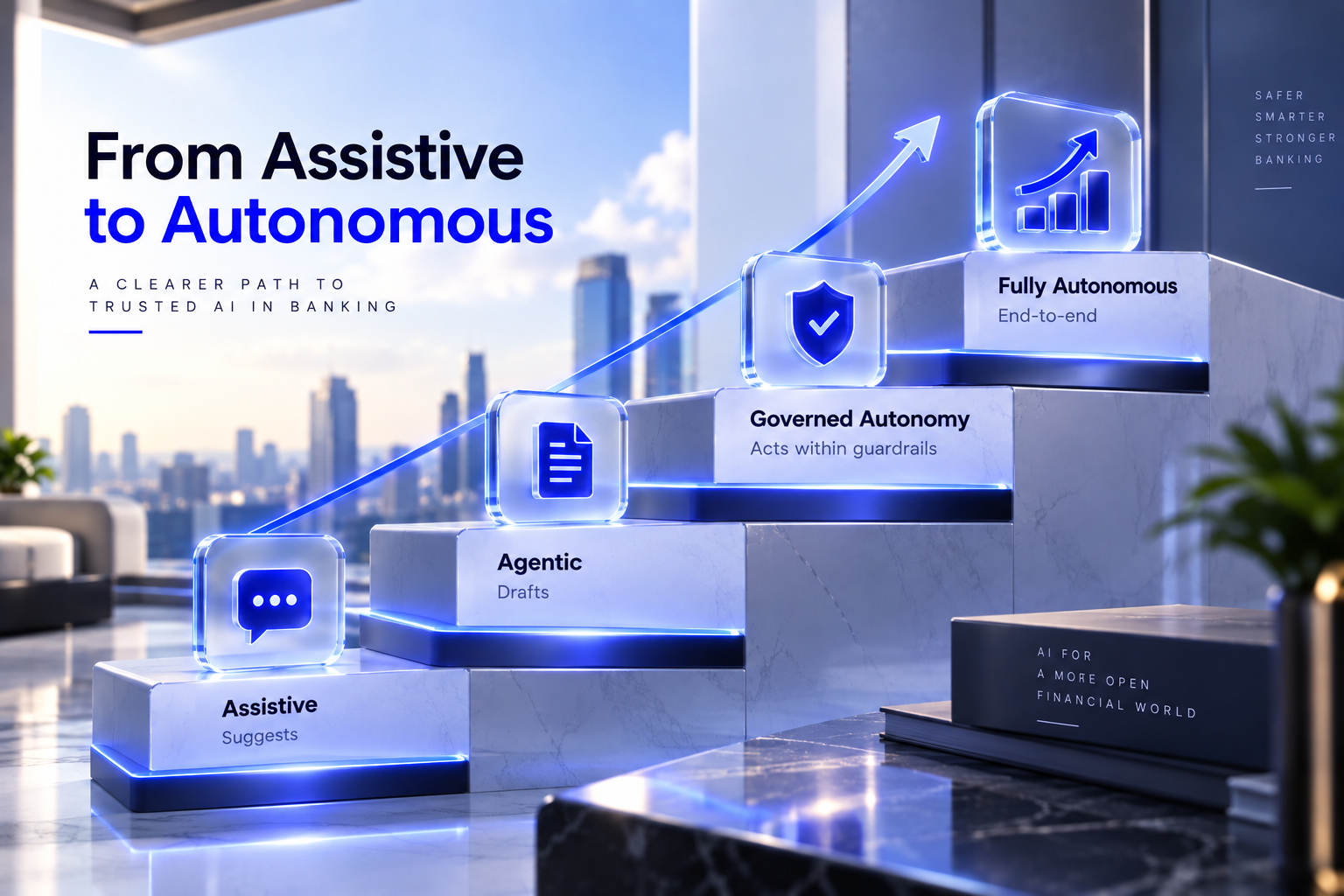
Assistive, agentic, autonomous: a capability ladder
Not all artificial intelligence tools can be treated as equally trustworthy. This is something that I have experienced myself as I saw people treating a chatbot as being capable of making independent lending decisions.
You need a clear ladder, so everyone in the building knows exactly how much rope a given tool has.
The jump from generative AI in banking to true agentic AI in banking isn't a small upgrade; it’s a completely different level of control, architecture, and safety.
A real agentic system needs four working parts: it has to read the data, reason about it, come up with a plan, and then execute that plan under supervision.
We built Thunai to live on rung three, Governed Autonomy. It can take real action inside your banking systems, but it never steps outside the fence you build for it, and every move gets logged.
Twelve AI in Banking use cases by Banking function
Every vendor deck shows you the same list of use cases. What they skip is the metric that actually matters and the exact way each project tends to fall apart. I've listed both, because knowing how a project fails is more useful than knowing how it's supposed to succeed.
McKinsey Global Institute: The economic potential of generative AI could add $200 billion to $340 billion a year to global banking.
Customer service and the contact centre
This is the biggest cost pool in retail banking, and it's also where I've seen AI pay for itself fastest. In fact, Deloitte shows that AI-assisted customer service can help banks improve both customer experiences and contact-centre efficiency.
Containment of everyday queries, assistance for agents while handling calls, automatic call summarization, multilingual support, and AI call scoring for every call as opposed to a mere sample these are the gains that really make the difference.
Fraud detection and transaction monitoring
Fraud rings move faster than any human team can track by hand. Good systems build a baseline of what normal spending looks like for each customer, then use network analysis to spot organized rings acting together in real time.
This matters even more now, as banks fight a rise in AI-assisted scams and social engineering. We cover the details in claims fraud detection.
AML and KYC compliance
I've watched compliance teams chase thousands of false alarms a month. Good tools cut that noise way down and speed up alert triage. IBM also identifies AI as a useful tool for KYC, AML, identity verification, and financial crime detection, helping banks reduce manual compliance work.
Some systems can even draft the first version of a Suspicious Activity Report for a human to review and sign.
Credit underwriting and loan decisioning
Software can now pull numbers out of messy tax returns and run cash-flow underwriting in seconds. But there's a hard line you can't cross: if you deny someone a loan, you have to tell them exactly why.
A black-box model can't do that. This is why fair-lending testing isn't optional, and it shapes how every bank approaches AI in retail banking.
Collections and recovery
Good segmentation helps know whom to call and when. The task of sending out reminders may be automated and only difficult situations passed on to specialists.
IBM also identifies debt collection as an area where generative AI can help banks analyze delinquency patterns and support more effective collection strategies. The one rule you cannot break here is the regulatory limit on when and how often you're allowed to contact someone.
Document and statement processing
For standard forms, extraction accuracy is already good enough for production use. But handwritten notes and complicated commercial documents still need a person to check the work.
In my experience, how well you handle the exceptions matters more than how good the base model is.
Regulatory reporting and reconciliation
AI speeds up tracing where your data came from and chasing down exceptions. But full automation usually stops one step short, because a human executive has to personally sign off on the report's accuracy. That's the law, and no tool changes it.
Personalisation and next-best-action
Marketing should be real to the customer experience, which could be a new job or a new home, and should offer some helpful suggestions to the individual.
Done well, this kind of personalisation can strengthen retention and improve customer lifetime value by making each interaction more relevant.
Employee knowledge and internal support
I've watched new hires spend their first weeks digging through outdated PDFs just to answer a simple question.
A good knowledge layer lets any employee ask a plain question and get an answer with a source attached. Also, McKinsey identifies workforce support as an important opportunity for retail banks, particularly as employees handle increasingly complex information and processes.
Treasury, markets and developer productivity
AI can help write code and forecast cash flow. But I'll be honest about the limits: traders use it to summarize the news, not to trade on their own. Fully autonomous trading is still far too risky to hand over.
The channel banks under-invest in: voice
Every bank I know has poured money into chatbots. Meanwhile, voice, the channel that costs the most and carries the most risk, barely gets a budget line. This is the biggest blind spot in banking AI today.
This issue could be resolved by using an AI contact center in the financial services sector, automating voice-based transactions and allowing humans to intervene where required.
The cost of handling a call manually is between $7 and $12; however, a good voice agent will only require $0.40 to $0.90, a reduction of 85 to 90 percent in cost.
Voice AI makes all the difference.
It ensures secure identity verification, replaces the frustrating IVR with natural dialogue, and allows banks to listen to 100 percent of calls to comply rather than just a few samples.
Unit economics: what AI actually changes on the P&L
If a project can't show a real financial benefit, it's a science experiment, not a business decision.
Gartner’s research shows that the median cost per contact is $13.50 for a human-assisted call vs. $1.84 for self-service
The real shift I ask every team to make to benefit from AI in banking is this: stop measuring cost-per-call, and start measuring cost-per-resolution.
As the former increases and the latter decreases, your efficiency quotient improves.
At the same time, every pilot who has not yet left the sandbox continues to incur the cost of software, consulting, and meetings while solving no customer problems at all.
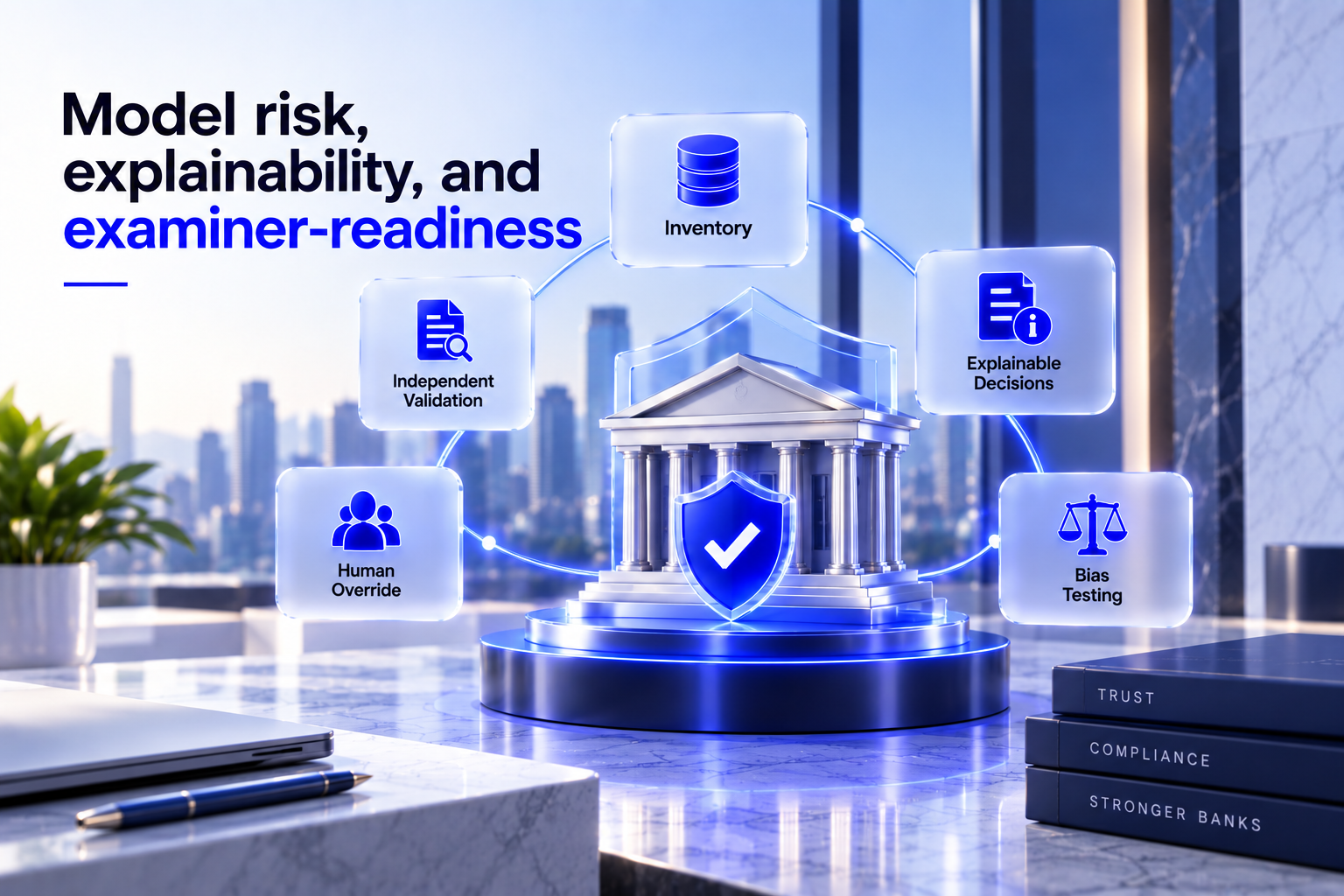
Model risk, explainability, and examiner-readiness
You can't deploy a tool in a bank just because it works. You have to prove it's safe, every time, to someone outside your team. Getting this right decides whether a project survives.
For over a decade, US banks followed SR 11-7, the Federal Reserve and OCC's guidance on model risk management. In April 2026, SR 26-2 updated that framework.
Generative AI doesn't technically fit the old definition of a statistical model, but examiners still expect the same discipline applied to it. This is why AI banking compliance has become a critical part of any AI deployment.
Every decision has to be explainable to a bank examiner, not just to your own product manager. Here's what I make sure is on the checklist before anything goes live:
- A strict inventory that tracks exactly where each tool is used.
- Independent validation from a team that didn't build the tool.
- A human override path for any critical financial decision.
- Clear adverse-action logic: when the system says no, it has to say why.
- Ongoing bias testing to catch fair-lending problems before they happen.
Data foundations: the part everyone skips
AI projects usually fail because of messy, contradictory data, not the models. Bad data leads to confidently incorrect AI outputs.
This will need a combination of the following two systems: Retrieval Augmented Generation (RAG), which will base all responses on authentic documents, and role-based access control (RBAC), where the user can only access the information that they are supposed to.
Permissions must perfectly match existing entitlements while respecting data residency rules.
Build, buy, or use your core vendor's AI
Every operations leader eventually hits this fork in the road: build it yourself, buy a startup's product, or wait for your core vendor to ship an update.
Most vendors won't tell you the real cost of the internal engineers you'll need to keep their system running.
Buying a layer that sits on top of what you already have means you're not ripping out your existing tech stack.
Why AI projects in banking fail
I've watched enough of these fail to see the pattern repeat. Here's what actually kills a project, every time:
- Hallucination in regulated advice. The bot makes up a fee structure that doesn't exist, and now you've got a compliance problem.
- Brittle intent trees. Old-style chatbots rely on rigid keyword trees. The moment a customer phrases something naturally, the bot breaks.
- No P&L owner. IT builds a tool that operations never asked for and never wanted.
- Measuring deflection, not resolution. Hanging up on a customer or trapping them in a loop looks good on a dashboard. It destroys trust.
- Vendor lock-in. The bank gets stuck with a proprietary format it can't move away from.
- Change management failures. Frontline staff worry the tool is coming for their job, so they quietly refuse to use it.
A 180-day implementation roadmap
To turn AI from a burden to an asset requires a timeline in earnest, not a wish. Here's the one I use.
Days 0–30 (Baseline and Selection).
Do not write any code yet. Determine the precise cost-to-serve right now.
Find your top ten highest-volume customer questions, then set up a model risk governance board, and pick one clear use case to start with.
Days 30–90 (Governed Pilot).
Roll out an agentic system for three high-volume, low-risk tasks; think balance checks or password resets.
Put full governance around it from day one and keep your human agents in the loop so they help train the system as it learns.
Days 90–180 (Scale and Industrialise).
Expand into more complex tasks, connect it deeply into your core CRM. Turn on 100 percent automated QA across every call.
Stop tracking pilot metrics and start tracking real efficiency ratio impact. Give every stage a clear owner, so nothing stalls for lack of accountability.
Deeper dives by segment
The right strategy changes depending on your business model and market. For insurance teams, AI in life insurance can extend beyond customer service into underwriting, claims, policyholder servicing, retention, and distribution.
- AI for credit unions
- KYC automation
- Claims fraud detection
- Contact-center optimisation
- AI voice agents
The practical side is choosing the right AI tools for insurance agents, particularly for customer service, lead management, claims support, CRM workflows, and compliance.
How Thunai adds personalized CX to banking
One of the reasons we built Thunai is that we got tired of watching good banks and enterprises stuck in the pilot trap.
Thunai is built as agentic middleware that sits directly on top of the CCaaS and CRM systems your banks already run.
Functioning as a knowledge-based agentic CX automation tool, Thunai offers you voice, chat, and email bots, along with live help for your live agents and automated quality assurance for all interactions.
It abides by a very specific and governed handover policy; as soon as it reaches its confidence threshold, it immediately transfers the entire conversation to a human being.
Ready to move past the pilot stage? Book a demo and see governed AI in action.
FAQs About AI in Banking
1. What are the main use cases of AI in banking?
In 2026, we advanced our key processes for fraud, AML, and underwriting through the use of agentic AI to transform them from disconnected task automation to full autonomy and orchestration of the process.
2. What is the difference between generative AI and agentic AI in banking?
Generative AI creates content, drafts emails, and answers questions. Agentic AI takes real, governed action inside banking systems to complete a task end to end.
3. Is AI in banking regulated?
Although unified AI laws don't yet exist, we remain fully bound by existing industry regulations, making transparent explainability the ultimate standard for every AI-driven decision.
4. How do banks measure ROI on AI?
Efficiency is measured via traditional operational measures such as cost per contact and handle time, but what matters in the end is not deflection but resolution of the customer's problem.
5. Why do AI projects in banking fail?
Failure is caused by a lack of ownership and baseline measures, brittle legacy architecture, a poor knowledge base, and stalled pilots.