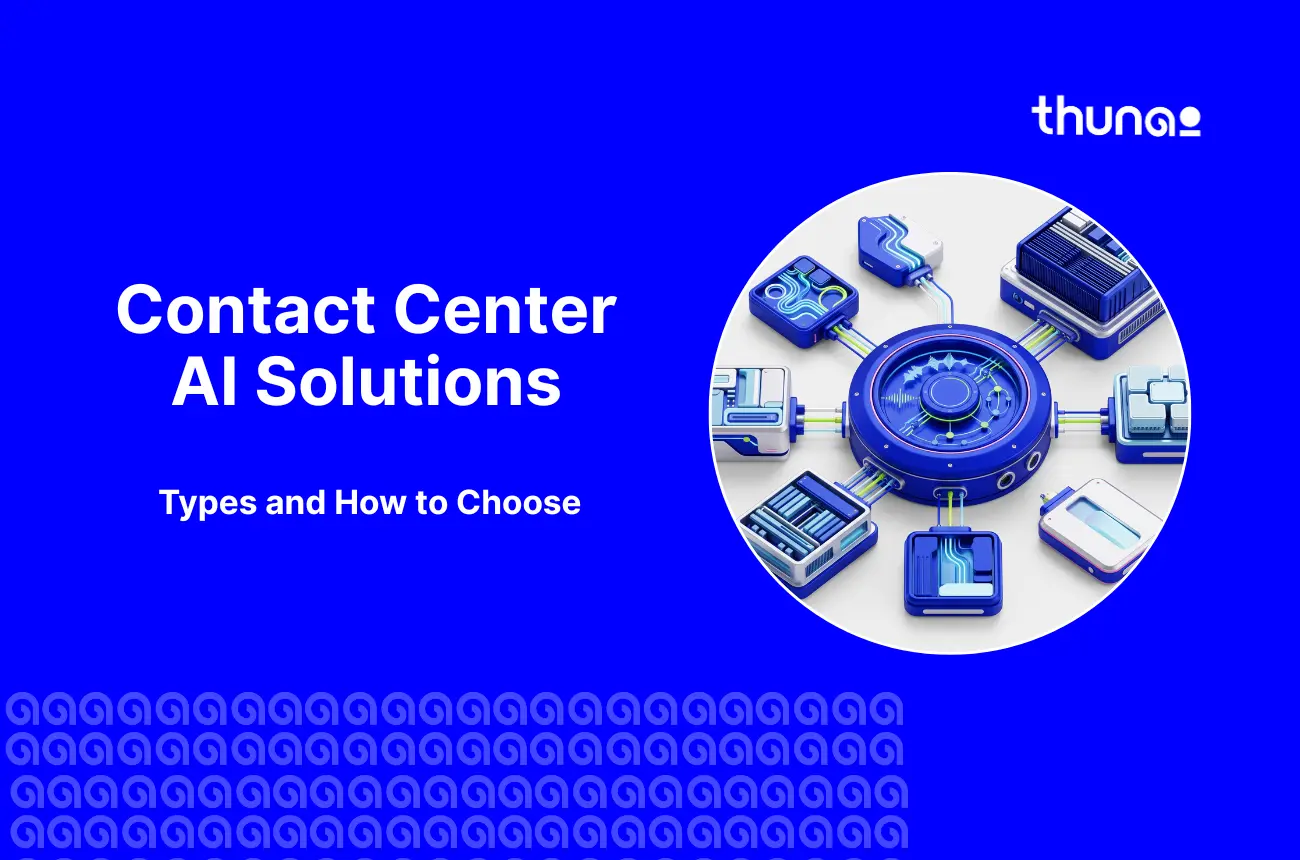

Still struggling to balance rising contact center costs with the demand for exceptional customer service?
You’re not alone. Many companies face immense pressure to deploy AI, but it's disruptive and slow to show ROI.
This guide is your solution. We break down 2026’s top Contact Center AI architectures to help you bypass costly infrastructure overhauls.
Discover how flexible AI middleware can slash handle times, empower your agents, and boost your bottom line in weeks, not years.
What is Contact Center AI?
The application of AI technology in contact centers has evolved beyond just chatbots and is now a complete layer in self-service, agent assistance, QA, and workforce management.
Advanced AI utilizes the capabilities of generative AI and NLP to resolve issues, provide refunds, update CRMs, and detect sentiment.
Gartner’s survey of 321 customer service leaders, 91% said they're under executive pressure to implement AI in 2026, with priorities shifting from cost-cutting to CSAT and first-contact resolution.
Integration challenges and long ROI timelines make careful platform evaluation essential for successful AI adoption.

The 3 Architectures of Contact Center AI Solutions
Buyers evaluating contact center AI solutions generally face three distinct architectural models.
The three primary architectures for contact center AI solutions include full-stack platforms with AI bolted on, dedicated AI layers or middleware, and voice-first automation tools.
Full-Stack CCaaS with AI Bolted On
A full CCaaS platform brings telephony, AI, and customer service tools into one system, making it easier to manage.
However, moving to one often requires replacing existing phone systems, which can be costly, disruptive, and time-consuming.
AI Layer and Middleware (Agentic Middleware)
AI middleware integrates directly with CCaaS software through APIs and provides companies with the ability to enhance intelligence in their systems.
Agentic middleware differs from basic contact center automationbecause they use self-sufficient AI agents capable of making decisions rather than being prompted.
Voice-First Automation
Voice-based automation tools offer complete automation of incoming and outgoing phone calls.
These act as autonomous digital receptionists for performing structured tasks such as order tracking and appointment scheduling.
These tools leverage elastic concurrency technology and allow scaling from five concurrent calls to thousands instantaneously without any loss of audio or performance.
Main Use Cases for Contact Center AI Solutions
When businesses search for AI in contact center environments, they generally look to solve specific, highly measurable operational bottlenecks.
Address these daily bottlenecks through five core enterprise use cases for the best contact center AI solutions
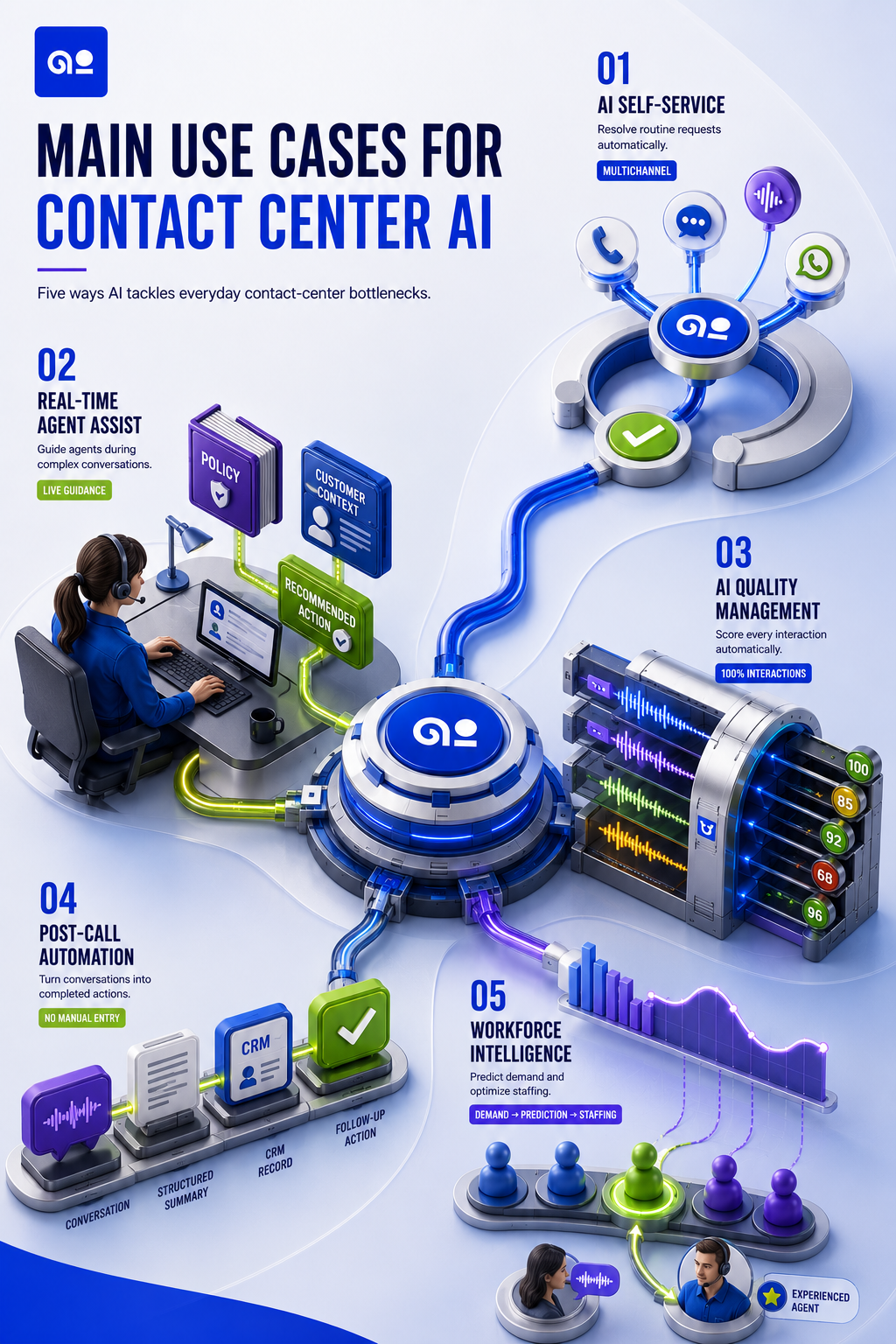
AI-Powered Self-Service and Virtual Agents
AI-based self-service agents make use of conversational technology in lieu of IVR prompts that help customers access assistance via voice, chat, SMS, and email.
Gartner says by 2029, agentic AI will autonomously resolve 80% of repetitive customer service cases. This will lead to an overall decrease in operating costs by 30%.
They also remember the conversation across channels, so customers don't have to repeat themselves.
Real-Time Agent Assist
Real-time agent assist tools support human workers during complex interactions by delivering crucial on-screen guidance instantly.
Given the latency rate, it is possible to interact with customers even during a sentence and offer them tailored battle cards or policies on the spot.
A McKinsey report says that, for a 5,000-agent team, AI-boosted hourly resolutions by 14% and cut handle times by 9%. It simultaneously drove a 25% drop in both agent turnover and manager escalations.
Automated Quality Management and Coaching
Manual quality assurance reviewed only a tiny fraction of interactions, creating massive operational blind spots that cost the industry billions due to inconsistent performance.
Modern AI solutions automate this process by transcribing and instantly grading 100 percent of interactions through automated call scoring against strict company rubrics for compliance and empathy.
Eliminating human bias and generating personalized coaching plans, these tools enable supervisors to focus their time on actively coaching employees based on objective, hard data.
Post-Call Workflow Automation
Workflow automation after the call involves the application of AI to minimize the manual processes that agents perform after each phone call.
AI is used to generate an abstract, and this is automated into CRM systems such as Salesforce; this way, agents will not need to do it manually.
With advanced AI, follow-up actions like generating refund tickets can be done too.
Forecasting and Workforce Management
AI workforce management uses historical data and trends to predict call volumes and set precise staffing requirements for each hour.
Workforce management will also manage call routing by using predictive analytics to spot potential churners and route them to experienced agents.
Together, these capabilities optimize staffing accuracy and improve customer retention outcomes.
Benefits and ROI of Contact Center AI Solutions
The financial impact of deploying robust contact center AI solutions is highly measurable and well documented.
Organizations that successfully implement these technologies see rapid returns on their investment.
Cost-Per-Contact Reduction
Contact center AI can reduce the cost of handling each customer interaction by automating repetitive tasks and resolving simple issues without human agents.
According to Gartner’s study, automating just 10% of interactions will save the industry $80 billion in agent labor costs in 2026.
The AI-based virtual agents can manage requests for order status, password reset, billing queries, and so on, whereas the agent-assist tools can assist human agents in accessing information more quickly.
CSAT Improvement and Productivity Gains
The contact center AI increases customer satisfaction through quick and consistent customer support across channels.
The virtual agents can resolve routine customer requests immediately, while agent assist tools help human agents in accessing information and resolving complicated queries quickly.
Why Using AI in Contact Centers Still Stall
However, despite the promising advantages, many contact center AI initiatives have difficulty producing results in the field.
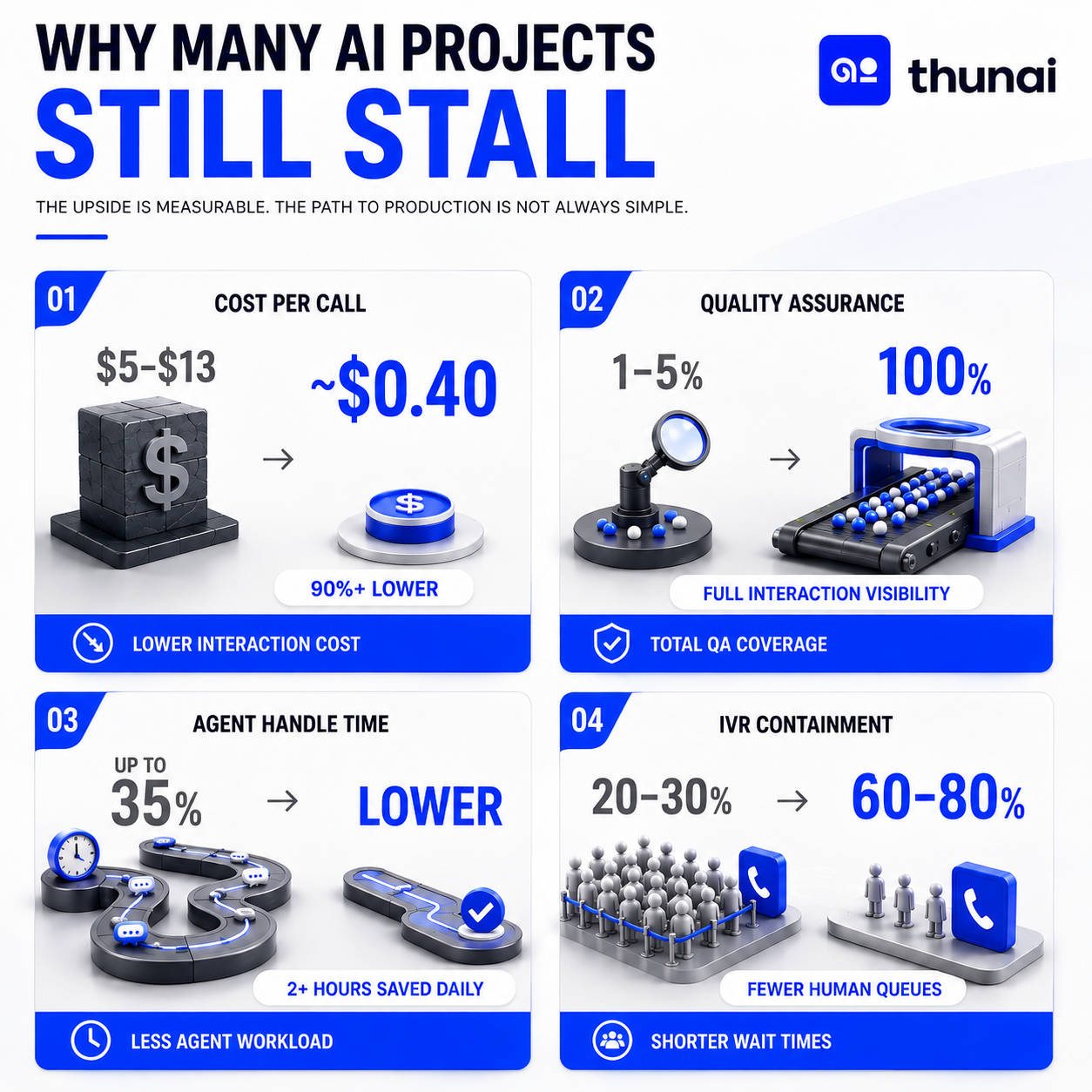
Integration into legacy telephone systems and existing software can be complicated, expensive, and time-intensive.
How to Evaluate Contact Center AI Solutions
Select the vendor depending on how compatible their AI is with your existing system rather than how impressive the demo is.
You should also verify the technology, installation process, security features, and compliance of the AI system.
Integration Depth with Existing Infrastructure
The best contact center AI solutions connect easily with existing tools like Genesys Cloud CX and Salesforce without complex custom setups.
Seek out platforms that have support for MCP, which allows the AI to access live information, utilize tools, and collaborate with each other.
Through integration, customer context is sustained during handoffs so that agents do not have to pester customers with questions regarding their problems.
Time-to-Value and Deployment Timeline
Time-to-value is a metric that indicates how fast an AI solution creates business value. Middleware solutions can work with existing systems and often launch much faster.
Full contact center AI platforms can take months to deploy, delaying ROI and increasing implementation risks.
This helps teams measure results early, improve the AI using real customer data, and scale it with greater confidence.
Channel and Language Coverage
The customer could begin a chat through a website chat tool, then send an email, and finally make a call the next day.
The finest contact center AI technologies analyze intents and sentiments correctly in tens of different languages, without the need to create unique logic trees for particular dialects.
Security, Compliance, and Data Governance
The processing of sensitive data is performed by contact center AI, so security and compliance are key issues.
Make sure to select providers that have certifications like SOC 2 Type II, ISO 27001, GDPR, and also HIPAA or PCI-DSS when necessary.
Good systems should incorporate such components as safe data storage, zero trust architecture, and multi-factor authentication.
NLU Accuracy and Architecture Constraints
The accuracy of NLU must be checked to ensure the AI is interpreting the customer's request properly and abiding by company policy.
Look for systems with strict controls that reduce AI hallucinations and keep AI responses within approved guidelines.
Vendors should provide benchmark results showing reliable accuracy, especially at large scale.
Top Contact Center AI Solutions Compared (2026)
To help enterprise buyers build a highly effective shortlist, this section compares the top contact center AI solutions in the 2026 market.
Thunai
Features:
- Multi-agent orchestration powered by Model Context Protocol (MCP) to automate Level-1 tickets and eliminate after-call work.
- Middleware overlay platform that integrates onto Genesys, NICE, or Amazon Connect to unify siloed organizational data.
Pros:
- Layers seamlessly onto existing telephony infrastructure without requiring a costly full-system replacement.
Cons:
- Cannot operate as a standalone contact center platform, requiring an underlying CCaaS system to function.
Cresta
Features:
- Real-time Agent Assist (under 200ms) that delivers behavioral coaching while making voice calls.
- AI models custom-trained based on conversation history of a company rather than general inputs.
Pros:
- Delivers mid-sentence guidance that enables agents to replicate the exact habits of top-performing reps.
Cons:
- Primarily focuses on live human agent enablement rather than fully autonomous, self-service virtual agents.
Observe.AI
Features:
- Post-call AI overlay that analyzes completed conversations to automate post-call quality management workflows.
- Automated call scoring against customizable, complex compliance rubrics tailored for highly regulated industries.
Pros:
- Analyzes 100% of completed customer calls without requiring changes to core telephony infrastructure.
Cons:
- Lacks real-time, autonomous customer-facing virtual agents to handle active calls live.
NICE CXone
Features:
- Comprehensive CCaaS solution combining native telephony, intelligent routing, and AI solutions in one.
- Advanced Workforce Engagement Management (WEM) combined with enterprise-level compliance functionalities.
Pros:
- Offers a comprehensive, highly reliable all-in-one ecosystem suited for massive global enterprises.
Cons:
- Requires standardizing the entire contact center on NICE infrastructure, resulting in a massive IT undertaking.
Genesys Cloud CX
Features:
- Enterprise omnichannel routing solution that will manage calls, emails, and chats for teams all around the world.
- AI built right into the solution for making intelligent routing and analysis decisions.
Pros:
- Proven industry leader capable of handling massive scale and serving as a single system of record.
Cons:
- Functions as a full-stack replacement platform, making deployment heavy for teams attached to current phone systems.
Five9
Features:
- CCaaS platform based on cloud technology, having its roots in automation of outbound dialing and campaigns.
- AI features developed for automatic summarization of the call records and routine outbound calling operations.
Pros:
- High platform reliability with best-in-class features for outbound-heavy contact center operations.
Cons:
- Operates as a full-stack telecom replacement rather than a flexible, plug-and-play middleware overlay.
Talkdesk
Features:
- Cloud-native, comprehensive CCaaS platform with drag-and-drop workflow builder.
- AI capabilities built right into the suite for self-service and agent automation purposes.
Pros:
- Delivers faster deployment times and easier administrative setup compared to legacy enterprise CCaaS platforms.
Cons:
- Requires replacing existing telephony systems rather than overlaying onto established legacy infrastructure.
Why Thunai is Built as Agentic Middleware, Not a Rip-and-Replace
- No need for System Change: It’s an AI layer that integrates into your current systems such as Genesys and Salesforce.
- AI Collaboration: A number of AI components work together to provide solutions to the problem.
- Valid Responses: It automatically checks company information to eliminate contradictions to ensure that the AI does not fabricate responses.
- Smooth Handoffs: If a human is needed, the AI passes over a complete summary so the customer never has to repeat themselves.
To see how our AI middleware integrates seamlessly into your existing setup to drive rapid ROI without a costly system replacement. Schedule a demo today.
FAQs
What are the main types of contact center AI solutions?
These products can be classified into three types: complete CCaaS systems with AI embedded directly within the system, middleware layers or AI that can be added on top of an existing CCaaS solution, and voice-first automation systems that have been completely architected for dealing with specific types of calls entirely.
Do I need to replace my CCaaS platform to add contact center AI?
No. Contact center AI middleware is purposely built to integrate into your existing contact center infrastructure (for example, Genesys, NICE, or Amazon Connect) without having to do a total replacement of your infrastructure. The contact center AI systems leverage secure APIs and the MCP protocol to inject AI intelligence into your existing infrastructure.
What is the fastest-growing use case in contact center AI?
Real-time assistance and post-call automation are some of the quickest use cases to be adopted, as they offer immediate and measurable productivity improvements in a much less risky manner than full automation.