
Struggling to figure out which customers are actually worth the investment and which ones are quietly draining your margins?
Typical businesses spend a fortune on customer acquisition without understanding the real return; it seems like revenues are great, but all the extra costs of support, customer churn, and bloated CAC reduce profits behind the scenes.
The consequences are wasted budget, poor customer retention, and unsustainable growth.
In this article, we'll explain how to determine, measure, and boost Customer Lifetime Value - turning a vague concept into a real number.
What is customer lifetime value?
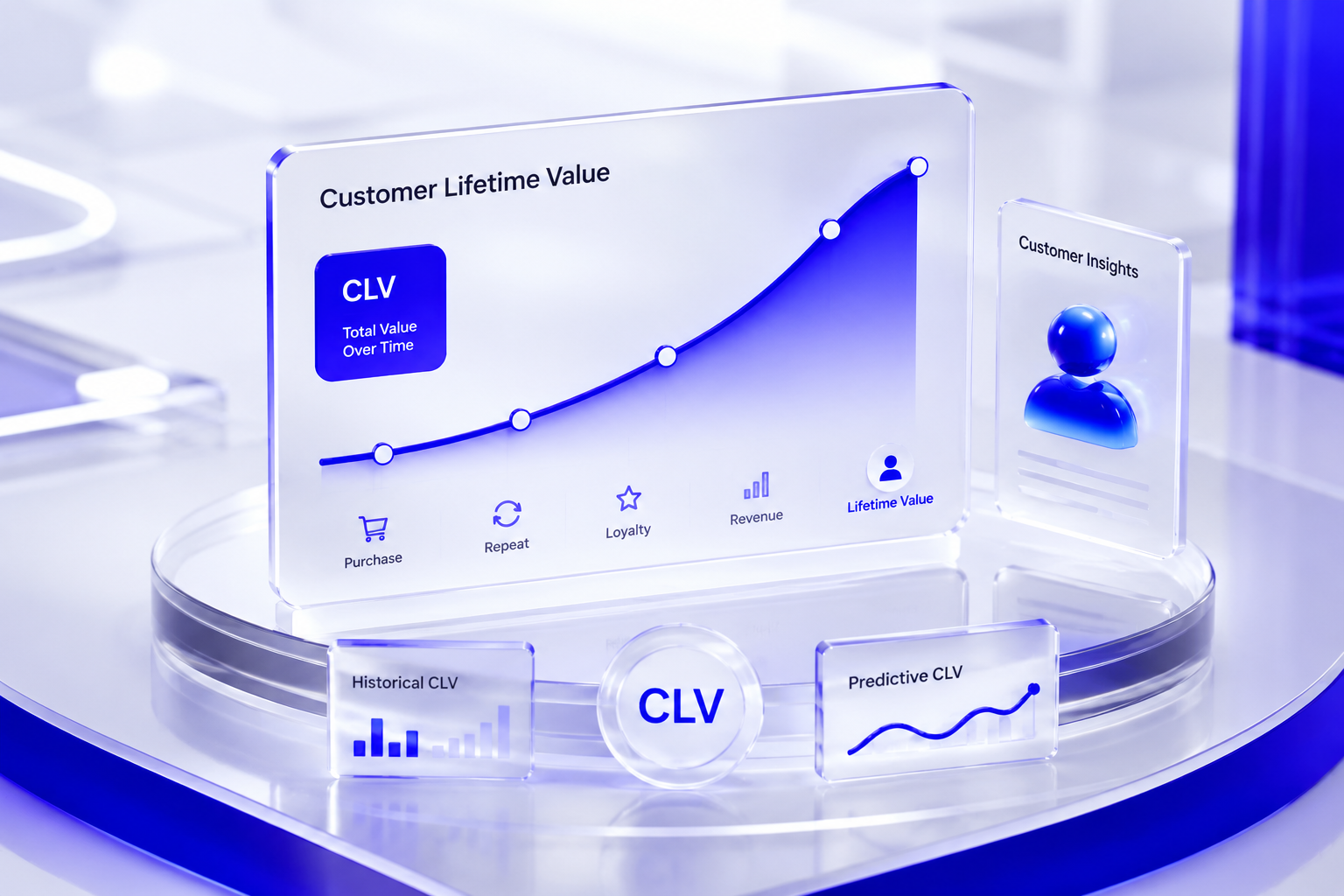
Customer Lifetime Value is the total money a business can earn from one customer over the full span of their relationship.
CLV links what a customer does to the money that action brings your business.

CLV, LTV, and CLTV: are they the same thing?
Yes. Analysts use these terms the same way across every industry.
Marketing teams may use one term. Finance teams may prefer another. But both point to the same idea: the value of a customer relationship over time.
Historical vs predictive customer lifetime value
Historical models look at the past. They add up what a customer has already spent.
Predictive models look ahead. They use machine learning and statistics to forecast future behavior.
Revenue CLV vs profit CLV
Revenue models only count total sales from a customer because it ignores costs.
Profit models subtract the cost to win, support, and keep that customer. This gives a truer picture of financial health, since it accounts for margins and support costs.
Why customer lifetime value matters
Understanding this metric fundamentally changes how a company operates. It aligns departments around long-term relationship health rather than short-term acquisition metrics.
CLV as the ceiling on what you can spend to acquire a customer
A business should never spend more to win a customer than that customer will earn in profit. CLV sets that spending limit.
If you spend too much on ads to win customers who don't stick around, you lose money in the end.
The CLV to CAC ratio and the 3:1 rule of thumb
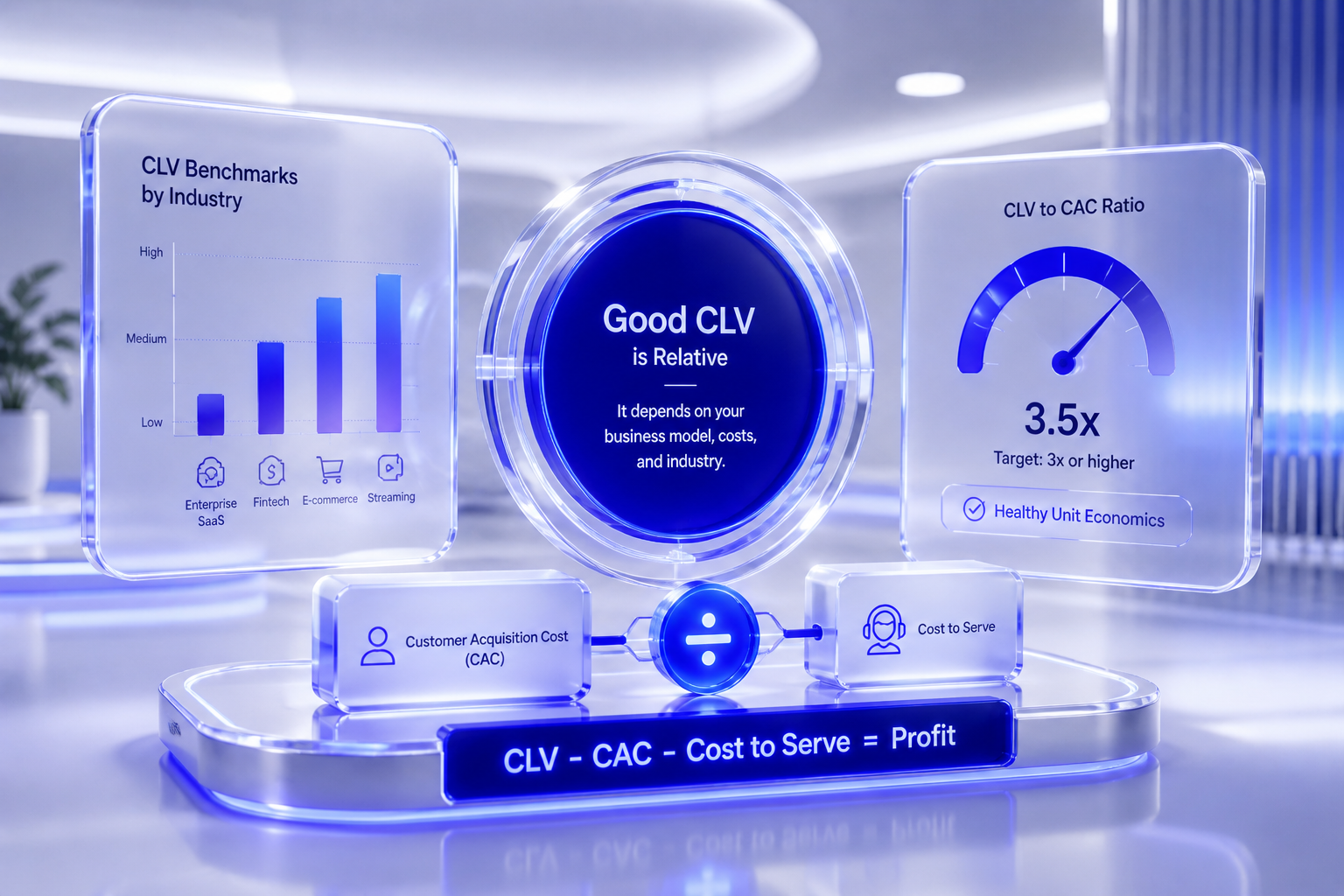
CLV/CAC ratio is used to measure the relationship between the CLV of a customer and the cost incurred to win him.
Normally, firms prefer a 3:1 ratio. This means that for each dollar invested in acquiring a customer, you earn three dollars in profit.
A low ratio means you're spending too much. A very high ratio can mean you're not investing enough in growth.
How CLV shifts budget between acquisition and retention
Measuring lifetime value is the math that proves customer retention can cost less than finding new customers.
Gartner survey shows that 243 CSOs and senior sales leaders found that 73% were prioritizing growth from existing customers in 2025.
Once managers see the link between keeping customers and their lifetime value, they realize it makes no sense to spend all their money chasing new customers through ads.
The inputs you need before you calculate CLV
To calculate CLV well, you need a few key numbers. Pull these from your billing system, service platform, and CRM.
Average purchase value, purchase frequency, and customer lifespan
These three figures are multiplied by analysts to generate the top figure. The first figure is the average order size, or what the customer spends on each transaction.
Second: transaction frequency, or how often they buy within a set time. Third: customer lifespan.
Gross margin and cost to serve
Gross margin is revenue minus the cost of the sale. But you also need to count the cost to keep that account running.
Cost-to-serve tracks these costs. Think help desk tickets, account management time, and logistics.
Churn rate and retention rate
Retention rate is the share of customers who keep buying from you. Churn rate is the share who leave.
Together, these two numbers set how long a typical customer sticks around.
Discount rate for future cash flows
Money today is worth more than the same money years from now. Inflation and investment returns explain why.
The discount rate adjusts for this. Advanced models use it to shrink future revenue down to its true value today.
How to calculate customer lifetime value: five formulas
Because business models vary, analysts use different formulas to find this metric. The use of one strategy is very important to ensure proper reporting.
Select the most appropriate model for your company's organization and information.
- Simple Model: Average amount spent per purchase × how often they buy × how long they stay a customer.
- Margin-Adjusted CLV: [(Yearly revenue × profit margin) − yearly cost to support them] × how long they stay. Good for regular retail stores.
- Subscription CLV: (Average revenue per account × profit margin) ÷ churn rate. Best for software (SaaS) companies.
- Discounted CLV: Expected profit × a retention number, adjusted for the fact that money today is worth more than money later. Used for big, long-term business deals.
- Predictive CLV: Uses computer models, like BG/NBD, to guess how long a customer will stick around based on their past behavior. Good for online stores where buying patterns are hard to predict.
Customer lifetime value examples
Customer Lifetime Value (CLV) calculations adapt to fit specific industry models:
- E-Commerce: Multiply yearly profit (yearly revenue × margin, minus service cost) by the years the customer stays.
- SaaS: Take the monthly fee after margin, then divide by monthly churn rate to get lifetime value.
- High Contact Services (Telecom/Insurance): Subtract yearly support costs from yearly profit, then multiply by the years the customer stays.
What is a good customer lifetime value?
A "good" value is relative, as it changes with your product type and your operating costs.
CLV benchmarks by industry and business model
Customer lifetime value benchmarks by industry vary drastically. A streaming service might show smaller numbers than a big software company. But both can still make good profit.
What matters most: does CLV cover the cost of running the business and winning new customers?
Why absolute CLV means nothing without CAC and cost to serve
A massive lifetime value means absolutely nothing if the acquisition and support costs wipe out the margin.
Analysts must track the CLV and CAC ratio benchmark closely. If the ratio drops too low, the business is likely spending excessively to acquire users or bleeding profit through inefficient customer service operations.
How to calculate cost to serve and subtract it properly
One flaw in most CLV models is that they skip ongoing support costs.
Marketing teams often don't see contact center costs. So they guess at a flat gross margin instead.
Key factors in true service costs:
- Service Burden: How often customers contact you, multiplied by the cost of each contact.
- Failure Demand: Repeat contacts caused by broken systems or a customer having to call back because the first fix didn't work. This idea comes from John Seddon.
- The Solution: Use a method called Time-Driven Activity-Based Costing (TDABC) to track these costs accurately and find where money is quietly being lost.
The link between customer service and customer lifetime value
Service interactions dictate how long a customer chooses to stay. The contact centre acts as the primary engine for long-term retention.
How resolution quality drives retention and repeat purchase
When agents solve problems quickly and accurately, customers stay loyal. If the business fails to resolve an issue, the customer leaves.
According to PwC research, 32% of consumers will abandon a brand they truly love after having a negative experience, and a good experience can earn you a 16 percent premium on your pricing.
Once leaders see how service shapes CLV, they stop viewing support as a cost to cut. They start seeing it as value to protect.
What FCR, CSAT, effort score, and escalation rate predict about churn
Operational metrics act as highly accurate early warning signals for churn. High first contact resolution correlates directly with long lifespans.
Conversely, high customer effort score readings indicate extreme churn risk; empirical research shows that customers who exert high effort to resolve issues become highly disloyal.
The revenue upside of proactive service and in-conversation expansion
Successful organizations view the call center as an engine for revenue generation rather than simply complaint management.
Experienced agents perform an account analysis in each conversation.
According to McKinsey, personalization will help reduce acquisition costs by up to 50% as well as boost revenues by between 5% and 15%.
Personalization helps in making recommendations for the necessary upgrades and avoids cancellations.
This proactive approach turns traditional service departments into direct revenue generators.
How to increase customer lifetime value
CLV is built by eliminating friction, providing better customer service, and effective utilization of conversation data.
Customer service automation can also eliminate the mundane while ensuring fast responses.
Reduce churn by fixing the top repeat-contact drivers
Customers hate calling twice about the same problem. Repeat contacts point to broken internal processes and create wasted work.
Find the root cause of repeat calls, then fix it. Removing this friction boosts retention.
Raise first contact resolution and cut customer effort
When agents have the tools and authority to fix problems fast, first contact resolution rises.
Customer effort drops, and that makes renewals and repeat purchases far more likely.
Personalise service using full conversation history
Customers expect agents to know their history. When your CRM connects tightly with your contact center, agents can see past purchases, complaints, and subscriptions.
Personal conversations keep customers around longer.
Cross-sell and upsell inside service conversations
Service interactions present natural, high-trust opportunities for expansion. If a customer hits a usage limit, the agent can suggest an upgrade on the spot.
Growing the account this way lifts CLV without any new marketing spend.
Lower cost to serve with L1 automation instead of headcount
Routine, low-complexity queries drain profit margins. Applying agentic AI to tier-one tasks results in a substantial drop in the cost per serve.
According to a CX Trends study conducted by Zendesk, 51% of consumers opt to converse with bots when they require instant service.
Win back at-risk accounts using churn signals from conversations
Angry calls and frustrated emails hold valuable clues. NLP tools can scan these conversations and flag at-risk accounts fast.
A success manager can then step in and win the customer back before they cancel.
How to segment customers by lifetime value
Not every customer deserves the same investment. Segmentation puts your limited resources where they matter most.
High-value, at-risk, and low-margin segments
Companies use the LTV formula to group customers into distinct tiers. High-value customers receive dedicated account managers and premium support.
Low-profit customers who need lots of support may actually cost you money.
Once you spot unprofitable customers, you can adjust pricing or push them toward self-service.
Routing and service levels by customer value
Understanding customer lifetime value in contact center environments drives intelligent routing logic. Modern telephony systems identify incoming callers based on their phone number or account ID.
High-value accounts are immediately routed to agents with prioritized wait times. Low-value accounts are routed to automated agentic AI workflows or general queues.
How to build predictive CLV from conversation data
Historical transaction data only tells half the story. The actual words customers use in their emails, chats, and phone calls contain massive predictive power.
Moving from sampled QA to 100% interaction analysis
Traditional quality assurance only reviews a tiny fraction of total calls. This manual sampling leaves leadership blind to broader trends.
Modern conversation intelligence platforms run 100% interaction analysis. AI call summarization can help transform the conversations into structured insights, while saving effort on post-conversation processing.
It will become clear what causes customer dissatisfaction and what problems exist on a systemic level.
Turning sentiment, intent, and churn signals into a CLV forecast
Machine learning models ingest this unstructured conversation data. They use sentiment analysis to pick out language, signs of frustration, and negative sentiments.
The algorithms detect accounts that exhibit such behaviors that cause churn, enabling the company to adjust its forecasted customer lifetime value estimates immediately.
Common mistakes when measuring CLV
This critical measure is miscalculated by many organizations failing their strategies. They calculate this metric using gross revenue rather than gross margin, making this figure appear inflated.
Also, they overlook the total cost to serve and treat the support departments as free labor.
These mistakes lead to reckless overspending on marketing. Leaders end up believing customers are worth far more than they really are.
There's also confusion between B2B and B2C. B2B needs account-based analysis, since many people take part in one purchase decision.
Gartner states that 14–23 people on average are involved in a technology purchase decision.
FAQs about Customer Lifetime Value
How can you calculate customer lifetime value?
The simplest way is to multiply transaction value by transaction frequency, then by customer life expectancy.
What is a good CLV to CAC ratio?
A healthy benchmark across most industries is 3:1. That means three dollars of lifetime profit for every dollar spent on sales and marketing.
How do you calculate CLV for a subscription business?
Divide average revenue per account by churn rate. Then multiply that by gross margin.
What is the difference between CLV and average order value?
Average order value only reflects one single transaction. CLV and LTV are the same thing, and both cover the full customer relationship.
At what frequency do you need to recalculate CLV?
Most businesses recalculate quarterly. Subscription software firms and fast-moving e-commerce companies often track it monthly.
Which team should own the CLV metric?
Finance owns the core financial model and reporting. Customer success and operations own the daily retention work that grows the number over time.