
What will be the effect if your costs in providing customer service continue to escalate, yet the customers leave dissatisfied?
In 2026, the dilemma facing those in charge of customer service operations is that despite a 38% increase in AI expenditure, total service expenditure has only increased by 2%, according to Gartner.
For business owners, every additional phone seat, AI addition, or manual CRM upgrade means an extra squeeze on margins.
The right Ringover alternative can help reduce that burden. Here are 7 competitors worth comparing in 2026.
Why Teams Look Beyond Ringover
Ringover is great for simple purposes, but as the number of people in the team increases, four challenges keep recurring, and each of them encourages buyers to look for Ringover alternatives.
The Compounding Burden of Feature Add-On Fees
- Ringover's Talk package is cheap at 15 to 20 per person monthly for an annual subscription, but when it comes time to using it for sales, it gets more expensive.
- Conversation intelligence from Empower is an additional $39, Cadence sequence goes for $59, AIRO voice agent is $0.39 per minute, and team analytics is another $6.
- Stack those together, and you are paying $92 to $145 per user every month, which is why plenty of people who compare Ringover alternatives start right here.
Contractual Lock-In and Seat Minimums
- Contracts are the next sore spot, because most plans are annual and paid up front, and the entry and mid-tier plans require at least three seats.
- However, once you have activated an add-on, you cannot deactivate it midway through the term; therefore, even if hiring becomes difficult, your bill will not.
- This inflexibility is one of the major reasons why people start looking for ringover alternatives.
Edge Network Stability and Mobile Application Friction
- Bluntness occurs when users complain about messages that don’t arrive, interrupted transactions, and delayed SMS.
- In the case of the desktop in Western Europe, everything is done perfectly, while teams in North America, Latin America, and Asia-Pacific have to face latency.
- When making outbound calls, any delay of even half a second could spoil the conversation.
Disconnected Data Flows and Superficial CRM Synchronization
- While Ringover integrates with Salesforce, HubSpot, Bullhorn, and Pipedrive, the integration is not deep because once the call is done, the system simply records the timestamp and the recording of the call.
- The representatives are still required to take notes by themselves, which takes up 20% to 30% more handling time, and this should sound familiar.
Ringover Alternatives Compared
There are currently three categories of phone platforms: cloud PBXs, outbound sales dialers, and agentic customer experience (CX) platforms.
The former just carries the voice, while the latter actually performs tasks both during and after the call, so that people no longer have to do their admin manually.
This is how the top ringover competitors stack up in 2026.
The pattern is clear enough: buyers want fewer tools that only record calls, and more tools that answer questions and update the database without anyone typing.
7 Best Ringover Alternatives
Now for the list itself, because these are the seven best ringover alternatives, ordered by how well they fit the needs of sales and support teams.
1. Thunai: Autonomous Agentic Orchestration and Live Interaction Assist
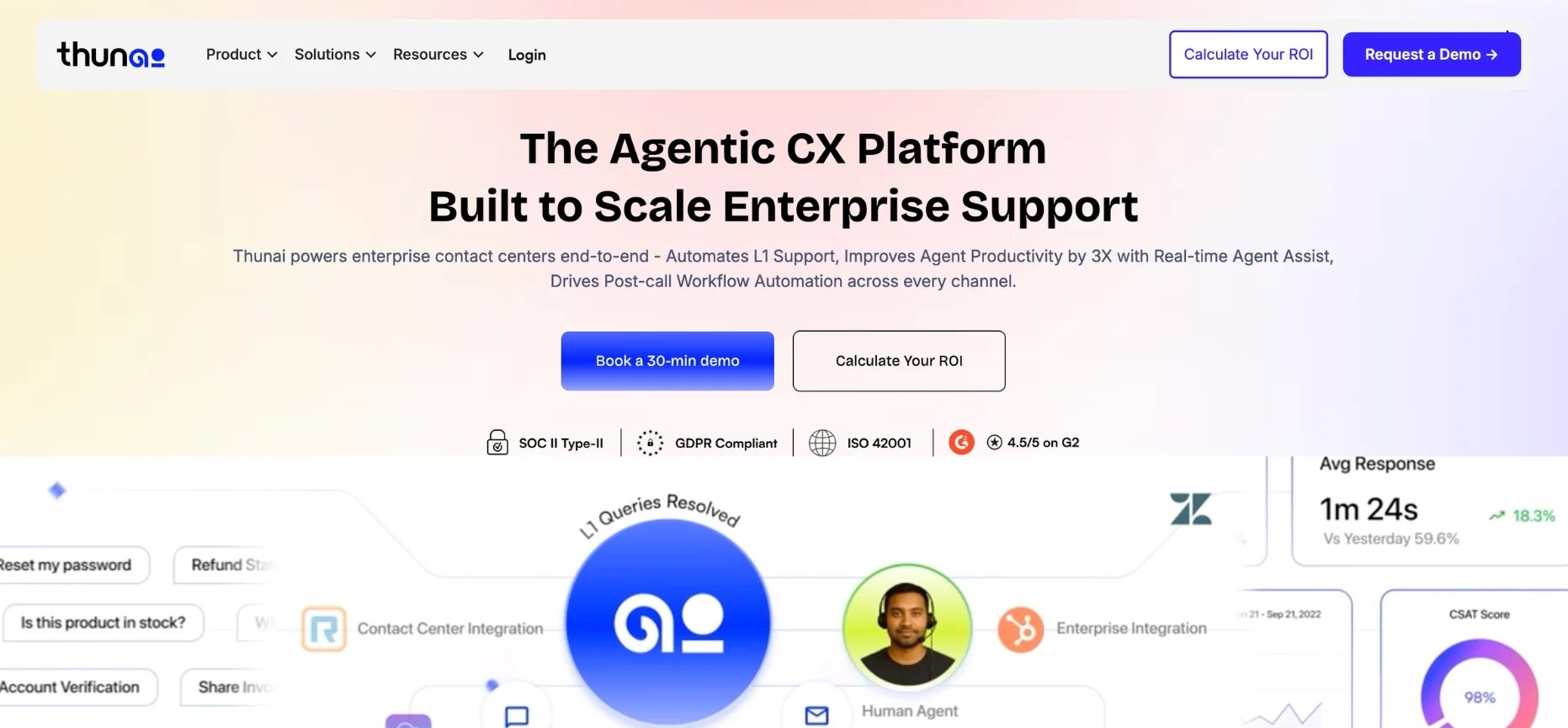
Short Definition: Thunai is an enterprise agentic CX platform. It resolves up to 80% of routine service questions on its own, coaches live agents in real time, and handles post-call CRM updates without scripts.
Thunai takes the top spot among ringover alternatives because it does far more than carry a call. Its “Thunai Brain” pulls company knowledge into a single place, cuts handle time by 70%, and audits every interaction for quality and compliance. If you want the longer version, Thunai's guide on AI Agents Benefits in Contact Centers and its Best Enterprise Contact Center Solutions analysis both go considerably deeper.
Reviewers seem to agree with that assessment. On G2, one user says Thunai “genuinely reduces our daily load,” and another says its agents “automate email follow-ups and handle lead qualification, which has saved me hours every day.”
Best for: Globally-based organizations located in North America, Europe, and APAC who require autonomous resolution, live agent support, and regional data compliance (SOC 2, GDPR, HIPAA).
Key features: Agentic AI within Thunai itself, the Thunai Brain, live agent support, zero touch post call CRM processes, and call scoring for 100% of calls in 24+ languages.
Pricing: Enterprise pricing with customizable self-hosted solutions.
Pros:
- Deflects up to 80% of routine L1 tickets.
- Unifies CRM data, transcripts, and docs with no scripting.
- Goes live in under 48 hours with regional hosting.
Cons:
- Not a standalone legacy SIP hardware PBX.
- Heavy regional accents may need early transcription tuning.
2. Aircall: The Ecosystem Benchmark for Multi-App Environments
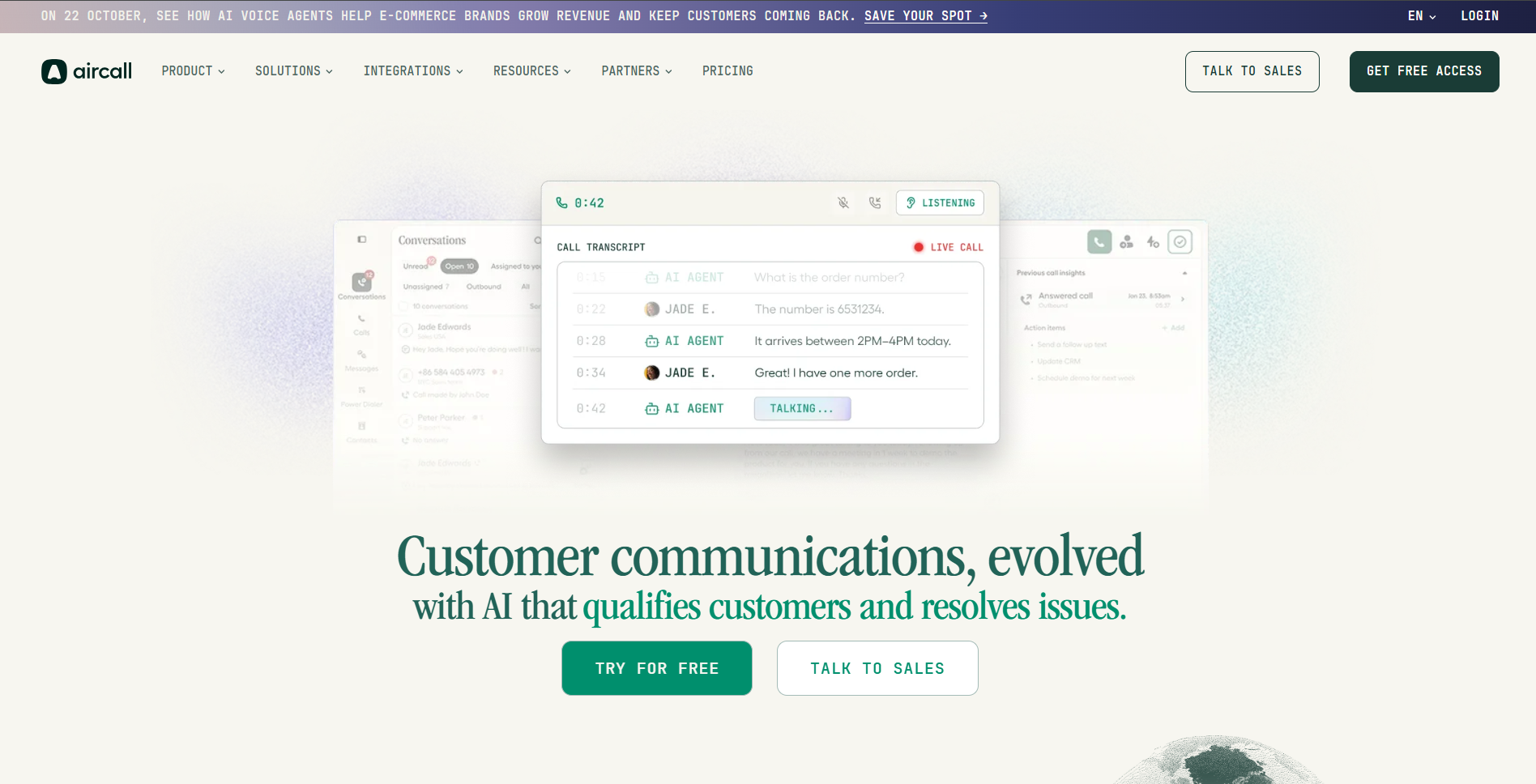
Short Definition: Aircall is a cloud-based business phone offering a marketplace for 160+ CRM and Help Desk native integrations.
If your tech stack is overloaded with apps, then Aircall should be your choice. It beats Ringover when comparing the quality of carriers in North America and Western Europe, uptime, and API design, all of which make Aircall one of the most reliable Ringover alternatives.
Best For: Groups of moderate size in North America, the United Kingdom, and Western Europe.
Key Features: Over 160 AppConnect integrations, power dialers, live call whispering, and basic artificial intelligence summaries.
Pricing: $30 (Essentials) or $50 (Professional) per user per month, annual billing, minimum of three users. AI Assist add-on prices vary between $9 and $49.
Pros:
- Excellent peering for carriers in the United States, Canada, and Western Europe.
- Bi-directional sync with Hubspot, Salesforce, and Zendesk.
Cons:
- The three-seat floor hurts solo reps.
- Advanced AI and dialers carry add-on fees.
- Phone support is limited outside French and North American hours.
3. JustCall: Multi-Channel Sales Outreach and Automated Quality Assurance
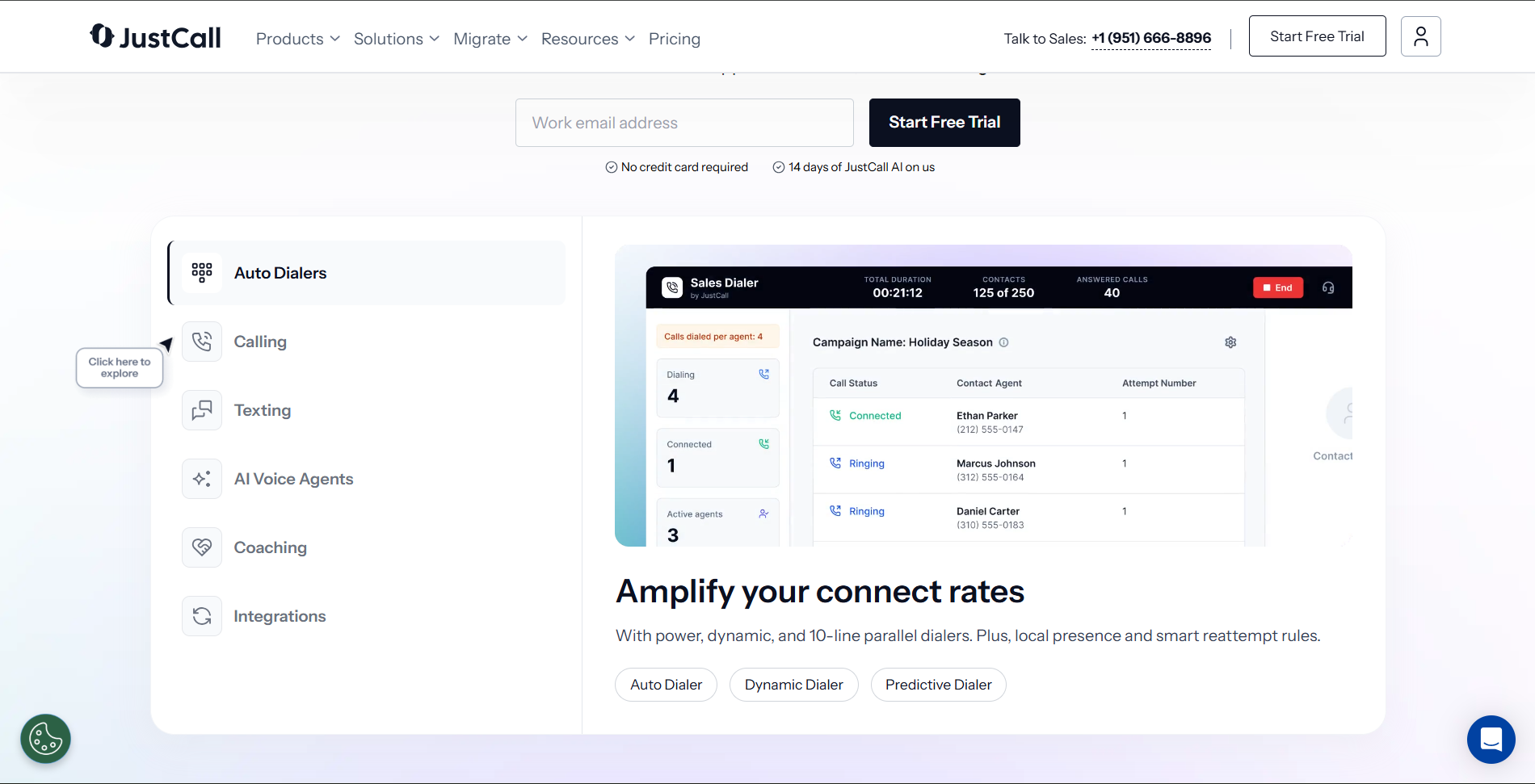
Short Definition: JustCall is a package of AI capabilities that includes voice calling, two-way SMS, MMS, and WhatsApp in the same workspace.
JustCall is ideal for companies that use several means of communication with customers; hence, it is one of the most flexible ringovers on the list. The capability of call scoring (referred to as JustCall IQ) is included in every plan, and the terms of every contract have to be monthly, which implies that there are no annual contracts in JustCall.
Best For: US, Canada, and UK-based inside sales and customer support agents who need voice, SMS, and WhatsApp services.
Key Features: Predictive dialer, call scoring, integrated WhatsApp and SMS inbox, local call display.
Pricing: Starts from $29/user/month without annual contract. Pro Dialer Plan – $49.
Pros:
- SMS and WhatsApp come bundled.
- Every call gets scored, not a sample.
- Month-to-month billing.
Cons:
- No live call whispering.
- A2P 10DLC registration can be slow.
4. Dialpad: Unified Communications Powered by Embedded Speech Analytics
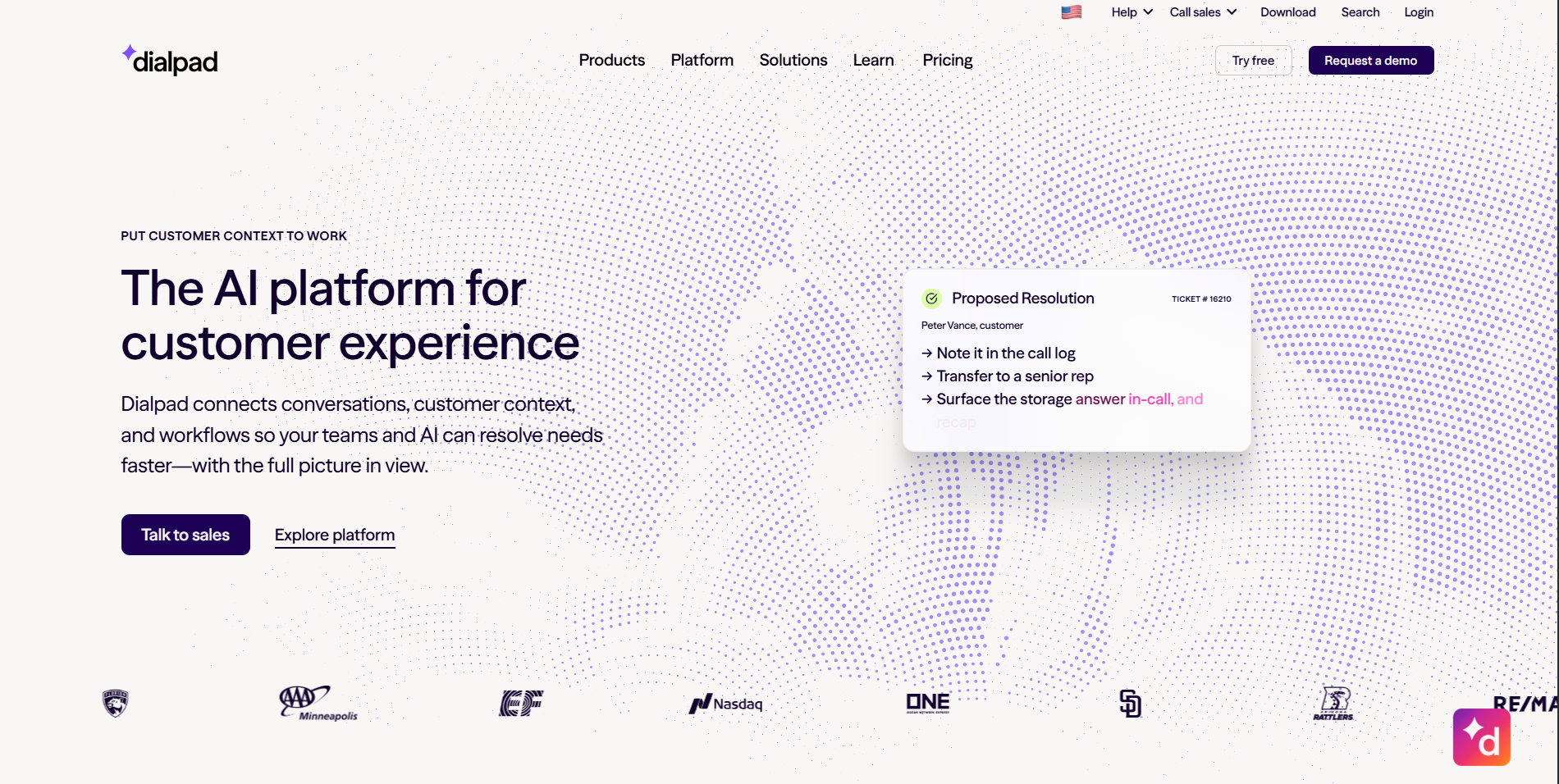
Short Definition: Dialpad is a platform for enterprises that offers telephony, video, and chat functions through its own real-time speech AI engine.
Ringover offers conversation intelligence as a distinct feature, Dialpad uses AI in the call itself, thus providing a good alternative to Ringover for all those people who love AI. You can enjoy real-time transcription, automatic action items, and even sentiment analysis on Dialpad.
Best for: Hybrid teams that operate within Google Workspace and Microsoft 365.
Key Features: Live transcription, sentiment analysis, and video are included.
Pricing: Connect is priced at $15 per user monthly, Sell is priced at $39 per user monthly, and Support is priced at $80 per user monthly (annually).
Pros:
- AI sits inside the core stack.
- Voice, chat, and HD video on one bill.
- 99.999% uptime SLA.
Cons:
- Advanced analytics sit behind the $80 tier.
- AI voice agents need a custom quote.
5. CloudTalk: Complex Inbound Routing and Expansive International Footprint
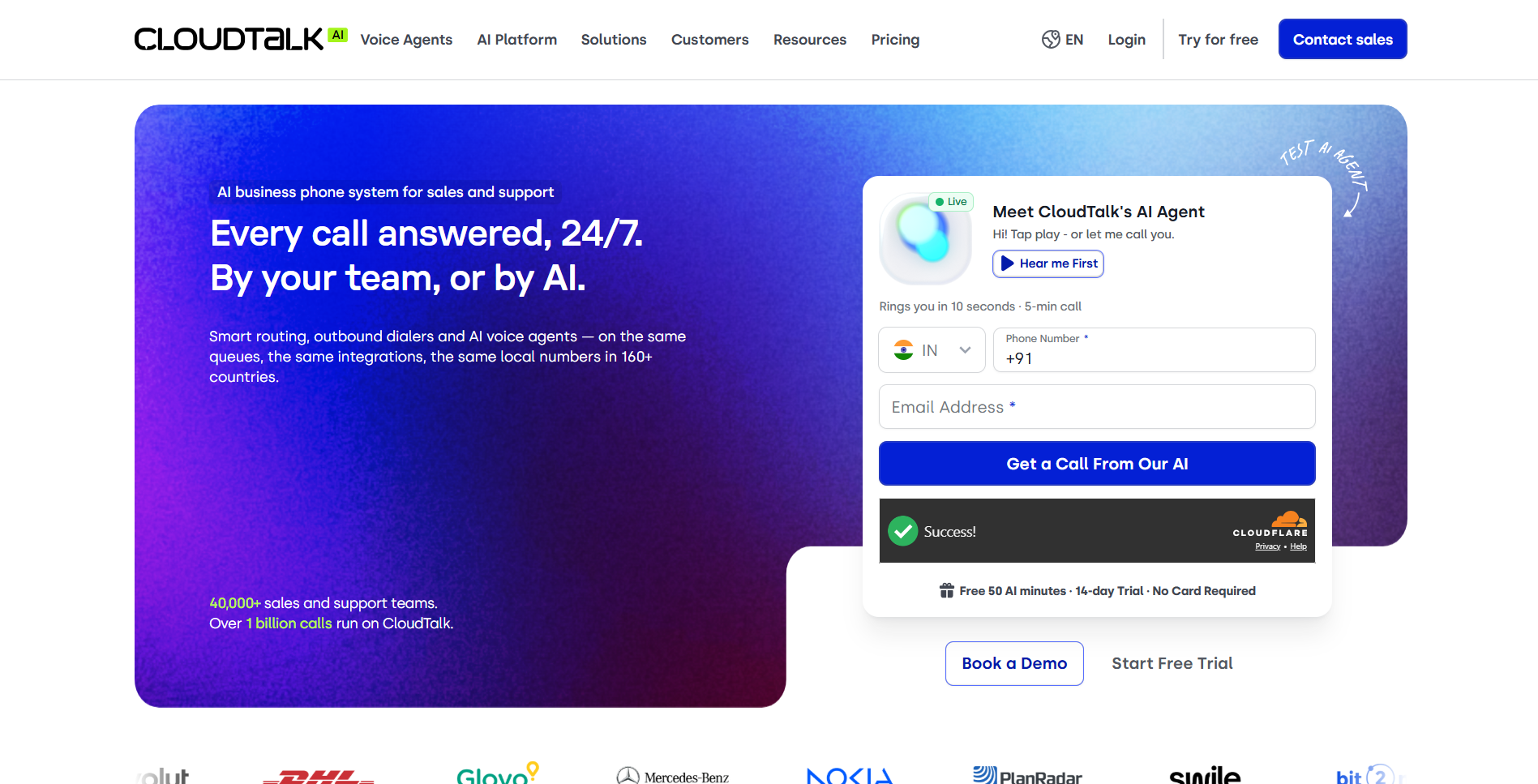
Short Definition: CloudTalk is a universal cloud contact center solution with local numbers in more than 160 countries.
Are you having trouble with call flow and routing problems? If so, then you should definitely consider CloudTalk as an option, as this provider provides the Drag and Drop Call Flow Designer that can be used to build IVR flow depending on the agent’s skills, the customer's activity, and the time of day.
Best for: Teams interested in international service and call flow routing.
Features: Visual Call Flow Designer, skill-based IVR, local numbers, and 100+ CRM integrations.
Pricing: 19 - 25 (Starter) to $49 (Expert) per user per month (yearly billing), and AI Conversation Intelligence for $9.
Pros:
- Local and Toll-Free Numbers in Over 160 Countries.
- Visual Routing Editor for Multi-Level Queues.
- GDPR Compliance.
Cons:
- Power dialers need higher tiers or add-ons ($15 to $39).
- Outbound minutes get pricey.
6. Allo: Mobile-First Calling for Agile and Lean Sales Teams
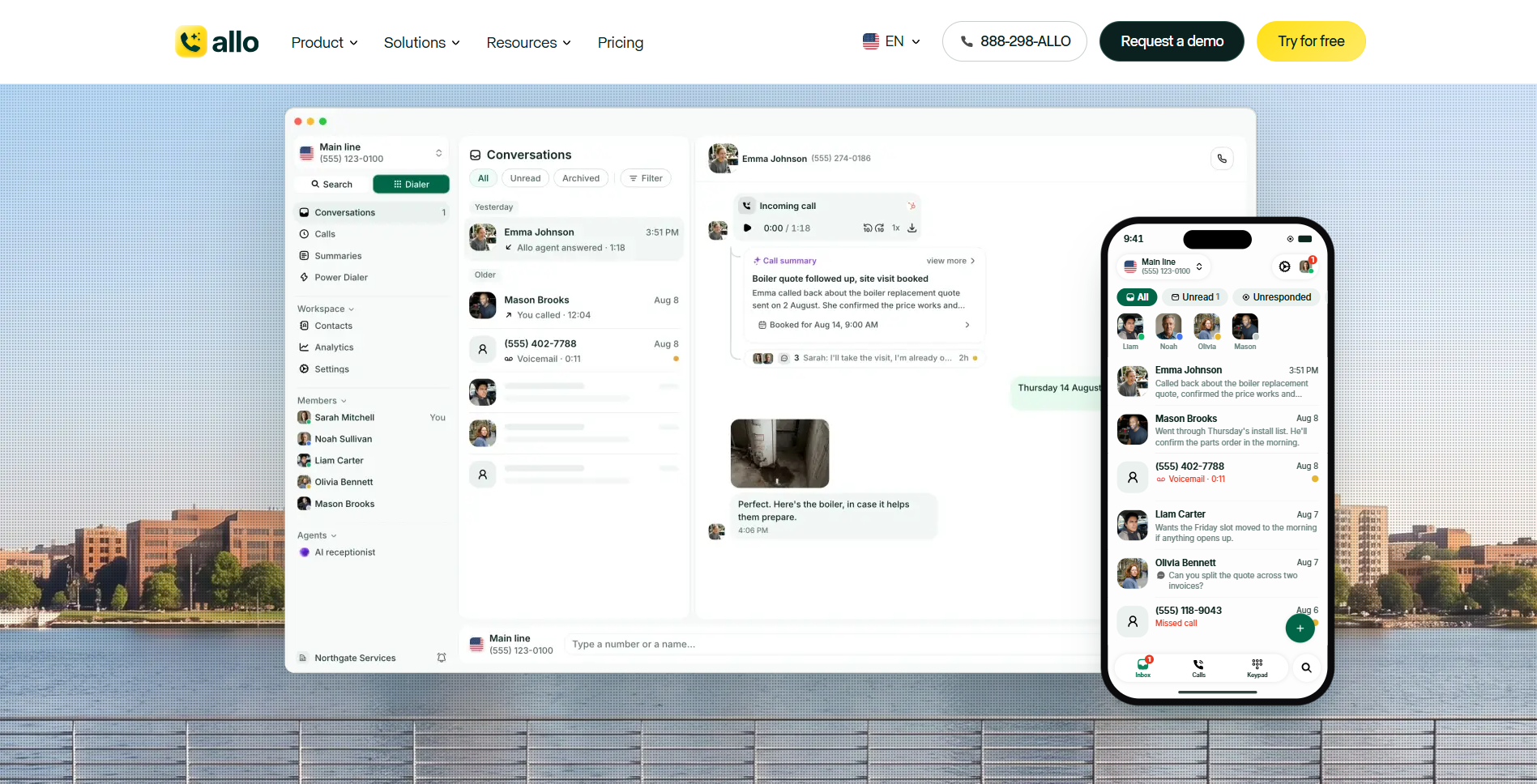
Short Definition: Allo is a lightweight, mobile-first AI phone for salespeople and startups working on either iOS or Android operating systems.
Allo is a simple application which does not feature any complex menu structures or notifications problems like those found in legacy VoIP apps. From all of the ringover competitors featured in this review, Allo is definitely the easiest one to start using since its pricing is simple and there are no additional fees involved at all.
Best for: Teams of salespeople and startups requiring a lightweight softphone solution..
Key Features: Mobile-first calling, AI-powered answering feature, auto-notations, and integration with CRM.
Pricing: $25/month/per user. Business Plan: $45 per user per month.
Pros:
- Reliable mobile push notifications.
- AI answering comes bundled.
- Setup in under five minutes.
Cons:
- No multi-tier IVR or call whispering.
- Smaller number inventory.
7. Kixie: High-Velocity Prospecting and Pipeline Acceleration
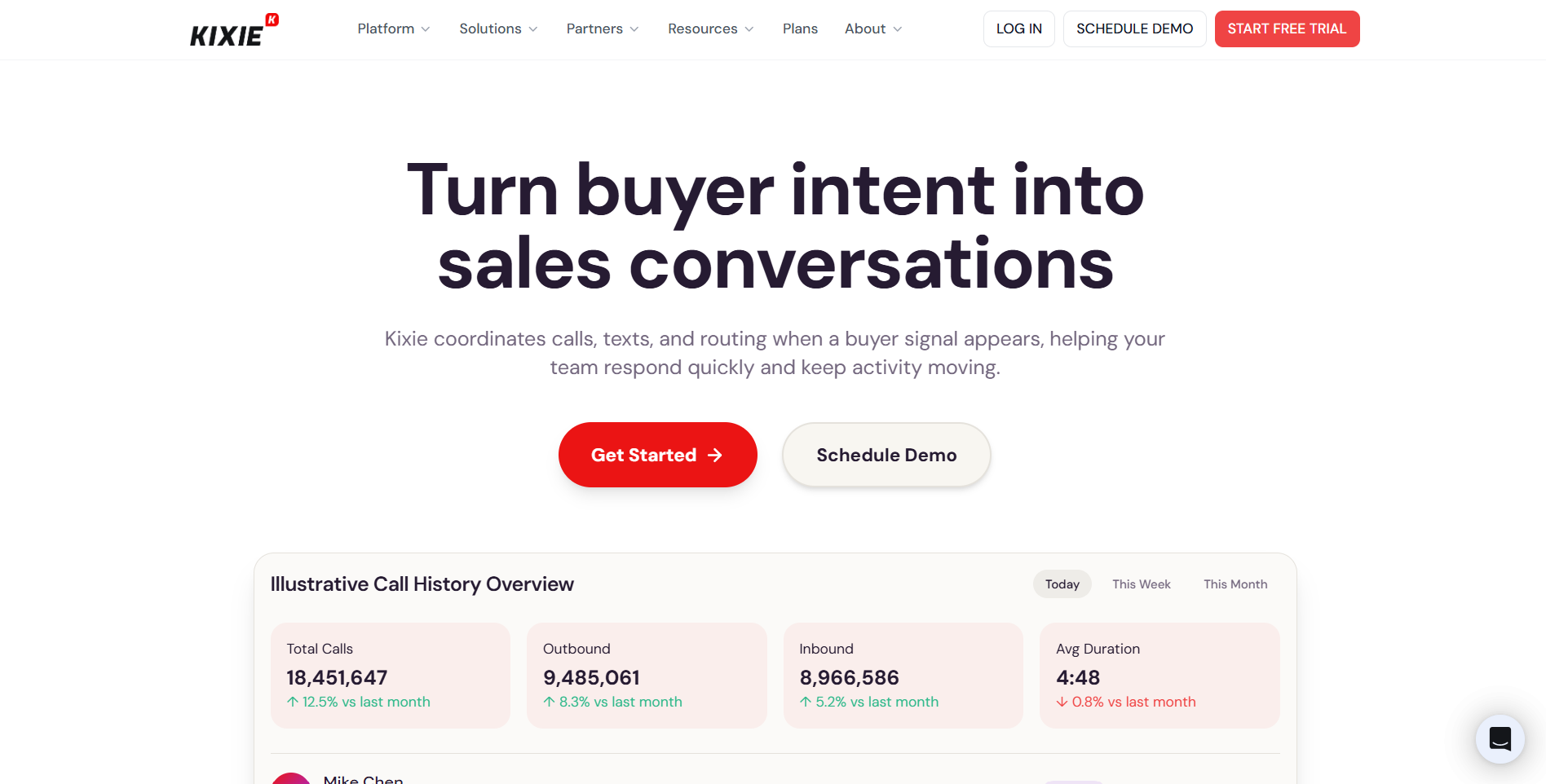
Short Definition: Kixie is an outbound sales tool that focuses on multi-line dialing and dynamic local presence.
Kixie operates in HubSpot, Pipedrive, and Zoho, making it the outbound sales tool among ringover competitors. Local area code matching offered by Kixie may increase your answering rate by 500% for companies that make numerous calls within the area codes of the US and Canada.
Best for: North American B2B businesses that perform a lot of cold calling.
Key Features: PowerCall dialer, local presence, voicemail, and SMS delivery based on triggers.
Pricing: It starts from $35 per user/month. Pricing for outbound automation varies from $65 to $95 depends upon the requirement.
Pros:
- In-browser CTI widget.
- Automated SMS triggers after web lead forms.
Cons:
- Not built for inbound support.
- Usage costs climb outside North America.
Ringover Integrations vs Alternatives: CRM and Helpdesk Fit
In terms of integration, that's when things begin to set one alternative to Ringover apart from the other. While Ringover has an impressive number of around 80-100 native integrations, most of these just dump data, which means they log the action, send the audio file, apply some tags, and that’s it.
Thunai's piece on Call Center Integrations puts the problem well, noting that legacy CTI adapters drop a softphone into a CRM screen but never turn the voice data into anything structured.
Two gaps show up as you scale. First, context gets split, because a standard PBX cannot pull from separate data silos in the middle of a call, so agents hunt through Google Drive, Zendesk, and Salesforce by hand.
Thunai's review of ServiceNow Integrations adds that synchronization often breaks without automated validation. Second, administrative work quietly swallows 20% to 30% of the day.
Aircall is much more effective at synchronization because of the improved two-way logic, CTI screen pops, and an open API that allows sending custom webhooks to BI applications instantly.
Thunai takes it a notch higher since the Multi-Connect Protocol connects Salesforce, ServiceNow, Amazon Connect, Genesys Cloud, and Microsoft Teams straight to your telephony layer. This is because:
- Zero-Touch Post-Call Workflows: Thunai picks up defects, changes, and churn, and updates the CRM and helpdesk.
- Contextual Live Guidance: It verifies policies, specifications, and customer history and then suggests tips on the rep’s screen.
- Orchestrates Multiple Models: It updates ServiceNow and Salesforce simultaneously.
Ringover Pricing vs Alternatives: What Changes at Scale
Take a close look at Ringover pricing, and you will see why budgets balloon as teams grow, which is also the moment when many buyers start eyeing Ringover alternatives.
- Talk Plan: $15 to $19 per user per month billed annually (three-seat minimum), or $24 to $29 monthly.
- Business Plan: $44 to $49 annually, or $57 to $69 monthly. It adds advanced IVR, recording, and power dialing.
- Advanced Plan: Custom pricing by sales quote, with local presence dialing and priority routing.
Then the “Add-On Tax” kicks in. Picture ten reps on the Business plan, which costs $470 a month, and then add Empower AI at $390 and Cadence at $590, and you land at $1,450, or $145 per seat. Throw in usage-based AIRO minutes and the final bill becomes very hard to predict.
Thunai's breakdown of Thunai vs Twilio and Legacy Voice Pricing shows how seat licenses, number rentals, and minute fees pile up over time, while its study of Retail Contact Center Outsourcing vs AI Agents compares human service at $8.00 to $15.00 per resolution with $0.50 to $2.00 for autonomous workflows.
In addition, Call Center Automation Trends reports that in 2026 teams are shifting toward agentic systems that audit 100% of interactions.
Here is how the cost scales across the main platforms.
Traditional vendors tack on a per-seat tax as you grow, whereas Thunai prices by agentic capacity, usually around $99 to $399 flat. Pair your reps with agents that resolve 80% of routine questions, and the cost per interaction drops from 8.00–15.00 to 0.50–2.00, which makes it the model, among these ringover alternatives, that stays steady as volume climbs.
How to Choose a Ringover Competitor

Do not try to evaluate everything at once, because four steps are enough to shrink your list of ringover alternatives down to the few that genuinely fit your operation.
1. Identify the Primary Operational Bottleneck
- Fix the bottleneck first and argue about price second.
- If your outbound reps cannot reach prospects, look at multi-line dialing and local presence, where JustCall and Kixie are the best fit among ringover alternatives, but if your support queues are long, you need autonomous resolution, and that is where Thunai stands out.
2. Calculate the True Total Cost of Ownership
- Ask every vendor for a full quote that spells out seat minimums, add-on modules, and per-minute fees.
- Once you compare Ringover alternatives on those terms, the real price gaps tend to jump out immediately.
3. Review Integration Requirements Beyond Call Logging
- If click to call and recording links are all you need, Aircall or CloudTalk will do the job, but if you want action across several systems at once, you should go with an agentic platform like Thunai.
- Few ringover alternatives can do both.
4. Review Carrier Latency, SLA Guarantees, and Security Compliance
- Last, look under the hood by checking carrier partners, a 99.99% uptime SLA, SOC 2 Type II status, GDPR alignment, and data residency options.
- Run the same checklist on every one of the Ringover alternatives on your shortlist.
Cut calling costs and eliminate manual work with Thunai’s AI agents. Book a demo today to see how Thunai can reduce costs and improve customer experience.
FAQs
What are the top Ringover competitors in 2026?
They fall into three groups: agentic AI platforms like Thunai, app-centric phone systems like Aircall and CloudTalk, and sales-focused tools like JustCall and Kixie. Together, those make up the leading Ringover alternatives.
How does Ringover vs Aircall compare for sales and support?
Ringover is often cheaper for small European teams, while Aircall brings 160+ integrations, stronger North American routes, and better administrative tools. Among Ringover alternatives, it is the safer mid-market choice, although it does enforce a three-seat minimum.
What are the main limitations of Ringover integrations?
Mostly, they work as call loggers; since they cannot check internal documents in the middle of a call, they do not trigger workflows across several systems, and they do not remove the manual data entry after each call.
How does Ringover pricing compare to autonomous AI platforms like Thunai?
Ringover bills per user, from $15 to $49 at the base level, and then adds charges on top, while Thunai uses a capacity model at roughly $99 to $399 a month. Of all the ringover alternatives, it is the one that drops per-seat add-on fees.
Can an enterprise transition away from Ringover without losing historical call logs?
Yes, because recordings, contacts, and logs can be exported through Ringover's REST API or as CSV files, and most Ringover alternatives can take that data in.