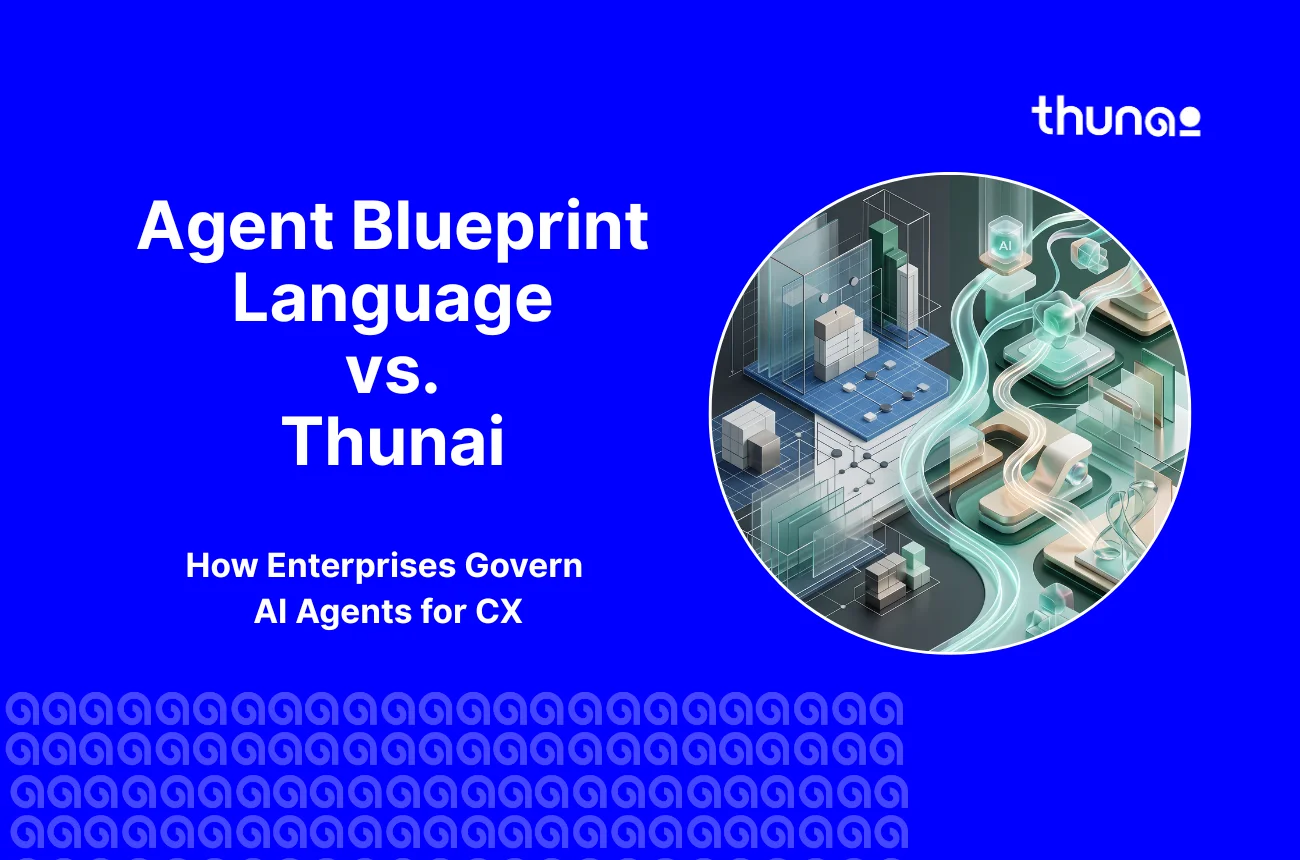

Companies control AI agents for customer experience (CX) in one of two ways. They either build hard rules straight into the agent's code, the way Kore.ai does with Agent Blueprint Language (ABL). Or they add active checks and human checkpoints on top of a no-code platform, the way Thunai does.
The right pick usually comes down to one question: does the business have engineers to keep up a compiled language, or does it need governed agents up and running within days?
What is Agent Blueprint Language (ABL)?
Agent Blueprint Language (ABL) is a compiled language that Kore.ai built to set up and control enterprise AI agents. ABL is the technical base of the Artemis platform from Kore.ai.
Written in YAML, ABL treats an agent's identity, tools, memory, and guardrails as one piece of version-controlled software, not a loose pile of prompts.
How does ABL apply governance at runtime instead of in prompts?
Kore.ai built ABL because prompt-based control breaks down under real enterprise pressure.
Plain-language rules can be worked around, read wrong by a new model version, or overridden by a cleverly worded attack. So instead of asking an LLM to remember the rules and stick to them, Agent Blueprint Language (ABL) takes the choice away for good.
This runs through the three-step build process covered below:
- First, the ABL compiler checks a submitted YAML file for missing tool links, broken handoffs, and gaps in guardrails, and it does this at commit-time.
- Second, once the file checks out, it compiles into a fixed Intermediate Representation (IR) that is easy to move around and version-controlled.
- Third, the platform runs that compiled IR in production instead of reading raw code on the fly. The same IR moves unchanged from staging to production. So the behavior does not drift when a model gets an upgrade, and any sessions already underway just wrap up on the version they kicked off with.
How does the ABL build process work?
This build process also powers Artemis's Dual-Brain Architecture. One engine handles loose, back-and-forth reasoning. A second engine follows hard business rules and never bends them.
- Developers set the line between the two with a piece of code called FLOW. Another piece of code, GATHER, holds up a workflow until a needed field, such as an account number, is filled in and checked.
- In banking use cases, a related piece of code runs REQUIRE and ON_FAIL logic. An unverified customer then gets sent to sign-in before any big-money transfer can go through.
Why aren't prompts enough to govern enterprise AI agents?
Prompts fall short because they sit inside the same AI layer they are supposed to keep in check. A rule written in plain language sits in the same context window as the user's input. So a cleverly worded message can override it. A model upgrade can quietly read it a new way.
These four points represent failure modes that are common among prompt-controlled agents:
- Overriding prompt by exploiting bypass resistance: An engineered or cleverly constructed input overrides the natural language system prompt and coerces the agent into actions it was not meant to take.
- Predictable responses: Given the contradictory context, the model might attempt to argue itself out of compliance with an explicit directive.
- Stability despite version upgrades: The latest version of the model interprets old prompts differently than before without making any changes to the setup.
- Audit trails: A plain-language prompt cannot reliably spell out, after the fact, exactly why an agent made a given call.
In regulated industries like banking, healthcare, and telecom, this gray area can be a huge issue.
What are the trade-offs of a compiled agent language like ABL?
Agent Blueprint Language, or ABL's strict setup, comes at a cost. G2 and Gartner Peer Insights' reviews suggest a solution which works great for large companies but demands much from smaller ones.
- High learning curve: Creating an FAQ bot is very quick and easy, but orchestrating complex multi-turn ABL conversations, providing memory grants, and building entity extraction is hard-core engineering.
- Cluttered UX for beginners: Reviewers call the interface packed and hard to take in at first, since it stacks a modern compiler on top of an older chatbot builder.
- Performance issues while under load: Some users experience delayed chats in case the bot is working off of multiple enterprise applications, and sometimes they even need to refresh to restore everything to normal.
- Pricing is unclear and usage-based: The platform bills in terms of 15-minute sessions, meaning that one chat could take several billing periods, making it difficult to estimate costs.
- Good NLU and enterprise scale: On the bright side, the platform's natural language understanding continues to earn praise from reviewers, and it has gained a good reputation among Fortune 2000 enterprises in terms of connecting deeply with legacy systems.
Does using ABL create vendor lock-in?
Not at the model level. Agent Blueprint Language or ABL is model-agnostic on purpose, and right now it backs 178 different AI models across 15 vendors, including OpenAI, Anthropic, Meta, and Cohere.
So a business can swap out the core LLM for cost or speed reasons without breaking its compiled agent logic.
The real lock-in risk sits somewhere else. Once a team has poured engineering time into ABL's orchestration patterns, compiler, and IDE, moving all that logic to a whole new framework is a much bigger job than swapping out a model.
How can enterprises get governed AI agents without a proprietary language?
They can lean on a platform that bakes governance into the product itself, instead of asking developers to write and compile it.
This is the path Thunai takes. Instead of a YAML-based language and a runtime compiler, Thunai controls agents through a self-learning Brain, a two-way connection layer, and a set of ready-made checks that sit between the AI and the systems it reaches into.
What is an agentic CX platform?
An agentic CX platform is a system with agentic capability allows AI to perform real actions within the customer experience process. This can be things like updating a CRM record or resolving a customer support issue without having to manually perform these actions.
Thunai can do this with the help of it’s Model Context Protocol (MCP) that enables more than 50+ enterprise application connectors.
While API simply performs read actions, Thunai allows the capability for AI to perform write actions into your MCP.
How does Thunai apply guardrails outside the model?
Thunai's main safeguard is an Active Verification Layer inside its self-learning Brain. Older retrieval systems often break down quietly when company data clashes with itself, like an out-of-date policy document sitting next to a newer field in the CRM.
Thunai's Brain keeps scanning connected knowledge sources for this exact kind of clash.
A second layer takes care of anything the AI wants to write back into a system like Salesforce. Every create, update, and delete an agent sets off passes through a Human-in-the-Loop checkpoint first.
How does Thunai make every AI agent decision auditable?
Every conversation and every backend action gets logged on its own, which turns a routine exchange into a compliance-ready record. This runs through two linked systems. Thunai's Common Agent logging framework tracks 100% of user-agent conversations and API runs.
- The framework writes down the exact timestamp, action, parameters, and input/output data for every change made in a connected platform. That hands administrators full tracking and the power to roll back any action the agent takes on its own.
- The second system, automated call scoring, takes on a gap most contact centers quietly live with.
- Staffing limits usually hold manual quality checks to somewhere between 2% and 5% of interactions. Thunai instead writes out and scores 100% of calls against a business's own scorecards. The system checks for SOP compliance and mood shifts on call.
Is enterprise AI agent data secure with Thunai?
Yes, and the certifications will prove that. Thunai remains compliant with GDPR, SOC 2 Type II, and ISO 27001 certifications in information security management.
Additionally, Thunai holds ISO/IEC 42001:2023 certification, the first worldwide standard specifically developed for AI management systems. Thunai also has the following certifications:
- ISO/IEC 42001:2023: certification for AI management systems
- SOC 2 Type II: security controls checked by an outside auditor
- ISO 27001: information security management
- GDPR compliance: data protection and privacy
- On-premises and isolated setups: customer data stays walled off and never gets used to train shared outside models.
Under these certifications, Thunai's Brain is built as a Knowledge Graph with built-in Knowledge Compartmentalization, so each tenant's data stays walled off by default. Role Management then maps onto a business's current RBAC structure.
How fast can you deploy governed AI agents?
Thunai's average time to go live sits under two days because it layers onto tools a business already runs instead of swapping them out. By comparison, G2 rollout data puts the average ABL setup at about two months.
Much of that comes from having to master multi-agent orchestration patterns and compile connectors by hand before anything reaches production.
Thunai's connections are built to skip that setup work for good:
- Genesys: Thunai's agents plug straight into the Genesys Cloud CX workspace, adding real-time help and automated quality checks on top of current voice and digital channels.
- Amazon Connect: It is possible to create a zero-code voice bot with a resolution process that follows six steps in just half an hour or less.
- Salesforce: Thunai Omni is a native component of the Lightning Web Component that appears on the Case or Contact page and integrates in 30 minutes or less without any coding.
- ServiceNow: The same connector pattern takes care of ticket creation, updates, and escalations without a separate connection project.
How much ROI can you expect to achieve using governed agentic CX in production?
Both products yield solid ROI, but each one achieves it in its own way. With Thunai, we've managed over 1 million customer sessions so far.
From the statistics, our CSAT is on average 95%, deflection rate is 80%, average handle time reduction is 70%, and we have seen a 3X agent productivity increase.
- Bazooka Candy: Mapped out over 10,000 B2B accounts on its own and cut ticket triage time by 60%.
- Talonify: Flagged 100% of legal risks while offboarding staff and cut prep time by 85%.
- A national pet retailer: Ran 210,000 calls a month on autopilot across 100+ AI agents while holding a 4.8+ CSAT score.
- Ion Exchange: Indexed 100,000 technical documents and sorted out 95% of complex engineering queries.
Kore.ai's ABL brings a different kind of result, built around scale inside businesses that have the engineering muscle to back it.
Want to see how Thunai helps teams? Book a free demo!
Frequently Asked Questions
What is Agent Blueprint Language (ABL)?
ABL is the compiled YAML language used by Kore.ai to configure and control enterprise AI agents. Artemis uses ABL and considers agent logic to be a version-controlled piece of software rather than a series of prompts.
Is ABL open-source or proprietary technology?
ABL technology is proprietary to Kore.ai. However, it is also model agnostic and supports 178 different AI models from 15 different vendors, allowing a company to change out the main LLM without having to reconfigure the compiled agent logic.
Do I need engineers or a special language to govern AI agents?
Not always. ABL needs engineering work to write, compile, and keep up. Thunai goes the other way and bakes governance into a no-code platform, so business teams can run and manage agents without picking up a new language.
How does Thunai differ from Kore.ai Artemis for CX?
Thunai tends to deploy more quickly and doesn’t put as much pressure on internal engineering resources. Kore.ai Artemis needs more direct hands-on development and management capabilities and is targeted at companies with complex global orchestration of agents across departments.
How does a chatbot differ from an agentic CX platform?
A chatbot tends to follow pre-defined scripts and simply wait for the next input from the user. An agentic CX platform follows a goal-oriented process, takes real action within integrated systems such as a CRM, and does so under governance policies.



.webp)