
Customer feedback from large ecommerce companies was severely impacted when there were disruptions in international shipping services in 2025, leading to order delays. Not only that but also an increase in the number of “Where Is My Order?” (WISMO) cases.
That is why AI order management is becoming essential for modern ecommerce.
With real time order tracking AI, brands can automate delivery updates, predict delays early, and reduce support overload while improving customer trust after every purchase.
Let’s explore how in this guide.
Why Ecommerce Brands Are Losing Customers After the Buy Button
In 2026, it costs an average of $29 to acquire a single customer. When you’re spending that kind of capital, the post purchase void is your biggest enemy.
Despite our best marketing efforts, 56% of customers report disappointment with their post purchase experience.
The silence that follows a purchase is a brand killer. When a customer receives a generic confirmation email and then nothing but a cold, label created status on a carrier portal, their order anxiety kicks in.
We know from industry data that 87% of customers will never return to your store if they encounter inaccurate or stale shipping information. You aren’t just losing a shipment; you’re losing the Customer Lifetime Value (CLV).
What AI Order Management Actually Means (Beyond the Buzzword)
- Traditional Order Management Systems (OMS) were deterministic, they followed rigid "if-then" rules created by humans. If a package was delayed, the system sent a standard delayed email.
- True ai order management is intent based. It doesn't just follow a script; it solves a goal.
- This is where ai order management agents come into play. Instead of waiting for a human to re-route a stuck shipment, the AI perceives the environment (a storm in a regional hub), reasons through the options (reroute to a secondary carrier), and acts autonomously to preserve the delivery promise.
- When we talk about an ai purchase order tracking system today, we’re talking about a system that understands the nuance of the physical world.
- It recognizes that delivery by Tuesday is a goal, and it will orchestrate every logistics node in the supply chain to hit that target without a manager ever opening a spreadsheet.
How Real Time Order Tracking AI Works Under the Hood
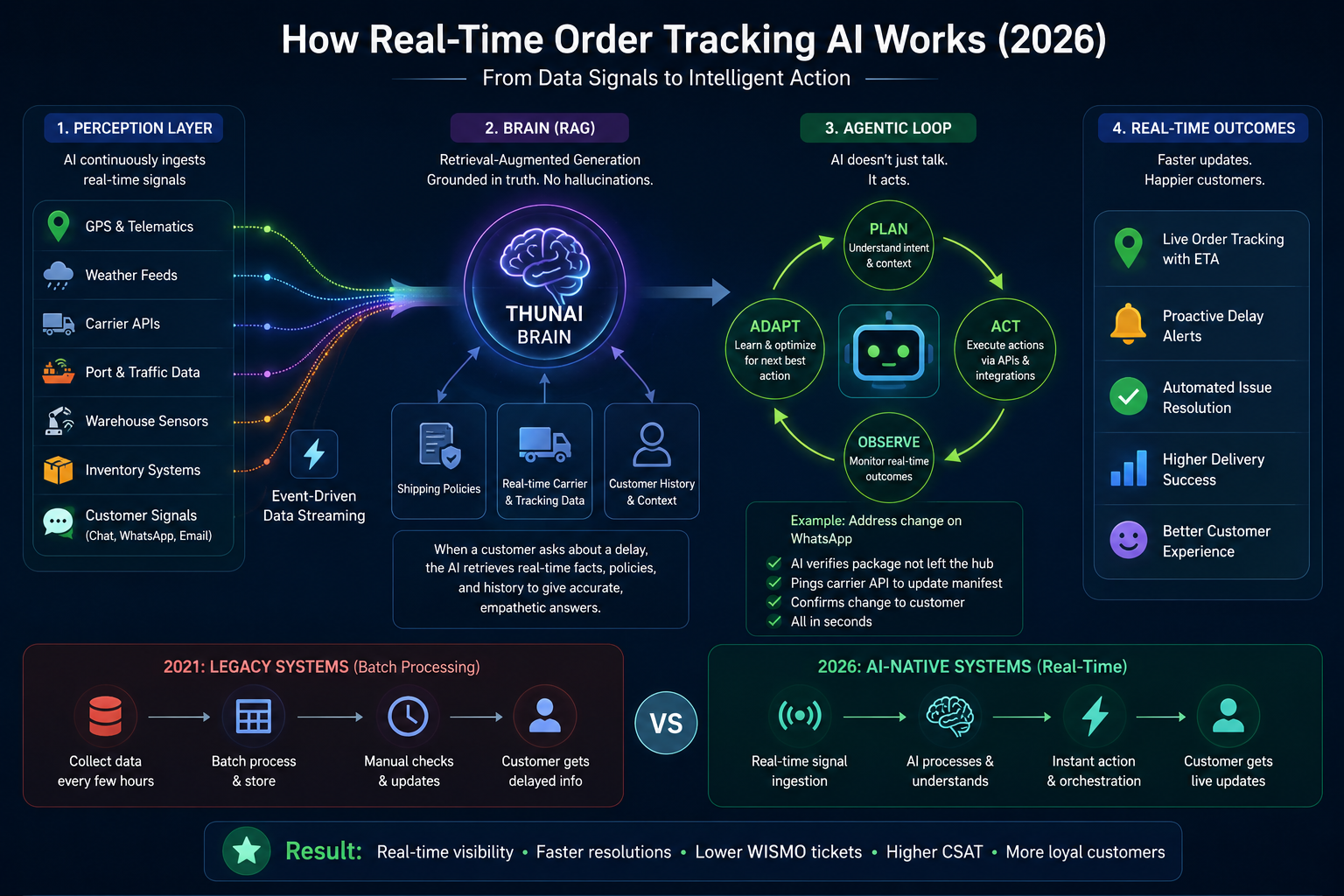
To appreciate how real time order tracking AI operates much more quickly than the technologies of 2021, one must first understand their architectural differences. The former utilized batch processing, where the system would ping carriers every few hours. In 2026, we employ event driven, low latency data streaming.
- Perception Layer: The AI continuously intakes information from a multitude of sources ranging from GPS coordinates, weather reports, port congestion reports, to even sensing data from robots at the warehouse.
- Retrieval Augmented Generation (RAG): Today, companies have a Brain (e.g., Thunai Brain) that ensures that the AI is anchored to reality. This means that instead of creating falsehoods, whenever a customer complains about a delay, the AI uses facts like the shipping policy, the status of the carrier, and previous customer behavior to provide answers.
- Agentic Loops: In today's advanced technology, there is an introduction of a Brain (e.g., Thunai Brain) that helps anchor the AI into reality. Instead of providing false claims, whenever the customer complains about a delay, the AI uses the real shipping policy, carrier status, and previous orders of the customer to answer.

Core Capabilities of a Modern AI Order Management System
A robust system in 2026 must act as a compounding intelligence asset. Platforms like Thunai deliver these capabilities natively, providing a unified workspace where order visibility ecommerce AI and automated delivery updates ecommerce live together.
- Omnichannel AI Support: Your AI system must handle voice, chat, email, and WhatsApp support smoothly. Thunai Omni is multilingual and understands 150+ languages, and also knows the intent and emotions of your customers.
- Self Learning Knowledge Hub: The Thunai Brain learns by uploading SOPs, PDFs, policies, and support documents, helping AI agents deliver accurate, context aware responses without manual script writing.
- Predictive Exception Handling: Modern AI order management systems do more than track shipments. They predict delays, detect stalled deliveries early, and help ecommerce teams resolve issues proactively before customers raise WISMO tickets.
- Unified Human Handoffs: When human support is needed, Thunai Sidekick provides agents with a complete conversation summary and customer context, so customers never have to repeat themselves.
AI Order Management Agents vs. Traditional OMS Platforms: What's the Real Difference?
The most significant distinction between a conventional OMS and the AI order management agent lies in their adaptability to changes and automation.
In contrast, traditional OMS systems operate under pre-defined procedures and manual interventions, which makes it difficult for them to cope with issues such as shipping problems, failure of API integration, and inventory disruption.
AI native order management platforms like Thunai use AI agents to automate fulfillment workflows, adapt in real time, and improve ecommerce order management efficiency.
Instead of weeks of custom development, AI-powered OMS solutions can quickly reconnect carriers, optimize delivery coordination, and scale operations using Multi Connect Protocol (MCP).
As one reviewer mentioned on G2 Reviews for Thunai.ai:
“Exceptional Adaptability and Support Make Thunai.ai Stand Out.”
In simple terms, a traditional OMS helps businesses process orders. AI order management agents help ecommerce brands automate fulfillment, improve operational efficiency, and scale customer experience intelligently.
The Business Case: What Automated Delivery Updates Actually Do for Revenue
For the CEO, the ROI of ai order management is found in the retention flywheel. A 5% increase in customer retention can boost profits by a staggering 25% to 95%.
- WISMO Deflection: Automated systems can deflect up to 75% of inbound inquiries through real time self service. At $6 per call, a brand handling 1,000 tickets a week saves $300,000 annually.
- Increased CLV: High confidence shoppers who receive proactive, transparent updates spend 140% more over their lifetime.
- Upsell Conversions: Because the AI agent for ecommerce understands the context of the shipment, it can suggest relevant additions. One pet care brand using Thunai saw a 2.5X increase in upsell conversions by identifying new puppy buying signals in real time.
How to Implement AI Order Processing Without Disrupting Your Current Stack
Don't let technical debt stop you. The Lean Scaling Model allows you to wrap your current stack with AI rather than replacing it.
- Phase 1: The Insight Layer (Days 1 to 7):
- Deploy read only adapters.
- Connect the AI to your order history and tracking feeds.
- This allows you to launch a branded tracking portal and a discovery assistant instantly.
- Phase 2: The Action Layer (Months 1 to 3):
- Give the AI write access to specific, low risk tasks like updating a shipping address or processing an exchange.
- Phase 3: Full Agency (Month 6+):
- Enable the AI to handle full end to end resolution, including autonomous refunds and multi-node routing.
The Gaps Most Ecommerce Teams Don't See Until It's Too Late
The most dangerous gap is silent degradation when your data stays static but the world moves.
- Siloed Messaging: 28% of shoppers abandon brands because they get buy now reminders for items they've already purchased. AI order processing ensures every channel (Email, SMS, WhatsApp) shares the same real time behavioral state.
- The Tracking Black Hole: Sending a customer to a carrier's portal is like sending your guest to a different restaurant for dessert. You lose 3 to 5 high intent touchpoints where you could have driven a repeat sale.
- Rule Brittleness: If your automation depends on "If-Then" scripts, it will eventually fail. In 2026, 85% of order processing should be handled by an AI that can reason through a messy address or a missing SKU.
Top Solutions for AI Order Tracking in Ecommerce (And How to Choose)
Choosing the best solutions for tracking orders after purchase depends on your scale. If you are an SMB, you need speed; if you are an enterprise, you need agentic autonomy.
If you want the best overall AI order management platform for enterprise ecommerce and CX automation, Thunai stands out because it combines:
- AI-powered order tracking
- Real time workflow automation
- Omnichannel customer support
- Predictive exception handling
- AI agents with adaptive reasoning
Unlike conventional trackers that offer limited capabilities to view shipments, Thunai's approach revolves around leveraging artificial intelligence for the entire order cycle management and context aware AI based decisions.
On balance, when you need a solution to cut down WISMO ticketing, automate the fulfillment process, and enhance the post order customer experience with AI-powered bots, Thunai stands out as the best one stop shop solution in this field.
Upgrade from basic tracking to AI-powered order management with Thunai — book your demo today.
FAQs
What is AI order management and how is it different from a traditional OMS?
Old school OMS solutions are essentially digital filing systems where orders are kept and strict rules are followed. In the case of AI enabled OMS, however, one could think of it as having a digital worker. This system has the ability to use logic and order automation in the realm of ecommerce to decipher the intention behind the order.
How does real time order tracking AI reduce WISMO (Where Is My Order?) support tickets?
By providing proactive visibility. Instead of the customer asking "Where is it?", the real time order tracking AI sends an automated update via WhatsApp or SMS the moment an event occurs. Brands using this see a 40% to 75% drop in WISMO inquiries, as customers feel in control through every step.
Can AI order management integrate with my existing ecommerce platform and shipping carriers?
Absolutely. Modern systems use API first architectures. Whether you are on Shopify, NetSuite, or a custom stack, ai order management connects via governed pipelines to your existing carriers (UPS, FedEx, DHL) and ERPs without requiring you to rip and replace your current infrastructure.
What's the best AI solution for tracking orders after purchase in ecommerce?
For fast growing brands that require something beyond a mere tracking link, Thunai stands out as the best in CX automation. But for those who only care about logistics within Europe, AfterShip and ParcelPerform come highly recommended. When it comes to maximizing profits from return processes, Outvio is considered the best solution.
How long does it take to implement an AI order management system without disrupting operations?
A pilot of an ai purchase order tracking system can go live in 1 to 7 days. A full enterprise wide rollout of ai order management agents typically takes 3 to 6 months as the system learns your specific business logic and SOPs through the brain layer.



.png)