



By 2026, the global chatbot market is expected to reach an estimated $11.8 billion, and the number keeps growing.
That growth is not coming from simple pop-up widgets or AI chatbots for customer support, asking if you need help. These typically are sophisticated AI chatbots capable of holding full conversations.
Yet, most enterprise teams are still running on a patchwork of disconnected tools.
We’ll walk through 10 leading AI-powered chatbot platforms in 2026, look at their architecture, pricing, compliance, and real-world ROI…
What an AI-Powered Chatbot Platform Actually Does (Beyond FAQs)
When a customer calls to process a return, an agentic platform verifies the user, finds the order in the ERP, triggers the return authorization, and sends a refund confirmation.
With a lot of enterprise chatbot platforms, all of that happens on its own, in under two minutes.
Three things to look for in the AI-powered chatbot platforms worth your money:
- Conversational AI handles inbound and outbound communication across voice, chat, SMS, and email.
- Agentic AI completes multi-step workflows on its own, filing claims, updating CRM records, and closing the loop without a human.
- Predictive AI uses historical data to flag churn risk, detect fraud, and score leads before they reach your sales team.
The platforms that matter are those where all three work inside one system.
7 Features That Separate the Best AI Chatbot Platforms from Mediocre Ones
Not every AI-powered chatbot platform that calls itself AI is worth your time.
Here are the seven things that decide whether a platform will deliver in production or quietly fail your customers while your team scrambles to keep up.
- Advanced RAG with Contradiction Resolution. Great AI-powered chatbot platforms proactively scan your data, flag conflicting policies across silos, and force resolution before the AI ever speaks to a customer. Without this step, wrong answers are guaranteed to show up sooner or later.
- Native Omnichannel Delivery. True enterprise platforms deliver native connections across web, mobile, WhatsApp, SMS, email, and voice. For true omnichannel AI chatbots, full context carries across every channel, so a customer who texts and then calls never has to repeat themselves.
- Agent-to-Agent Orchestration via MCP. The Model Context Protocol lets specialized AI agents hand tasks off to each other without losing context. A Voice Agent logs the call data and passes it to an Email Agent that sends the follow-up. All of that happens on its own.
- Human Handoff Logic. Great platforms use real-time sentiment analysis to catch frustration early, escalate gracefully, and hand the human agent a full AI-generated summary. Customers should never have to repeat themselves.
- Enterprise Compliance Certifications. Look for independently audited SOC 2 Type II, ISO 27001, HIPAA, GDPR, and PCI DSS certifications. Platforms that rely only on their LLM provider's security are not enterprise-grade.
- Deterministic Policy Layers. Your AI chatbot for customer support needs a rules engine outside the LLM. This could mean no AI output can approve unauthorized refunds, grant restricted access, or break a hard-coded business rule. Every interaction must be auditable.
- Predictable Scaled Pricing. Per-resolution billing looks cheap until a traffic spike triples your invoice overnight. The best AI-powered chatbot platforms use flat-rate or clearly tiered pricing you can forecast at 3x and 10x your current volume.
Top AI-Powered Chatbot Platforms Compared (2026 Edition)
1. Thunai AI
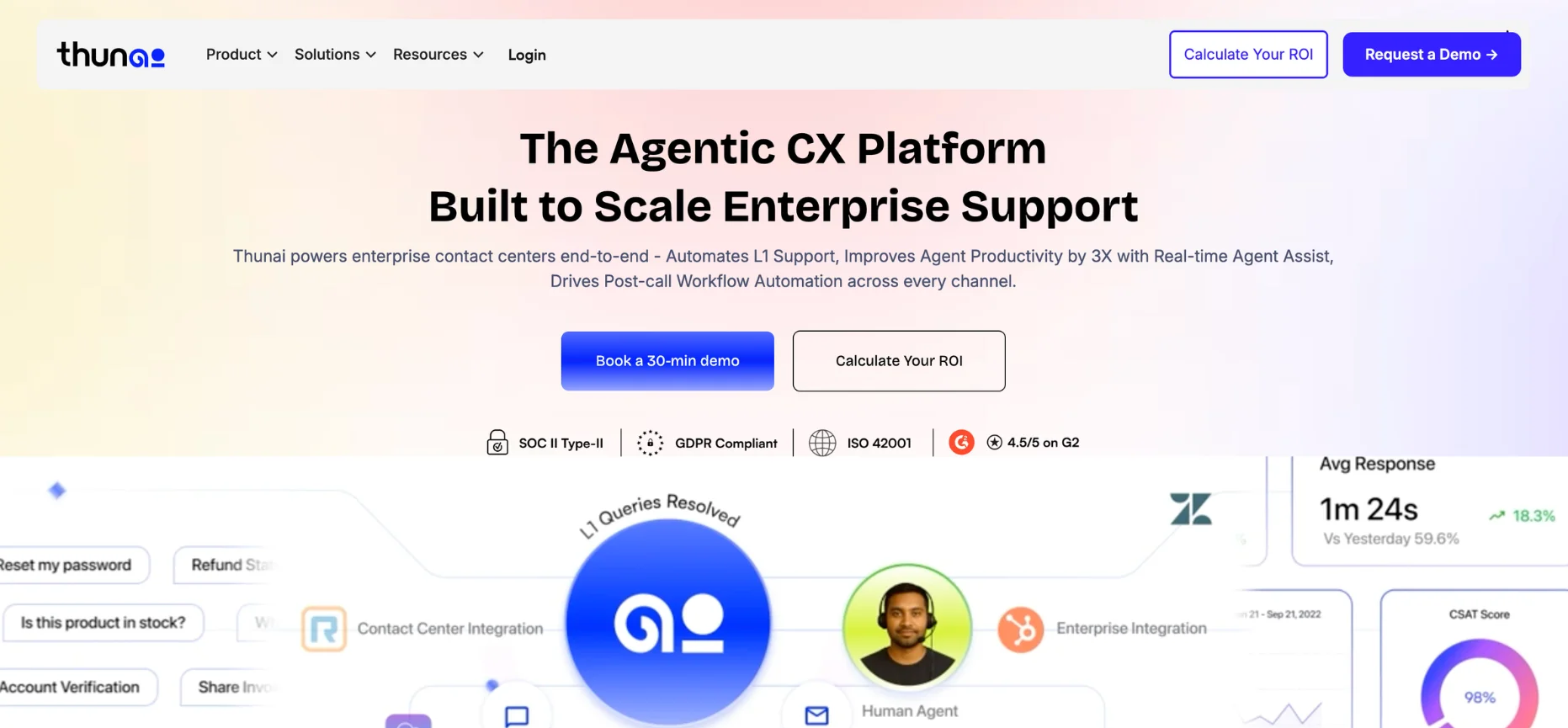
Thunai is an agentic AI middleware platform that takes your siloed organizational data and turns it into a single executing intelligence (without contradictions).
Thunai fixes the underlying data problem first, and that is what makes everything else work with SOC-II, GDPR, and ISO 420001 compliance.
This is the best AI-powered chatbot platform for enterprises wanting fast deployment, unified knowledge management, and agentic automation.
This happens across voice, chat, and email without a six-month setup or a six-figure price tag.
Not to mention, Thunai also protects sensitive data using its feature Thunai Safemind and role-based access control.
Features:
- Thunai Brain: The core intelligence layer scans 50-plus enterprise apps and documents using Contradiction and Relationship Resolution algorithms to flag conflicting data before the AI speaks to any customer.
- Agent Studio: A no-code builder for deploying Voice, Chat, Email, and Meeting Agents in minutes. Agents work together through MCP. Meaning, a Voice Agent can handle a call, update the CRM, and hand notes to an Email Agent all on its own.
- Thunai MCP: Thunai also comes with its own MCP layer, making it ready to integrate with whatever tools you already use, like Salesforce, ServiceNow, HubSpot, and so on.
- Revenue AI: Watches every call and email to score deal likelihood, flag churn signals, and surface buying intent.
Pros:
- Contradiction Resolution Engine: Unlike other platforms, Thunai comes with a contradiction removal engine that settles on the right answer after confirming the same with admins.
- Compliance Ready: Holds GDPR, SOC 2, and ISO 27001 certifications, giving enterprise procurement teams the documentation they need to move quickly through security reviews.
Cons:
- Initial Setup: Connecting the full agentic node system to older systems can take a few days to iron out bugs.
2. Voiceflow
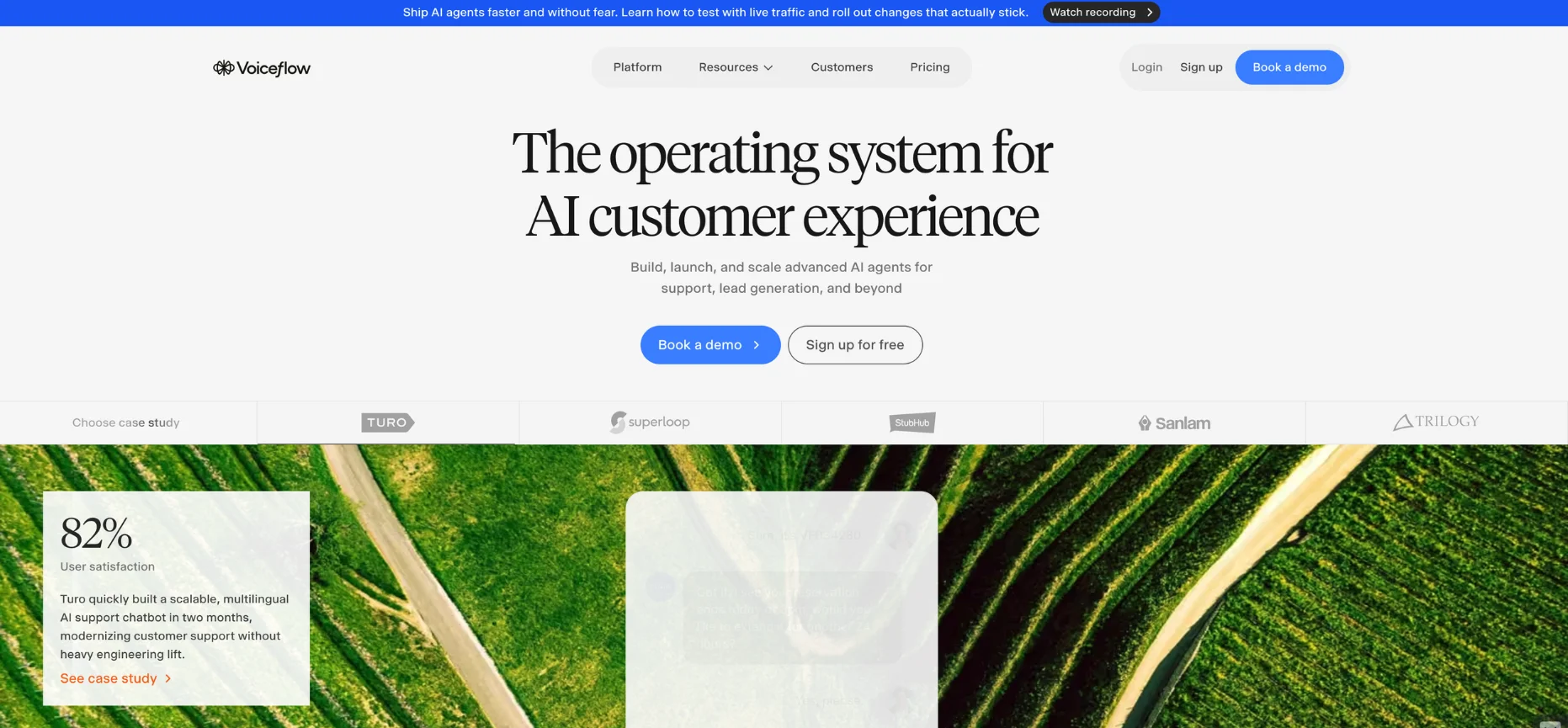
Voiceflow is a visual conversation design platform built for teams that want to prototype, test, and deploy AI agents together.
That said, this AI chatbot for customer support works best when your team has a mix of designers, product managers, and developers who need to move fast on agent logic without waiting on engineering cycles.
This is one of the top AI-powered chatbot platforms for product and engineering teams needing a visual-first environment.
This is to design, test, and hand off AI agent logic across and for different CX automation workflows.
Features:
- Visual Canvas Builder. A Figma-style drag-and-drop canvas for designing full conversation flows with real-time multiplayer collaboration, multi-LLM support, and built-in vector document storage for RAG-driven answers without extra setup.
- Open APIs and SDKs. Teams can export visual logic into custom software stacks via open APIs and SDKs. In doing so, they avoid platform lock-in and keep full control over their deployment environment.
- Version Control and Testing. Real-time comment threads, version history, and a built-in testing tool let teams audit conversation flows before going live. This gives non-technical stakeholders clear visibility into what the AI will actually say.
Pros:
- Collaborative Design: One of the most intuitive visual builders for multi-person teams, closing the gap between a designer's intent and a developer's final build.
- LLM Flexibility: Native support for multiple model providers means teams are not stuck with one AI engine and can route to cheaper or faster models depending on the query type.
Cons:
- Seat Cost Creep: Every additional editor adds $50/month. A five-person Pro team pays $260/month rather than $60. That math changes quickly for growing teams.
- Voice Testing Gap: The built-in emulator is built for text. Voice-specific testing requires manual wiring to external telephony like Twilio, which adds extra steps for voice-first deployments.
3. Tidio
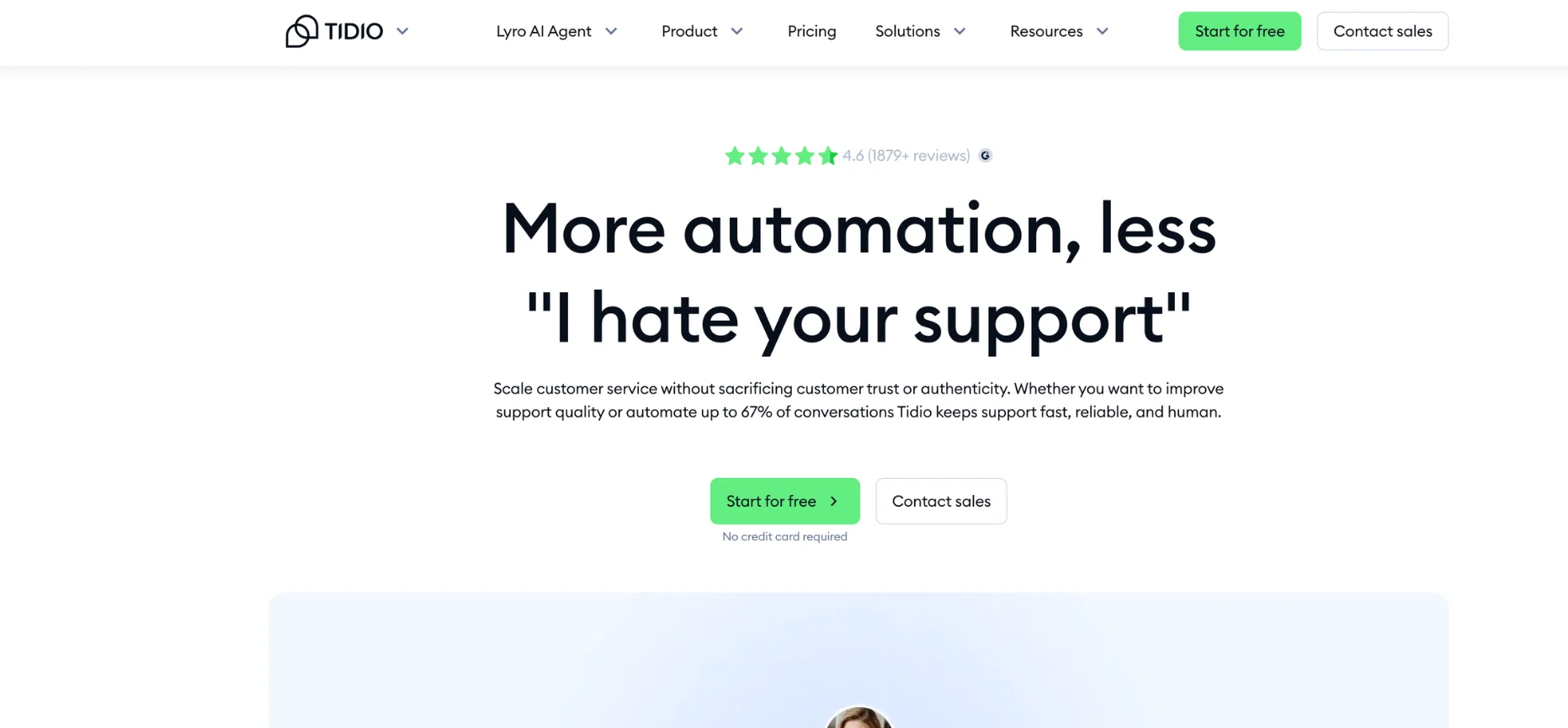
If you are running a Shopify or WooCommerce store and want a tool that can work in under an hour, Tidio delivers just that and quite well.
This is the best AI-powered chatbot platform for Small e-commerce stores on Shopify or WooCommerce needing fast, no-code setup.
On the whole, this enterprise chatbot platform comes with live chat, basic AI support, and order tracking automation right out of the box - making it a popular option for e-commerce stores.
Features:
- Lyro AI Agent. Powered by Anthropic's Claude, Lyro handles e-commerce order tracking, account tasks, and proactive cart actions by pulling from help center URLs, PDFs, and Q&A databases automatically.
- Visual Automation Flows. A no-code flow builder with pre-built e-commerce templates and a 15-minute widget setup. Most users are alive and running before their morning coffee is cold.
- Unified Inbox. Live chat, email, and ticketing arrive in a single inbox with a mobile app, so small support teams stay on top of things without jumping between tabs all day.
Pros:
- Fast Deployment: A 15-minute setup with visual templates gives Tidio one of the lowest barriers to entry on this list. That makes it ideal for lean teams with no IT support on hand.
- Shopify Native: Deep Shopify and WooCommerce connections make Tidio a practical first step for e-commerce businesses that want AI support without a complex buying process.
Cons:
- Pricing Cliff: This is a serious trap for businesses that outgrow the basic plan.
- AI as an Add-On: The real cost of using AI features runs much higher than the headline price suggests.
4. Intercom
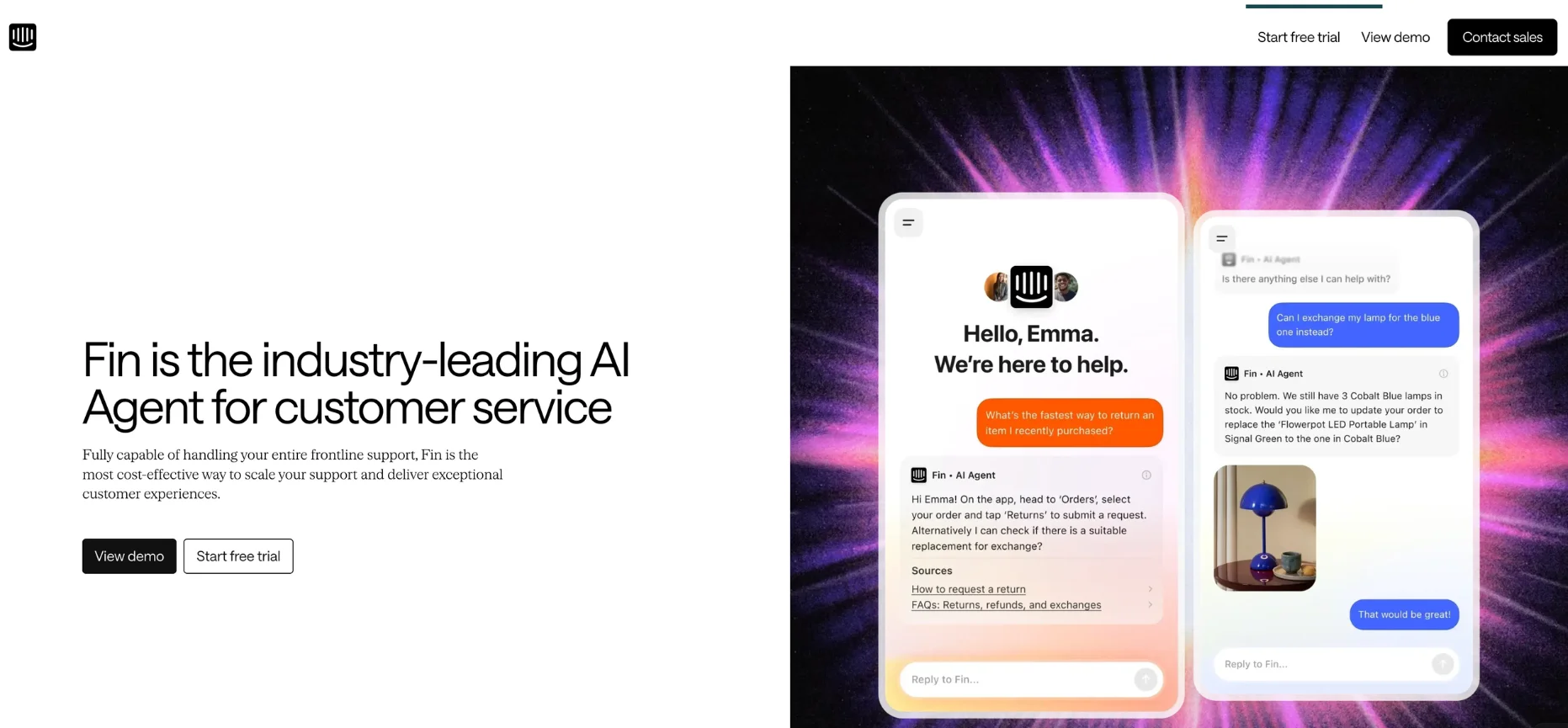
For SaaS companies already deep in the Intercom ecosystem, Fin is an AI chatbot for customer support that adds real automation value. That said, its billing model demands close attention before you scale.
This is one of the top AI-powered chatbot platform for funded B2B SaaS companies already using Intercom.
Especially those that need accurate, knowledge-base-driven AI resolution and an agent copilot built into a single inbox.
Features:
- Fin AI Agent. Resolves complex support queries using RAG over synced help documents and CRM data. Fin ranks among the more accurate AI agents for knowledge-heavy B2B products, handling multi-step questions.
- Fin AI Copilot. An internal sidebar that auto-drafts replies, summarizes long threads, and suggests next steps in real time. This, in turn, cuts average handle time for high-volume support teams.
- Proactive Support Plus. Sends targeted in-app guides, checklists, and mobile push notifications based on user behavior. For SaaS products, where onboarding drop-off costs revenue.
Pros:
- Ecosystem Depth: For teams using Intercom for sales and marketing, adding Fin creates a unified customer lifecycle view that few platforms can match right out of the box
- Resolution Accuracy: Fin's performance on complex, multi-part knowledge base queries is consistently rated among the strongest in the B2B space by G2 reviewers.
Cons:
- Billing Shock Risk: A $4,000 monthly seat bill can climb past $9,000 once AI resolution surcharges are added at scale.
- Knowledge Hygiene Burden: Keeping Fin accurate requires 3 to 5 hours per week, updating and auditing help documentation.
5. LivePerson
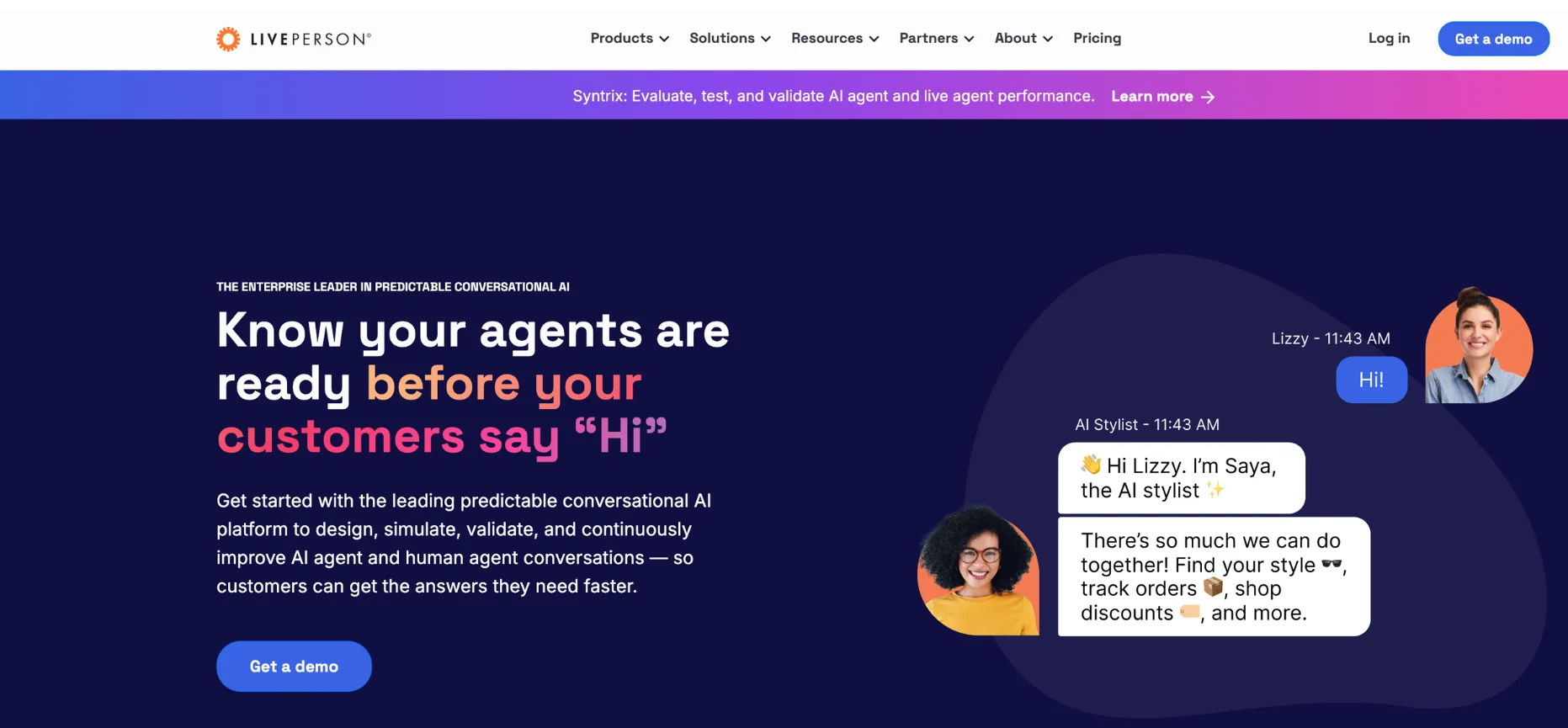
LivePerson is a veteran enterprise AI chatbot for customer support for managing nearly one billion conversational interactions monthly across some of the world's largest consumer brands.
This is one of the best AI-powered chatbot platforms for large enterprise contact centers handling hundreds of thousands of monthly conversations across multiple channels.
The tool works for teams that need proven infrastructure, co-browsing, and real-time sentiment analysis at scale.
Features:
- Conversational Cloud. Acts as an omnichannel AI chatbot coordinating across SMS, WhatsApp, Apple Business Chat, web chat, and voice with advanced natural language understanding built in.
- Real-Time Sentiment Analysis. Flags angry or high-risk customers mid-conversation, giving agents emotional context before they respond. That is especially useful in claims-heavy industries.
- Co-Browsing and Conversation Archiving. Live agents can view and navigate a customer's browser in real time for guided support. Full conversation archiving gives regulated operations the audit trail they need to stay compliant.
Pros:
- Proven Scale: A billion monthly interactions is not a marketing claim. That is hard evidence that LivePerson can handle the volume of the world's largest contact centers without breaking down.
- Security: Enterprise-grade encryption and compliance controls make LivePerson one of the most trusted platforms in regulated industries where data handling is a legal requirement, not a preference.
Cons:
- Long Deployment Timeline: Setup averages two months, with a 19-month average ROI cycle on G2.
- Opaque Pricing: Conversation-based billing combined with seasonal volume spikes makes budget planning genuinely difficult.
6. Botpress
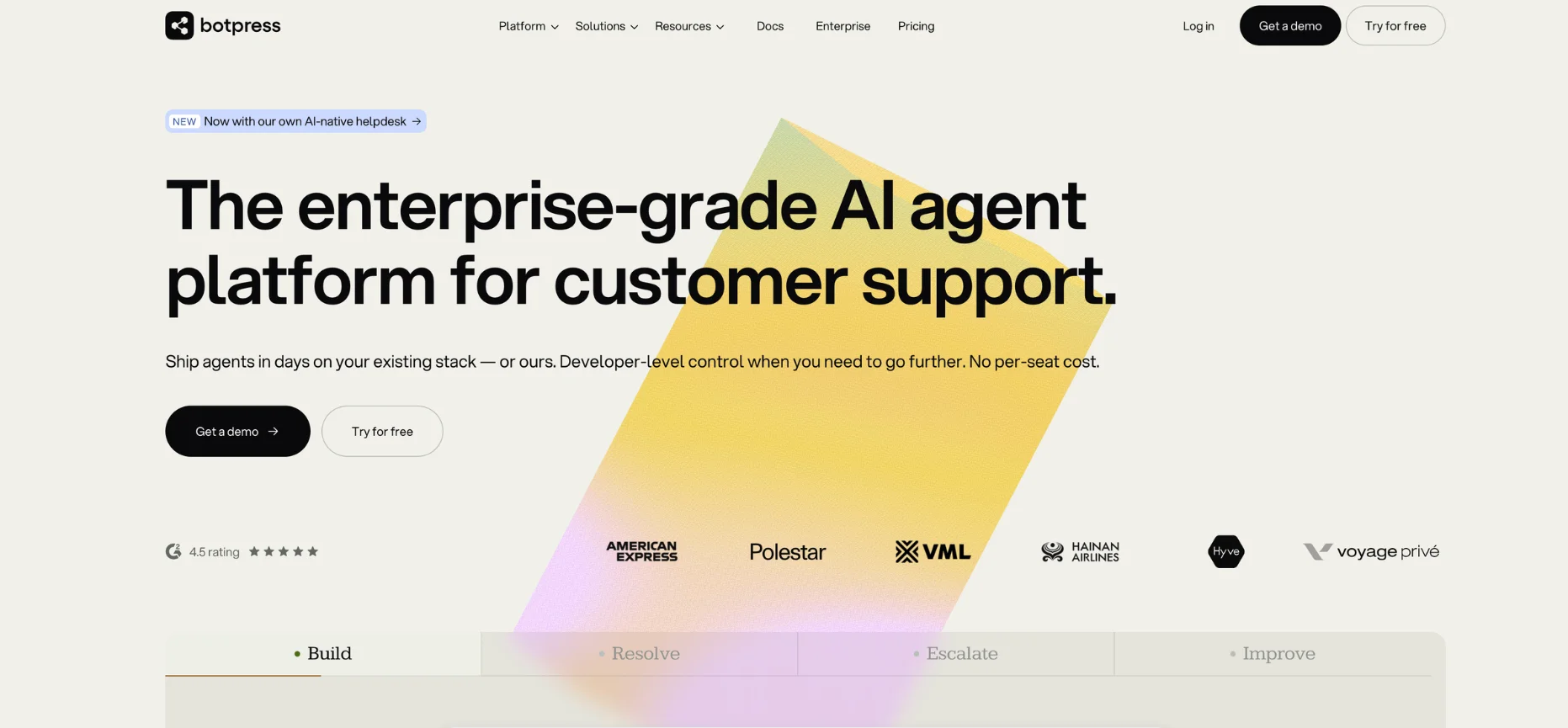
Powerful, model-agnostic, and refreshingly transparent on cost, Botpress rewards teams that know exactly what they want to build.
This is the best AI-powered chatbot platform for engineering teams needing full programmatic control over AI logic.
And overall, Botpress is an AI chatbot for customer support of choice for developer-led teams that want full control over every node, every connection, and every model call without being locked into a vendor's preferred setup.
Features:
- Model-Agnostic Studio. Route queries across OpenAI, Anthropic Claude, and Google Gemini from one visual builder, or inject custom JavaScript via TypeScript SDK for full programmatic control.
- Seatless Licensing. Unlimited human agent access on all paid tiers removes the escalation penalty that bloats costs on hybrid AI platforms where human handoffs happen often.
- Zero-Markup API Costs. AI usage is passed through at true provider rates with no platform markup. For high-volume teams, that cost transparency stands out compared to platforms that hide model costs inside vague usage tiers.
Pros:
- Developer Control: A Visual Studio paired with deep TypeScript code injection gives technical teams no-code speed for simple flows and full precision for complex ones, all inside the same environment.
- Cost Transparency: Knowing exactly what every token costs with no markup makes Botpress one of the most forecastable platforms for engineering-led procurement teams.
Cons:
- Non-Technical Barrier: Visual Studio has a steep learning curve for business users without a technical background.
- Accuracy Risk at Scale: Technical audits show accuracy drops when loading 10 to 15 or more product specifications into automated knowledge bases.
7. UChat
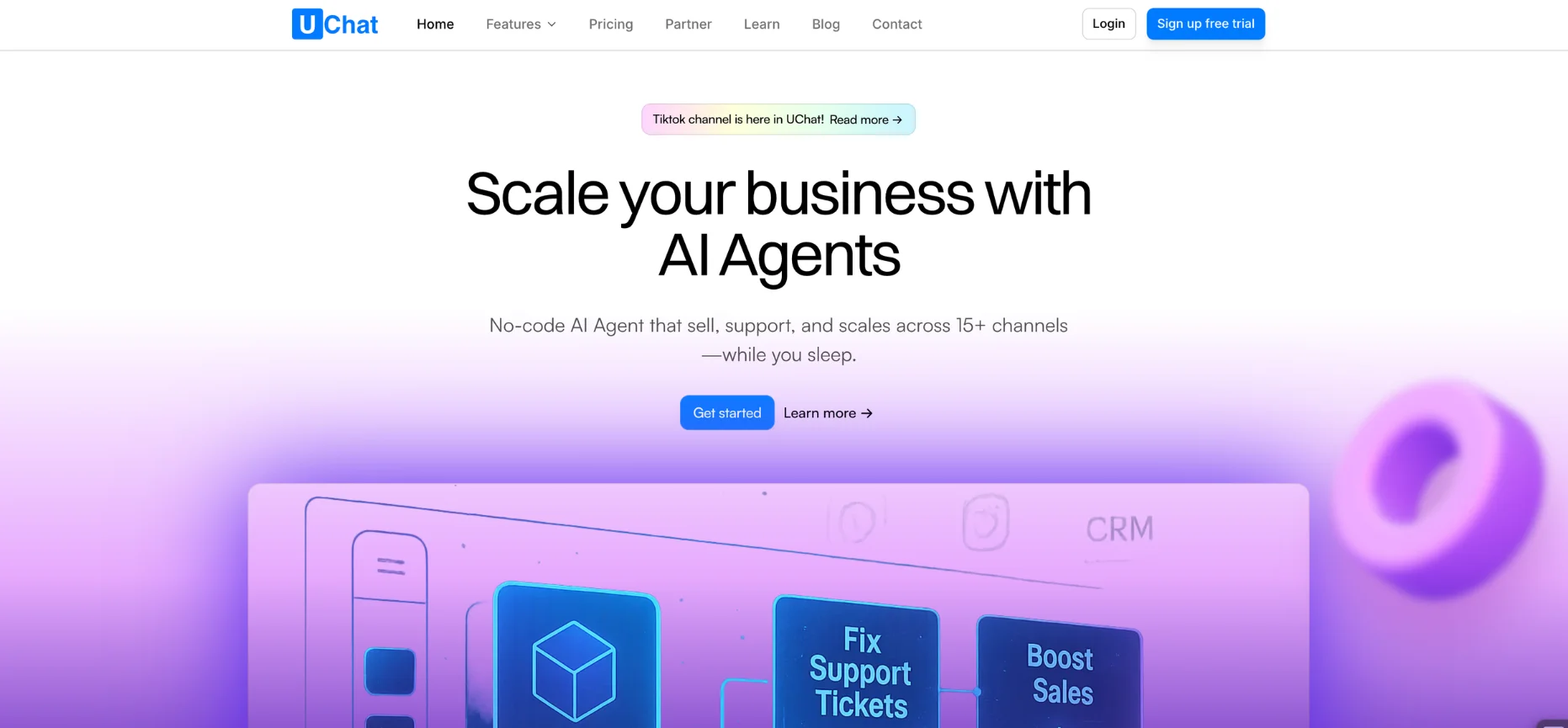
For agencies and marketing teams managing client conversations across WhatsApp, Instagram, Telegram, and the web at the same time, UChat keeps software costs stable as the channel count grows.
This is one of the top AI-powered chatbot platforms for marketing agencies and resellers needing white-label omnichannel automation.
The tool itself works across 12 channels with predictable per-workspace pricing and full control over client margins.
Features:
- 12-Channel Native Reach. Automates conversations across WhatsApp, Messenger, Instagram, Telegram, LINE, WeChat, Viber, Slack, VK, SMS, voice, and web chat from one builder. Multi-LLM support works through drag-and-drop, with no coding required.
- Agency White-Label Partner Tier. The $199/month Partner plan unlocks full white-labeling, custom domain mapping, and a customizable checkout system. Agencies keep 100% of profit above UChat's base workspace costs. Meaning, the margin structure is entirely in your hands.
- Shopify and WooCommerce Catalog Sync. Direct e-commerce catalog connections let bots surface product details, manage order lookups, and trigger cart actions natively without needing a third-party layer between the bot and the store.
Pros:
- Channel Coverage: No other platform on this list matches UChat's native 12-channel reach at its price point. That makes it especially strong for businesses where customer conversations happen across multiple messaging apps at once.
- Responsive Support: A 9.4 out of 10 support score on G2 and a library of 700-plus YouTube training videos make UChat accessible for teams without a dedicated setup partner.
Cons:
- Workspace-Locked Licenses: Paid licenses are permanently tied to the workspace they are created in. Deleting a workspace permanently destroys the license.
- Single Flow Limitation: The platform only supports one visual flow for omnichannel bots.
8. Kore AI
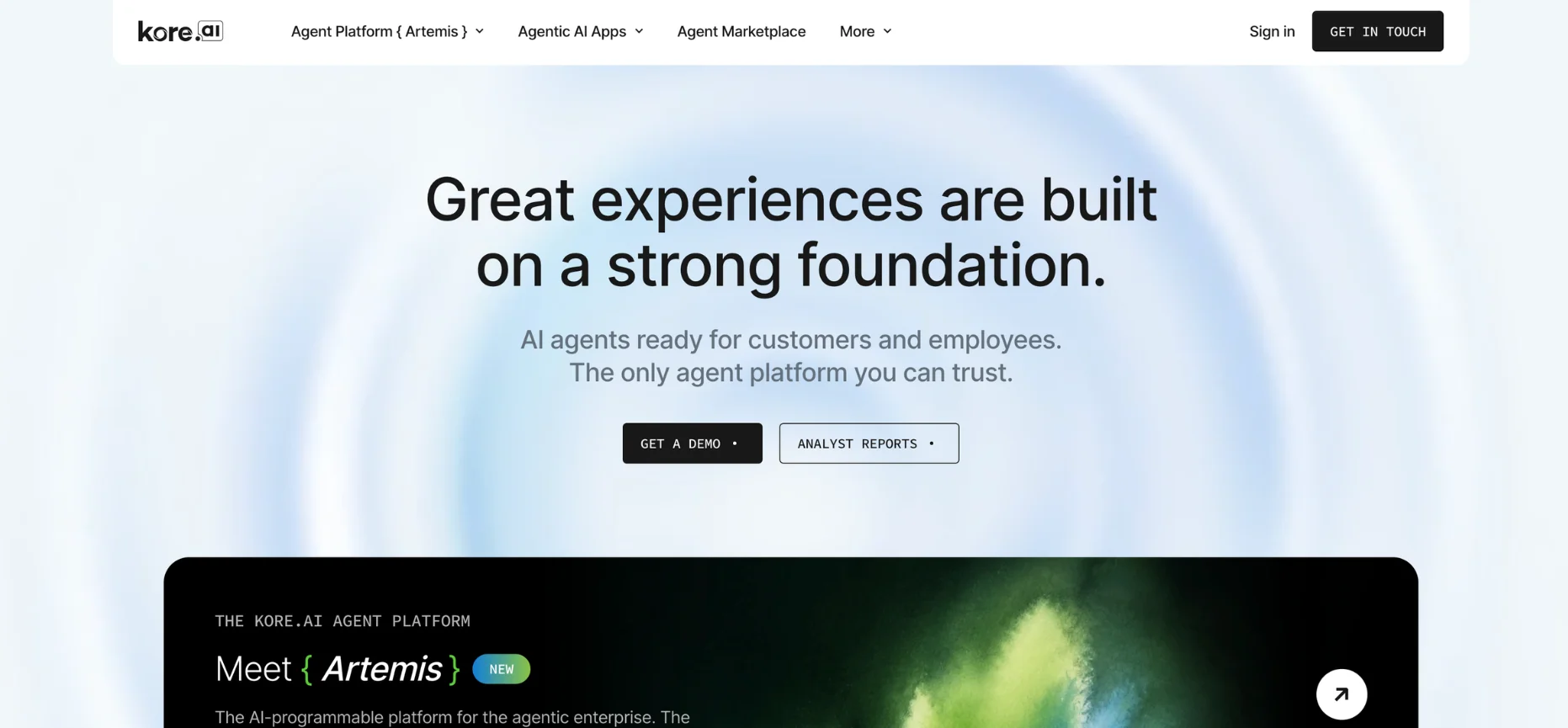
Kore.ai is a conversational AI enterprise platform built for Fortune 2000 companies that need deep governance, precise natural language understanding, and complex multi-agent coordination at scale.
Kore.ai comes with an enterprise price tag and setup timeline to match.
This is the best AI-powered chatbot platform for Fortune 2000 enterprises in banking, healthcare, and regulated industries.
Kore AI comes with NLU precision, strict data residency controls, and native CCaaS telephony connections.
Features:
- XO Platform and XO-GPT Models. Proprietary fine-tuned language models that need less than 2% of the standard enterprise training data used by commercial cloud models. This is paired with a visual Dialog Task editor and Knowledge Graph FAQ engine.
- GALE for Secure Enterprise Deployment. Deploys generative AI without exposing proprietary data to public model training pipelines. For regulated industries where data residency is non-negotiable.
- SmartAssist CCaaS Connection. Links directly to enterprise telephony systems for full voice automation, routing intelligence, and live agent assist within a single governance framework.
Pros:
- NLU Precision: Kore.ai's natural language understanding engine is consistently rated among the most accurate on the market, especially for complex, multi-intent queries in specialized enterprise contexts.
- Governance at Scale: Compliance depth and data residency controls give banking, healthcare, and government procurement teams a level of enterprise readiness that few competitors can match.
Cons:
- Session Billing Inflation: This can push actual costs 40 to 60% above what a simple conversation count would suggest.
- Long Setup Timeline: Complex banking or healthcare environments average 6 to 18 months from purchase to production.
9. Manychat

Manychat is the top platform for social media and messaging automation, used by over one million business accounts across 170 countries.
This is one of the best AI-powered chatbot platforms for e-commerce brands and social media creators.
This applies especially for anyone needing high-converting Instagram and Facebook DM automation with comment-to-buy flows and campaign templates ready to deploy in hours.
Features:
- Comment-to-Buy Automation. Turns post comments and story replies into automated DM conversations that qualify leads and drive purchases. Instagram comment automations alone have delivered 80% open rates and up to 56% click-through rates for e-commerce brands.
- Visual Flow Builder. A drag-and-drop Flow Builder with Manychat AI powered by GPT-4o lets teams auto-generate copy, map intent, and personalize message sequences at scale without a copywriter in the loop.
- Multi-Channel Social Reach. Automates conversations across Instagram, WhatsApp, Messenger, TikTok, Telegram, SMS, and email from one platform, covering every channel social-first brands actually use.
Pros:
- Social Conversion Rates: No platform on this list delivers higher open and click-through rates in social messaging contexts. For e-commerce and creator brands, the conversion numbers are compelling and well-documented.
- Speed to Launch: Template-driven setup means most campaigns are live within hours, with no technical knowledge needed to start seeing results from day one.
Cons:
- Billing Model Change: For seasonal businesses with irregular traffic, this significantly raises monthly costs.
- Narrow Use Case: Manychat is built for social and messaging automation. That said, it was not designed for enterprise support, CRM workflows, or voice.
10. Yellow AI
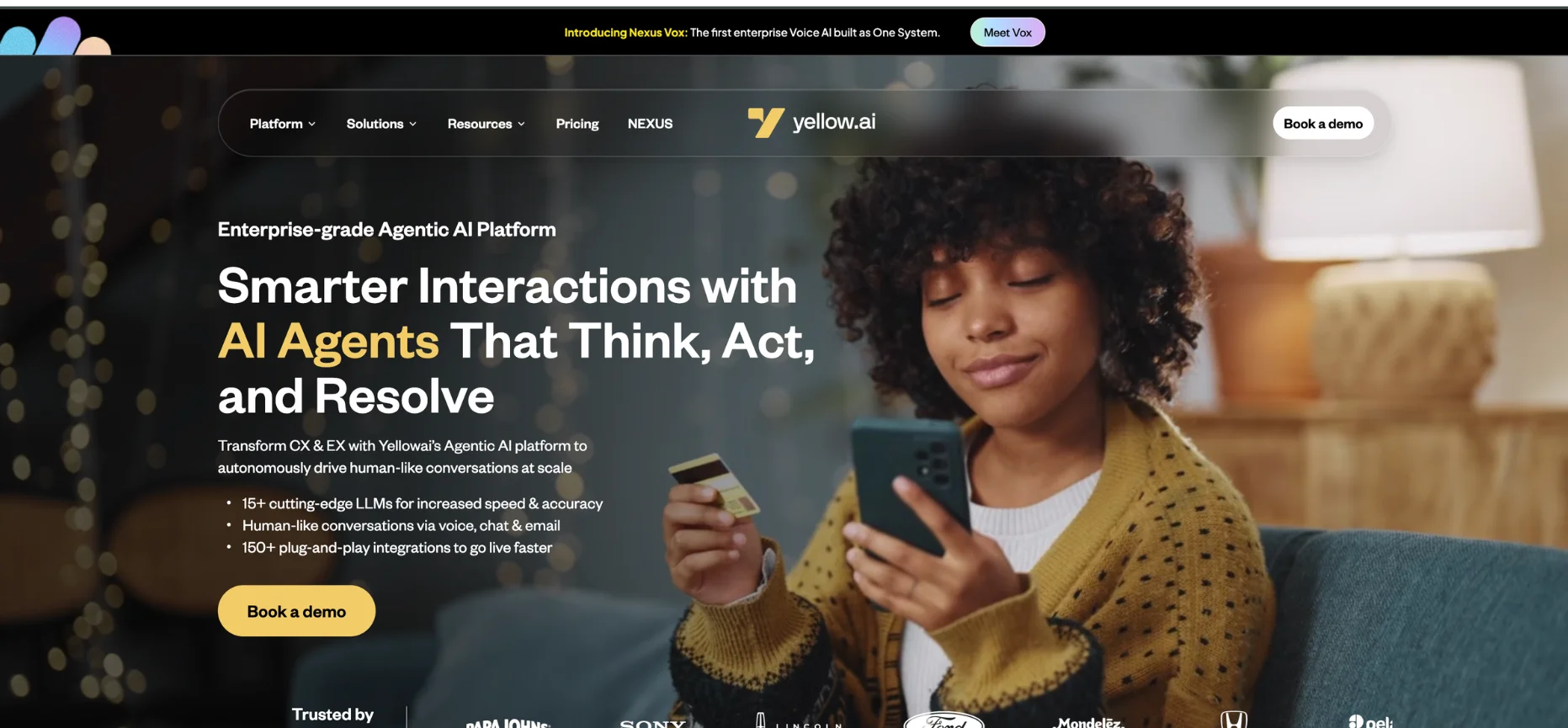
Yellow.ai is a major conversational AI enterprise platform built for the global enterprise market.
This is the best AI-powered chatbot platform for Global enterprises across South and Southeast Asia needing native support in 135+ languages.
This blended dialect handling and RBI-compliant billing for Indian markets also make it a suitable chatbot for fintech and BFSI CX automation.
Features:
- Dynamic Automation Platform and Nexus Vox. Coordinates over 15 LLMs across 135-plus languages and 35-plus messaging and telephony channels.
- Campaign Management Tools. Outbound campaign management with live agent handoff logic built in. Meaning, enterprises need both inbound automation and proactive outreach.
- Regional Billing Compliance. An established Bangalore entity manages invoicing and UPI autopay within the RBI's domestic payment framework. This sidesteps the 28 to 36% card decline rates that global SaaS platforms face in India.
Pros:
- Multilingual Depth: Support for blended dialects like Hinglish and Tanglish alongside 135-plus languages makes Yellow.ai the strongest platform on this list for enterprise operations in South and Southeast Asia.
- India Payment System: Domestic payment handling is a practical operational advantage for enterprises managing subscriptions and billing in India that global platforms simply cannot match without workarounds.
Cons:
- Code Editor Bug Risk: Custom cloud function scripts can erase themselves if run with syntax errors.
- Long Setup Timeline: Setup averages four months with a 14-month ROI timeline on G2.
How Thunai Handles What Other AI Chatbot Platforms Get Wrong
Most AI-powered chatbot platforms assume your data is clean. But by doing so, they skip the problem that causes most AI failures.
Years of unedited internal wikis, contradictory policy PDFs, and fragmented SharePoint drives are the reality inside every enterprise. But Thunai is the best enterprise chatbot in 2026 as it helps fix this for enterprise teams by:
- Thunai fixes the data before fixing the conversation. Thunai Brain scans connected enterprise systems, flags policy contradictions, and surfaces them for review before the AI responds to anyone. This single step cuts wrong answer rates by up to 95% without building a single hard-coded flow - with a complete centralized knowledgebase.
- Deploys in days, not months. While AI-powered chatbot platforms like Sierra and Parloa require six to twelve months of consultative setup and a full replacement of your existing support stack, Thunai connects to your existing CCaaS, CRM, and helpdesk tools via native APIs in under two days.
- Thunai runs on real-time data streaming. Built on Confluent, Apache Kafka, and Apache Flink, Thunai pulls in live call transcripts, CRM events, and workflow updates without relying on batch database updates. Live Agent Assist latency stays under 50 milliseconds.
- A multi-agent ecosystem via MCP. Where most AI-powered chatbot platforms run isolated bots, Thunai's Voice, Chat, Email, and Meeting Agents share context continuously. When the Meeting Agent transcribes an internal product update, that information is immediately available to the external-facing Chat Agent.
Which AI Chatbot Platform Is Right for Your Business Size?
Matching platform strength to business scale is one of the most important decisions in this buying process. A platform built for a global banking contact center will overwhelm a mid-market SaaS team.
A lightweight e-commerce widget will completely lack the governance a Fortune 500 company needs. Here is a clear framework for AI-powered chatbot platforms.
Enterprise Contact Centers and Regulated Industries
- Enterprise (500-plus seats): Thunai AI, Kore AI, LivePerson
- Use Cases: Banking and financial services, healthcare, global logistics, government operations
- Priority Features: Deep telephony connections, strict regulatory compliance, multi-agent coordination, data residency controls
Mid-Market and B2B SaaS
- Mid-Market (20 to 200 seats): Thunai AI, Intercom, Botpress
- Use Cases: B2B software support, sales automation, customer success operations
- Priority Features: CRM connection depth, predictable pricing, AI copilot for human agents, knowledge base automation
Small Business and E-Commerce
- Small Business (1 to 20 seats): Tidio, UChat, Manychat
- Use Cases: Shopify and WooCommerce stores, social media marketing, local service businesses
- Priority Features: Fast setup, e-commerce platform connection, social channel automation, low entry cost
Developer and Agency Teams
- Technical Teams: Botpress, Voiceflow, UChat Partner
- Use Cases: Custom AI agent builds, white-label agency resale, multi-client automation management
- Priority Features: Open APIs, self-hosting options, model-agnostic architecture, white-label options
How to Buy an AI Chatbot Platform Without Getting Burned
Sales demos are built on clean data running over fast connections. Meaning, these calls rarely tell you what happens when a customer sends a half-typed question at 11 PM from a spotty mobile connection.
So, here is how to test AI-powered chatbot platforms against reality rather than a curated presentation.
- Define Your Success Metrics Before the Demo: Enter vendor talks with specific targets: containment rate, response time, CSAT, and revenue. No POC against your numbers = no shortlist.
- Audit Native Versus Third-Party Connections: Ask exactly how integrations work. Middleware like Zapier is a single point of failure. Meaning, if this layer goes down, your entire support pipeline goes with it.
- Stress-Test the Escalation Logic: Ask a hard question during the demo. Does it loop, hallucinate, or hand off gracefully with context? Escalation is where most platforms fail customers.
- Ask How the AI Updates Its Knowledge: How fast do policy changes go live? Some take hours; others sync in near real time. For fast-moving businesses, this gap has a direct revenue impact.
- Calculate the Cost at Three Times Your Current Volume: Model pricing at 1×, 3×, and 10× volume. Per-resolution billing can double or triple costs during traffic spikes. Overall, this is something worth knowing before signing.
5 Mistakes Companies Make When Deploying AI Chatbot Platforms
The post-mortem on most failed AI-powered chatbot platform deployments points to the same avoidable errors. Technology is rarely the problem. The organizational approach almost always is.
- Judging the Platform on a Polished Demo. Demos use clean data and ideal conditions. Test your AI-powered chatbot platforms against real historical support conversations aspects like slang, typos, and performance during off-hours before you commit.
- Skipping Knowledge Base Hygiene. Feeding AI years of contradictory wikis and outdated PDFs produces wrong answers. Data cleanup must happen before deployment, not after brand damage occurs.
- Optimizing for Deflection Instead of Resolution. AI-powered chatbot platforms that frustrate customers into giving up has deflected a ticket and lost a customer. Measure issues resolved, not tickets deflected. In this case chatbot deflection rate is less of a priority rather than AHT or CSAT.
- Treating Deployment as a One-Time IT Project. AI needs ongoing log reviews, escalation analysis, prompt refinement, and knowledge updates. Set it and forget it, and failures will silently compound.
- Letting LLMs Execute Unguarded Business Logic. Wrong actions like unauthorized refunds, invalid discounts can create real liability for you and your company. Every high-risk action must sit behind a deterministic rules layer outside the LLM.
Want to see how Thunai avoids this?
Book a free Thunai demo and run it against your real support scenarios before you commit.
Frequently Asked Questions About AI-Powered Chatbot Platforms
What is the difference between conversational AI and agentic AI?
Conversational AI handles communication. Agentic AI takes multi-step action on its own, verifying users, updating records, and closing workflows without waiting for a human at each step.
What is the Model Context Protocol and why does it matter?
MCP lets separate AI agents share context and pass tasks without losing state. A Voice Agent handles a call, hands it to an Email Agent, and updates the CRM. All of that happens in sequence, without any human stepping in.
How long does it take to deploy an AI chatbot platform?
Traditional enterprise AI-powered chatbot platforms average 6 to 12 months. Modern platforms with native API connections can go live in days. Thunai connects to existing CRM, CCaaS, and helpdesk tools in under two days with zero downtime.
Can AI chatbot platforms replace human support agents?
No. Seventy-five percent of CX leaders see AI-powered chatbot platforms as a tools for amplifying human work, not cutting headcount. Agentic AI handles repetitive tasks so human agents can focus on the complex conversations that actually need judgment and empathy.



.png)
