
What if you could catch fraud before the first call even ends? When we built AI tools for major insurance carriers, I sat side by side with SIU leaders and watched sharp investigators drown in flags raised days or weeks after that first call.
By then, the evidence had gone cold. The industry treated fraud like a math problem to solve at the adjuster's desk, long after the moment that mattered had passed.
This blog breaks down how we rebuilt claims fraud detection from the ground up, starting at the one place fraud actually begins: the intake call.
What claims fraud detection means in 2026
The Modern Definition: In 2026, claims fraud detection is not one score made after a claim is filed. It links early detection, smart referrals, and human investigators, and the skill of telling a real loss apart from a fake one, in real time.
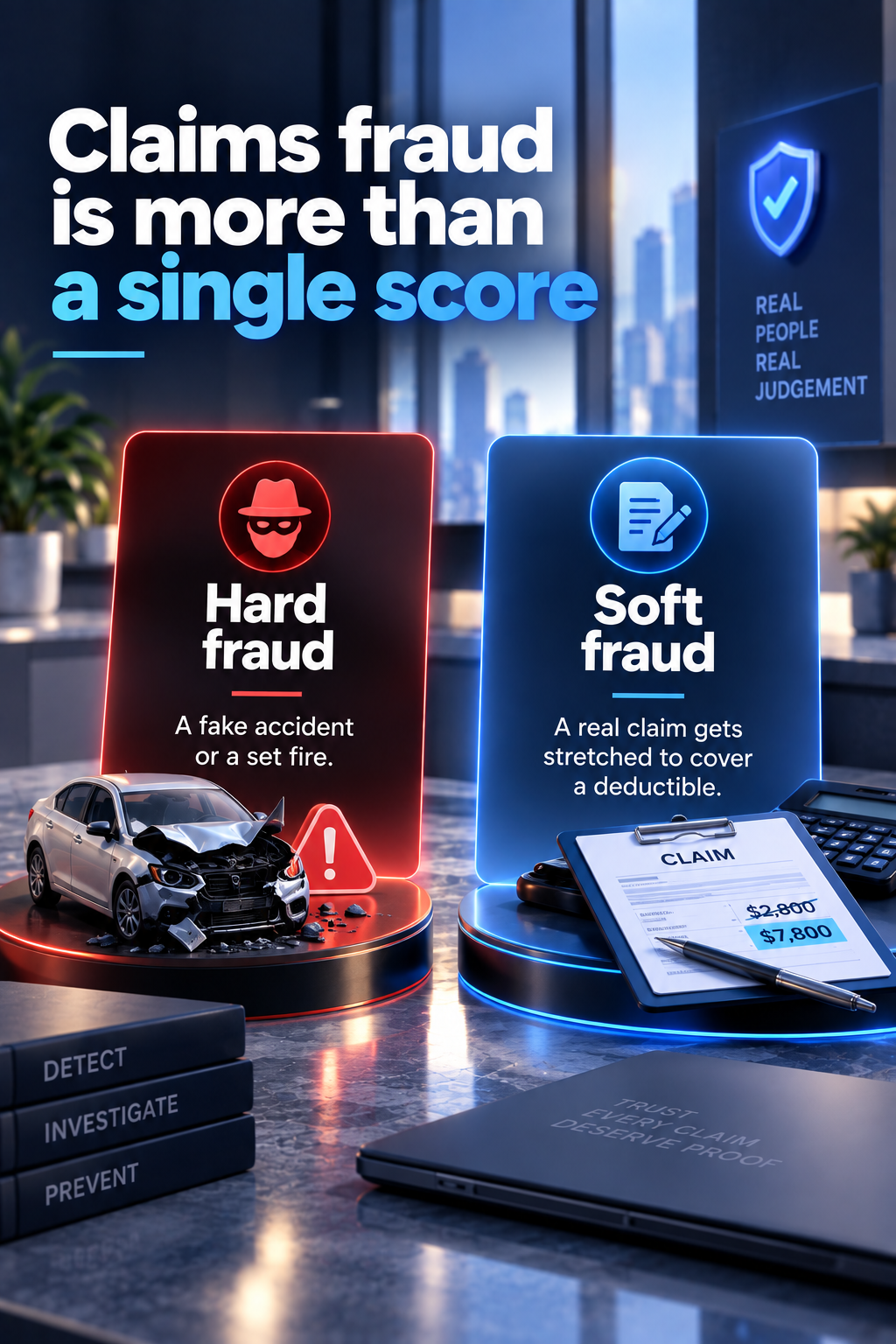
To stop fraud without slowing down honest payouts, systems must catch two kinds of fraud:
- Hard fraud means a fake accident or a set fire.
- Soft fraud means a real claim gets stretched to cover a deductible.
Where fraud actually hides, by typology
Fraud takes different forms, and each leaves different clues. Understanding these signs helps insurers spot fraud across the claims process, where old rule-based systems can easily miss them.
Here’s a shorter, simpler version while keeping the meaning clear:
Network-level clues can be especially useful when several parties appear in the same claim. In one Wipro analysis, 20% of fraudulent claims involved multiple parties, and claims involving multiple parties had a 73% chance of being fraudulent in that dataset.
Why rules engines stopped working
When we looked at older carrier systems, the problems were clear. Rules engines rely on fixed limits.
For example, they may flag a repair bill above a set dollar amount or a claim filed soon after a policy begins.
The problem is that fixed limits can be learned. Skilled fraudsters test the carrier’s rules until they find the exact threshold.
The volume of questionable claims also creates a scale problem. NICB processed 208,956 questionable claim submissions in 2025, showing why manual review alone becomes difficult to sustain.
Data teams struggle to keep up, false alerts increase, and investigators begin to lose trust in the system. This can leave the carrier exposed to new forms of fraud.
Detection techniques compared
To move past simple rules, we built a system with many layers. Each method solves a different problem. Using just one method leaves big gaps.
Carriers looking at AI fraud tools need to know one thing. Supervised models need clean, labeled fraud history.
This is why tools that work with no past data, like our conversational signals, matter most for fast results.
The class-imbalance problem, briefly
With machine learning, overall accuracy can trick you. Most claims are honest, and only a few are fraud.
So a model that says "yes" to every claim can still look accurate. What matters is the balance between two things:
- catching real fraud (recall), and making sure flagged claims really are fraud (precision).
Getting this balance right is the base of any strong fraud program.
The intake conversation is your earliest fraud signal
The biggest lesson for our team was this: the First Notice of Loss (FNOL) call holds the best, most unused proof in the whole process.
Analyzing every voice call, chat, and email creates a more complete data layer for fraud analysis, with consistent information that can be compared across the claim lifecycle.
This broader use of AI in life insurance can also help carriers connect claims data with customer service and policy workflows.
A broader approach to call center optimization can help insurers analyze every voice call, chat, and email as part of a more complete data layer for fraud analysis.
Consistency checking across the claim timeline
Fraud often falls apart when the story changes. A claimant might say on the first call they were alone in the car.
Later, an adjuster's note or a doctor's bill might mention a passenger. No single person can easily catch this across different systems.
Our language tool spots these gaps right away, across the whole timeline. This gives investigators a real edge.
What conversational signals cannot do
Critical Guardrail: Conversational signals are tools for triage. A shaky voice is not proof of a lie.
Someone who just lost their home in a fire will sound upset. That's normal. We built our AI so no single voice signal can ever be the only reason to deny a claim.
The new threat surface: deepfakes and synthetic evidence
Right as we improved our voice tools, a new danger showed up. Cheap AI tools became easy to get.
Bad actors now use them to fake repair bills, copy voices for intake calls, and make damage photos that look real.
Identity-based fraud is also becoming more complex. NICB projected a 49% increase in insurance fraud involving identity theft during 2025.
The human eye can no longer catch this alone. Modern defense needs deep checks on file data and where evidence came from.
Some tools, like C2PA, add a proof trail to images. But most chat apps strip that proof out. To fight this, we mix pixel-level checks with strict checks on where each file came from.
The same AI that helps us catch fraud also makes fraud cheaper to try.
False positives are not free
The Cost of Getting It Wrong: A claim flagged by mistake delays payment to someone who just went through a real loss. This drives away customers, brings complaints, and hurts trust.
What’s even worse is that denying or delaying a claim based on a bad model can bring serious legal trouble under unfair claims laws.
Because a wrong flag causes real harm, raw flag counts mean nothing. What matters is referral precision, how often a flagged claim turns out to be real fraud. That is the true test of a safe program.
From score to action: an SIU referral workflow that does not stall
Even a sharp model is useless if the SIU process gets stuck. We've seen programs where big caseloads and slow manual checks let flagged claims slip through. They got paid with no review at all.
A working system needs clear rules for routing, based on claim type and value. Once a claim crosses that line, the investigator needs a full case file on day one. Our system makes this handoff smooth.
The SIU worker gets the full call, the flagged story gaps, the key data, and the link maps right away.
The goal is not simply to generate a fraud score. The result needs to move quickly to the right person with enough context to act.
That is where insurance workflow automation becomes important, connecting fraud signals with the claims, documentation, and investigation steps that follow.
Explainability and regulatory defensibility
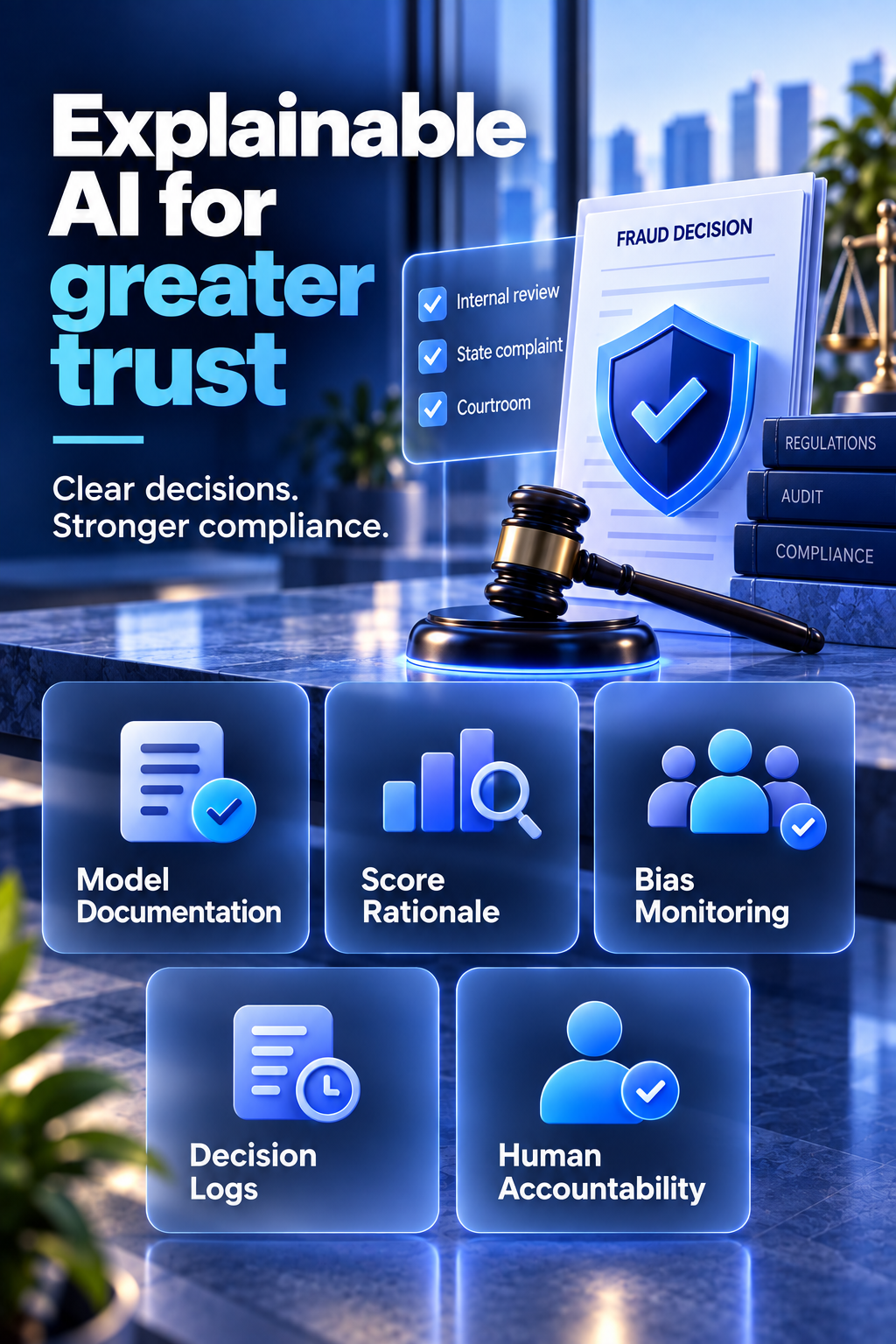
Every fraud flag must hold up under three tests: an internal review, a state complaint, and maybe a courtroom. A model no one can explain is a big risk. To stay safe, we follow strict rules:
- Model Documentation: Clear, tracked records of training data and every model change.
- Score Rationale: Turning model math into plain words (using tools called SHAP and LIME), so investigators know why a claim got flagged.
- Bias Monitoring: Regular checks to make sure the model treats all groups fairly.
- Decision Logs: Permanent records that show what the model said versus what the human chose.
- Human Accountability: One named person is responsible for every denied claim.
The metrics that prove the programme works
Fake, feel-good numbers wear teams down. A big number of "alerts sent" just means the team is close to burning out. We tell carriers to watch these numbers instead:
Build, buy, or extend what you already run
Carriers face a hard choice. Build a custom model from scratch. Buy a brand-new claims system. Or add fraud tools onto the system they already have.
Total cost drives this choice. Building takes a lot of data work and constant checking. Buying a new system disrupts daily work. We think adding tools to your current system is the fastest way to see results.
A 120-day rollout sequence
Fraud tools should not take years to set up. We walk partners through four steps, so they see value fast while keeping risk low:
- Days 1–30 (Baseline & Instrument): Measure how much fraud slips through now. Set a starting point for referral precision. Start capturing call data at intake.
- Days 31–60 (Triage Deployment): Turn on triage routing for one busy line of business. Adjust the limits to match how many cases SIU can handle.
- Days 61–90 (Verification Expansion): Add document checks and photo checks to catch deepfakes.
- Days 91–120 (Network Activation): Turn on link analysis to catch fraud rings across claims. Set clear goals and stop points for the whole program.
How Thunai fits a claims operation
Thunai focuses on the conversation layer, not pricing or underwriting. At intake, its voice tools capture FNOL data, flag story gaps and unusual behavior, support adjusters in real time, create call summaries, and send case details to the SIU team.
This approach fits into existing enterprise contact centre environments and CRM systems rather than requiring a complete system overhaul.
It gives insurers a way to add conversational intelligence to existing workflows while helping teams review claims more efficiently.
Turn FNOL conversations into fraud signals. Book a demo now!
FAQs on Claim Fraud Detection
1. How does AI detect insurance fraud?
AI spots fraud patterns, unusual behavior, claim gaps, and links between claims, and also checks documents and images and flags claims for human review.
2. What percentage of insurance claims are fraudulent?
There is no fixed percentage because fraud rates vary by insurance line and definition. Carriers should focus on finding fraud patterns within their own claims data.
3. Can AI-generated photos and deepfakes beat claims fraud checks?
Yes. AI-generated photos, fake documents, and cloned voices can make fraud harder to spot. Carriers need file checks, proof trails, and cross-checks across multiple sources.
4. What is a good fraud referral precision rate?
There is no single target because it depends on the carrier, claim type, and SIU capacity, and the goal is to send useful referrals without overwhelming the team with false flags.
5. Do fraud detection models need to be explainable?
Yes. Fraud flags should have clear reasons, audit trails, and fairness checks, which help teams defend decisions during reviews, complaints, or legal challenges.