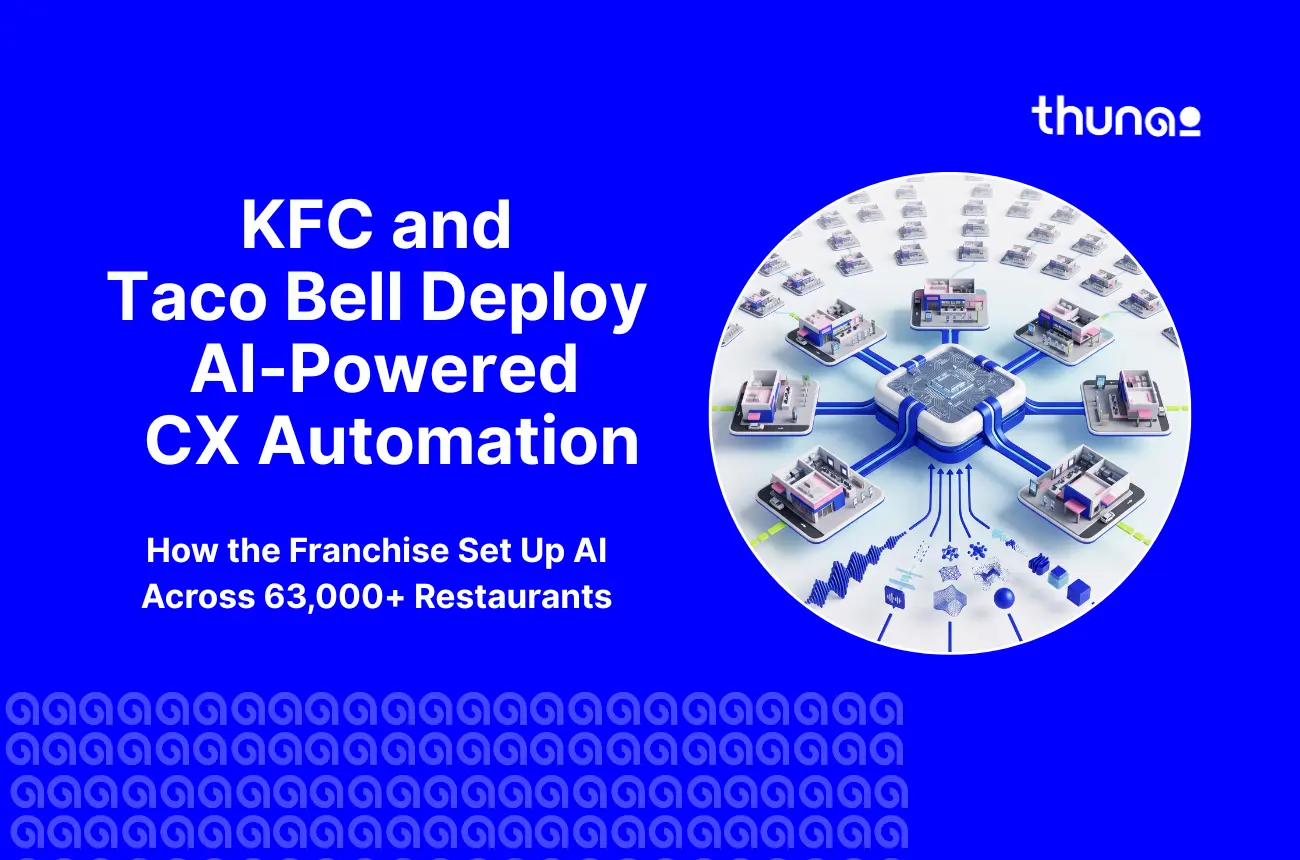

Yum! Brands confirmed in August 2026 that KFC and Taco Bell have moved artificial intelligence out of pilot mode and into daily operations.
Jim Dausch, the company's Chief Digital and Technology Officer, is leading a rollout that touches nearly all of Yum's 63,000 restaurants worldwide, including KFC, Taco Bell, Pizza Hut, and Habit Burger and Grill.
But that 63,000 number needs some unpacking. Taco Bell's Voice AI ordering system runs in about 900 U.S. drive-thru locations, not all 63,000 stores.
What's actually live everywhere is Byte by Yum, a data platform now running in more than 25,000 restaurants. Voice ordering, dynamic menu boards, and the rest of the customer-facing tools all sit on top of that one foundation.
How Yum Brands Built the AI Infrastructure Behind KFC and Taco Bell's CX Automation
Before a single customer ever talks to an AI drive-thru, Yum had a much less glamorous problem to solve: fragmented data. Independent franchisees run about 98% of Yum's restaurants.
For years, each brand leaned on separate, aging systems for point-of-sale, online ordering, and kitchen management. That's a problem, because AI models can't produce reliable results when they're pulling from outdated records.
- Byte by Yum is a SaaS platform built by Yum that pulls point-of-sale, digital ordering, kitchen systems, inventory, delivery, and labor scheduling into one connected system.
- It's already running in more than 25,000 restaurants, replacing older tools like Poseidon POS and the Yum Commerce Platform. Yum also picked Nvidia's small language models over heavier, general AI. The goal: faster response times and full ownership of its own data.
- The result is that every AI tool built on top of Byte, from voice ordering to inventory forecasting, pulls from one clean source of truth.

What is KFC and Taco Bell Automating with AI-Powered CX Automation?
With that foundation in place, Yum has automated four layers of the customer experience so far:
- Drive-thru voice ordering: Taco Bell's AI takes spoken orders right at the menu board, turns them into structured data, and sends them straight to the point-of-sale system. As covered in Thunai’s customer self-service guide, easy order collection for automated workflows helps.
- Back-of-house inventory: Predictive forecasting tied to Byte catches stock issues before they hit the line. That cuts ingredient stockouts by 85%.
- Menu personalization: Digital boards shift layout and item visibility car-by-car, based on time of day, weather, and loyalty status.
- Corporate workflow agents: More than 400 internal AI agents now support finance, operations, and menu teams companywide.
Two of these already run at real scale. The other two are still careful, small-scale pilots.
Taco Bell Uses Voice AI Across Its Drive-Thru Network
Taco Bell's Voice AI runs on tech from Omilia and Nvidia's small language models. It's now live in more than 890 U.S. drive-thru locations. The system listens for natural speech, slang, mid-order changes, all of it, then turns that into a structured order in real time. Locations running the AI have also shaved nearly two minutes off total drive-thru time compared to the old average.
On its own, the AI gets orders right 83% of the time, a bit below the 89% human benchmark. But Taco Bell doesn't run it alone.
When the system's confidence score drops, say from background noise or a heavy accent, the call gets bridged instantly to an employee's headset. In that hybrid setup, accuracy jumps to 97%, though about one in four orders still needs a human somewhere in the process.
Using AI to Automate Operations Behind the Counter
Voice ordering gets the headlines, but the real financial win is happening in the kitchen and the supply chain. KFC, the largest brand in Yum's portfolio with nearly 35,000 locations, leans on Byte-powered kitchen displays and predictive inventory tools instead of customer-facing voice AI.
The payoff: an 85% drop in ingredient stockouts system-wide. KFC also built a Global Innovation Pantry, which uses AI to flag which menu items and flavors are likely to succeed in new markets before they launch.
KFC's digital sales mix has climbed to 67% of total system sales, largely thanks to this back-of-house work.
Digital Menu Boards That Personalize the Drive-Thru Experience
Taco Bell is also piloting AI-arranged digital menu boards. They shift layout and content based on real-time context: weather, time of day, loyalty status, even the specific car in line.
The goal is simple: cut decision fatigue and surface items a customer is more likely to order.
Yum executives have been clear on one point, though. This isn't dynamic pricing. Every item costs the same no matter who's looking at the board or when. The system changes what's shown, not what's charged.
That's helped Yum avoid the backlash other brands have faced when customers suspected an algorithm was pricing them individually.
Using Thunai AI for Restaurants and Hospitality Workflows
Yum's approach is basically a playbook now, and it applies well beyond quick-service restaurants. Connect your data first. Keep a human in the loop. Measure everything against real ROI.
Thunai AI agents for restaurants and hospitality are built around that exact sequence.
- Connect the data first: Byte unified POS, kitchen, and inventory data before any customer-facing AI went live. Thunai Brain does the same thing. It pulls your POS, CRM, ticketing, and property systems into one knowledge base before any agent ever talks to a guest.
- Keep a human in the loop: Taco Bell's confidence-score handoff shows up again in Thunai's voice and chat agents. They escalate to a real person the moment a request gets too complicated. Accuracy shouldn't come at the guest's expense.
- Measure everything against ROI: Yum's 1,500 franchisees won't adopt tech without proof it works. Thunai agents are built the same way. They're judged on ticket deflection, response time, and guest satisfaction, not novelty.
In practice, that looks like:
- Reservations and orders handled across voice, chat, and email. No repeating yourself at every handoff. Looking at real-world performance metrics can be helped by reviewing hotel AI booking case studies to gauge conversion impacts.
- Maintenance and service issues turned into tickets automatically, synced back to your property systems in real time. Guest experience in luxury dining can be improved with OpEx savings of over $95,000.
- Consistent service across every location, whether you run three restaurants or three thousand.
Curious what this playbook looks like for your own restaurant or hospitality brand?
Connect with the Thunai team to see how AI agents can cut ticket volume, protect margins, and free your team to focus on the guests standing in front of them.