



Are your self-service channels truly resolving customer issues, or just keeping tickets away from your support team?
Many businesses celebrate high deflection rates while overlooking unresolved customer problems.
The real measure of success is resolution, not avoidance.
This guide explains how to measure containment correctly, design smarter AI to human escalations, and build customer self-service experiences that actually solve customer requests.
What is customer self service?
Customer self-service refers to the form of support whereby customers perform actions or seek answers without involving agents, through means such as knowledge bases, portals, AI chatbots, voice bots, communities, and email resolution automation. The end result is action rather than the provision of information.
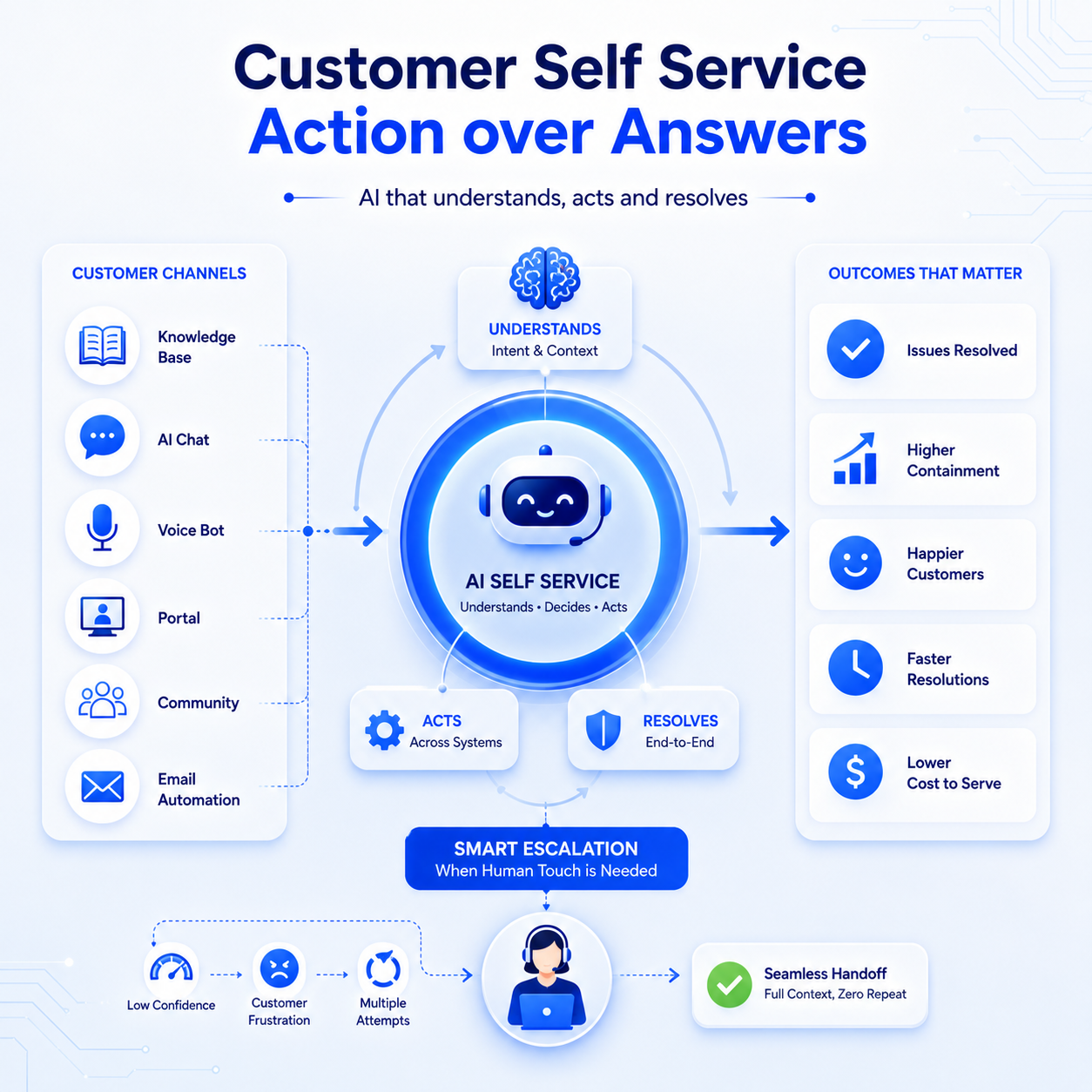
Most self-service programs hit a plateau since they have been designed to provide answers rather than resolve requests. This article shows how to raise containment without wrecking CSAT by measuring what actually matters, designing escalation on purpose, and moving from FAQ deflection to agentic resolution.

The self-service channels, and what each is actually good for
A modern customer self-service setup must cover voice and email, not just chat. An intelligent AI voice agent handles real phone calls. This explains why legacy menu-driven IVR is not self-service. Tools like Thunai Omni unite all these channels into one clean workflow.
How to measure containment properly
This is the biggest hole in the SERP. Both Zendesk and Salesforce have mentioned deflection rate in their single-line KPIs. Neither IBM nor Freshworks nor Intercom nor Aisera nor eGain mentions containment or deflection even once among them. No one talks about a formula or benchmark.
Define the metrics separately and precisely, because they get conflated:
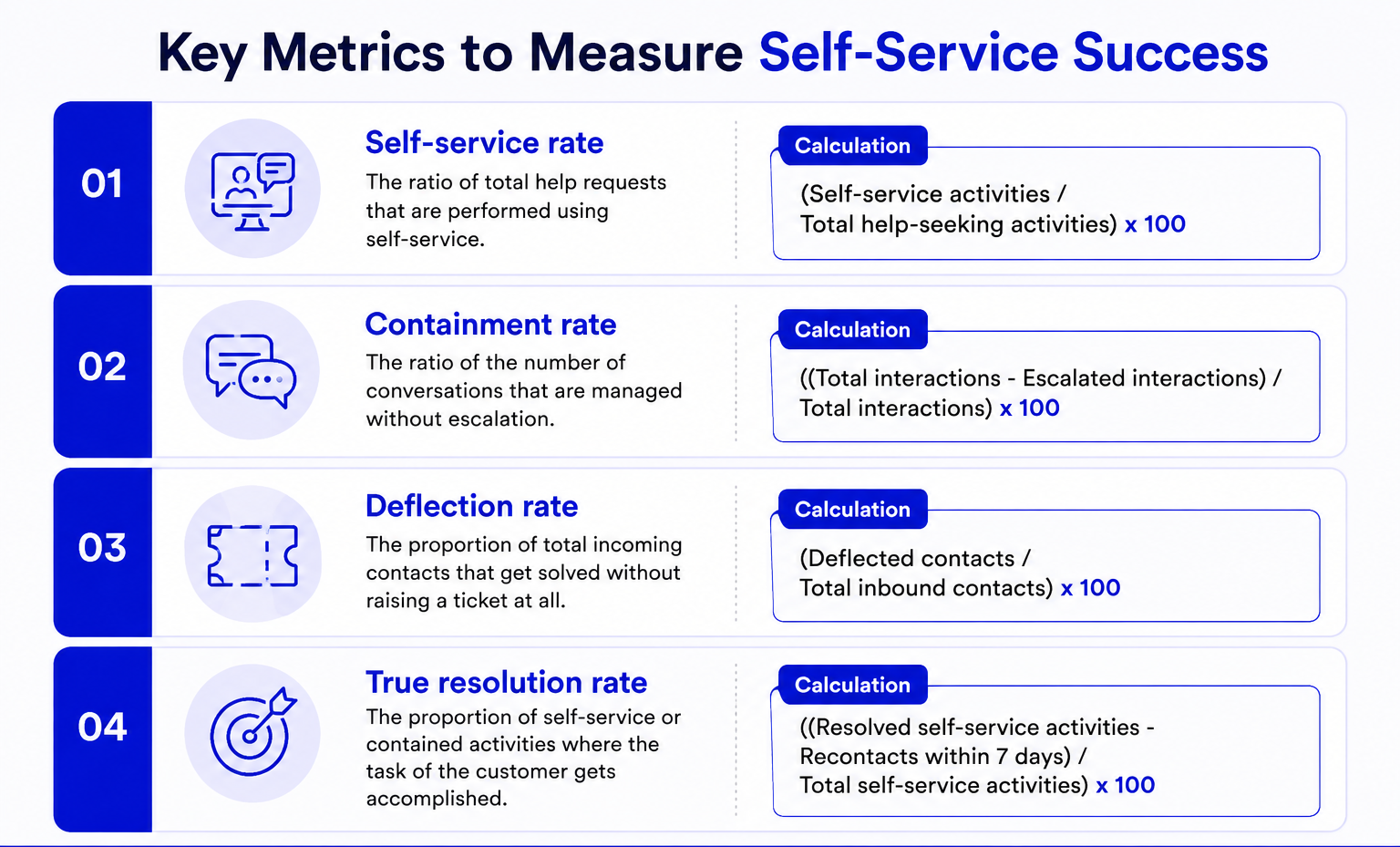
Example: How These Metrics Work
Imagine your support team helps 10,000 customers in a month.
- 6,000 customers use self-service options like your help center, AI chatbot, or customer portal.
- 4,500 customers find what they need without being transferred to a live agent. These are contained in interactions.
- Out of those, 3,900 customers don't contact support again within the next 7 days. That means their issue was actually resolved.
Now let's calculate each metric:
- self-service rate: 60%
- containment rate: 75%
- Deflection rate: 45%
- Rate of true resolution: 65%
The difference between 75% containment and 65% actual resolution is where abandonment and unmanaged issues lurk.
Include counter metrics that prevent containment from being manipulated: repeat contact rate within 7 days, escalation rate after a self-service attempt, CSAT/DSAT for contained contacts, and abandonment while in process. Tie these into your KPI set so that containment can never be measured in isolation.
As per Gartner’s research, only 14% of customer problems are fully solved through self-service. It further emphasizes the importance of measuring containment based on true resolution, repeat contacts, and customer satisfaction rather than just ticket deflection.
To stop teams from gaming numbers, check counter metrics. Monitor 7-day repeat contacts, mid-flow drop-offs, and CSAT. Learn more by reading our guides on improving first call resolution, reducing high DSAT drivers, and auditing essential contact center KPIs.
Calculate Your Potential Savings: Estimate your cost savings using the interactive Thunai CX ROI Calculator.
Designing Intentional Escalation Systems
When building customer self-service workflows, design them to fail on purpose when needed. Systems should spot issues fast. They must route users to human agents before frustration turns into churn.
Use these five guardrails for live agent handoffs:
- Confidence Floor Thresholds: Below a certain threshold of confidence by AI (say 85%), it stops, and the interaction gets handed over to the human.
- Sentiment and Frustration Trigger: Sentiment analysis causes frustration and triggers human agents.
- Attempt Limits: A hard cap of two failed attempts routes the user to live support.
- Account Value Rules: High-value enterprise clients bypass bots based on account status.
- Regulated Work Carve Outs: Tasks with legal, medical, or complex rules route directly to human specialists.
Passing context during handoffs is mandatory. Human agents must instantly see full transcripts, customer intent, user identity, and attempted steps. For design rules, check our guide on designing the human handoff.
Some issues should always use human agents. Bereavement, fraud claims, legal disputes, and intense cancellation talks should never be automated.
From FAQ Deflection to Agentic Resolution
The history of customer self-service spans three distinct eras:
- Static Content Era (1.0): Users read static help articles in a standard help center.
- Conversational Retrieval Era (2.0): AI bots read documents and answered questions in chat without taking action.
- Agentic Execution Era (3.0): Autonomous AI systems connect to backend tools to run tasks in real time.
Take an address change request as an example. Era 1.0 shows a policy page on address rules. Era 2.0 explains that address changes must happen within 24 hours. Era 3.0 verifies the user, checks order status via API, updates the shipping address in the system, and sends a receipt.
As per Gartner, "By 2029, Agentic AI will autonomously solve 80% of the most common customer service issues at 30% less operating cost," indicating the shift of AI from being a question-solving one to a task-solving one.
To learn how autonomous AI handles workflows, read about what agentic AI means for support. For setup steps, view our guides on AI for FAQ deflection and ticket deflection with AI. Modern setups use specialized AI chat agents to complete tasks safely.
Grounding, Hallucination Control, and AI Governance
Enterprise adoption of AI customer self service requires strong safeguards to prevent hallucinations and secure customer data. Leaders must assure risk teams that AI answers are safe and accurate.
Follow these five AI governance standards:
- Grounded Retrieval: Limit AI output strictly to approved internal knowledge docs.
- Source Citations: Show direct links to source articles in customer answers.
- Confidence Based Refusals: Direct tricky questions to human agents when confidence drops.
- Transcript Audits: Review AI logs routinely to spot errors early.
Clean documentation is mandatory. Conflicting or outdated help pages cause wrong answers. Reduce risk by reading about thunai iso 42001 ai certification, preventing hallucinations in customer service, and contact center data security. Manage knowledge smoothly using tools like Thunai Brain and AI knowledge management.
A Phased Customer Self Service Maturity Model
Building a successful customer self-service setup takes a phased roadmap. This prevents tech issues and operational friction.
Do not jump to API write access before setting up identity checks and data rules. Teams must complete each phase before moving forward.
Production Case Studies and Operational Proof
Deploying customer self-service systems creates clear, measurable operational gains across industries:
- Global E-Commerce Brand: Managed holiday traffic spikes using AI linked to their order system. The platform reached a 65% query deflection rate for order tracking, saved $127,000 in temp hiring costs, and lowered cart drop-offs by 17%.
- Global Water Treatment Company (Ion Exchange): Centralized 100,000 technical documents, automated 95% of incoming technical questions, and built sales proposals 70% faster.
- Healthcare Provider (Neuberg): Deployed AI voice and email agents to resolve cases 70% faster and answered over 200 emails in under two hours. Over 500 teams use these tools today.
Read our detailed case studies on our hybrid voice & call routing success story and intelligent email agent success story.
Every rollout has limits. While simple tasks show high containment, complex billing cases still need human oversight to protect relationships and lower risk.
Five Major Self-Service Implementation Mistakes
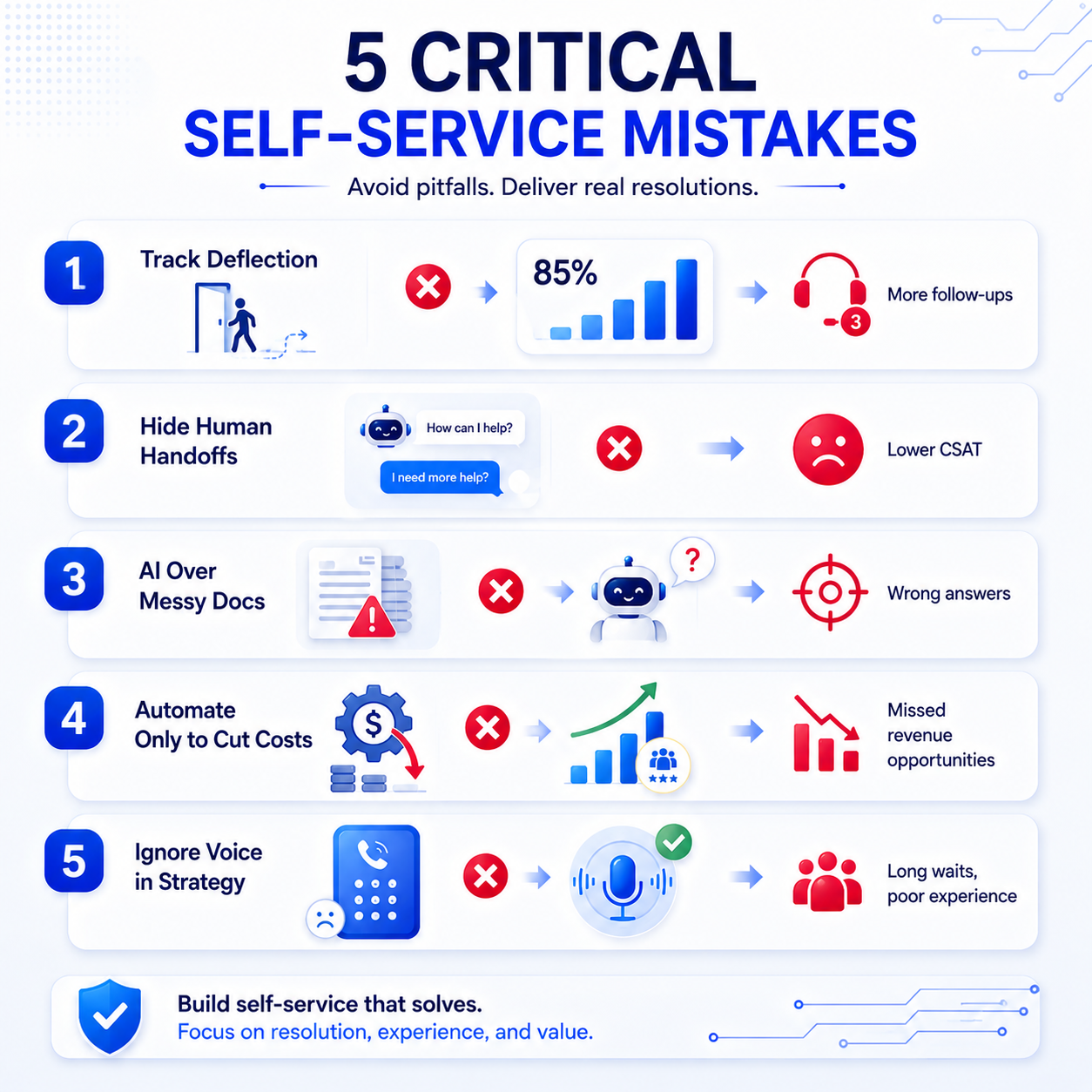
- Tracking Deflection Without Repeat Contacts: Counting simple exits as success hides customer effort and drives follow-up calls.
- Hiding Human Handoffs to Force Containment: Removing live chat links hurts CSAT and drives users away.
- Deploying AI Over Messy Documentation: Running AI over outdated articles creates wrong answers.
- Using Automation Only to Cut Costs: Treating tools only as cost cutters overlooks support as a revenue engine.
- Ignoring Voice in Your Digital Strategy: Leaving voice out of your plan keeps phone queues trapped in rigid legacy IVR systems.
Turn self-service into true resolution with AI that acts - not just answers. Book a demo today.
FAQs on Customer self-service
What is customer self-service?
Customer self service is any support experience where the customer completes their task without a human. This includes knowledge bases or AI agents. The test is whether the request was resolved.
What is required for customer self service?
Four things: accurate content, a way to find it, secure identity, and integration into systems where work happens.
How do I balance self service with human support?
Set explicit escalation triggers: confidence floor, failed attempt cap, sentiment detection, and carve-outs. Transfer full context.
How do you measure self-service success?
Not by deflection alone. Use true resolution rate, repeat contact, escalation rate, abandonment, and CSAT.




.png)
