
Is your AI service desk still the right investment after ServiceNow acquired Moveworks?
For CEOs and IT leaders, this is no longer just about choosing a smarter chatbot.
It is about lowering support costs, automating real work, and avoiding long-term platform dependency.
The following article will list 7 Moveworks alternatives in 2026 that will help you in making the right choice.
The short answer
The right Moveworks alternative will be different depending on your actual problem. Here's the short answer:
If your ServiceNow environment is mature and deeply configured, staying put often makes sense. If you're running something else, or you need to automate a contact center, that's where the Moveworks alternatives below earn their place.
What the ServiceNow acquisition changes for buyers
- ServiceNow’s purchase of Moveworks occurred on March 10, 2025. The acquisition was finalized on December 15, 2025, at the cost of $2.85 billion.
- This did not take long before ServiceNow released EmployeeWorks, which integrated Moveworks conversational search into the workflow engine of ServiceNow.
- This took place in February 2026. Later, in May 2026, ServiceNow went ahead and integrated EmployeeWorks, Now Assist, and its AI layer into one front end known as Otto.
- Existing Moveworks contracts still stand, and standalone sales haven't stopped. But the product roadmap has clearly shifted toward the Now Platform.
- Support is migrating into ServiceNow Now Support. If your organization doesn't run ServiceNow, that shift is reason enough to start comparing Moveworks alternatives now, not later.

What it means if ServiceNow is your system of record
- If you're already deep in ServiceNow, this acquisition probably works in your favor.
- EmployeeWorks gives you a conversational front door wired directly into Now Platform workflows and governance.
- No middleware to maintain. CMDB queries get simpler. Vendor management consolidates under one contract.
- For these teams, staying is the low-friction choice.
What it means if it is not
This is not the case for teams using Jira Service Management, Freshservice, Zendesk, and Salesforce.
The investment in engineering for native ServiceNow integrations is happening first, which does raise the valid point of how the third-party connectors will continue to compete.
It's also common for acquired products to get folded into premium bundles at renewal time, which quietly erodes your negotiating leverage.
That combination is pushing a lot of non-ServiceNow buyers to shop around.
Why teams evaluated alternatives even before the acquisition
The acquisition accelerated a search that was already underway. Procurement and IT teams had real complaints about Moveworks well before the deal closed:
- Departmental scope. It was built for internal IT and HR, with no real support for customer-facing operations.
- Access provisioning limits. Time-bound, granular access automation often needed heavy custom integration work.
- Administrative overhead. Routine workflow changes frequently required going through a vendor CSM instead of doing it yourself.
- Workflow friction. Coordinating actions across Slack, Teams, and Jira created ongoing sync headaches.
- Opaque pricing. Headcount-based enterprise pricing penalized companies with low per-employee ticket volume.
- No contact center channel. There was no native voice telephony, call auditing, or contact center co-pilot support.
Those gaps, not just the acquisition, are what sent buyers looking elsewhere.
Two camps: AI-native execution versus ITSM with AI attached
The AI help desk market really splits into two different architectures, and this distinction matters more than most vendor pitches let on.
Traditional ITSM suites bolt a language model onto an existing ticketing flow. The intake conversation feels smart, but a human still resets the password or provisions the access behind the scenes. That's where most of the labor cost actually lives between the ticket being logged and the work getting done.
AI-native platforms skip that handoff. An employee requesting app access triggers authentication and verification, followed by routing of the request within the chat and API-driven provisioning of the entitlement. There is no request waiting to be actioned by a human being in a queue.
When you're comparing Moveworks alternatives, ask directly: does this platform execute the task, or does it just describe the task to someone else who will?
The 7 best Moveworks alternatives
Console - best for AI-native IT execution
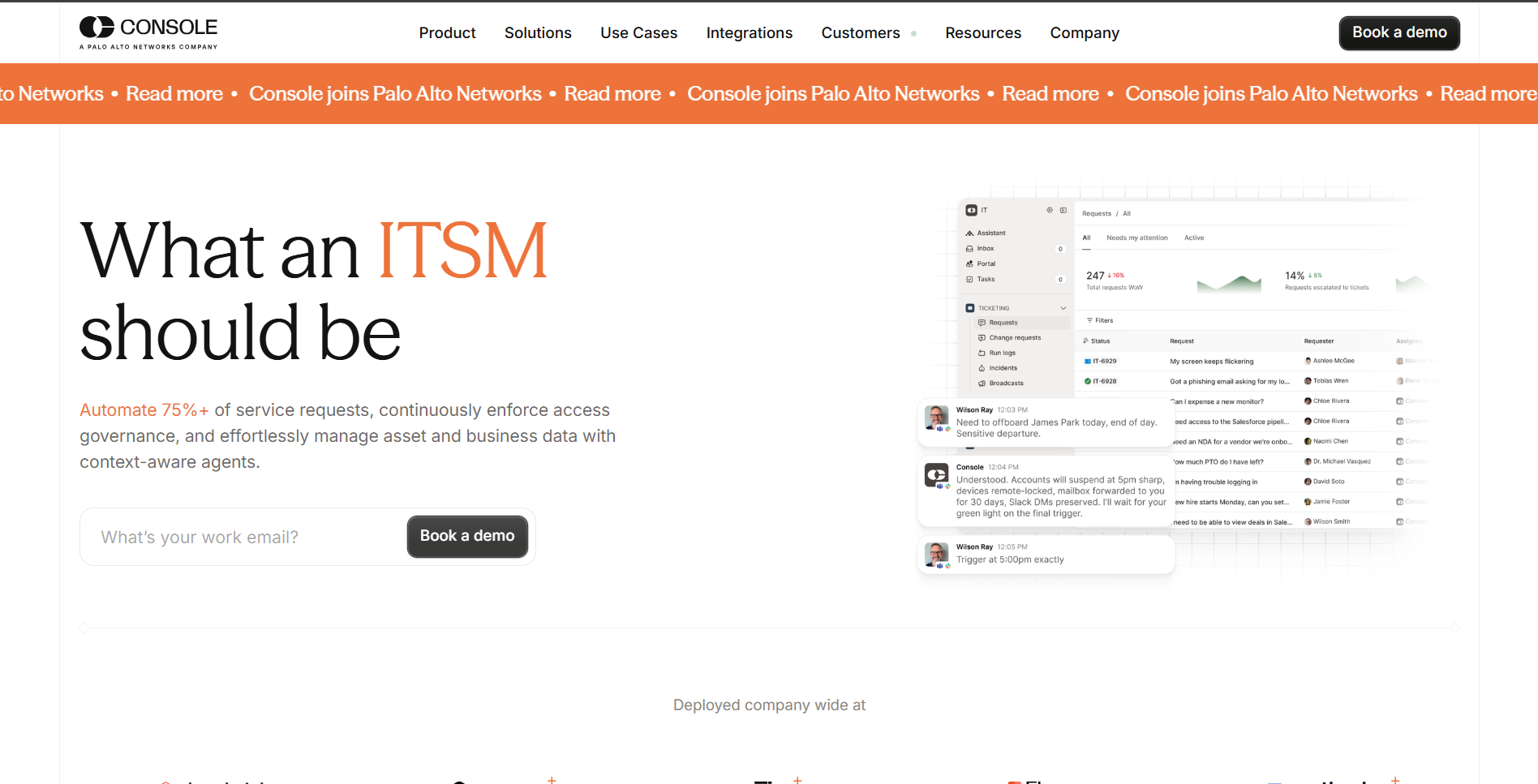
Console is an ITSM software designed for solving IT-related problems within the organization via Slack and Microsoft Teams.
- What it is: An ITSM service platform residing in Slack and Teams.
- Best for: Teams that want autonomous resolution of internal IT tickets and software entitlements, not just faster routing.
- Strengths: Autonomous resolution rates above 50% on routine IT requests, with some production deployments reaching 87%. Strong identity and access automation.
- Limitations: Internal IT and access only; no customer-facing capability.
- Deployment model: Cloud Saas with Chat Integrations.
- Price: Usage-based and linked to workflows rather than seat fees.
If your team needs a product that is close in terms of architecture to Moveworks but without reliance on humans, try Console.
Kore.ai - best for cross-department conversational AI at enterprise scale

The Kore.ai platform is a Conversational AI for Enterprise, which automates complicated processes in IT, HR, procurement, and other departments of any company.
- What it is: Business chat software with a no-code agent builder and dialogue governance.
- Ideal for: Enterprises that require development of complex agents in various departments, such as IT, HR, procurement, operations, etc.
- Pros: LLM orchestration, strong dialogue management capabilities, multilingual capabilities.
- Limitations: Building custom workflows takes real administrative and technical effort.
- Deployment options: Multi-cloud, hybrid, and on-premises deployment options.
- Cost: Custom, per session, bots, and platform level.
Kore.ai stands out when the scope is broad enterprise orchestration rather than a single department.
Glean and GoSearch - best when the real problem is enterprise search
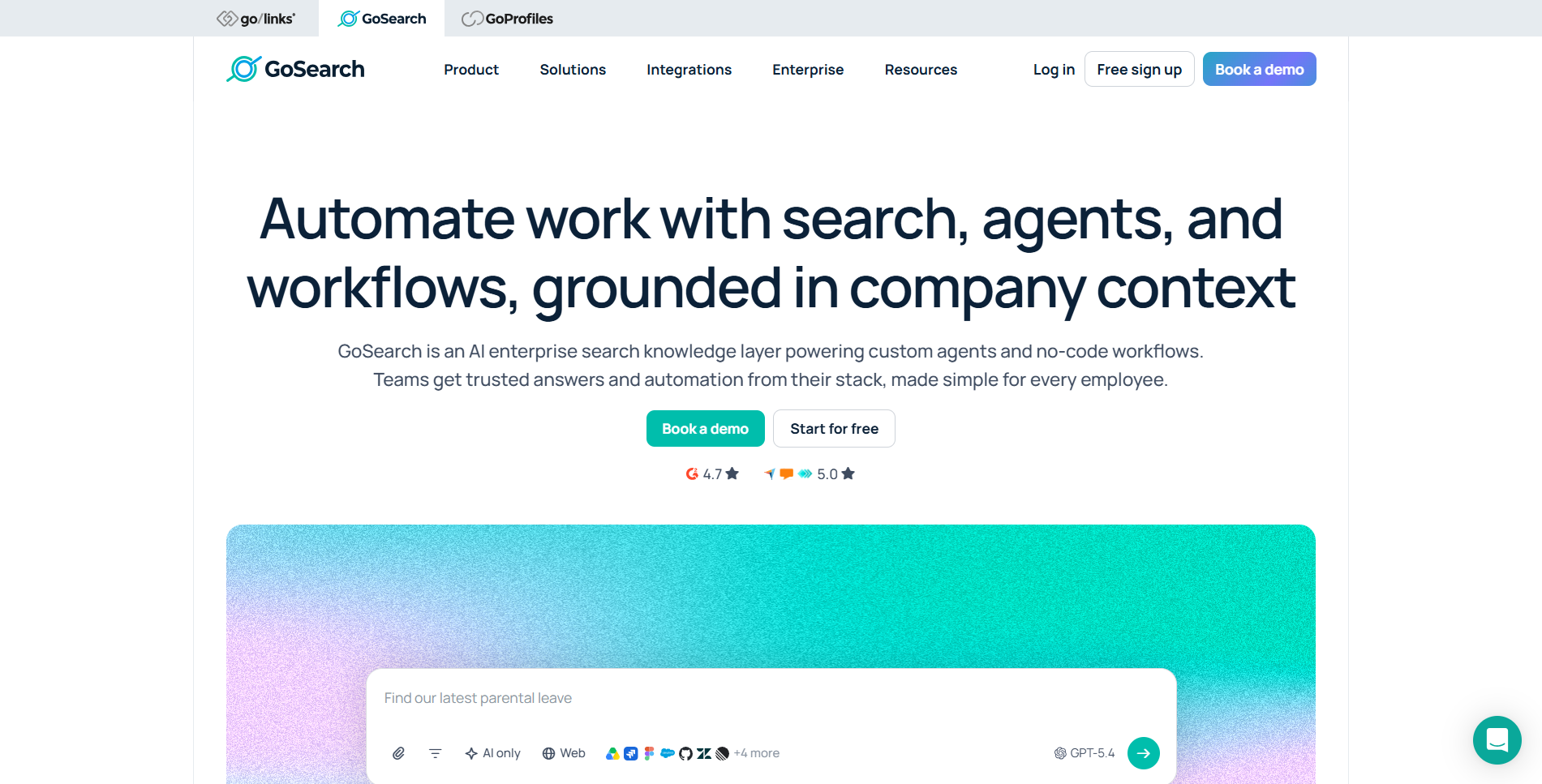
GoSearch is a search engine that utilizes artificial intelligence in searching for information from different business systems.
- What it is: A generative search engines that index across drives, chat, wikis, and internal databases.
- Best for: Knowledge-intensive companies where the real problem is sourcing valid information rather than completing tasks.
- Strengths: Permission-based RAG with citations to validate answers.
- Limitations: Retrieval-focused; doesn't execute backend IT tasks or provision access.
- Deployment model: Cloud SaaS.
- Pricing: Per-user annual subscription.
If your teams keep re-asking questions that already have answers buried somewhere in your stack, this is the fix, not a task-execution platform.
Aisera - best for multi-domain breadth
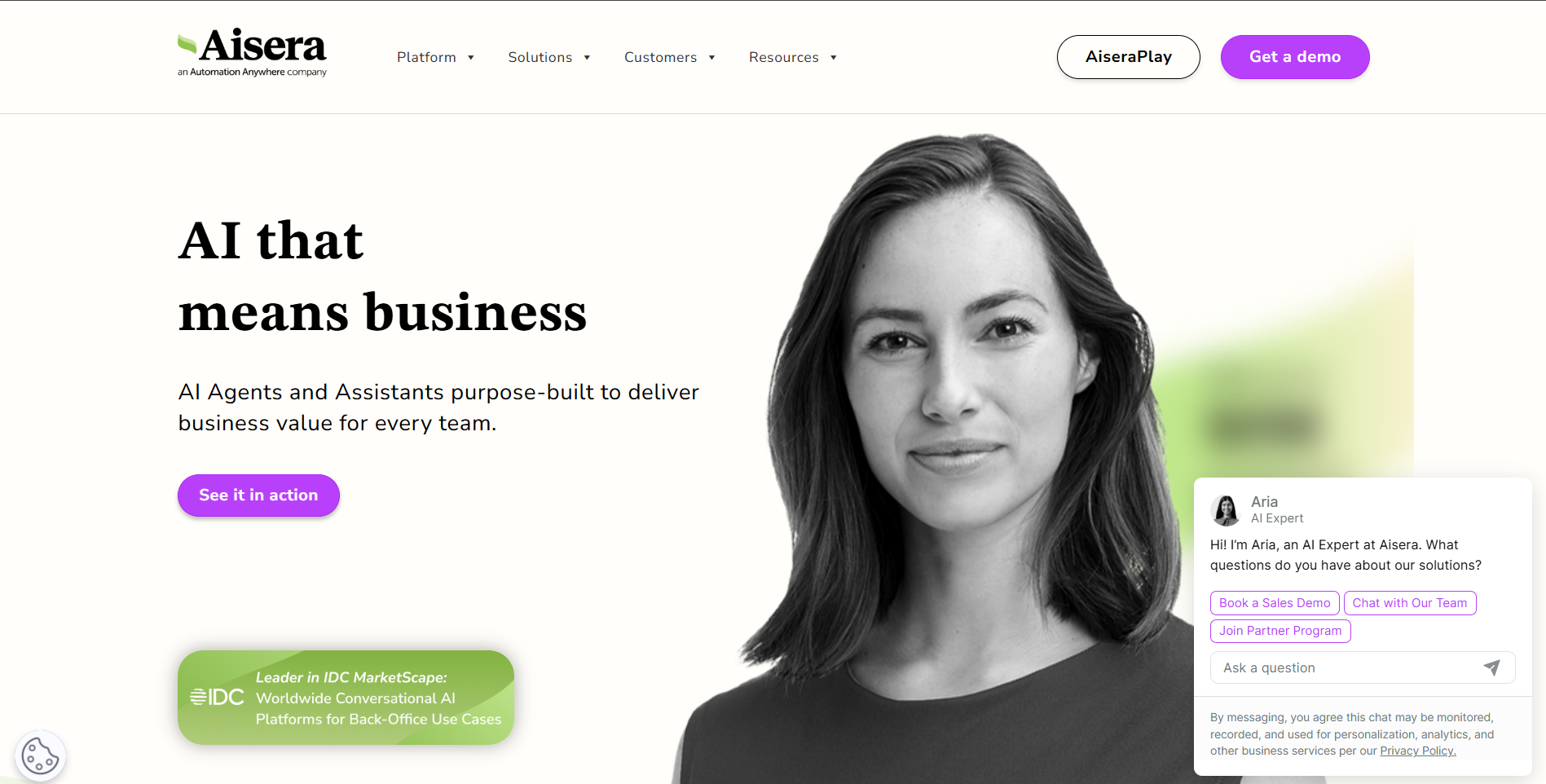
Aisera is a service automation solution that utilizes AI in order to aid IT, HR, and customer service processes.
- What it is: A platform that delivers automation of enterprise services such as IT, HR, and customer support, along with pre-built domain packs.
- Best for: Enterprises that want an AI-based platform for their internal services as well as ticketing services.
- Strengths: A huge selection of pre-made integrations and service catalogs across departments.
- Limitations: Implementation overhead is real; expect professional services time to align taxonomies.
- Deployment model: Cloud SaaS.
- Pricing: Custom, based on modules and interaction volume.
In head-to-head Moveworks vs. Aisera comparisons, Aisera generally wins on out-of-the-box departmental coverage.
Freshservice and Jira Service Management - best for modernizing an existing service desk
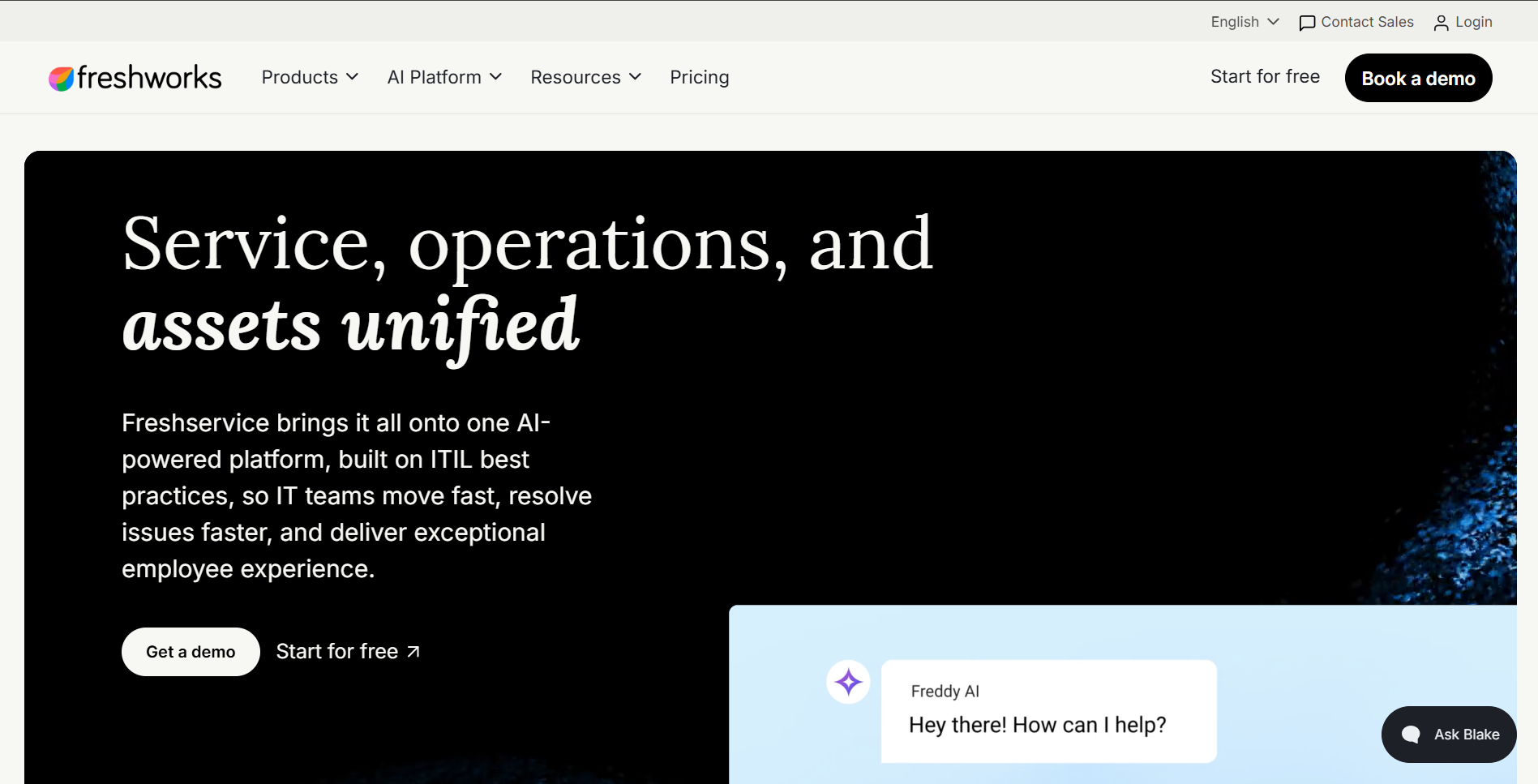
Freshservice is an ITSM cloud computing solution that enables incident, asset, change, and service request management with the help of AI.
- What it is: Established ITSM suites with generative AI layered in (Freddy AI, Atlassian Rovo).
- Best for: Desks standardizing on structured ITIL processes and developer-aligned workflows.
- Strengths: High-level incident, assets, and change management; highly aligned to Atlassian and/or Freshworks platforms.
- Limitations: Designed for agent-assisted triaging process, but not end-to-end resolution.
- Deployment model: Cloud SaaS deployment.
- Pricing: Published per-agent subscription.
Both are dependable choices if the goal is modernizing what you already have, not replacing it.
Rezolve.ai - best for mid-market agentic service desk
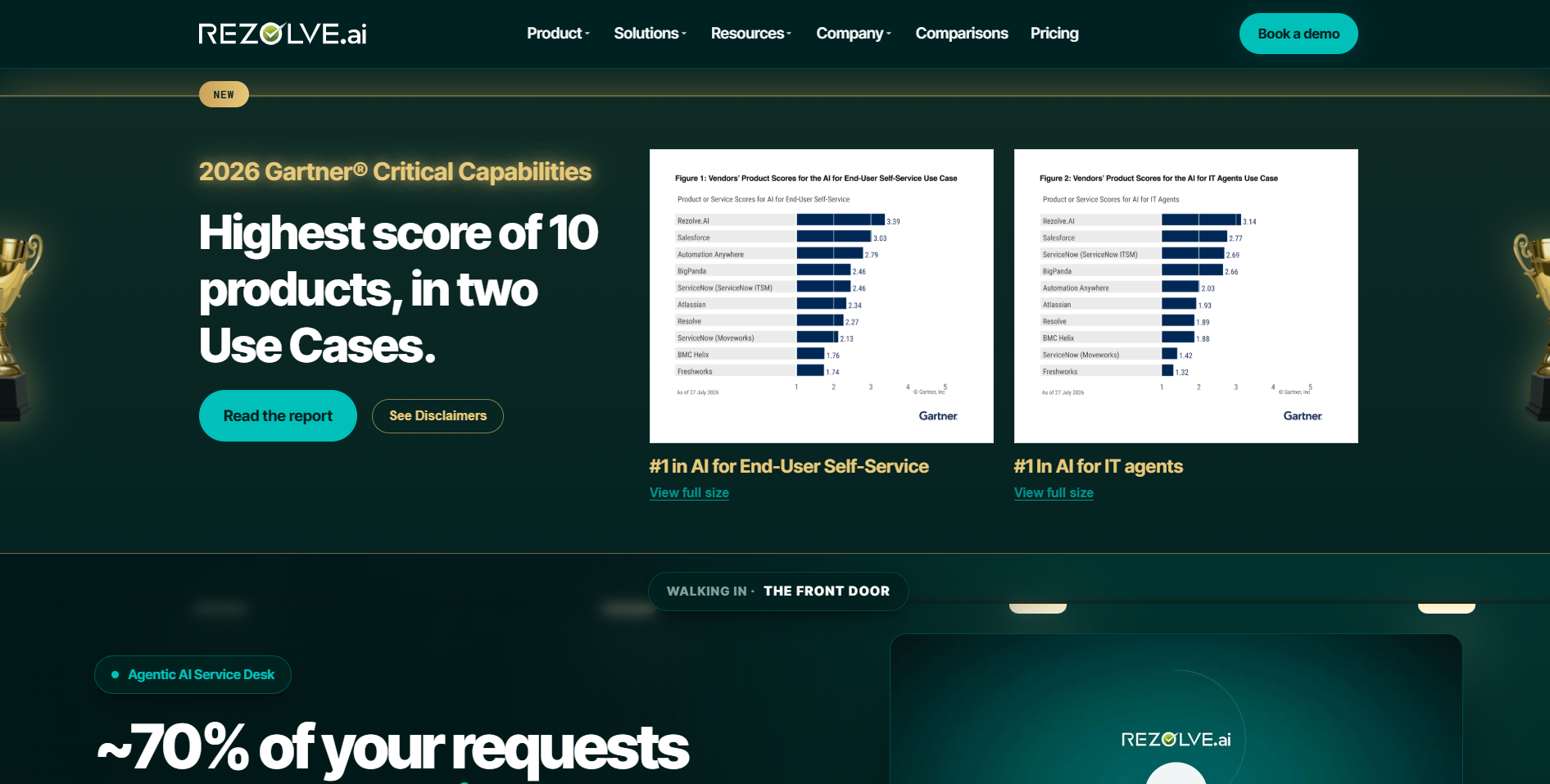
Rezolve.ai is a solution that utilizes AI capabilities to manage employee service desk requests and automate IT/HR processes on Microsoft Teams.
- What it is: It is a dedicated agent service desk solution for Microsoft Teams.
- Best for: Medium enterprises that need to see value fast in Microsoft Teams.
- Strengths: 65% to 70% of support queries are addressed on the platform itself by the staff on their own, within 2 to 4 weeks from the date of deployment.
- Weaknesses: It lacks the required coupling with the on-premises system required by some large organizations.
- Deployment Model: The platform is natively deployed on Microsoft Teams as a SaaS solution.
- Cost: Clear cost structure with price starting from $2.50 to $3.00 per user per month.
Rezolve.ai could be said to be the quickest Moveworks competitor available for Microsoft 365 customers.
Thunai - best when the harder problem is customer-facing
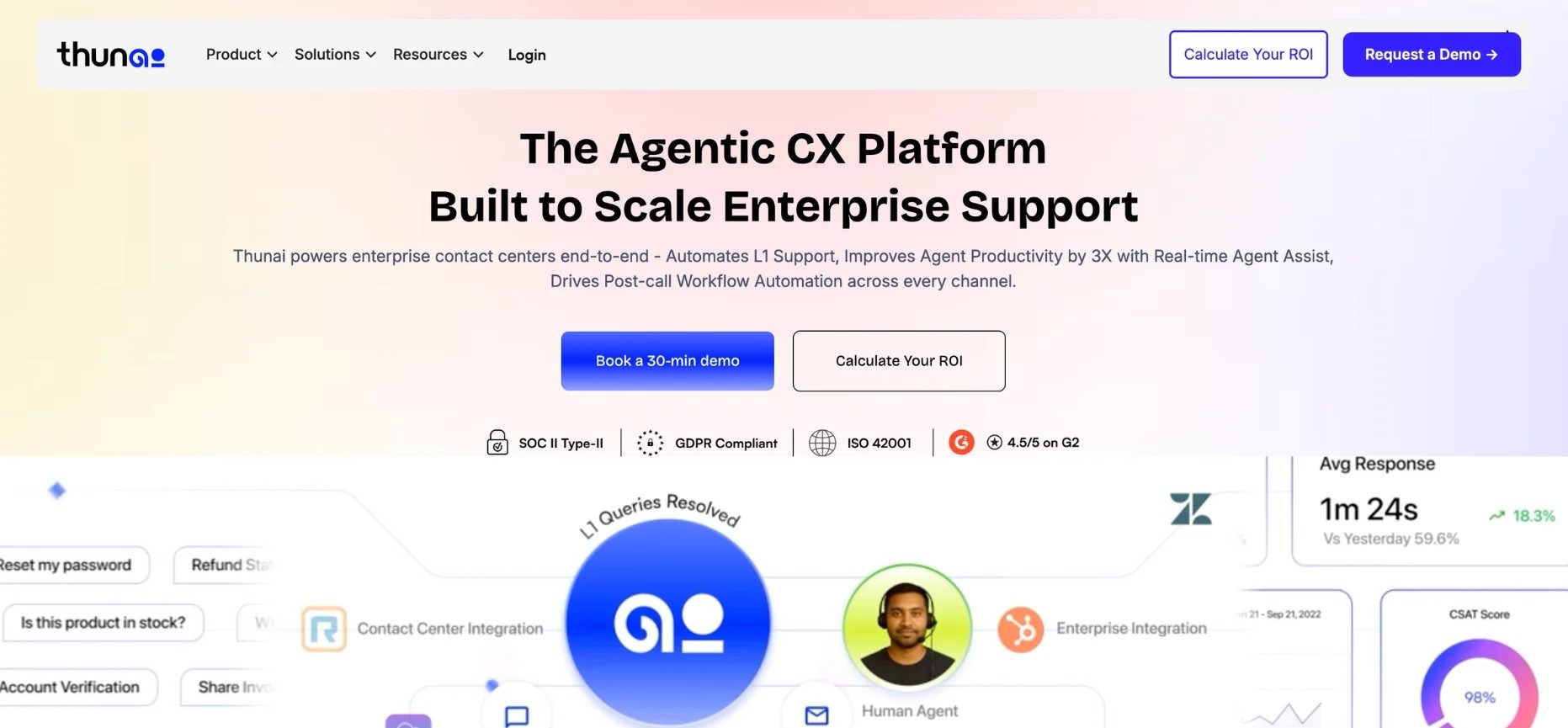
Thunai is an Agentic CX system that aims to automate customer service via voice, chat, email, and contact center transactions.
- What it is: An Agentic CX system that automates the large-scale operation of the contact center in terms of voice, chat, and email.
- Best for: Enterprises whose problem lies in the time required to solve their customer service issues.
- Strengths:
- Thunai can plug right into current CCaaS technology platforms like NICE, Amazon Connect, Genesys, RingCentral, and Microsoft Teams Phone without dismantling the underlying architecture.
- It provides human-like AI agents in more than 150 languages, co-pilot support for human agents, and voice agent technology with screen-share capabilities.
- It also automates 100% of call scoring and QA review. Real deployments back this up: Bazooka Candy cut ticket triage time by 60% and projected $4M in annual supply chain savings, and a large retail client automated more than 210,000 monthly calls at a 78% deflection rate while holding a 4.8+ CSAT score.
- Setup takes under two days.
- Limitations: Built for customer experience, not internal ITIL ticketing.
- Deployment model: Cloud AI layer over existing contact center telephony.
- Pricing: Scalable, based on capacity and interaction volume.
For companies whose real problem lives in the contact center rather than the internal help desk, Thunai is the strongest Moveworks alternative on this list. Worth a look: Thunai's Enterprise Contact Center overview.
Full comparison table
Employee support and customer support are different purchases
One mistake shows up again and again: trying to run internal and external support through the same platform. They're just not the same problem.
Internal ITSM tools generally lack the low-latency telephony, speech recognition, and agent co-pilot tooling a contact center needs. Companies with both needs typically run a dedicated Moveworks alternative internally and a specialized platform like Thunai for the contact center side.
Evaluation criteria and the RFP questions that matter
When you're comparing proposals and Moveworks pricing structures, a few pointed questions cut through the marketing fast:
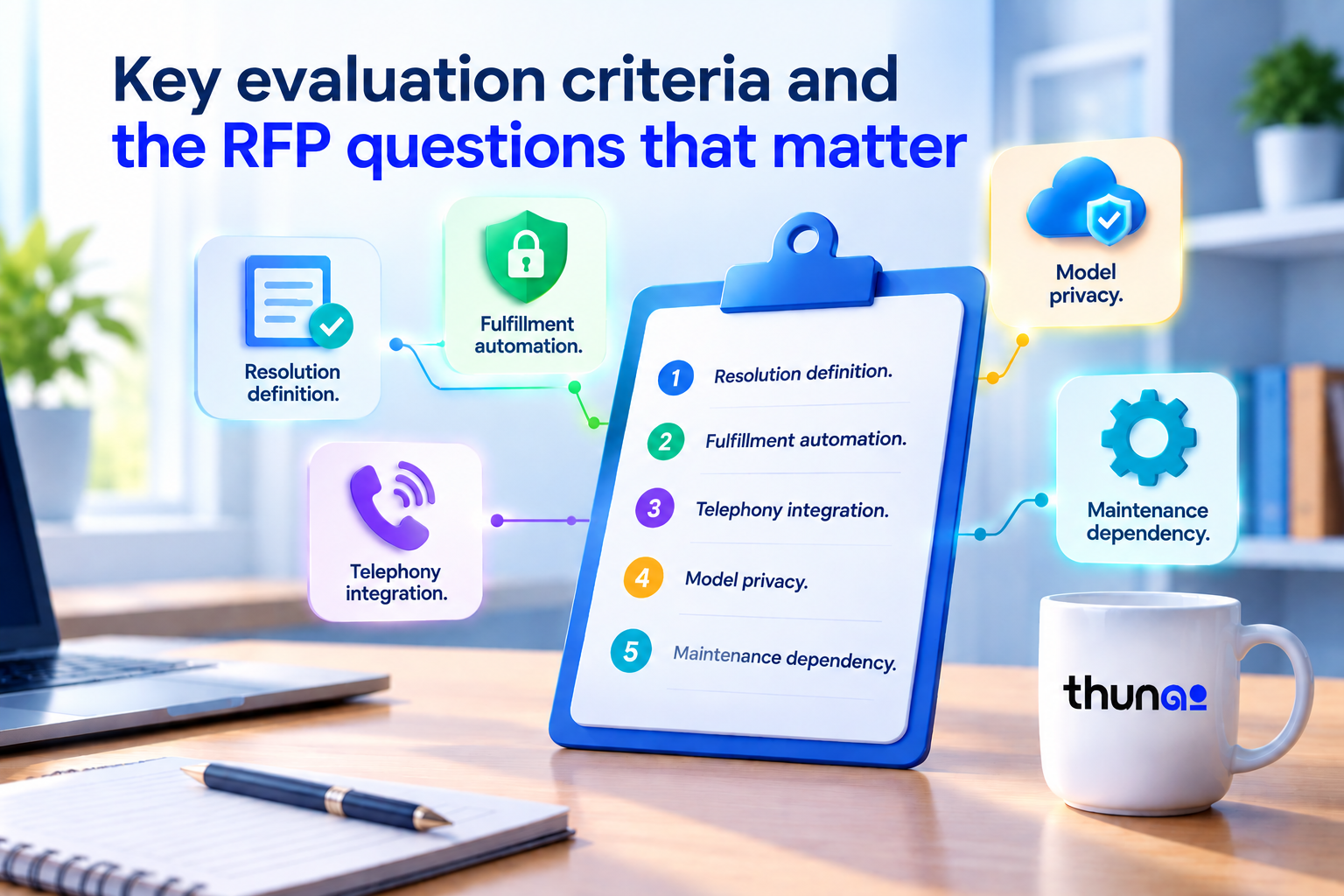
- Resolution definition. Does "resolved" mean the user saw a help article, or did the system actually complete the task through an API?
- Fulfillment automation. Can it provision and revoke time-bound access in Okta or Azure AD without custom scripting?
- Telephony integration. Does it plug natively into Amazon Connect, NICE, or Genesys?
- Model privacy. Can you choose the underlying LLM, and will the vendor commit contractually to zero training on your data?
- Maintenance dependency. Can your own admins adjust intents and build workflows without paying for professional services every time?
These five questions do more to separate real Moveworks alternatives from repackaged chatbots than any demo will.
When to stay with Moveworks
Sometimes the right move is no move. Staying makes sense if:
- ServiceNow is your enterprise system of record across the business.
- You're above 10,000 employees and benefit from Moveworks' pre-trained enterprise models.
- Your automation need is strictly internal IT and HR, with no contact center requirement.
- Your existing contract locks in multi-year price protection.
For organizations in that position, switching creates more friction than it solves.
How to design a pilot that measures resolution, not deflection
Deflection and resolution get confused constantly, and it costs teams real money. Deflection just means someone left a chat without filing a ticket that can hide an unresolved problem as easily as it can reflect a solved one. Resolution means the system actually finished the task.
A tight four-week pilot keeps vendors honest:
- Week 1: Define target workflows. Pick 5 to 10 high-frequency, structured requests: password resets, software access, that kind of thing.
- Week 2: Run parallel testing. Deploy alongside your human team on live queues, without auto-closing tickets, so you can check classification accuracy.
- Week 3: Enable autonomous execution. Let the system complete end-to-end API actions and track how often a human still has to step in.
- Week 4: Audit the metrics. Calculate the real autonomous resolution rate, average handle time change, CSAT, and the hours spent on prompt tuning.
Looking for AI that does more than route tickets? Book a demo with Thunai and see how agentic AI can automate real customer support work.
FAQs on Moveworks Alternatives
Did ServiceNow acquire Moveworks?
Yes. ServiceNow signed the agreement on March 10, 2025, and closed the deal on December 15, 2025, for about $2.85 billion. Moveworks' conversational search and reasoning tech now sits inside ServiceNow EmployeeWorks and Otto.
Should I still buy Moveworks after the acquisition?
If you're standardized on ServiceNow, the acquisition strengthens the platform through deeper integration. If you're not, it introduces roadmap dependency and possible licensing cost increases, which is exactly why it's worth comparing Moveworks alternatives.
What is the best Moveworks alternative?
It depends on the problem. Console leads for AI-native internal IT execution. Kore.ai fits large-scale conversational governance. Glean excels at enterprise search. Thunai is the strongest option for customer-facing contact centers.
What's the difference between ticket deflection and resolution?
Deflection means a user left a chat or viewed an article without opening a ticket. Resolution means the software actually completed the request or fixed the issue end-to-end.
Can one AI platform handle both employee and customer support?
Rarely well. Internal support is about access control, ITSM tickets, and async workflows. Customer support demands instant response times, voice CCaaS integration, and context-rich routing. Most enterprises get better resolution rates by running separate, specialized platforms for each.