
As a CEO, I see one problem that hurts international admissions again and again - language.
Students want answers fast, but in their own language. If they do not get them, they move on.
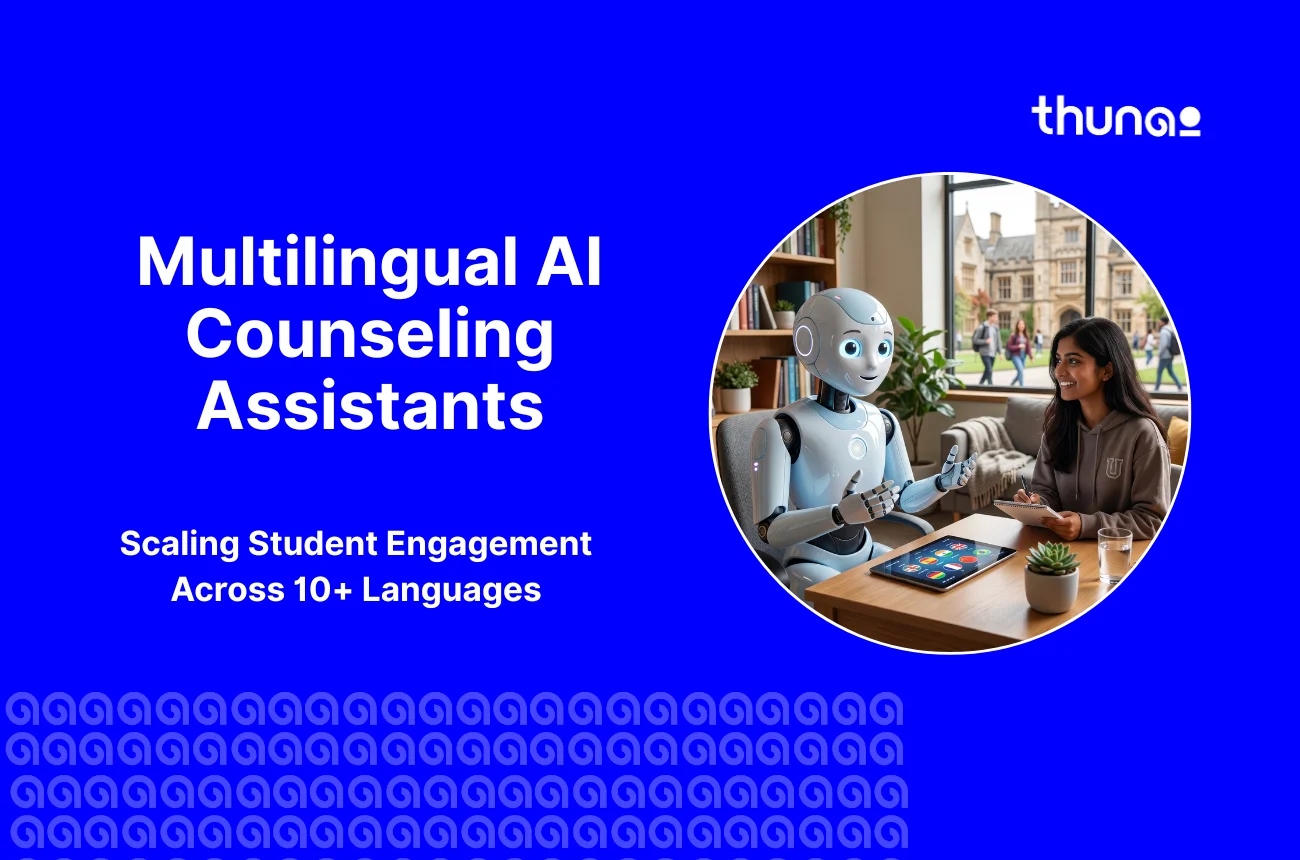
A multilingual AI counseling assistant helps to solve that problem.
It gives students quick help by voice or chat. It also helps universities respond faster, reduce workload, and improve conversion. In short, it makes student support easier to scale.
Why Language Barriers Are Quietly Killing International Student Conversion
Language is trust. When a student cannot get a clear answer, they lose confidence. That loss is often enough to stop the application.
This happens in small ways:
- The student takes too long to receive a response.
- The student does not comprehend a rule or deadline.
- The student feels that the university is speaking a different language.
These issues might appear to be trivial, but they prevent conversion. An artificial intelligence counselor for universities in several languages will eliminate this friction. It provides fast and relevant assistance in a language that the student understands.
What a Multilingual AI Counseling Assistant Actually Is — and Isn't
A multilingual AI counseling assistant for university admissions is a system that can talk with students in more than one language. It can answer questions, schedule calls, and guide students through the admissions process.
It is not:
- A replacement for human counselors.
- A simple FAQ bot.
- A tool that only translates words without understanding the meaning.
It is:
- A support system for admissions teams.
- A way to answer common questions quickly.
- A tool that helps students feel heard.
The best systems work like a helpful first layer. They handle routine questions and send harder cases to a human.
The 4 Capabilities That Separate Effective Multilingual AI Counselors from Basic Chatbots
A basic chatbot only answers simple questions. A strong multilingual AI counseling assistant for university work can do much more.
Here are the four main capabilities:
- It comprehends spoken and written language in several languages.
Students must be able to type and speak in natural language. - It is integrated into the university’s system.
It is expected to be able to check the application status, schedule appointments, and update records. - It handles real conversations.
It should understand follow-up questions, not just one message at a time. - It reads emotion.
It should notice when a student sounds confused, stressed, or excited.
These four things make the difference between a basic chatbot and a real admissions assistant.
How Thunai AI Powers Multilingual Student Counseling at Scale
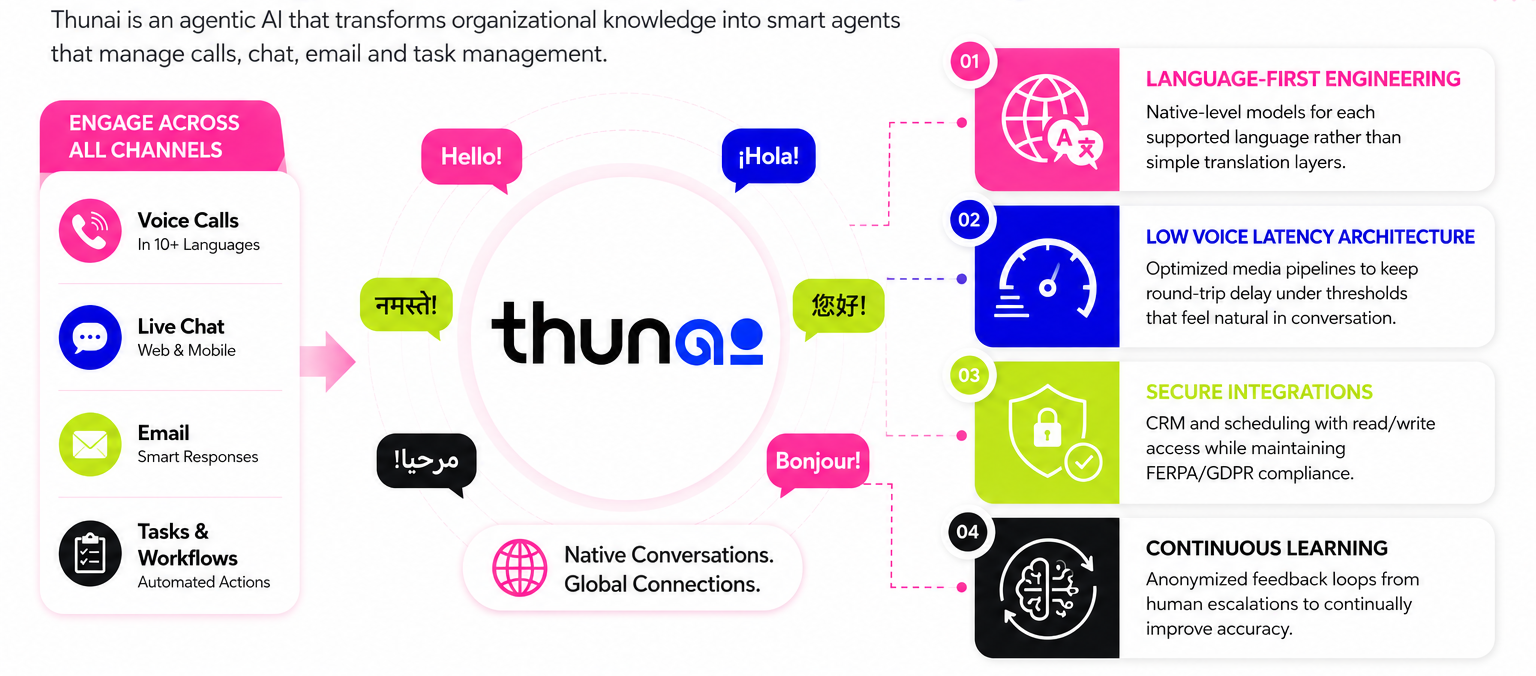
Thunai is an agentic AI that was created to transform organization knowledge into smart agents that manage calls, chat, email and task management.
Key design principles:
- Language first engineering: native level models for each supported language rather than simple translation layers.
- Low voice latency architecture: optimized media pipelines to keep round trip delay under thresholds that feel natural in conversation.
- Security Integrations: CRM and scheduling with read/write access but maintaining FERPA/GDPR compliance.
- Continuous learning: anonymized feedback loops from human escalations to improve accuracy.
Example:
- If the organization uses thunai to handle their important communication in six distinct markets.
- The employee dials to the local number and communicates with the agent in their native language then the agent will check whether the candidate is eligible for the program, notify about the vacant position and set up an interview with the counselor over a single conversation.
- In six months, the university observed a 35% reduction in the time spent by the counselors in answering repetitive questions and a 12% increase in application submissions.
User feedback for Thunai.AI
- On G2, Mohamed E., a validated user, highlighted that "Exceptional Adaptability and Support Make Thunai.ai Stand Out", calling out its impressive impact on reducing response times.
- On Product Hunt, another user, Arun S., wrote that "Thunai.ai is a game-changer for businesses!", pointing out how easily it automates workflows and integrates with CRM tools like HubSpot.
A multilingual AI counseling assistant for university built on Thunai’s agentic brain can unify revenue teams and automate growth workflows across chats, calls, and tasks.
The Voice Latency Problem - Why It Matters More in Counseling Than Any Other Use Case
Voice latency equals delay. If the assistant takes too much time to reply, then there will be an awkward feeling.
That matters a lot in counseling because:
- Students expect a natural flow.
- Delays make the system feel less human.
- Long pauses reduce trust.
In voice support, speed is part of the experience. If the response is too slow, the student may repeat the question or leave. A good multilingual AI counseling assistant for university use should feel quick and smooth.
Sentiment Analysis in Multilingual Counseling - Reading What Students Don't Say Directly
Not every student says exactly what they mean. Some sound polite but are actually unsure. Others seem calm but are close to dropping off.
That is where sentiment analysis helps. It can notice:
- Frustration.
- Interest.
- Confusion.
- Urgency.
This helps admissions teams know who needs a human follow-up. It also helps them find students who may be ready to apply. When used well, AI sentiment analysis admissions tools can improve both service and conversion.
What Universities Gain: Enrollment, Efficiency, and Student Experience Outcomes
Universities get three big benefits from a multilingual AI counseling assistant for university admissions.
First, they get better enrollment results. Students get answers faster, so they are more likely to continue.
Second, It saves time. Less time will be spent for answering repeated questions, leaving more time for valuable conversations.
Third, they improve the students' experience. Students feel supported, particularly for those, whose native language is not English.
In many cases, this leads to:
- More applications.
- Faster response times.
- Lower support workload.
- Better satisfaction scores.
How to Implement a Multilingual AI Counseling Assistant — A Phased Approach
Phase 1: Knowledge Mapping and Database Ingestion
- The first step of implementing an AI counseling assistant that is multilingual to universities includes thorough documentation gathering.
- Collect all your admission brochures, fee schedules, housing guidelines, and transcript policies.
- Thunai.AI uploads all these documents straight into your Thunai Brain.
Phase 2: Dialogue Flow Orchestration and Pilot Integration
- Map out common query paths and sync the platform across your key channels, starting with web chat and WhatsApp.
- Focus initial pilot testing on your largest international markets, verifying response accuracy.
Step 3: Optimization of Voice for Low Latency and Utilizing SIP
- Connect the assistant to the phone system through SIP trunking and Twilio.
- Allow low latency voice generation as well as accent routing through dial-ins.
Step 4: Scaling, Monitoring and Sentiment Audit
- This strategy ensures that your multilingual AI counseling assistant for university outreach doesn’t commit any operational mistakes.
- Scale up the system to support more than 10 languages. Conduct sentiment audit for the transcripts of calls made.
4 Mistakes Universities Make When Deploying Multilingual AI for Student Counseling
Many colleges fall into the same trap when they first attempt this solution.
- They concentrate on too many languages right off the bat.
- They choose translation over real understanding.
- They ignore voice speed and sound quality.
- They forget to set up human handoff rules.
A multilingual AI Counseling assistant for universities serves the university team well if it enables the humans rather than replace them.
Turn every student inquiry into an enrollment opportunity with Thunai.AI's multilingual AI counseling assistants. Book your demo now ..
FAQs
Would there be an artificial intelligence assistant speaking several languages to replace human counselors?
No. The former performs the routine, labor intensive work while human counselors deal with more complicated tasks involving advice and interaction.
Which languages do we need to support at the beginning?
Support for your top 2 to 4 markets that speak other languages apart from English.
How do we track the performance?
Response time, conversion rate (from lead to application), counselor’s saved time, escalations, CSAT/NPS.
Is latency in voice addressed?
No, not fully. There are solutions, such as edge servers, models that support streaming, and TTS optimizations. Make sure the vendor has metrics for low latency.
And how about privacy and compliance?
Ensure that your provider offers encryption, data residency, and is in compliance with such legislations as FERPA, GDPR, etc. Establish retention and access rules.