



In 2025, U.S. ecommerce sellers faced major inventory sync failures during high traffic sales events, causing oversold products, canceled orders, and overwhelmed customer support teams.
Some merchants even reported damaged marketplace ratings after customers purchased out of stock items.
Basic automation could not react fast enough to prevent operational chaos. Modern agentic ai shopify systems can detect sync issues, update inventory in real time, and proactively handle customer communication before revenue and trust are lost.
Want to avoid the next ecommerce operations headline? See how intelligent automation works in this guide.
Why Manual Order and Fulfillment Workflows Break Down as You Scale
When we talk about scale, we often think of revenue. But as a CEO, I think about friction.
Every manual step in your fulfillment process is a point of failure. We call this "Admin Debt" the cumulative weight of manual inventory tweaks, answering "Where is my order?" (WISMO) emails, and managing delivery exceptions.
As you scale, manual workflows break under increasing data density. In 2025, major carriers like FedEx and USPS missed delivery commitments at rates between 8.2% and 9.6% during peak seasons, turning every delay into support tickets and potential refunds.
This is why shopify workflow automation is now a survival requirement. Without agentic ai shopify, businesses remain stuck in pilot purgatory having the tools, but lacking autonomous execution.

What Shopify Workflow Automation Actually Covers — And Where Most Stores Stop Short
A sophisticated shopify workflow automation strategy in 2026 isn't just about "if-then" rules. It is a three layered stack:
- Capture and Ingestion: Moving structured data from orders and invoices into your systems.
- Execution: The standard RPA (Robotic Process Automation) that tags customers or updates spreadsheets.
- Cognitive Intelligence: This is the brain layer. It classifies risk, scores customer intent, and forecasts demand.
Most stores stop at execution. They think that because they have an automated email, they are automated. But they are missing the benefits of AI agent for shopify in the cognitive layer.
True intelligent automation identifies a visitor about to bounce with 92% accuracy and engages them with a personalized offer before they ever hit the close button.
If your shopify workflow automation doesn't have a reasoning component, it's just a faster way to make mistakes.
Shopify Flow vs. Agentic AI: Understanding the Real Difference
There is often a misunderstanding in the C-suite about the difference between Shopify Flow and Agentic AI. Shopify Flow is our deterministic execution layer.
It follows a JSON based domain specific language (DSL) that is rigid and predictable. It’s perfect for: If an order is over $200, tag the customer as VIP.
However, agentic ai shopify represents non deterministic reasoning. An agent perceives the state of your store, reasons against a goal, and takes action. Platforms like Thunai serve as a prime example here.
Unlike a standard bot, Thunai acts as a robotic supervisor. It doesn't just answer questions, it uses the Thunai Brain, a self learning knowledge hub to perform backend tasks like processing refunds or initiating RMAs directly in the Shopify Admin.
User feedback:
- Mano mani recently noted on Product Hunt that a platform like Thunai is a "A true productivity booster!" for its ability to pull scattered information into one centralized brain for streamlined workflows.
- Another user, Jegan Selva, described it as a "Brain Addon" that enables 24/7 unlimited support and sales without manual scripting. While flow is the recipient of events, agentic AI is the decision maker that tells flow what to do.
The Core Workflows Every Shopify Store Should Automate First
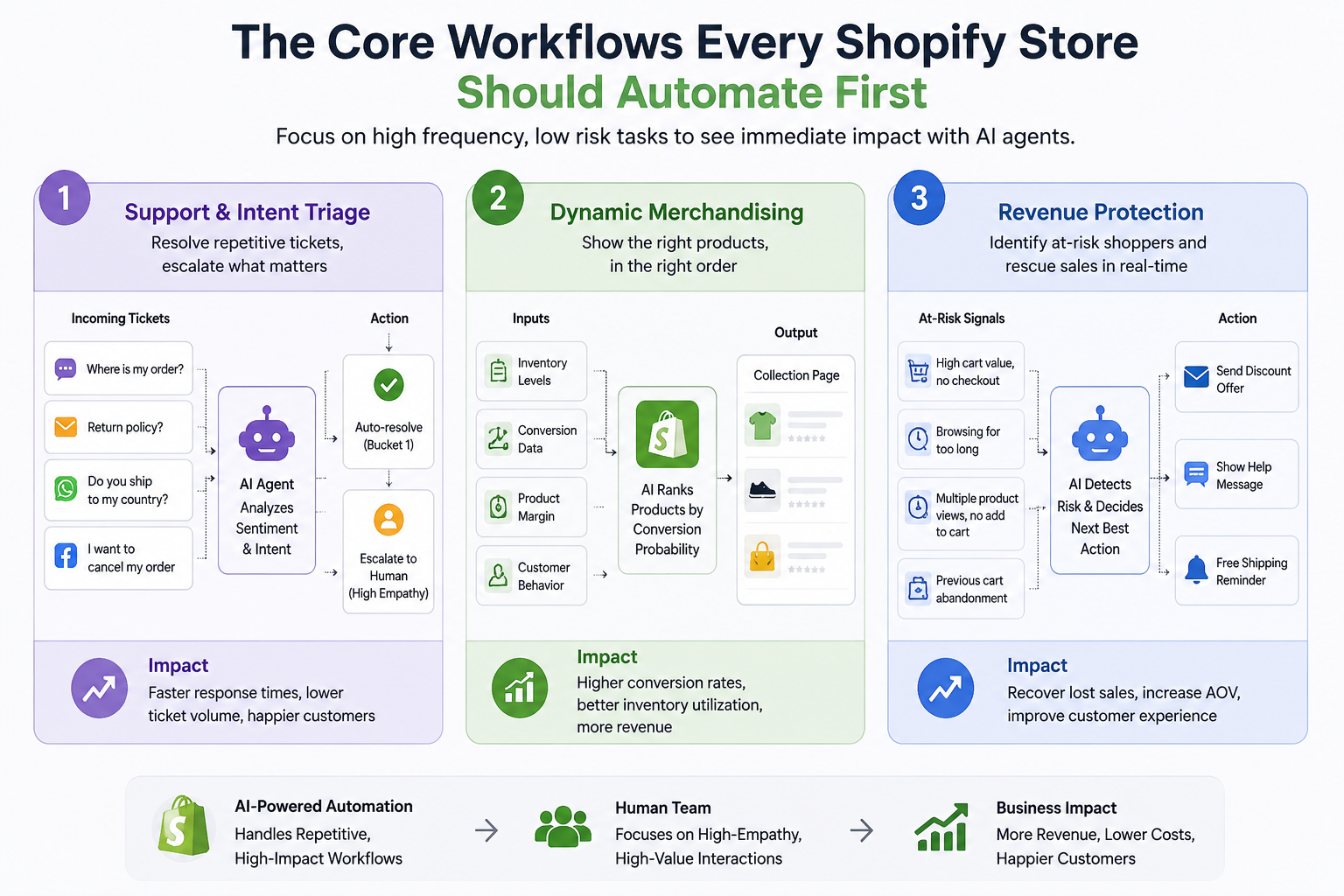
If you want to see the benefits of AI agents for shopify immediately, you have to prioritize high frequency, low risk tasks.
- Support & Intent Triage: Use agents to analyze sentiment and intent before a human sees a ticket. This resolves Bucket 1 tickets (the repetitive ones) so your humans can focus on high empathy brand building.
- Dynamic Merchandising: Automation can now rank your collection pages by conversion probability and inventory levels. This ensures your high margin, in-stock products are always at the top.
- Revenue Protection: Use behavioral AI to identify struggling shoppers and rescue the sale in real time.
Shopify Delivery Workflow Automation — From Order Confirmation to Last Mile Resolution
- In 2026, shopify workflow automation is the primary tool for turning a logistical headache into a competitive advantage.
- WISMO inquiries represent a $3.8 billion software category because customers check their order status an average of 4.6 times per shipment.
- By automating this via shopify workflow automation, you reduce support volume by 26%.
- Advanced agents now monitor carrier APIs and preempt delays.
- If a package is stuck, the agent can proactively update the delivery window on the tracking page and send an apology discount before the customer even knows there is a problem.
AI Agents for Shopify and WooCommerce: How Automation Works Across Both Platforms
- Whether you are on Shopify (which holds 32% of the hosted market) or WooCommerce (36% market share), the need for shopify workflow automation is universal.
- Nonetheless, there is a difference in implementation. Shopify offers managed hosting services, whereas WooCommerce forces you to be responsible for all your plugin debts and server maintenance issues.
- For brands running multi-channel operations, you need AI agents for shopify and woocommerce that can bridge the two.
- Using platforms such as Thunai, Kore.ai, or Gorgias means that you will have a single source of truth across platforms.
- For example, a Thunai Agent could consume data from Shopify and WooCommerce to answer customer questions consistently, irrespective of whether they visit your website or shop on your blog.
The Measurable Benefits of AI Agents for Shopify Operations
The benefits of AI agents for shopify are most clearly seen in the bottom line. Research shows that marketing automation programs return a median of $5.44 for every $1 spent. For those in the top quartile, that ROI can jump to over $8.00.
Additional metrics we track in 2026:
- Conversion Lift: AI-powered search and personalization drive a 15% to 30% increase in conversion rates.
- Admin Savings: Merchants using tools like Sidekick report a 40% reduction in administrative time.
- New Buyer Growth: New buyer orders from AI searches occur at nearly twice the rate of traditional organic search.
How to Build Your Shopify Automation Stack Without Creating New Bottlenecks
Building your shopify workflow automation stack shouldn't be a shot in the dark. We recommend a 90 day transition roadmap:
- Phase 1: The Workflow Audit (Days 1 to 30): Isolate repetitive tasks like automating returns triage. Set a target, such as cutting cycle time by 20%.
- Phase 2: Data Foundation (Days 31 to 60): Clean your metadata. AI agents for retail and shopify don't browse, they read structured data. Use Thunai Brain to ingest your SOPs, PDFs, and product catalogs into a single truth source.
- Phase 3: Deployment (Days 61 to 90): Use the HTTP Request trigger in Shopify Flow to connect your AI agents. This ensures your agents can execute tasks (like issuing a refund) securely within your pre-defined guardrails.
Workflow Automation Mistakes That Cost Shopify Stores Time and Revenue
The most common mistake is Pilot Purgatory, failing to move beyond small tests into full scale production. Other critical errors include:
- Manual Token Management: Relying on manual API setup is a scaling nightmare.
- Dirty Data: If your product SKUs differ across systems, your AI will hallucinate errors.
- Ignoring Real Time Sync: A 15 minute delay in inventory sync is an eternity in 2026. Use tools like Thunai Sync to keep your catalog updated in real time through continuous API based synchronization across Shopify, warehouses, marketplaces, and backend systems.
Ready to Move Beyond Shopify Flow? Here's Where Agentic Automation Takes Over
As commerce shifts toward AI driven buying experiences, Shopify Flow can automate workflows, but it cannot think or make decisions. Platforms like Thunai AI go further with agentic automation.
- Thunai Brain uploads and centralizes documents, SOPs, FAQs, product catalogs, and business data into a self learning knowledge hub.
- Thunai Chat Agent automates customer support and sales conversations.
- Thunai Voice Agent handles AI-powered voice interactions 24/7.
- Thunai Omni connects Shopify, WhatsApp, CRM, email, and support channels in one place.
- Thunai Workflow Automation executes refunds, RMAs, routing, and backend operations automatically.
Unlike static workflows, agentic ai shopify systems can reason, recommend, and act autonomously. Combined with shopify workflow automation, Thunai helps businesses build intelligent commerce operations for the AI first future.
Unlock smarter Shopify automation — book your demo with Thunai AI today.
FAQs on Shopify Workflow Automation
What is Shopify workflow automation and how is it different from Shopify Flow?
Shopify workflow automation is the high level strategy of making your store's operations autonomous. Shopify Flow is a specific tool that uses rigid "if,then" logic for simple tasks. In 2026, shopify workflow automation also includes Agentic AI (like Thunai), which can reason through complex problems that Flow cannot handle.
Can AI agents handle Shopify order fulfillment and delivery exceptions automatically?
Yes, with shopify delivery workflow automation, agents can track carrier signals and automatically inform customers, give discounts on delays, or even trigger a resend in case there is a loss in transit, without any human interaction required.
Does Shopify workflow automation work for WooCommerce stores too?
Absolutely. While Shopify has more native agentic ready features, you can use ai agents for shopify and woocommerce like Thunai or Kore.ai to manage both platforms from a single centralized intelligence hub.
How long does it take to set up agentic AI automation for a Shopify store?
Current platforms such as Thunai can be launched in less than 48 hours to maximize return on investment. Nonetheless, a complete system revamp will usually require a 90 day timeline so that your data infrastructure is totally spotless.
What happens when an automated workflow fails — who catches the error?
Safety is built into the architecture. We use a human in the loop model where the AI flags any edge case or high risk action (like a refund over $100) for manual review. All decisions are recorded in an audit trail for your team to supervise.




.png)
