


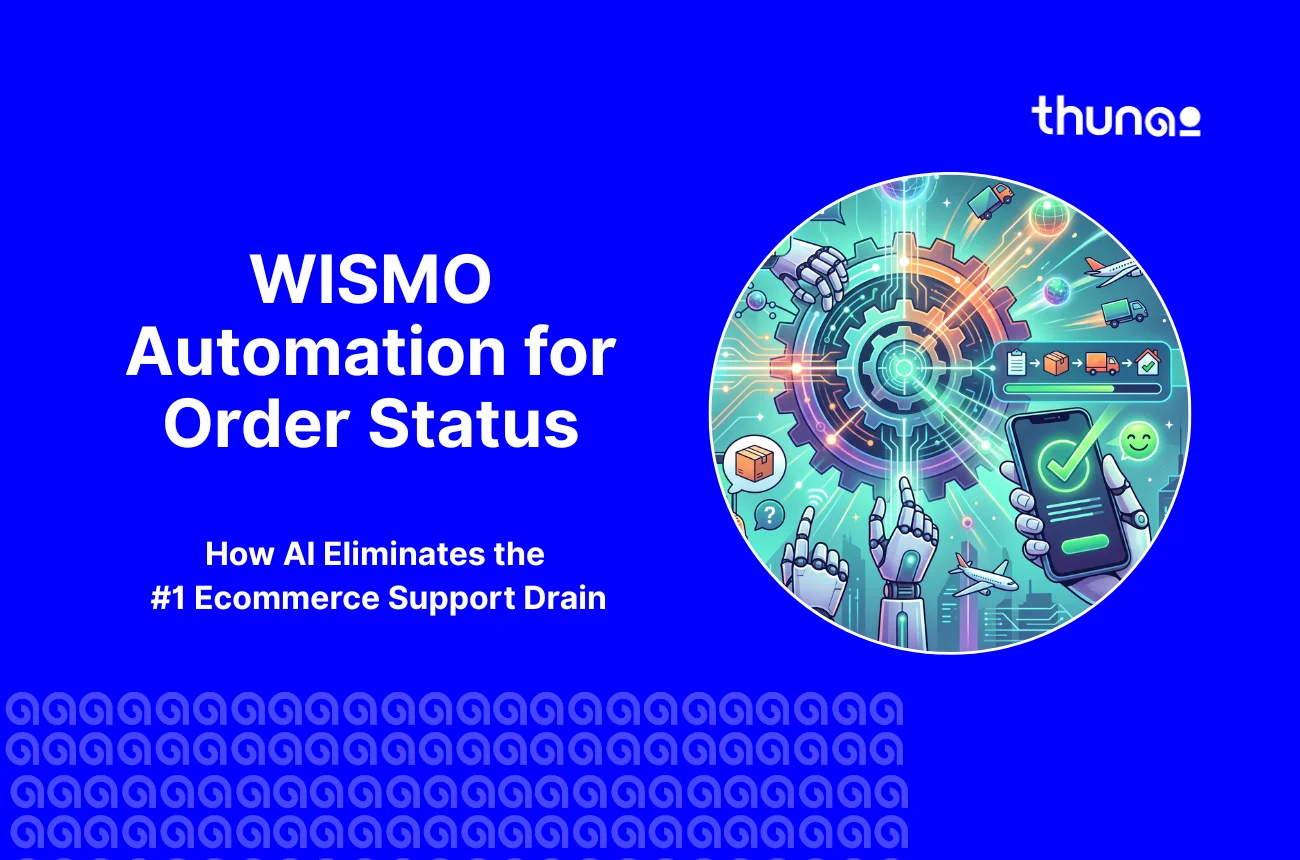

Is your support team spending most of their day answering: Where is my order?
That’s actually VERY common!
When your ecommerce customers don't get updates after placing an order, they panic and reach out to support.
This means your team gets buried in tickets that should never have existed to begin with.
So to help you handle this, our guide will walk you through exactly how WISMO automation works.
Why Every Where Is My Order Ticket Is a System Failure in Disguise
Every WISMO ticket your team receives is not a customer service problem. This is a visibility problem your brand created.
Every ecommerce brand is now judged against that exact benchmark, no matter the size of the company.
In fact, research shows that 96% of shoppers actively track their orders when tracking is available, and 43% check that data daily until the moment of delivery.
But if the carrier doesn't physically scan the package for 48 hours, the customer is left staring at a tracking link stuck on pre-shipment.
When that happens, customers don't assume a logistics issue - they assume your brand lets them down!
A properly built WISMO automation for order status post-purchase system picks up on scan gaps, breaks down delivery exceptions, and sends reassuring updates before the customer ever feels the need to reach out.
What WISMO Automation Actually Means (Beyond Just Sending Tracking Emails)
WISMO automation for order status is not a tracking email. This is a fully self-running system that monitors, interprets, acts, and communicates across your entire logistics chain without a human agent involved.
For years, automating order tracking meant setting up a basic webhook to fire a confirmation email with a carrier link the moment an order was marked as fulfilled.
True WISMO automation for order status using agentic AI is something else entirely.
Rather than sharing pre-written text based on keyword triggers, an agentic AI picks up on customer behaviour, figures out what the customer means, takes action across backend systems, and keeps learning over time.
What this looks like in practice:
- Event-driven monitoring: The AI constantly listens for order and delivery events such as shipment creation, carrier status changes, and delivery exceptions via live API polling across the logistics network.
- Context-aware communication: When a customer asks, I ordered this for a wedding on Saturday, will it arrive at my hotel in Chicago in time, the AI picks up on the urgency, checks the delivery estimate, and responds with a real, helpful answer, not just a tracking URL.
- Bidirectional system access: The AI can query order data, pull up live carrier updates, log notes in the CRM, and trigger notifications across SMS, email, WhatsApp, or voice.
- Logistics translation: Carrier jargon like Terminal Sortation Exception Code 43 gets broken down into plain language. The customer hears that there was a weather delay, their package is safe, and delivery is set for the next day.
Why Traditional Order Tracking Tools Fall Apart at Scale and What AI Does Differently
The main problem with traditional tracking tools is not that they are slow - its that legacy tools fall apart the moment anything unexpected comes up.
Traditional automation follows a fixed, rigid set of programmed rules.
The instant an interaction falls outside the defined script, the system either fails, puts out a nonsensical response, or hands the issue back to the human queue.
Imagine this scenario: a customer replies to a shipping confirmation email saying, I accidentally entered my old zip code, can you change it before the truck leaves?
A traditional tracking tool is completely blind to that type of context.
Which is exactly why non-AI automation like WISMO automation for order status flows can take three to four months to build..
Here is how the two compare across the areas that matter most:
How a WISMO AI Agent Works: From Customer Query to Instant Resolution
A fully self-running WISMO AI agent sorts out complex logistics queries in milliseconds through a tightly coordinated, multi-step workflow with no human involvement required.
Here is exactly what happens the moment a customer asks where their purchase is with WISMO automation for order status:
- Omnichannel Ingestion: The customer reaches out through any channel, whether live chat, email, SMS, or voice. The AI immediately identifies them by cross-referencing the incoming contact data with the CRM or ecommerce platform. No order number required. No manual verification loop.
- Intent Recognition: The NLP layer breaks down the raw message and instantly flags it as a WISMO inquiry, regardless of phrasing. Phrases like Has it shipped yet, When will it get here, and Still waiting on my package all point to the same operational intent.
- Real-Time Data Retrieval: The AI starts simultaneous API calls to both the Order Management System to check internal fulfilment status and the third-party carrier to pull up the latest scan data. This dual-query gives the AI a complete, current picture of the order's journey.
- Synthesis and Translation: The AI pulls together both data sources. If the OMS says Fulfilled but the carrier says Label Created, Awaiting Item, the AI figures out the package is likely sitting on the warehouse dock waiting for carrier pickup. That gets translated into a clear, brand-appropriate message.
- Instant Resolution: The AI sends a personalised, accurate response on the customer's chosen channel. The full process, from reading the query to sending a response like Your order 1020 was scanned in Paris this morning and is expected at your address tomorrow by 6 PM, takes a fraction of a second.
This end-to-end WISMO automation for order status runs entirely in the background so the support team never even has to see the ticket.
The 4 Types of WISMO Queries AI Can Fully Resolve Without a Human Agent
WISMO is a broad category, but most order-status queries fall into four specific scenarios. A well-connected AI agent can handle all four completely on its own.
- Order Received, Not Yet Shipped: Customers often reach out hours after ordering to ask why nothing has moved yet. A basic bot just repeats back the same status they can already see. An agentic AI checks the order's timestamp against the brand's fulfilment SLA, looks into whether the item is a pre-order or backordered, and comes back with something genuinely useful like: Your order is being packed right now. Our standard processing time is 3 days and everything is on track. You will get your tracking link by tomorrow evening.
- Order Shipped, In Transit: This is the most common query. The WISMO automation for order status pulls up real-time location data and delivery estimates directly from the carrier API and brings that information into the conversation, not as an external link to a confusing third-party tracking page
- Order Delivered, But Not Found: An advanced AI first checks the carrier's delivery logs for specific drop-off notes like Left with neighbor or Placed in side-door mailbox. Where those exist, the WISMO automation for order status passes them on. Where the package is genuinely missing, the AI walks the customer through standard waiting periods and automatically schedules a follow-up or opens a claim ticket if the item stays missing.
- Order Lost or Carrier Exception: When tracking hasn't moved in an extended period, the AI looks into the logistics data, spots a genuinely stuck package, and cross-references the brand's resolution policies. The AI then puts a concrete choice to the customer: Your package hasn't moved since Tuesday. Would you like me to send a replacement right away or issue a full refund?
Proactive vs. Reactive WISMO Automation: Why Most Ecommerce Teams Get the Order Wrong
Most ecommerce brands invest in automation that answers WISMO questions. The brands winning on post-purchase experience invest in automation that stops those questions from ever being asked.
Reactive automation is what most teams build. Ticket deflection metrics can look good on paper. But the problem is rarely fully solved.
Proactive automation works differently. The WISMO automation for order status constantly monitors the logistics chain, picks up on anomalies, and reaches out to customers before they have reason to worry. Here is how to set it up properly:
- Map the full order journey from payment confirmation to final delivery, noting every historical touchpoint where delays or exceptions tend to come up.
- Connect all systems including storefront, warehouse, carrier, payment, and returns tools into a centralised data layer that acts as a single source of truth.
- Set predictive detection rules inside the AI for triggers like late initial scans, fulfilment holds, and weather-related carrier alerts.
- Roll out automated outreach the moment a trigger fires. If a package hasn't received a carrier scan in 48 hours, the AI sends: We noticed your package is moving slightly slower than expected. We are keeping a close eye on it and will give you a clear update by tomorrow.
Brands that make this move from reactive to proactive consistently see a 70% to 90% drop in inbound WISMO tickets right after launch.
WISMO Automation for Shopify: What Native Tools Miss and Where AI Fills the Gap
Shopify's native tools are a good starting point for simple stores, but the moment your tech stack extends beyond Shopify's own ecosystem, they fall short fast.
Shopify Inbox and its built-in AI assistant handle basic queries well for brands whose entire operation runs inside the Shopify ecosystem. For non-technical store owners managing straightforward, single-warehouse fulfilment, the native tooling is genuinely convenient with low setup overhead.
That said, Shopify's native agents don't coordinate workflows across external systems. They work well inside their own ecosystem and can't act outside of it.
A purpose-built AI agent will cross-reference the Shopify order, check with the external Warehouse Management System that the order hasn't been picked yet, pause fulfilment, update the address in both systems, and confirm the change in real time, all without a human touching the ticket.
This is where purpose-built platforms like Thunai, Fin, and Alhena step in. These tools sit above Shopify as a coordination layer, using API tools like n8n or Make to tie Shopify into the full operational stack and give the AI agent access to every system it needs to take real action.
How to Connect Your AI Order Tracking System to Existing Helpdesk and OMS Stacks
An AI agent is only as good as the data it can access. Disconnected systems put out inaccurate answers, frustrate customers, and cause the AI to produce wrong information instead of helping.
The main goal of a proper connection setup is to cut out the tab-switching that slows human agents down, constantly moving between the Helpdesk, Shopify, and a carrier portal just to answer one question.
WISMO automation for order status needs secure, real-time read and write access across all relevant platforms to take over that process entirely.
Here is how a proper WISMO automation for order status setup is structured:
- API Gateways: Build custom scripts or use native webhook connections to set up constant, secure communication between the Helpdesk and the backend OMS. For Zendesk specifically, this means building out custom scripts using the Make API call step to allow the agent to securely pull up external tracking data.
- Dynamic Variables and Macros: In platforms like Gorgias, set up pre-built macros that pull in real-time variables like $Order_Status, $Tracking_Number, and $Expected_Delivery_Date directly into the AI's response logic before a reply goes out. This makes sure the AI is always working from current data.
- Actionable Tooling Permissions: The AI needs clear digital authority to take action, not just read data. In the Crisp ecosystem, for example, this means switching on a specific Get Order Details skill that gives the LLM direct permission to query the connected ecommerce database.
- A Centralised Coordination Layer: Rather than building fragile point-to-point connections between every tool, enterprise brands increasingly route everything through a central platform like Make, n8n, or Thunai's Universal Commerce Protocol. This acts as a data routing hub, pulling in inventory logic, carrier rules, and customer history so the AI can carry out tasks like a deeply embedded digital worker rather than an external chatbot.
Measuring Success: The KPIs That Prove Your WISMO Automation Is Actually Working
Deploying an AI agent is a real investment. Proving it's working means tracking the right numbers, not the ones that look good on a dashboard but the ones that reflect actual outcomes for your team and your customers.
Here are the metrics that matter for WISMO automation order status tickets and queries:
One important distinction to keep in mind: Resolution Rate and Deflection Rate are not the same thing. Deflection just means the customer was kept away from a human agent.
Turning WISMO Queries from a Cost Centre Into a Post-Purchase Revenue Touchpoint
The post-purchase window is the most underused revenue opportunity in ecommerce, and AI turns it into a channel for repeat sales and brand loyalty.
Most ecommerce executives treat the support operation strictly as a cost centre. But behavioural data tells a different story. On average, customers check their branded tracking page 3.5 times per order.
Platforms like Alhena take this further with dual-agent setups, where an Order Management Agent handles the logistics query while a Product Expert Agent monitors the interaction for upselling opportunities.
With this WISMO automation for order status setup, WISMO automation using AI turns every single tracking touchpoint into a measurable sales moment.
Delivering instant, accurate updates builds a level of trust that directly drives repeat purchase rates and higher Customer Lifetime Value.
Rather than letting WISMO drain your team's energy and cut into your margins, proactive AI automation turns every delivery journey into a loyalty-building experience at a fraction of the cost of human-handled support.
5 WISMO Automation Mistakes That Silently Destroy Post-Purchase Customer Trust
WISMO automation, when done poorly, can damage your brand faster than doing nothing at all. Here are the five mistakes to steer clear of:
- Using AI as a Defensive Wall, Not a Helper: Designing your bot to make it exhausting for customers to reach a human agent is a fatal error. Endless looping menus built to wear people out and cut costs breed resentment and vocal complaints on public forums.
- Wrapping a Broken Tracking Integration in a Chatbot Shell: If the carrier's API is stale and your AI just serves up that same frozen link, things get worse. A package showing Label Created for four days needs the AI to explain the delay and put forward a real resolution, not act as a pass-through for bad data.
- Passing Raw Logistics Jargon to Customers: Terms like Terminal Dispatch or Exception Code 11 mean nothing to a consumer and create unnecessary anxiety. Every carrier status that goes out to a customer should be translated into plain, reassuring language first.
- Buying the Tool Before Mapping the Process: Purchasing a flashy AI platform before cleaning up internal workflows is one of the most common and costly mistakes growing brands make. If your inventory systems are disconnected or your return policies are poorly documented, the AI will take in that mess and put out inaccurate information. Fix the operations before you automate them.
- Treating Each Channel as a Silo: If a customer asks about their order on Instagram and then follows up via email three hours later, the AI must carry over full context from the first conversation. Forcing customers to start over across channels instantly breaks down the sense of smart, personalised service.
How Thunai Automates WISMO Queries Across Chat, Email, and Voice Without Rebuilding Your Stack
A lot of ecommerce automation platforms are overpriced, inflexible, and force you to rebuild your entire tech stack just to get started.
Thunai works differently. The platform sits as a smart coordination layer on top of your existing tools, tying into the platforms you already use without requiring you to rip anything out.
Here is how it works in practice:
- Thunai Brain: A centralised knowledge store that takes in both structured data such as Shopify order histories, inventory levels, and CRM records, as well as unstructured data like PDF return policy documents, past support transcripts, and product manuals. This gives the AI full business context when making decisions.
- Thunai Model Context Protocol (MCP): The protocol allows the Thunai AI to carry out complex logic, pass on live inventory levels, and handle dynamic pricing across all operational surfaces. Thunai does not require you to replace your existing Helpdesk or ERP. The platform connects directly with tools like Zendesk, Salesforce, ServiceNow, and Amazon Connect, acting on your data exactly where it already lives.
- Thunai Omni: Thunai rolls out specialised agents across every customer channel. The Voice Agent turns incoming WISMO phone calls into actionable digital tickets in real time, handling complex conversations in over 200 languages. The Chat Agent sorts out text-based queries at scale without hardcoded scripts.
Would you like to see how it works? Try Thunai for free.
FAQs on WISMO Automation
What is WISMO?
WISMO stands for Where Is My Order. This is the single most common customer support enquiry in ecommerce. The term refers to any customer contact made to ask about the status, location, or estimated delivery date of an order your customers have already placed.
At what order volume does WISMO automation start paying for itself?
Industry consensus puts the tipping point at around 1,200 to 1,500 orders per month. Below that threshold, setup costs may outweigh immediate savings. Beyond it, automation quickly becomes a necessity, especially during peak periods like Black Friday, when WISMO volume can overwhelm any manual support operation.
Will AI replace my human support team?
No. AI handles high-frequency, low-complexity tasks like order tracking, standard refunds, and simple order edits, which can make up to 70% of total ticket volume. This frees your human agents to focus on high-value interactions that call for empathy, judgement, and complex problem-solving.
How does an AI agent handle stale or frozen carrier tracking data?
Advanced AI agents are specifically built to pick up on scan gaps, meaning packages showing no movement for an extended period. Rather than passing that stale data to the customer, the AI sends out a proactive delay notification and, depending on brand policy, can automatically kick off a replacement order or file a lost package claim without any human involvement.
Can Shopify's native tools handle WISMO at scale?
For simple, single-platform operations Shopify’s native tools can! But according to users on Reddit for brands using external CRMs, 3PL partners, specialised return portals, or multi-channel fulfilment, native tools can't coordinate across those systems. For multi-system setups, a dedicated AI coordination layer is needed to carry out true, end-to-end automation.
Is deflection rate a good measure of automation success?
No, and relying on it is a serious mistake. Deflection only measures whether a customer was kept away from a human agent, not whether their problem was actually sorted out. The metrics that truly reflect success are True Resolution Rate and First-Contact Resolution Rate, cross-referenced with CSAT and NPS scores.



.png)
