An AI medical assistant is software that uses natural language processing and large language models to help doctors.
The tool handles clinical documentation, patient details, and daily clinic tasks. The assistant listens to visits, drafts notes, and looks up records. With this, the doctor only has to check, edit, and sign off before a note goes into the chart.
What Is an AI Medical Assistant?
An AI medical assistant is a software tool that takes paperwork off the plates of doctors and clinic staff. This be all the forms, notes, and records that pile up around patient care. for doctors and administration
The tool uses natural language processing (NLP) to make sense of spoken and written medical terms. Large language models (LLMs) then turn those words into notes, short recaps, and answers. Meaning, the tool reads and writes the way a trained helper would. You may also hear it called an AI healthcare assistant or an AI clinical assistant. For the bigger picture, read up on AI assistant capabilities beyond healthcare.
Doctor-facing assistants work quietly in the background of a visit. They pick up the talk and draft notes. Patient-facing assistants talk straight to patients. They answer questions, book visits, and handle intake. On the whole, most clinics end up using a mix of both.
So does any of this take over a doctor’s judgment? No. The assistant gathers the facts and lays them out. But the doctor decides what is right and what happens next. Read more about Thunai’s AI healthcare assistant.
How Do AI Medical Assistants Work?
Behind the scenes, an AI medical assistant works in three steps. The tool listens, makes sense of what it hears, and writes things down. Each step leans on speech-to-text, NLP, LLMs, and a safe link to your electronic health record (EHR).
Picking Up the Patient Visit
The process kicks off with ambient listening. A phone or desktop mic picks up the visit. Speech-to-text then turns the sound into text. In doing so, the tool tells the doctor’s voice apart from the patient’s.
Medical transcription AI then weeds out small talk and background noise. That means doctors get notes without typing a word. Still, patients should always be told that the mic is on. They should also give consent first.
Making Sense of the Visit
Once the sound becomes text, healthcare natural language processing picks out symptoms, diagnoses, meds, and doses.
LLMs then draw on details from past visits to put together a medical history summary. Meaning, the note reflects the whole patient and not just today’s chat. This step is also where mistakes can creep in. That is why review matters so much.
Writing Notes and Filling In Records
The system sorts it all into SOAP notes (Subjective, Objective, Assessment, Plan). Next, the tool fills in the right EHR fields through HL7 FHIR. HL7 FHIR is a common format for sharing health data between systems.
With this, what comes out is a draft. The draft only joins the chart after the doctor checks and signs off on it. See how AI note taking and workflow automation handle this step.
Key Features of an AI Medical Assistant
A good AI medical assistant does more than take notes. So which features matter day to day? These four make the biggest change in clinic life.
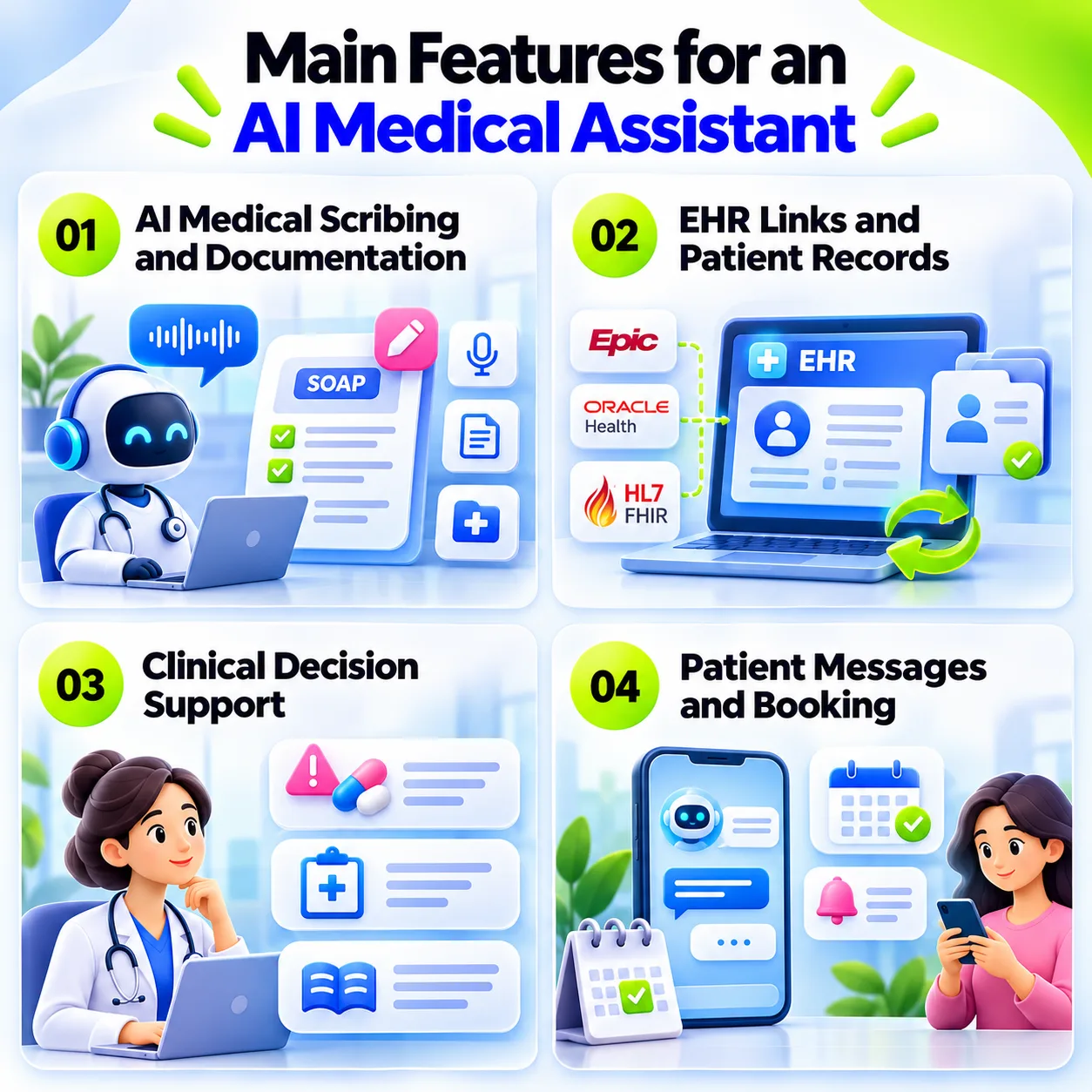
1. AI Medical Scribing and Documentation
Scribing is the base layer. This covers visit transcripts, SOAP notes, clinical summaries, and automated medical documentation. All of it comes straight from the talk in the room. Plus, specialty templates let notes match how each team works.
Scribe tools such as Abridge, Suki AI, Nabla, Heidi Health, Ambience Healthcare, DeepScribe, Freed AI, and Microsoft Dragon Copilot mostly stick to this area. So check whether you need a scribe or a full assistant.
2. EHR Links and Patient Records
The assistant hooks into Epic Systems, Oracle Health, and other electronic health records through HL7 FHIR.
Patient records then update on their own. Meaning, staff no longer type the same data twice. Notes, meds, and past visits stay in one place. A proper link also stops the AI from making extra copies of records.
3. Clinical Decision Support
Clinical decision support (CDS) brings up patient history, context, and guidelines at the right moment. Think alerts when two drugs clash, or a quick history recap before a visit.
These pointers are tips, not orders. A doctor goes over each one before acting on it. Used this way, CDS works like a second pair of eyes rather than a second opinion.
4. Patient Messages and Booking
AI patient communication covers booking help, intake, FAQs, and follow-up messages. These virtual medical assistant workflows make patient care simpler to run. They also free up your front desk to look after the people standing right in front of them. With this, clinics can pick up routine calls after hours, too. Larger clinics can also hook AI assistants for healthcare customer support into their call center tools.
Why Clinics Are Turning to AI Medical Assistants
Clinics are not turning to AI because AI is trendy. They are turning to AI because paperwork is crowding out patient care. Many doctors wrap up their charts late at night. Some doctors even have a name for this: pajama time. Wider AI automation trends point the same way outside healthcare, too.
How many hours a week does your team lose to typing up notes? For most clinics, the answer is too many.
- Less Repeat Admin Work: Clinical workflow automation takes over booking, intake, and record updates. These tasks used to eat into staff hours. In doing so, medical practice automation also cuts down on errors from typing the same data twice.
- Lower Burnout: Paperwork is a leading cause of doctor burnout. In one study of ambient AI scribes, self-reported burnout fell from 51.9% to 38.8%. Meaning, the paperwork load can be brought down.
- Faster Notes, More Time for Patients: In one large rollout, 7,260 doctors saved about 15,791 hours of note-writing time. Those savings came across 2.5 million patient visits. That time goes back to the patient in the room.
- Quicker Access to Patient Details: With an AI assistant, past visits, meds, and old notes show up in seconds. On the whole, care stays joined up when a patient sees more than one doctor.
For clinics, the payoff is a calmer day and a fuller record. Schedule a demo to see how the tool works in your practice.
Real-World Use Cases of AI Medical Assistants
Here is where an AI assistant for doctors earns its place, from the exam room to the front desk.
1. During Patient Visits
Ambient documentation writes down the talk in real time. The tool drafts a clinical note as the visit happens. So doctors can keep their eyes on the patient and off the keyboard.
In one study at a teaching hospital, ambient scribes increased doctor eye contact time by 10.6%. The same scribes also cut the time spent on notes during shifts. With this, the assistant puts together a short recap of each visit. The doctor can look the recap over before the next patient walks in.
2. After Patient Visits
After the visit, the assistant wraps up SOAP notes and updates the EHR. The tool also gets referral forms and follow-up notes ready. Medical history summaries help the next doctor catch up fast.
Teams see less late-night charting as a result. Plus, fewer notes are left hanging at the end of the day. Wouldn’t your doctors rather head home on time?
3. Across Daily Clinic Work
Booking, patient messages, and intake run quietly in the background. Front-desk medical AI assistants can pick up routine calls and book visits at any hour. On the whole, this kind of medical practice automation reaches well beyond the exam room. Your admin team gets room to breathe.
4. Across Many Specialties
Emergency medicine, primary care, cardiology, oncology, and mental health all write notes in their own way. Specialty templates let one assistant adjust to each team’s workflow and terms. That covers it all, from fast ER notes to long primary care visits with many symptoms.
But complex specialties may need extra review. So try the tool out in your own setting first.
What to Look for in an AI Medical Assistant
Not every AI medical assistant is built the same. Run through these four checks before you sign up.
1. EHR Fit and Links
Ask whether the tool works with Epic Systems, Oracle Health, and your current electronic health records through HL7 FHIR. Some tools lean on fragile screen-scraping instead.
Systems that truly talk to each other keep records in sync. In doing so, data does not end up stuck in silos. Also ask about setup costs and vendor lock-in.
2. Data Safety and HIPAA Compliance
A HIPAA-compliant AI assistant needs more than a signed Business Associate Agreement. Look for encryption, role-based access controls, and audit logs. Also ask whether protected health information (PHI) is used to train models.
Why does this matter so much? The stakes are high. HHS fined Montefiore Medical Center $4.75 million after an insider data breach.
3. Getting Notes Right and Doctor Review
Hallucinations are a known risk. One review found that up to 70% of ambient scribe notes had at least one error. Meaning, most of these were gaps where details were left out.
So pick a tool that makes doctor review a must before a note gets saved to the chart.
4. Custom Workflows and Ease of Use
Look for specialty workflows, custom note templates, and quick setup. The tool should fit into your current clinic systems and patient routines. If the tool does not match how your clinic works, your doctors will not use it.
Limits and Risks of AI Medical Assistants
AI medical assistants are useful, but they come with risks. Knowing the limits helps you use them safely.
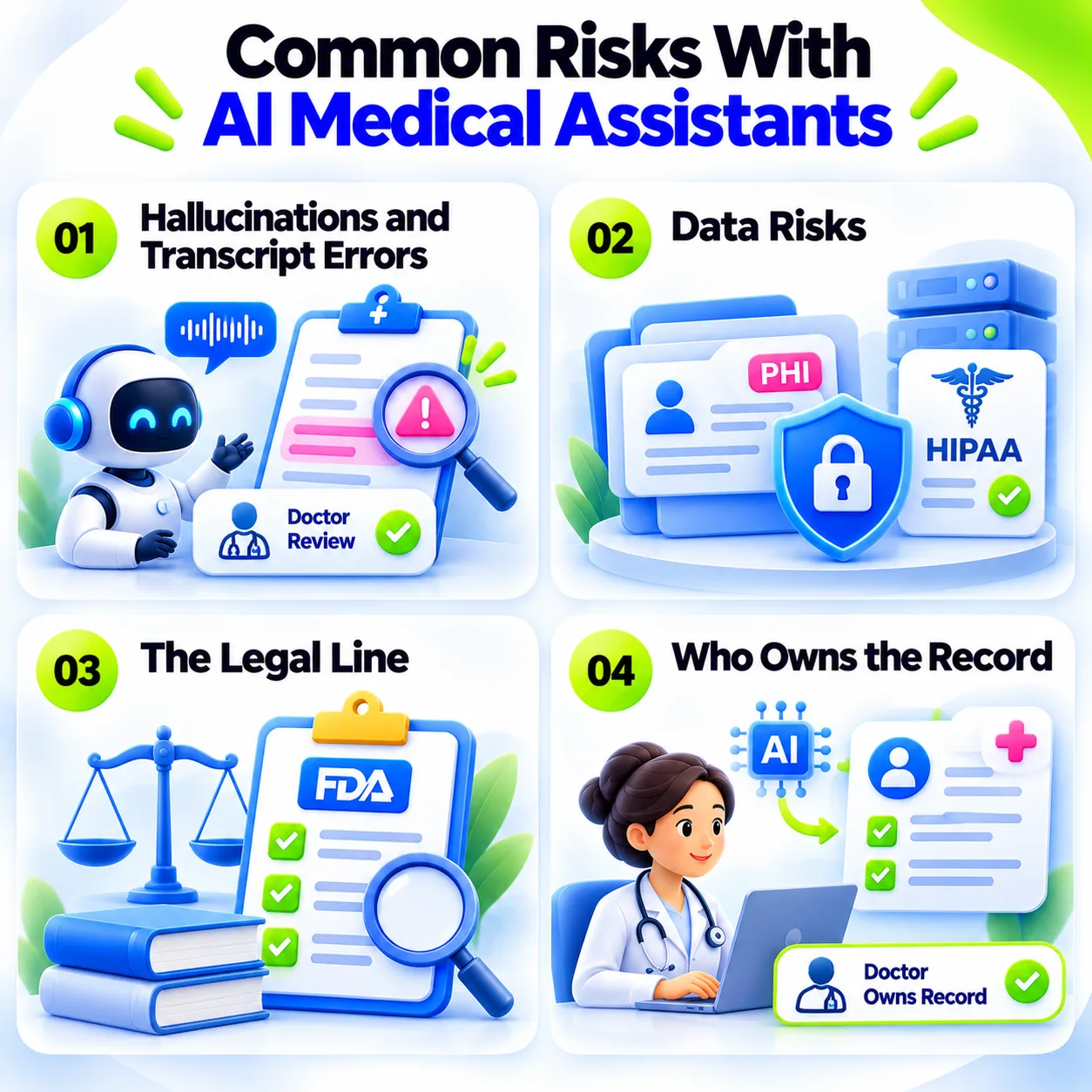
- Hallucinations and Transcript Errors: LLMs can make up or leave out clinical details. That is why every AI-written note needs doctor review before going into the record.
- Data Risks: Patient talks contain PHI. Weak safeguards can lead to data leaks and HIPAA breaches.
- The Legal Line: Admin help is not the same as a medical device. Under FDA guidance on clinical decision support software, doctors must be able to check the basis of any advice on their own. That is one of the tests software must pass to stay outside device rules.
- Who Owns the Record: The doctor stays in charge of the final record. AI should back up clinical choices and never make them alone. With this, patients stay safe.
Thunai: The AI Medical Assistant Built for Doctors and Clinics
Good AI gives doctors their time back. No one needs one more screen to stare at. Thunai is an agentic AI platform built for clinical documentation, medical scribing, patient data handling, workflow automation, and healthcare data security.
So what does that look like in practice?
Automate Clinical Documentation
Thunai Medical Scribe picks up visits in real time. The tool sorts the doctor’s orders from the patient’s story. Then the scribe drafts structured SOAP notes.
Plus, the scribe supports over 150 languages and can be set up for each specialty. Thunai states that clinics can save around two hours per doctor each day.
Connect Patient Data and Workflows
Thunai Brain works as one search layer across systems like Epic, Oracle Health (Cerner), eClinicalWorks, and Google Suite. Meaning, the right context is always one search away. Thunai Brain also uses contradiction detection to cross-check facts.
Through secure APIs and webhooks, Thunai Brain can also kick off tasks like booking visits and sending in prior authorization requests.
Support Doctors Without Replacing Them
Thunai works as a silent clinical partner. Thunai does not diagnose or suggest treatments. Every note needs a doctor to check the draft and sign off.
Live dashboards also let staff step in. With this, when a patient-facing chatbot runs into a hard question, the chat gets handed over to a human. The staff member then gets AI-powered real time support while taking over the chat.
Protect Private Health Data
Thunai Safemind keeps each practice’s data walled off and encrypted, with role-based access controls.
Thunai states that the platform follows zero data retention after processing. Patient data is also not used to train public LLMs. On top of that, Thunai stands by SOC 2 and HIPAA compliance.
Want to see it in action? Schedule a demo with Thunai today.
FAQs About AI Medical Assistants
What Does an AI Medical Assistant Do?
An AI medical assistant automates clinical documentation, writes up visit transcripts, and handles patient messages. Advanced versions also pull up records from the EHR, book visits, and take care of admin tasks. On the whole, this lightens the load on your team.
Can AI Medical Assistants Replace Medical Scribes?
These tools can take over much of what a human scribe does. That includes real-time transcripts and drafting clinical notes. Still, doctors must check every note, since errors and hallucinations can slip through.
Are AI Medical Assistants HIPAA-Compliant?
Not by default. The vendor must sign a Business Associate Agreement. The vendor also needs safeguards like encryption and access controls to protect PHI. Even so, clinics stay on the hook for risk checks under HHS rules. Clinics should also look into how their vendor keeps data safe.
Can AI Medical Assistants Connect With EHR Systems?
Yes. Leading tools connect to Epic Systems and Oracle Health through HL7 FHIR and secure APIs. Older systems may need workarounds. So check how the link works before you buy.
Can AI Medical Assistants Make Medical Diagnoses?
No. These tools work as admin helpers and clinical decision support. They do not diagnose on their own. The FDA may treat software that diagnoses without a doctor as a medical device. Either way, the doctor keeps full charge of diagnosis and treatment.