



What Is an AI Voice Agent and How Does It Actually Work?
In 2026, an AI voice bot is not a phone tree with a friendlier voice. It listens, understands, pulls the right answer from your knowledge base, acts inside your CRM, and closes the loop, all without a human in the seat. Today's voice AI for customer support run on three layers:
Conversational AI
Conversational AI voice agents are those that handles live voice, chat, SMS, and email across every channel. The best systems keep context intact as a conversation moves from chatbot to phone call to email follow-up.
Agentic AI
Agentic AI voice agents go beyond just answering by completing tasks such as:
- Looking up order or policy records in real time
- Updating CRM fields and creating tickets automatically
- Triggering escalation workflows when sentiment drops
- Sending confirmation messages post-call without human input
Predictive AI
Predictive AI voice agents uses your historical support data to:
- Identify which customers are at risk of churning
- Flag calls likely to escalate before they do
- Route calls to agents with the best success rate for that issue
- Surface the next best action during a live interaction
The platforms with real value connect all three layers.
By 2026, over 77 percent of customer-facing operations teams had deployed AI voice technology, yet the average agent still spends close to 2.5 hours per shift on tasks AI handles in seconds.
This article is for support operations managers, CX leaders, and agency owners who want to close that gap with AI voice agents. This guide will cover:
- Support teams handling high call volume
- CX leaders managing omnichannel queues
- Operations managers cutting AHT and cost-per-contact
- Enterprise IT and CX teams assessing platforms
- Agencies building white-label voice support
We tested 15 platforms across latency, resolution accuracy, CRM connection, compliance, and real total cost of ownership.
15 Best AI Voice Agents in 2026: Quick Comparison
Best AI Voice Agents in 2026 (Tested & Ranked)
1. Genesys Cloud CX
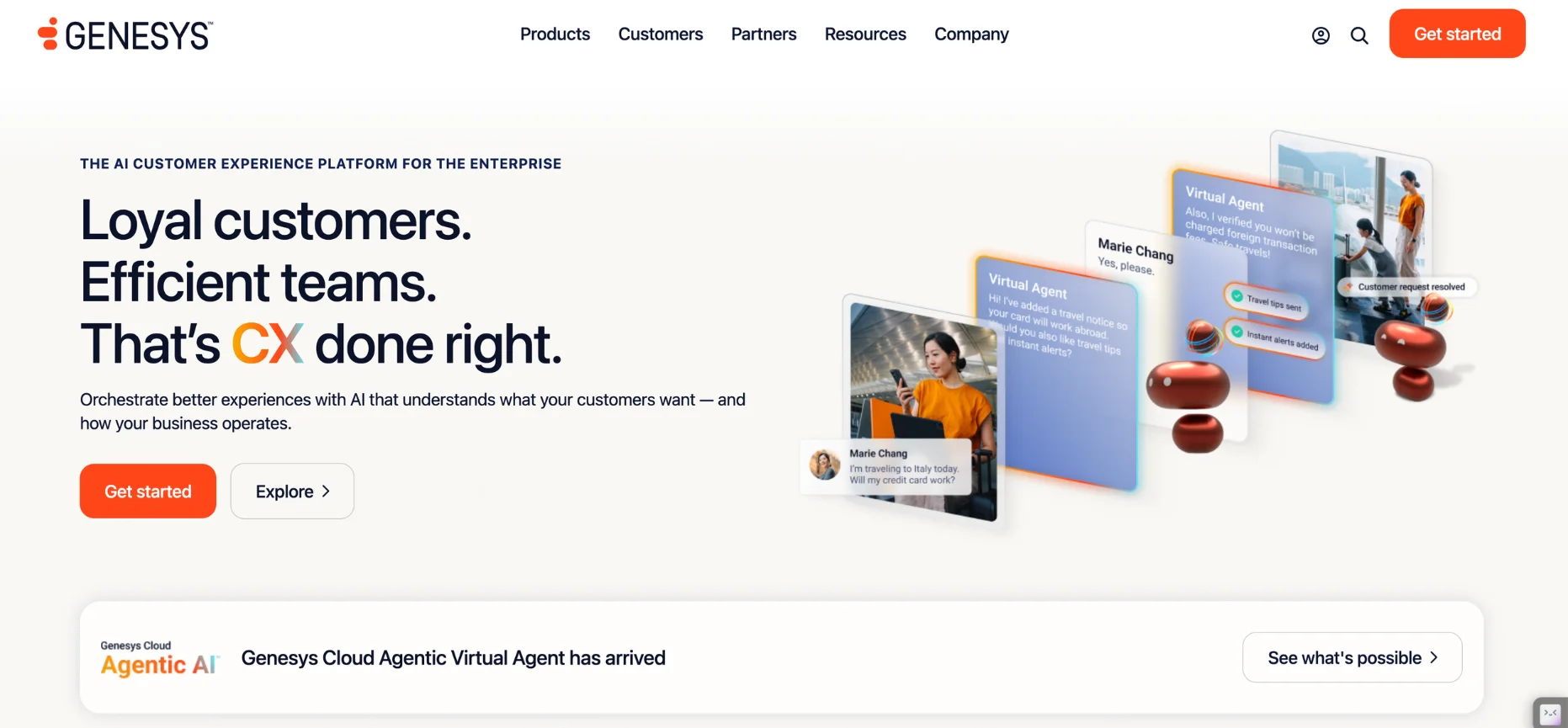
Genesys is one of the most reliable AI voice agents for large enterprise contact centers that need predictive routing and deep CRM connectivity in a single, proven platform.
Genesys is the ideal enterprise choice, proven at scale for decades, with AI woven into routing, workforce management, and analytics, not bolted on.
Features:
- Agent Copilot with Predictive Routing. Surfaces suggested responses, policy references, and next steps to the agent in real time.
- Architect Flow Builder. Visual drag-and-drop for call flows, escalation paths, and IVR logic, no code.
- Workforce Engagement Management. Built-in forecasting, scheduling, and quality monitoring in one view for staffing, coaching, and performance.
Pros:
- Proven Scale: Handles enterprise operations at a scale most platforms here have never faced.
- Ecosystem Depth: Native Salesforce, ServiceNow, and major CRM/ITSM connections mean no rebuilding your data layer.
Cons:
- Opaque Total Cost: Pricing runs $75-$240/user/mo, with a complex AI calling software experience Token model that makes budgeting difficult.
- Slow to Deploy: Average enterprise setup takes around five months, a real delay for teams needing relief now.
2. Thunai
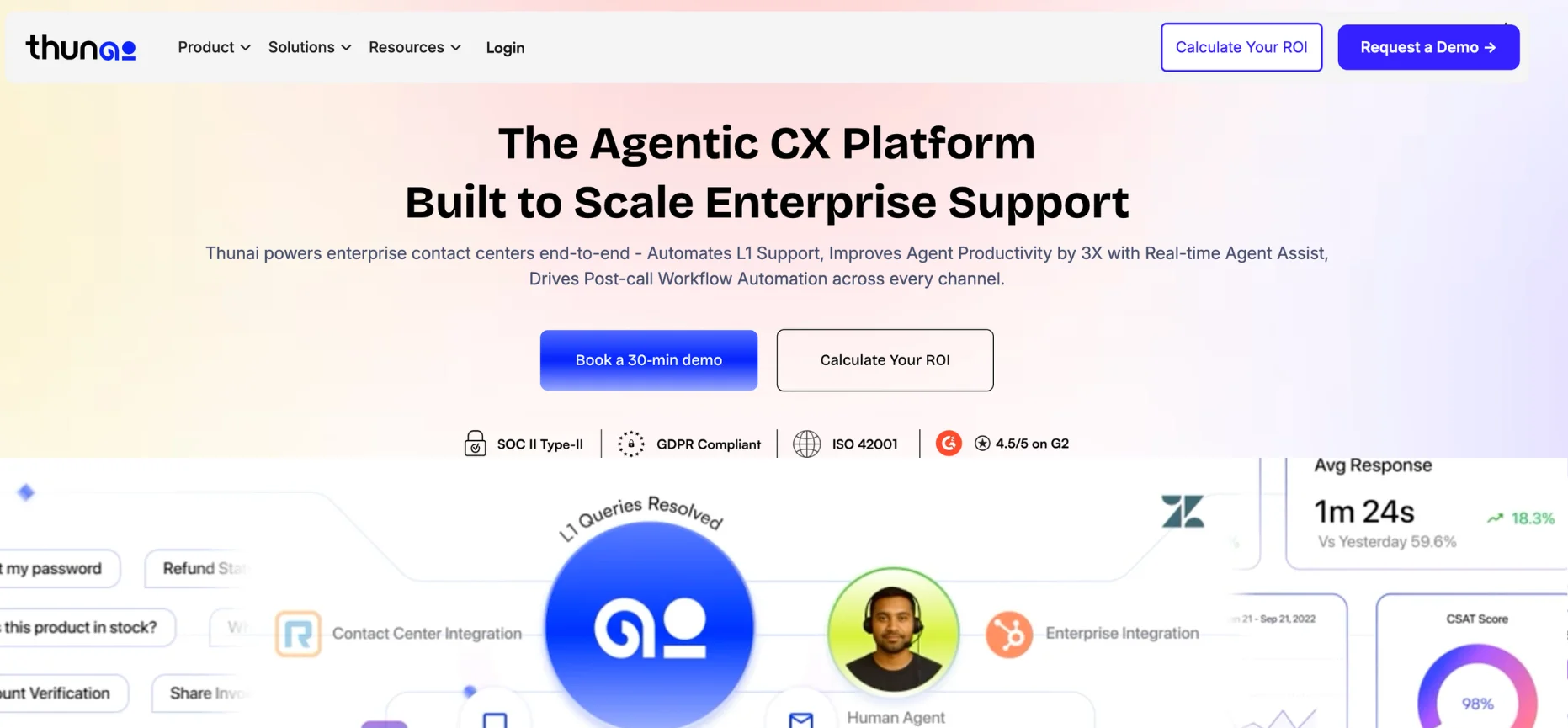
Thunai is one of the best AI voice agents for support teams needing real-time knowledge accuracy, live CRM write-back, and one platform that closes the full resolution loop.
While most agents answer questions, Thunai closes tickets and resolves issues with workflows.
Thunai ingests live CRM, ticketing, and call audio at once, to help agents on calls using AI real-time assist and in the case of AI vocie agents intimate to human agents when they can barge-in to prevent escalations from happening on call.
Features:
- Thunai Brain with Contradiction Resolution. Scans every document for conflicts before they reach a customer, creating one source of truth.
- Agent Studio. No-code tools deploy voice and chat agents in hours, trained on your knowledge base from day one.
- Multilingual support. Thunai comes real-time translation in over 200+ languages making it reliable for global use.
- 100% Call Scoring. Thunai comes with 100% QA using AI calls with on the AI based auditing and call scoring metrics you choose.
- Live Screensharing on Voice Calls. Unique here. The agent sees the customer's screen and guides them verbally, cutting MTTR.
Pros:
- Pricing Starts at: $149/mo for 600 minutes on Pro, with no per-seat charge, so large teams aren't penalized for adding agents.
- Hallucination Resistance: The contradiction layer is a structural advantage, making it the safest choice for regulated support.
Cons:
- Initial Setup: Connecting data and configuring the knowledge graph takes upfront effort; teams without clear docs need a few days.
3. ElevenLabs

Best AI voice agents for teams needing hyper-realistic voice synthesis as a layer inside a custom support stack.
The most realistic voice layer available. ElevenLabs’ Conversational AI 2.0 handles full-duplex calls, detects end-of-speech via breath patterns, and supports 70+ languages.
Features:
- Flash v2.5 TTS Engine. Targets sub-100ms generation, the fastest synthesis available, with near-zero lag between decision and speech.
- Multilingual Auto-Detection. Spots a mid-call language switch and adapts without restarting, ideal for diverse support bases.
- Proprietary Turn-Taking Model. Reads audio cues rather than silence timers, cutting the awkward pauses that feel robotic.
Pros:
- Voice Realism: Unmatched output quality for pure synthesis, the preferred backend where brand voice matters.
- Developer Flexibility: API-first design layers easily into an existing stack as the voice output layer.
Cons:
- Credit Unpredictability: Character-based billing makes high-volume costs nearly impossible to forecast; a busy day burns the allocation.
- Not a Complete Platform: It handles voice but not tickets, CRM, or workflows; you build the surrounding stack.
4. Retell AI
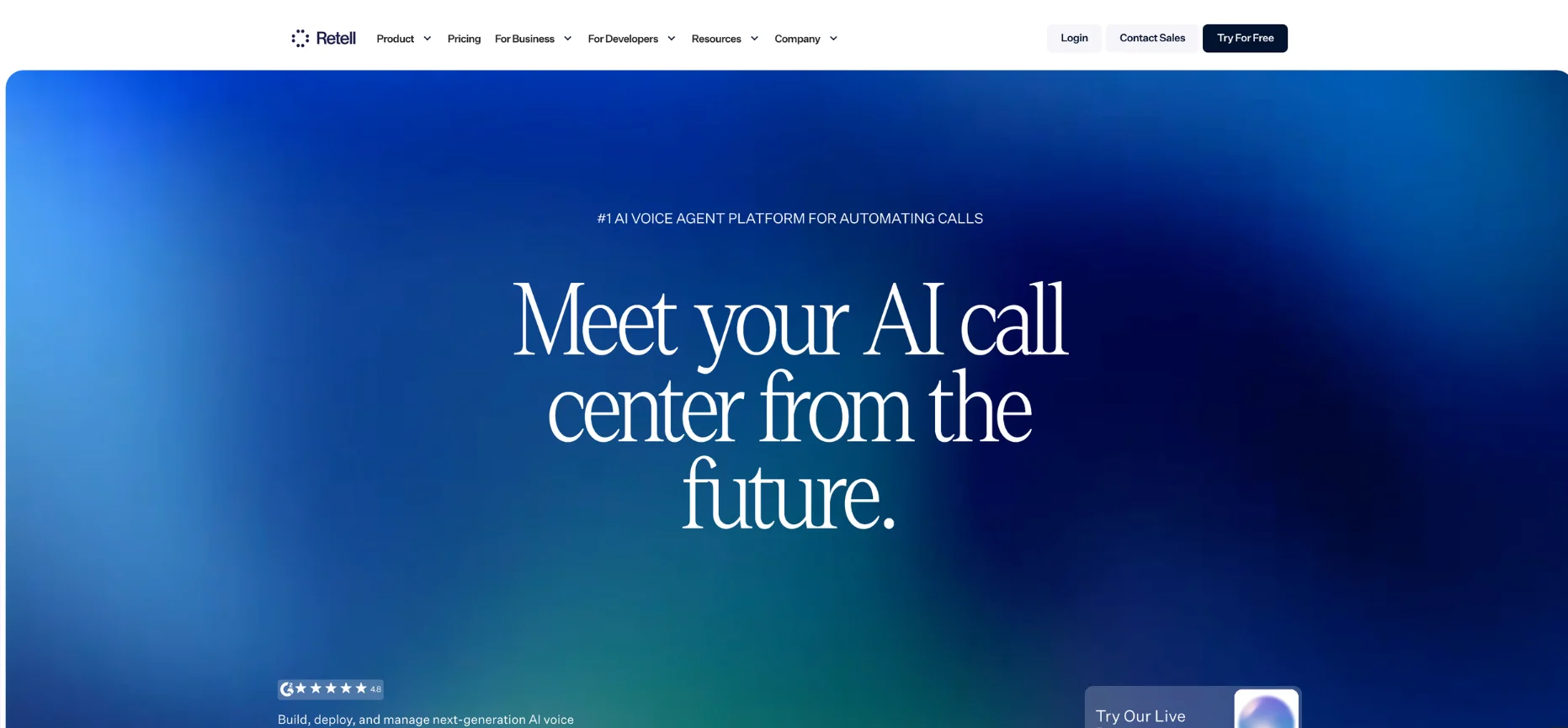
Retell AI is one of the top AI voice agents for developer teams building inbound products that demand low, consistent latency and full component control.
The developer community's top pick, abstracting telephony and LLM orchestration while keeping latency bounded at 620-800ms, where calls still feel natural.
Features:
- Bring-Your-Own Model. Connect your own LLMs, choose TTS like ElevenLabs or Cartesia, and wire telephony via Twilio or Vonage.
- Visual Conversation Flows Builder. Multi-node design with simulation testing, so engineers catch hallucination risks before going live.
- Proprietary Turn-Taking Model. A native layer keeps latency consistent under spikes and handles interruptions naturally.
Pros:
- Latency Performance: The 620-800ms range holds under load, one of the most dependable for inbound.
- Developer Community: 4.8/5 across 1,400+ G2 reviews reflects genuine practitioner satisfaction.
Cons:
- Stacked Pricing: The $0.07/min base balloons to $0.15-$0.33/min with LLM, premium TTS, and telephony fees.
- Voice-Only Scope: No native omnichannel, so unifying voice with chat and email needs middleware.
5. SynthFlow AI
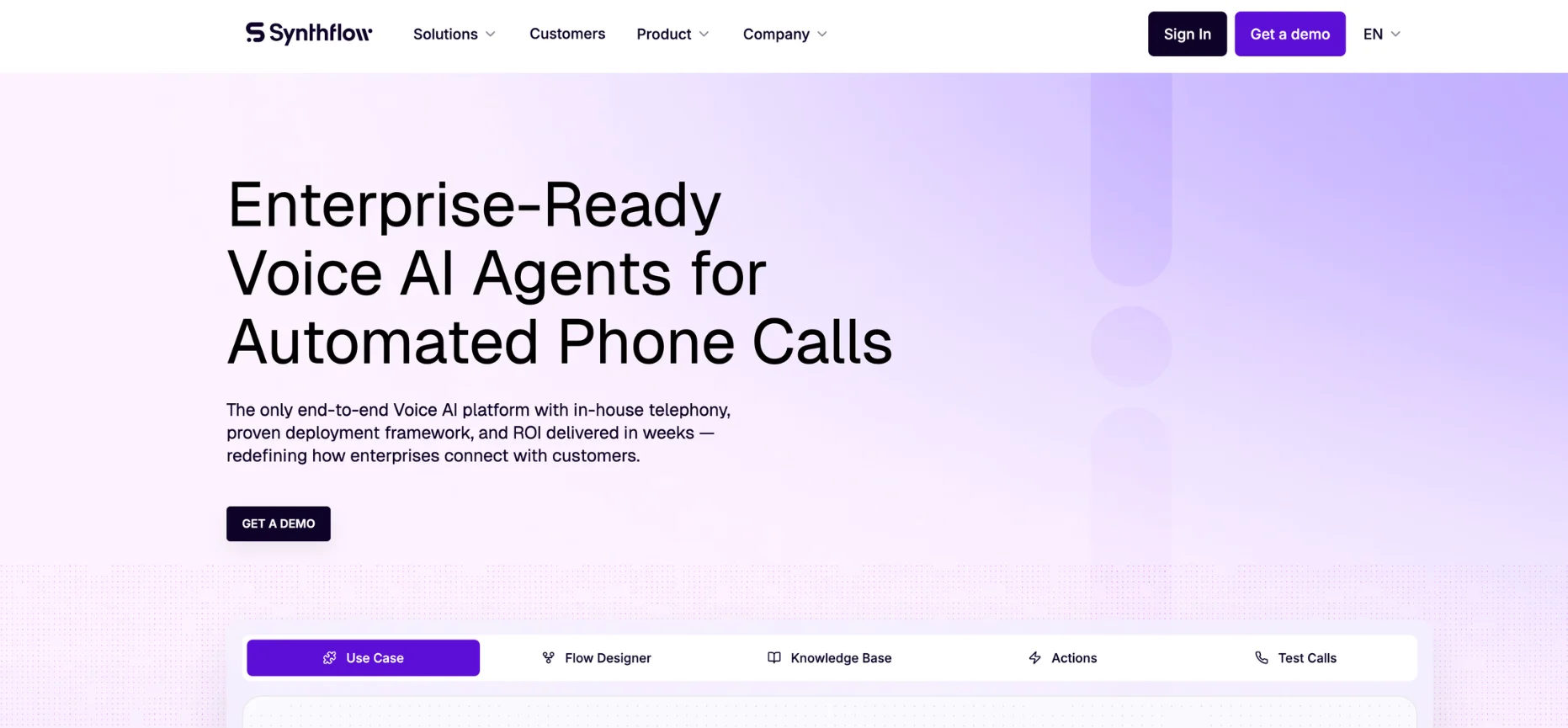
This platform has the best AI voice agents for small and mid-size teams that want to go live in under an hour with no code.
On the whole, SynthFlow AI has one of the fastest paths from zero to a live agent.
This makes it ideal for non-technical managers to launch a production phone agent in under 30 minutes via Flow Studio, no code required.
Features:
- Drag-and-Drop Flow Studio. Define prompts, pick ElevenLabs voices, and map paths visually, removing the engineering bottleneck.
- Native CRM and Helpdesk Connections. Out-of-the-box links to common SMB tools let the agent pull history and log outcomes.
- Inbound and Outbound Concurrency. Handles both directions at once, fitting teams that also run proactive outreach.
Pros:
- Speed to Value: Faster than anything here, with a 30-minute deployment claim backed by G2 reviewers.
- Accessible Pricing: Plans start at $29/mo, the most affordable entry point for small teams.
Cons:
- Off-Script Weakness: When callers deviate, the agent loses context and reverts toward an old IVR.
- Pricing Escalation: Low entry cost masks steep jumps as volume scales; some users call the tiers a bait and switch.
6. VoiceFlow
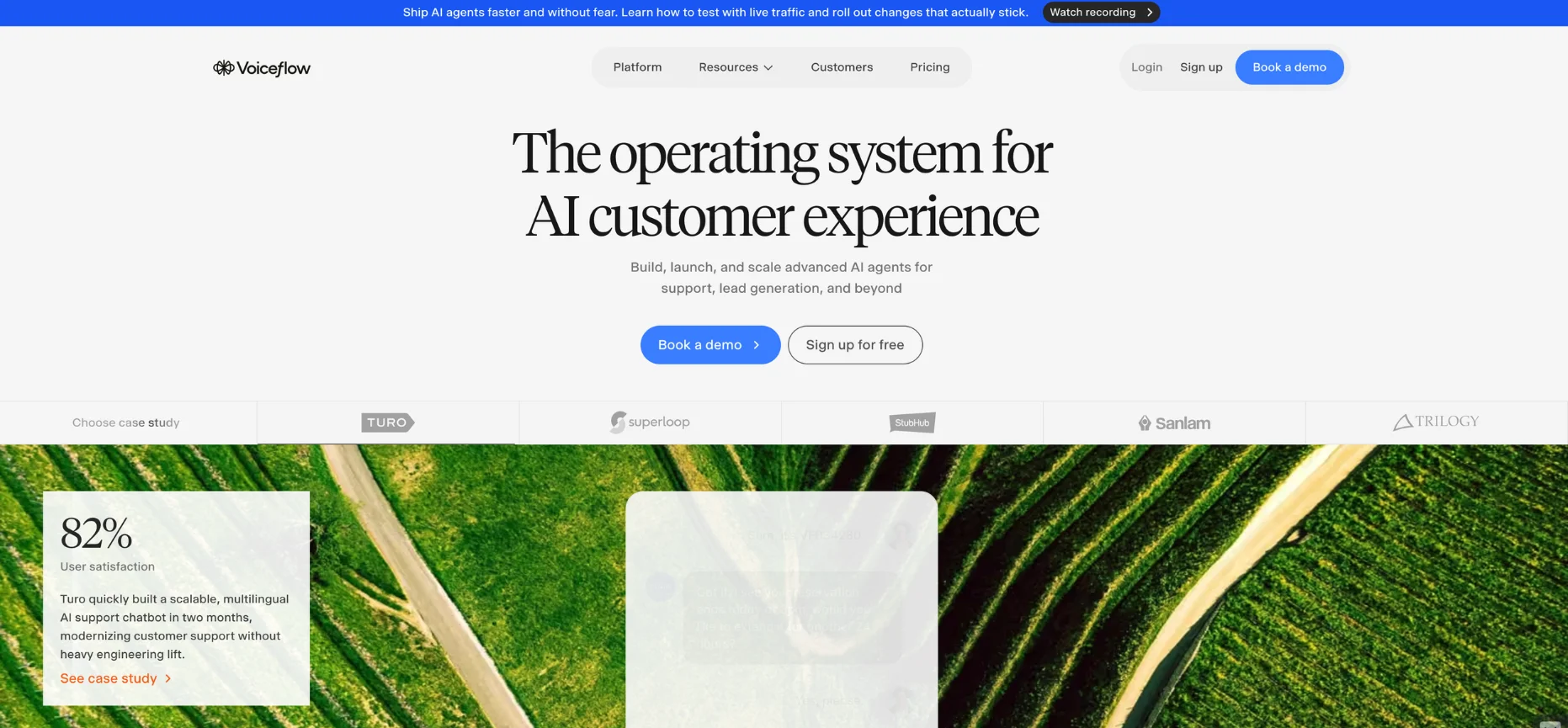
Voiceflow has some of the most suitable AI voice agents for product and design teams that build and test
These are also suitable for handling version control in complex conversation flows before launch.
The closest thing to a Figma for dialogue, letting PMs, writers, and developers collaborate on multi-turn flows in a shared, version-controlled workspace.
Features:
- Collaborative Conversation Canvas. A visual environment to map every branch, add logic, and share drafts, with instant rollback.
- Multi-Channel Deployment. Designs push to voice, web chat, and SMS from one source for consistent architecture across touchpoints.
- AI-Powered Flow Builder. Natural language prompts generate baseline flows refined in the canvas, cutting design time for new scripts.
Pros:
- Design Quality: Where the script is the product, VoiceFlow produces the most polished, auditable dialogue architecture here.
- Cross-Team Collaboration: Non-technical writers contribute without touching code, giving CX teams real ownership.
Cons:
- High Latency in Production: Calls via external Twilio connections regularly exceed 1,400ms, creating unnatural pauses.
- Credit Cost Complexity: A three-minute call can burn 100+ credits plus telephony fees, unworkable at scale.
7. Bland AI
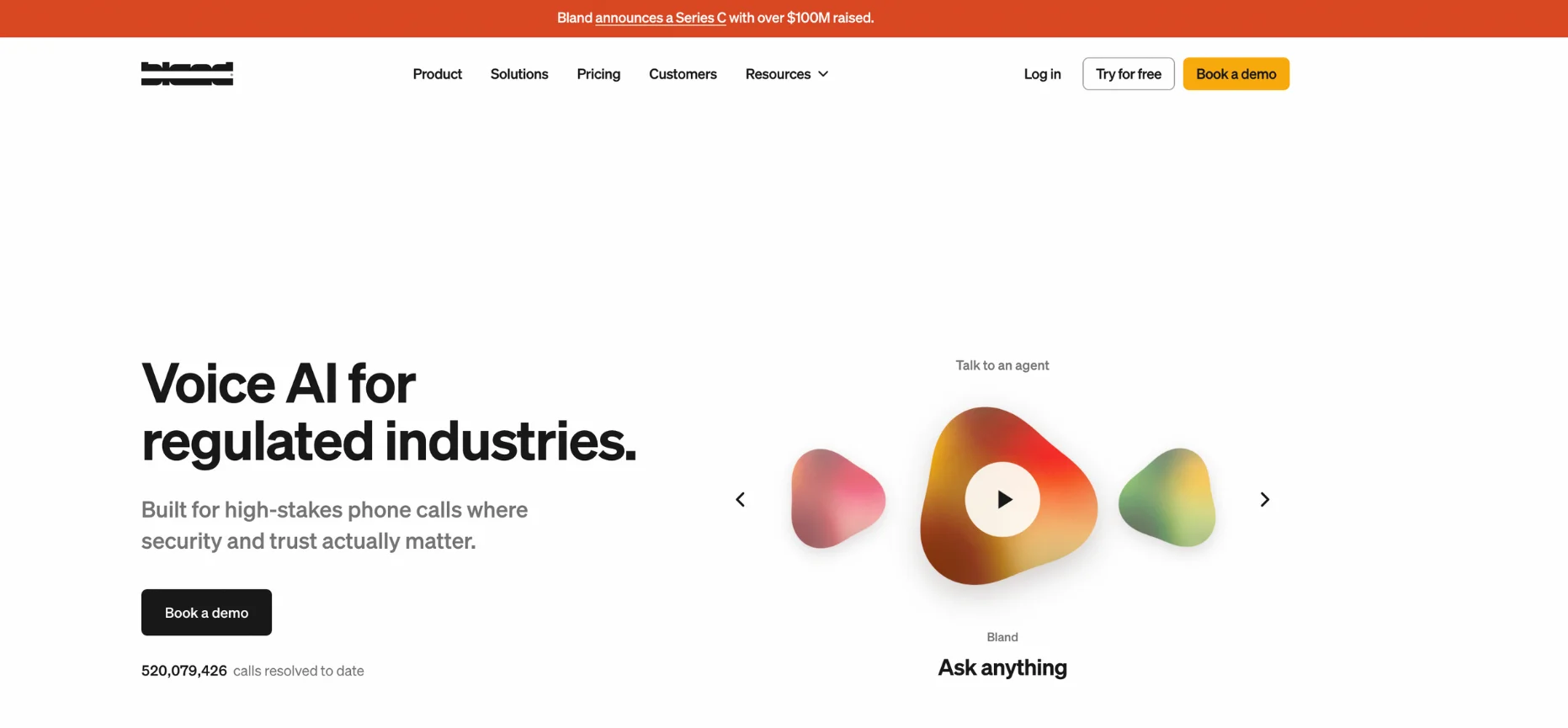
Best for teams running high-volume structured outbound campaigns like reminders, renewals, and post-ticket surveys, Bland AI comes with some of the top AI voice agents.
Bland AI is an AI voice agent platform built for volume, reaching 100 customers at once.
The Pathways builder in Bland AI maps branching flows, webhooks, and transfers for high-concurrency outbound.
Features:
- Pathways Visual Builder. Maps outbound logic for a no, a transfer, or a keyword, without engineering support.
- Mass Concurrent Dialing. Up to 100 simultaneous outbound calls on standard tiers without degradation.
- Webhook and CRM Triggers. When a call ends, Bland fires webhooks to update CRM, trigger follow-ups, or log results.
Pros:
- Outbound Scale: Handles concurrent dial capacity most platforms can't match at this price level.
- Structured Campaign Control: Pathways gives precise call-logic control, making compliance-sensitive campaigns auditable.
Cons:
- Rigid Off-Script Handling: Struggles to recover naturally when customers go off path, a serious limit for inbound support.
- Pricing Instability: A recent 55% base hike plus layered fees for SMS, transfers, and failed calls hurt forecasting.
8. Cognigy
Cognigy has some of the best AI voice agents for European enterprise teams in regulated industries needing legally auditable call paths with modern fluency.
The enterprise AI platform dominates European enterprise voice by pairing generative LLM flexibility with rules-based guardrails: scripted safety with modern fluency.
Features:
- Hybrid LLM and Rules Architecture. High-risk workflows follow strict auditable paths; low-risk ones use generative AI.
- Internal Voice Gateway at Scale. ~500ms latency even under 25,000 concurrent sessions, ahead of competitors like Kore.ai.
- Deep CCaaS Connections. Native links to Avaya, NICE, and others let it sit inside an existing stack.
Pros:
- Compliance Architecture: The rules layer over generative AI is uniquely valuable for regulated sectors.
- Voice Latency at Scale: Consistent 500ms under extreme concurrency is a measurable advantage for large centers.
Cons:
- High Total Cost: Licensing, telephony, and mandatory consulting push annual costs to $100,000-$350,000.
- Long Deployment: Two to six months to full production is a heavy commitment under pressure to show results.
9. PolyAI
For Fortune 500 contact centers where the call containment rate at massive volume justifies the investment, PolyAI is one of the platforms for AI voice agents to work with.
PolyAI has its own proprietary Raven model, trained on over a billion enterprise conversations, that handles accents, noise, and topic shifts that generic LLM platforms cannot match.
Features:
- Raven Acoustic Model. Handles real call conditions, from noise to thick accents to topic-jumping callers.
- Fully Managed Deployment. PolyAI engineers design, train, deploy, and maintain agents; no internal AI expertise needed.
- Enterprise Call Containment. Built to maximize calls resolved without a human, offsetting headcount costs at volume.
Pros:
- Acoustic Performance: In noisy, accented real-world conditions, it outperforms every platform here on speech understanding.
- G2 Validation: A 5.0/5 rating from enterprise buyers reflects genuine outcomes.
Cons:
- Cost Barrier: The $150,000 annual minimum puts it out of reach for all but the largest.
- Zero Internal Control: Quick flow updates must go back through the managed team, slowing agility.
10. Vapi
Best for engineering teams that swap models mid-call, chain agents, and build a fully custom voice product.
Pushes programmatic control furthest: swap LLMs per call stage, chain agents via Squads, and run real-time emotion detection mid-call.
Features:
- Dynamic LLM Swapping via Squads. Different call stages use different models: a cheap one for verification, a stronger one for resolution.
- Real-Time Emotion Detection. Reads signals mid-call to trigger escalation, change tone, or alert a supervisor.
- Maximum Modularity. Every component is replaceable, with no vendor lock-in on any LLM, TTS engine, or telephony provider.
Pros:
- Technical Flexibility: Removes the constraints packaged platforms impose on data residency and architecture.
- Competitive Base Rate: $0.05/min orchestration is among the lowest, for teams that can manage the stack.
Cons:
- HIPAA Compliance Cost: A mandatory $1,000/mo add-on changes unit economics for healthcare support.
- Platform Instability: Communities report breaking updates and reliance on a public Discord.
11. Sierra AI
Best for regulated consumer brands needing a fully managed service with elite compliance certifications.
Co-founded by Bret Taylor and Clay Bavor, Sierra uses a multi-model Constellation Architecture to balance speed, reasoning, and the guardrails enterprise procurement requires.
Features:
- Constellation Multi-Model Architecture for balanced reasoning and hallucination prevention
- Outcomes-Based Pricing charging only for successfully resolved support tickets
- ISO 42001, SOC 2, and HIPAA Certification for regulated industry deployment
Pros:
- Elite brand safety controls and compliance certifications for enterprise procurement
- Fully managed setup with dedicated professional services teams
Cons:
- Year-one budgets frequently exceed $200,000-$350,000 with no self-serve path to test
- Buyers cannot edit prompt logic themselves, creating deep vendor dependency
12. Kore AI
Best for Fortune 2000 firms and tier-one banks needing multi-department orchestration with strict security controls.
Kore AI is also a consistent Gartner Quadrant Leader. Its XO Platform orchestrates agents across IT, HR, and customer service at once without dropping context.
Features:
- Multi-Agent XO Platform for cross-department orchestration without context loss
- SOC 2 Type II, ISO 27001, HIPAA, and PCI-DSS Compliance for regulated enterprise support
- On-Premises and Private Cloud Deployment for strict data residency requirements
Pros:
- Among the strongest compliance and security posture of any platform in this category
- Proven at tier-one banking and Fortune 2000 teams where complexity is highest
Cons:
- Voice latency averages 800-1000ms with spikes during mid-call API queries, damaging live calls
- No proper testing sandbox, forcing teams to push changes to live environments to validate
13. Parloa

Best for European regulated-sector teams needing rigorous pre-deployment simulation and real-time SLA monitoring.
The European counterpart to Cognigy, built around GDPR and pre-deployment simulation, letting teams test agents against synthetic scenarios before going live.
Features:
- Enterprise Simulation Engine for rigorous pre-deployment testing against synthetic scenarios
- GDPR-Native Architecture with deep Salesforce and ServiceNow connection for European teams
- Real-Time SLA Monitoring for ongoing visibility into agent performance against commitments
Pros:
- The strongest pre-deployment simulation in the European enterprise market for regulated sectors
- A 105 million euro Series C in 2025 gives it the capitalization for long-term commitments
Cons:
- Minimum budgets estimated at $300,000/year with no public pricing or self-serve path to test
- When docs change, agents need manual updates, unlike streaming platforms like Thunai that auto-resolve conflicts
14. Lindy AI

Best for support managers needing a back-office assistant for inbox triage, CRM logging, and follow-up scheduling.
Works best as an AI executive assistant for back-office support work: triaging inboxes, scheduling follow-ups, logging CRM, and summarizing escalation calls.
Features:
- Natural Language Task Instructions across 200 native app connections for workflow automation
- Inbox Triage and Meeting Summaries for managers handling high email volume
- Voice Calling Add-On at $0.19/min for outbound follow-up campaigns
Pros:
- A 4.9/5 on G2 for ease of use, the most intuitive tool here for non-technical managers
- Excellent for single-step automation like drafting responses or scheduling follow-ups
Cons:
- Multi-step autonomous workflows stall or burn credits early due to execution loops
- The $0.19/min calling rate is the highest baseline here, a poor fit as a primary channel
15. Amazon Lex
Best for AWS-native teams wanting maximum pricing control and ready to build the surrounding experience themselves.
The raw cloud layer for AWS-native teams. It connects natively to Lambda and Amazon Connect, and at $0.004 per speech request offers the lowest raw cost here.
Features:
- Native AWS Ecosystem Connection with Lambda, Connect, and the full cloud stack
- Pay-As-You-Go Pricing at $0.004 per speech request with no platform minimums
- Intent and Entity Recognition for structured support dialogue flows
Pros:
- The lowest raw cost per interaction here for teams that can build the surrounding experience
- Deep AWS connection suits teams already running their stack on Amazon tools
Cons:
- Without heavy custom engineering, Lex lacks the turn-taking and generative quality customers expect
- A raw cloud component, not a platform; build cost in engineering time often exceeds a packaged license
How I Tested These AI Voice Agents
Every platform for ai voice agents was tested against real support workloads, not demos, to find where each holds up and where it breaks.
Test Criteria:
- Latency Under Load. We measured response delay from end of speech to first agent word at low and peak concurrency; over 1,000ms flagged.
- Off-Script Recovery. We tested callers who changed topics or got frustrated; platforms reverting to IVR menus rated lower.
- CRM Write-Back Accuracy. We tested whether each platform logged outcomes, contact details, and issue categories without human review.
- True Total Cost of Ownership. We calculated all-in cost at 1,000, 5,000, and 20,000 minutes: telephony, tokens, TTS, and compliance.
- Knowledge Accuracy. We fed each platform conflicting documents to see if it resolved or fabricated the answer.
Top Use Cases for AI Voice Agents That Actually Drive ROI
Not every use case benefits equally. The highest ROI for ai voice agents comes from lanes where volume is high, the interaction is structured enough to succeed, and speed moves a metric leadership tracks.
I. After-Hours Support Coverage
Most teams handle 20 to 30 percent of weekly volume outside business hours. AI voice agents resolving tier-one issues at 11pm protect relationships that would sit unresolved until Monday.
II. First Contact Resolution for Tier-One Issues
AI voice agents can help with order status, account balance, password reset, and policy lookups, dominating most queues. They're structured and repeated constantly, freeing agents for calls that need empathy and expertise.
III. Proactive Outbound Support
In terms of renewal reminders, payment notices, post-ticket surveys, and onboarding check-ins, running them on outbound ai voice agents assures a fraction of human cost. Pick Bland AI or Thunai, which holds quality at concurrency.
IV. Real-Time Agent Assist During Live Calls
On complex calls, assist tools that surface articles, suggest next steps, and detect sentiment cut handle time. Genesys and Thunai deliver this in-workflow.
Limitations Every Business Should Know Before Buying
No AI voice agents on this list can handle your entire queue on day one without oversight. The best results come from teams that design around the current limits.
- Accent and Audio Sensitivity. Most platforms struggle with heavy accents and noise; only PolyAI's Raven is trained for it.
- Complex Multi-Step Reasoning. Agents handle single issues well; multi-issue calls still need a human. Route them faster.
- Compliance and Data Residency. HIPAA, GDPR, and PCI-DSS are architectural decisions, not checkboxes. Calculate the compliance-included price.
- Knowledge Base Quality. An agent is only as accurate as its documents; conflicting content reaches customers at scale. Fix it first.
- Setup and Maintenance. Even fast platforms need upkeep as products change. Decide who owns the config before going live.
How to Choose the Right AI Voice Agent for Your Team
The right AI phone agents aren't the ones with the longest feature list. It fits your team size, technical resources, compliance needs, and where AI voice agents deliver the fastest return.
By Team Size
- Small Teams (1-20 agents): SynthFlow AI or Thunai. Low-cost, fast deployment, no engineering needed.
- Mid-Market (20-100 agents): Retell AI, Thunai, or HubSpot with a voice layer. Flexibility, CRM depth, affordable scaling.
- Enterprise (100+ agents): Thunai, Genesys, PolyAI, Cognigy, or Parloa by region, compliance, and engineering capacity.
By Primary Support Use Case
- Inbound deflection and tier-one resolution: Thunai, Retell AI, SynthFlow
- High-volume outbound campaigns: Bland AI, Thunai
- Regulated industry support: Cognigy, Parloa, Kore.ai, Sierra AI
- Developer-built custom voice products: Retell AI, Vapi
Key Checklist Before You Shortlist
Before finalizing, confirm the platform supports:
- Your existing CRM (Salesforce, HubSpot, Zendesk, ServiceNow)
- Your telephony provider (Twilio, Vonage, Amazon Connect)
- Your required compliance certifications (HIPAA, GDPR, SOC 2, PCI-DSS)
- Bidirectional CRM write-back, not just data read access
Why Thunai Is the Smarter AI Voice Agent for Enterprise Teams
For one platform for AI voice agents handling the full loop (call to CRM update to follow-up trigger), Thunai is the strongest 2026 choice for teams that can't afford a wrong answer.
While most AI phone agent platforms answer questions - Thunai goes ahead and resolves issues with the workflows you set.
- Thunai: This allows you to automate all customer interactions without any gap in past interactions, allowing agents to pick up effortlessly on voice, chat and email based on past interactions.
- Multilingual support: Thunai comes with real-time translation in over 200+ languages, making it reliable for global use.
- AI voice with Live screensharing: Thunai voice calls are unique here. For SaaS support and IT helpdesks, agents can also see the screen if permitted and guide the customer through a fix, expanding the issues that never need a human.
Ready to see a unified AI voice support layer in practice?
Book a free Thunai demo and runour AI voice agents in real scenarios before you commit.
Frequently Asked Questions About AI Voice Agents
What is an AI voice agent for customer support?
Software that handles live phone calls using natural language and LLMs. Unlike old IVR, it understands speech, resolves common issues, updates CRM in real time, and escalates to a human when needed.
Can AI voice agents replace human support agents?
No, and the best leaders aren't trying to. AI handles high-volume, structured calls that don't need judgment, freeing agents for the empathy, complex reasoning, and relationship work that remains.
How much do AI voice agents cost for a support team?
From $29/mo for SMB no-code tools like SynthFlow to $150,000+/year for managed platforms like PolyAI. Developer-first tools land at $0.15-$0.33/min all-in. Calculate cost at your real volume.
What is agentic AI in a support context?
Systems that don't just answer but act: look up an account, check a policy, update CRM, create a ticket, send follow-ups, and trigger escalation, all in one call with no human in the loop.
Which AI voice agent has the lowest latency for support calls?
ElevenLabs leads on raw TTS at sub-100ms. End-to-end, Retell hits 620-800ms, Thunai claims sub-100ms, and PolyAI and Cognigy stay under 500ms. VoiceFlow and Kore.ai often exceed 1,000ms.
How do I make sure an AI voice agent gives accurate answers?
Knowledge base quality is the foundation; outdated or conflicting content produces errors at scale. Thunai's Contradiction Resolution scans for conflicts before the AI speaks; others need manual review.
Are AI voice agents HIPAA compliant?
Some are. Thunai, Genesys, Cognigy, PolyAI, and Sierra AI are HIPAA-ready natively. Vapi needs a $1,000/mo add-on. SynthFlow, Bland, and VoiceFlow don't support it. Always verify with the vendor.
How long does it take to deploy an AI voice agent for support?
From 30 minutes for no-code tools like SynthFlow to five months for enterprise platforms like Genesys. Thunai sits at days to two weeks; documentation quality is the biggest factor.
What ROI should a support team expect from an AI voice agent?
Teams using AI for tier-one deflection report a 35-40% drop in per-contact cost within a quarter, plus CSAT gains from after-hours coverage. Combining inbound and outbound on one platform drives the most.



.png)
