
Ever open a company's help center, click around for five minutes, hit a dead end, and just give up?
Then you call anyway and wait on hold.
Then HAVE to explain the whole thing from scratch! (Surprise, surprise - you’re not the only person stuck in this loop)
The reality is that the average self-service success rate sits at just 14%.
Which is exactly why this guide breaks down what digital self-service really is, where it keeps falling apart and what separates the 10% of platforms people actually use from the 90% they don't - and here's what you need to know to do this…
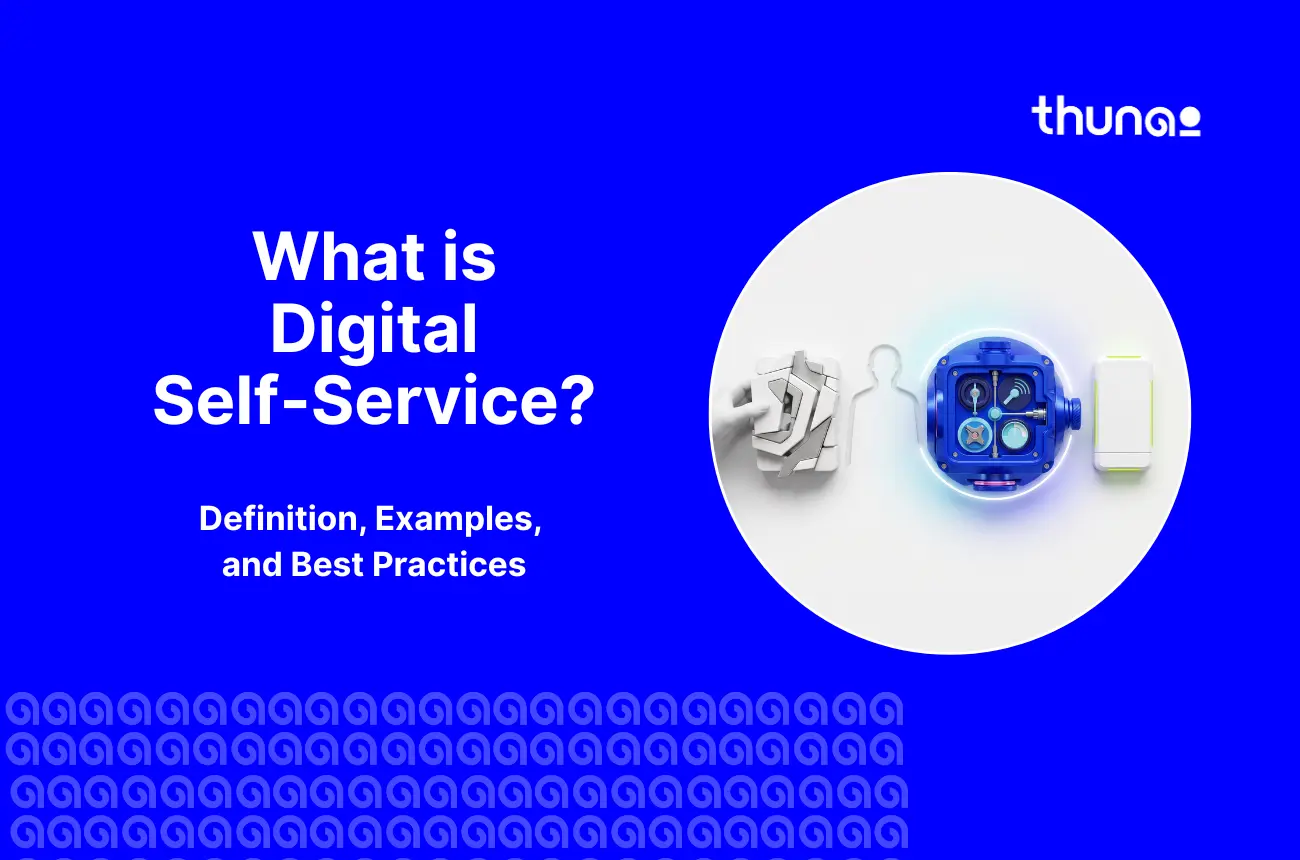
What Is Digital Self-Service?
Digital self-service is a simple system that lets customers find answers, finish transactions, and fix their issues through digital tools without talking to any human support agents.
That could mean a basic FAQ page. Or it could mean an AI assistant that reads messy questions and takes action behind the scenes on its own.
Think about every online purchase, balance check, or plan upgrade you've done without calling someone. That's the self-service loop doing its job. And it runs under a huge chunk of modern digital commerce.
Research from McKinsey paints a pretty stark picture:
- The Existing Gap: 77% of companies say they've built platforms for customer self-service. But only 10% have platforms that are fully running with real user adoption. Aligning portal features with proven strategies in our customer self-service guide can help when scaling platform adoption.
- Independent Customers: Only 20% of digital contacts finish without any human help at all. The other 80% still need a person to step in somewhere.
- The Root Cause: According to PwC, 87% of leaders say poor data quality is actively blocking the smooth handoffs a platform needs to solve problems on its own.

How Does Digital Self-Service Work? The Channels
Customers jump between different touchpoints depending on how urgent or complex their issue is.
The whole system only works if those channels actually share data with each other. Right now, only 12% of digital platforms are considered highly integrated. That's a problem.
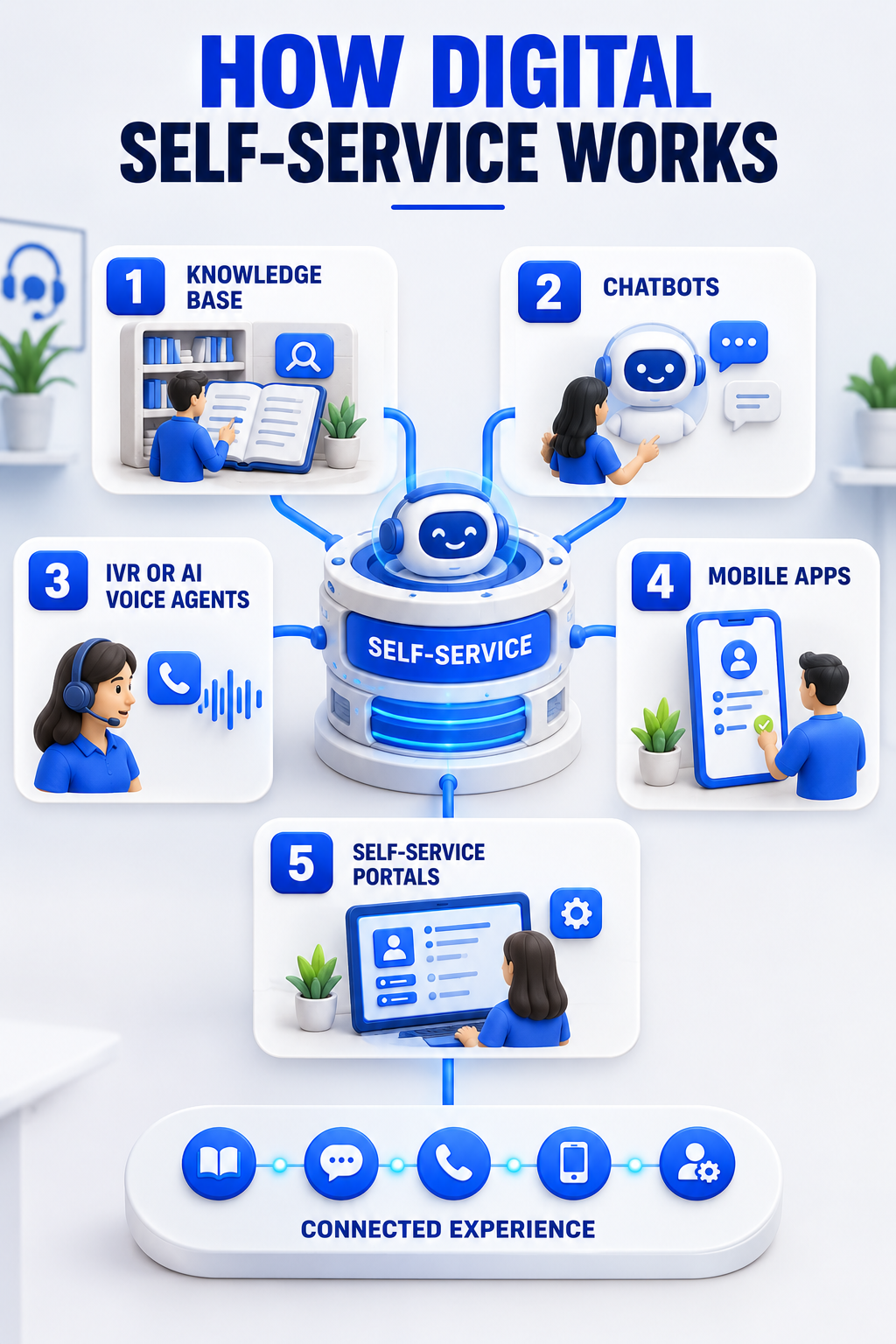
1. Knowledge Bases and FAQs
This is the oldest self-service channel out there. Account dashboards, help articles, documentation libraries. It's been around for years and still forms the backbone for a lot of companies.
That said, Gartner's research on self-service shows that the real test of a knowledge base is whether it resolves the issue before the customer gives up and opens a support ticket.
2. Chatots
Older chatbots use outdated decision tree models and simple keyword matching. Meaning, the minute a user asks a question outside of what is expected by the system, everything stops working.
IBM's overview of conversational AI outlines how the current generation replaces this with natural language processing.
This type is capable of taking care of spelling errors, unusual formulations, and additional questions
According to predictions, by 2028, 70% of users will start their journey in services with a conversational AI tool like AI chatbots for CX.
3. Interactive Voice Response (IVR)
IVR is something that has likely led you to press that zero button countless times just so you could talk to a live agent.
The traditional IVR systems are gradually getting phased out due to new voice AI solutions that actually listen to what you are saying.
They analyze what you say using speech-to-text and natural language processing to solve your problem or route your call immediately.
To improve this, guiding callers through multi-step technical issues can be improved by using an AI voice agent with screen sharing alongside conversational voice capabilities.
4. Mobile Apps
Apps have a big built-in advantage. Unlike other digital self-service channels, they remain logged in on your phone at all times.
Meaning, that there will be no need for any password or identity verification each time you log in to such applications. You will have been authenticated already.
Which is exactly why, you can engage in activities like wire transfer, upgrades, and modifications.
5. Self-Service Portals
These are web-based dashboards for billing, account management, and transaction history. They tend to be the most feature-packed channel, which also makes them the most fragile when backend data doesn't sync properly across systems.
One thing that’s worth pointing out: there’s an enormous difference in the level of complexity between those channels. Portals and traditional chatbots belong to the less complex category - they are primarily responsible for navigation and lookup by keywords.
Conversational AI belongs to the more complex category since it requires knowledge of language to process the interactive dialogue. There are a lot of cases of self-service failure since people try to achieve complex goals using simple tools.
Benefits of Digital Self-Service
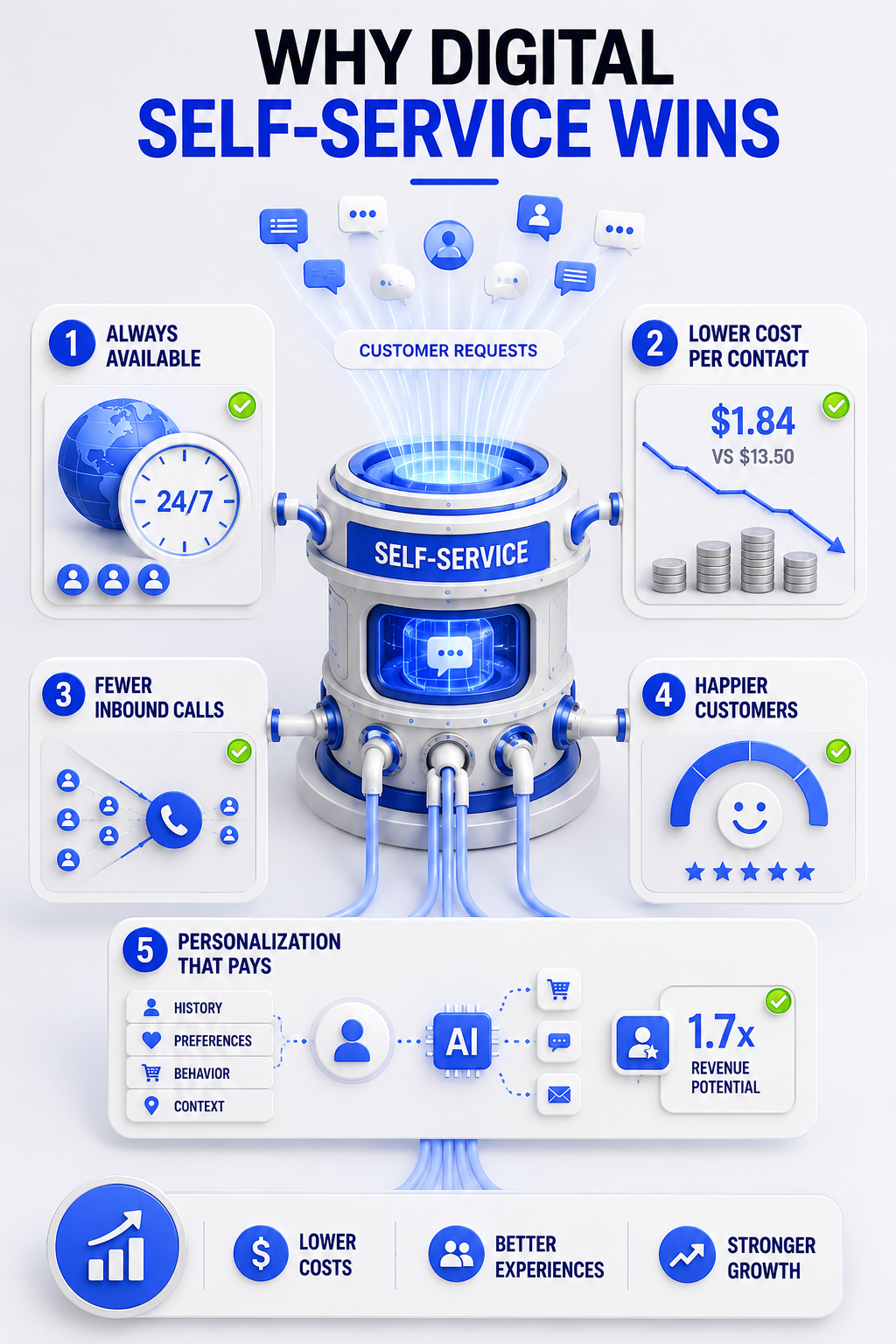
When it's done well, digital self-service pays off across cost, scale, customer satisfaction, and revenue all at once. That's why leadership keeps putting money into it, even when the rollout is rocky.
- Available 24/7: No need for any shift scheduling (irrespective of time zones). No long queues even in hours of heavy traffic. And there is absolutely no compromise on quality when peak volumes are handled by digital self-service platforms.
- Far More Economical: According to Gartner's benchmarking data the median cost per contact stands at $1.84 for self-service, whereas it comes to $13.50 for phone, live chat, and email. This kind of margin cannot be overlooked by any contact center.
- Lower Number of Inbound Calls: 66% of companies that were able to decrease their inbound call volume have attributed the achievement to better self-service capabilities.
- More Satisfied Customers and Data: With the help of AI-driven decision making across the entire customer journey, the customer satisfaction rate rises by 15 to 20%. Additionally, there is an expected rise in the rate of self-service resolutions by 47% by 2027.
- Easy Personalization: Those who master personalization are able to not only reduce costs but increase revenue 1.7 times and increase customer lifetime value more than two-fold. Self-service is not only about cost savings. It is also a powerful revenue driver. Connecting customer historical data through AI personalization can be improved to tailor automated responses dynamically.
Digital Self-Service Examples by Industry
What digital self-service looks like in practice depends a lot on the industry. Regulations, how complex the transactions are, and what customers expect when they walk in all shape the design.
Telecom
Billing questions and plan changes make up most of telecom's self-service load. 89% of tech and telecom operations leaders are pushing digital tools outward to customer-facing channels.
About 34% say they're comfortable letting AI agents handle entire processes start to finish. The goal is simple: protect revenue per user and stop customers from leaving.
Improving customer journeys using AI in telecom contact centers can be helped to automate routine plan updates and reduce customer churn.
Banking, Insurance and Financial Services (BFSI)
Fraud disputes and account management demand the tightest compliance of any industry. Over 54% of financial services companies have connected their digital systems end-to-end.
That's the highest rate across all sectors surveyed. McKinsey estimates that AI-enabled service could drive a big chunk of the up to $1 trillion in extra value AI is expected to unlock in global banking each year.
Healthcare
The area where digital self-service in healthcare is moving forward the fastest is appointment booking and online check-in.
Already, 80% of consumers use mobile devices or wearable devices to do their health-related chores.
Among the youth population, 86% feel comfortable using AI-powered applications for health and wellness purposes.
And the frontier is moving fast. A first-of-its-kind pilot in Utah now legally allows an AI agent to renew prescriptions for 192 drugs used to treat chronic conditions, all under strict safety oversight.
Retail
Order tracking and returns are the lifeblood of self-service retail. We’re living in a hybrid world now, thanks to self-checkout terminals, scan and go, and in-store shopping apps on smartphones.
Getting things right has never been more crucial, since 99 percent of customers have indicated that customer service influences their purchases.
Comparing integrated software solutions across the best retail CX platforms can be improved to deliver consistent hybrid support.
The Common Failure Mode: Self-Service That Backfires
When a company designs self-service to contain customers rather than actually help them, it doesn't save anyone time.
This just delays the same conversation while burning trust along the way. Monitoring frustration indicators like what is DSAT can be helped to catch flawed self-service workflows before they damage customer retention.
- Menus That Can't Handle Nuance: FAQ pages and decision trees will fail the moment the problem of a customer does not fit within any of the predefined paths.
- Escalation That Happens Anyway, Just Worse: 53% of consumers now skip self-service altogether and go straight to a human. In another situation, 60% of the agents do not even refer to self-service to the callers. Of the remaining 40%, 25% mention it without much interest, and 12% bad-mouth it. But what happens when the customer succeeds in talking to an actual person after dealing with the bot?
- Forced Automation: Survey data from SurveyMonkey puts the skepticism in sharp focus. 79% of Americans still prefer a human over an AI agent. 84% believe humans are more accurate. And 81% suspect self-service exists mostly to cut the company's costs, not to actually help them. Every rigid, escalation-blocking bot out there reinforces exactly that suspicion.
The bottom line? Automation can handle a routine billing question just fine. But it has no business stepping into genuine human distress. Forcing containment there isn't a design mistake. It's a real harm.
From Static Self-Service to Agentic Self-Service
Legacy automation runs on if/then logic. At best, it does basic document retrieval, basically keyword search against a library of articles.
It's reactive by nature. The second a customer goes off-script, the whole thing falls apart.
An agentic system however, is different. AI agents access the customer's history, figure out what they're actually trying to do, and goes after it. It pulls data from backend systems and takes action directly.
- It Fixes the Containment Loop: Because it constantly reads intent and emotion, an agentic system can spot a frustrated customer and send them to a human right away. It hands over a full summary of the conversation so the customer never has to repeat themselves.
- The Results Are Already Showing Up: McKinsey's research on generative AI reports early agentic deployments showing a 14% increase in issue resolution per hour and a 9% drop in average handle time. At full maturity, these systems are expected to automate 50 to 70% of all customer contacts.
How Thunai Powers Agentic Digital Self-Service
Thunai is one of the strongest examples of agentic self-service designed for large-scale operations. This CX tool is an integrated Agentic CX Platform, which integrates voice, chat, email, and CRM into a single intelligent layer.
Voice and Chat AI Everywhere: Human-like AI agents serve on websites, mobiles, and self-service portals. They safely manage 70 to 80% of level one queries.
- Voice and Chat AI Across Every Surface: Human-like AI agents work across web, mobile, and self-service portals. They safely handle 70 to 80% of Level 1 queries. Some tickets resolve in as little as 0.8 seconds, and the platform still holds a 4.8+ CSAT score throughout.
- 150+ Languages, 15+ Channels: The platform runs using Apache Kafka for real-time data streaming, with a MongoDB vector database driving semantic search. That means enterprise-scale performance and live AI without the batch-processing delays older systems carry.
- Escalation With Sentiment Analysis: If there is a need for escalation to human support, Thunai Omni will listen across all channels, detect intent, identify growing frustration, and instantly escalate the conversation with all the information summarized.
- Enterprise-Grade Trust: 100% of conversations are automatically monitored against customized SOPs. No customer data is exposed to the shared training model. And the integration with 50+ applications usually happens within two days.
Want to see Thunai in action? Book a free demo with our team!
FAQs on Digital Self-Service
What is an example of digital self-service?
Some of the common examples include online knowledge bases, frequently asked questions, chatbots, interactive voice response call centers, mobile banking applications, and websites where customers can make payments, track order statuses, book appointments, and more.
Why do digital self-service tools sometimes frustrate customers?
ecause the technology was designed to keep customers away from interacting with an actual human, not to fix their problem. Menus that cannot be navigated, FAQ pages that contain outdated information, or the lack of an option to speak with a person may trap them in an endless cycle.
What is agentic self-service?
Agentic self-service uses AI agents that actually understand what the customer wants. They reason through multi-step requests and hand off to a human with full context when things get complicated. Instead of pulling up a pre-written answer, the agent figures out a path to the customer's real goal and carries it out directly across backend systems, in real time.