
Handling time being high does not only have implications for the call centers. It may be an indicator of high costs, inefficiency, and customer dissatisfaction.
While most customer inquiries take around six minutes to handle, technical support requires over ten minutes per call. How do you reduce AHT without compromising customer experience?
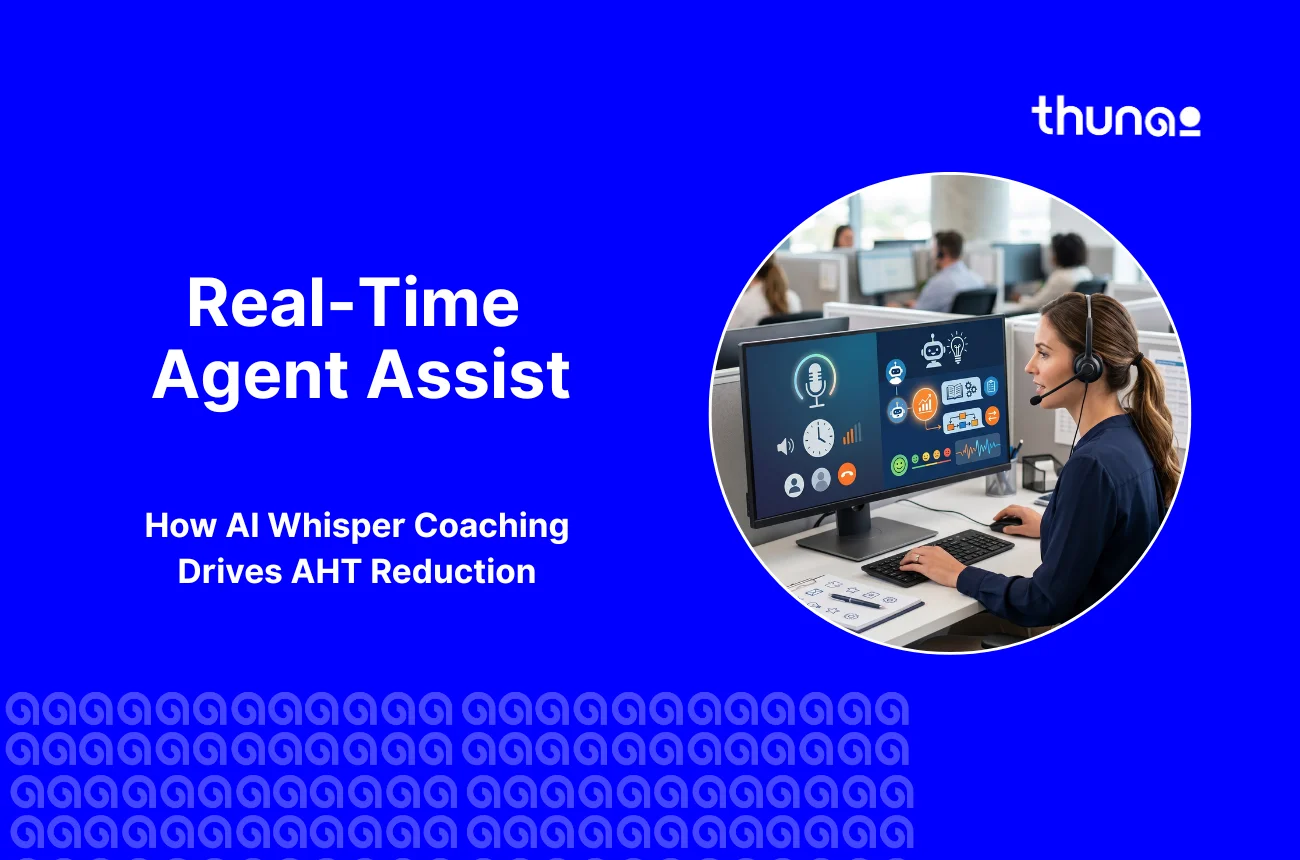
With real-time agent assistance and AI whisper coaching, agents can get advice during the calls. That way, they will resolve the queries faster, improving customer satisfaction and lowering AHT.
Why Contact Center Managers Are Losing Handle Time to Preventable Agent Gaps
Each moment spent interacting with customers has financial implications. Monitoring the average handle time (AHT) will help CX managers identify inefficiencies.
Contact centers have yet to overcome many challenges in reaching their objectives due to typical problems encountered in the workflow process.
A high AHT often happens when agents switch between multiple tools and search for information on their own. Without real-time support, even simple customer questions can take longer to resolve.
According to industry statistics, an average of 6 minutes and 10 seconds is taken for each call, whereas technical support takes over 10 minutes. High AHT causes long waiting periods, and customers become dissatisfied because of that
What Real-Time Agent Assist Actually Means (Beyond the Buzzword)
- Some of these companies offer artificial intelligence as a solution that can fix any problem within the organization. Business executives need to move beyond the hype to comprehend how AI assist technology works. This technology is not a basic, scripted chatbot designed to block customer access.
- A real live call AI assist system acts as an active partner. It runs silently, listening to live dialogue to help agents solve problems instantly. Deploying real time agent assist AHT reduction strategies ensures that your staff has instant access to exact, policy compliant instructions when they need them.
- The primary driver here is AI whisper coaching. Traditionally, whisper coaching meant a supervisor speaking into an agent's headset. AI whisper coaching scales this by delivering scripts, tips, and compliance prompts to the agent's screen.
- Rather than using keyword matching, the engine uses deep learning to track customer intent and emotion. When frustration peaks, the tool prompts the agent with de-escalation scripts.
- Using real-time agent assist AHT reduction models allows brands to maintain high service quality without putting customers on hold.

How Real-Time Agent Assist Directly Reduces AHT — The Mechanics
To measure operational efficiency, contact center managers rely on a classic mathematical formula:
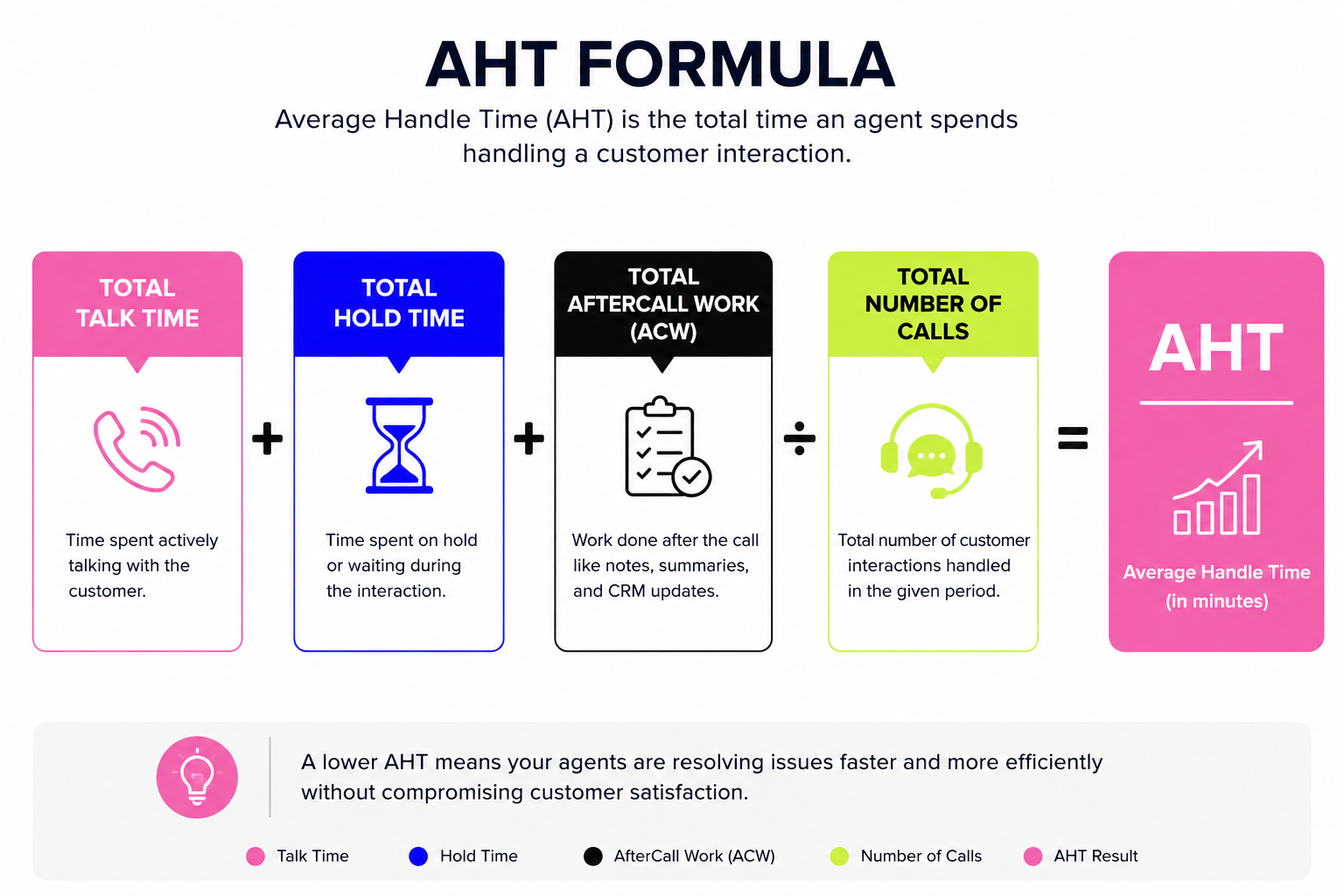
Let us look at how real time agent assist AHT reduction mechanics optimize all three variables simultaneously:
- Talk Time Reduction: Agents no longer need to switch tabs or dig through static documents. The system retrieves answers from company policies in under a second.
- Hold Time Elimination: Placing a customer on hold to ask a manager is a major source of delay. Real time tools display exact answers instantly in the call window.
- Automation of After Call Work (ACW): Rather than wasting their time in writing call reports, the representatives can now depend on AI to take care of that task. The calls get transcribed accurately by more than 95%, and CRM notes are created automatically by the program.
This allows agents to immediately take the next customer call, improving your center's total capacity.
The Thunai Omni Module in Action — Real-Time Assist Built for Contact Centers
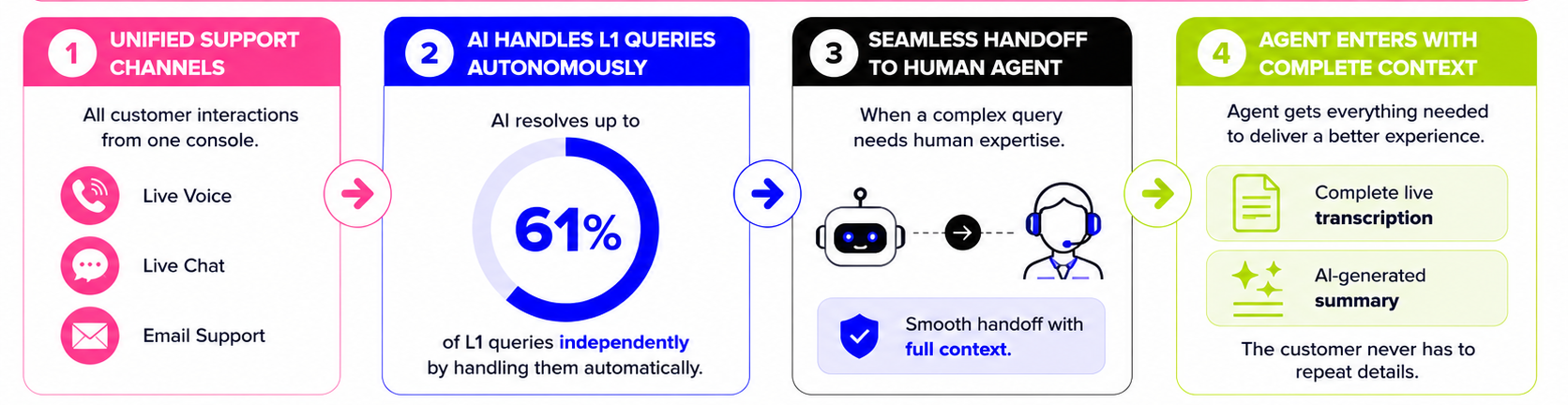
When deploying these tools at scale, Our Thunai Omni Module represents an industry leading standard.
The system combines live voice, live chat, and email support from one console. It is capable of dealing with as much as 61% of L1 queries independently by handling them automatically.
When a complex issue needs human help, the platform transfers the conversation smoothly. The agent gets a live transcript and an AI-generated summary before joining the call.
This means customers do not have to repeat their information. With real-time agent assist, agents can solve problems faster and deliver better support.
User reviews:
- The real value of this approach is backed by actual customer reviews on Product Hunt, which has rated Thunai a perfect 5/5.
- Users say Thunai saves time and makes work easier. On Product Hunt, Ram Prasad Rengan called Thunai's Brain feature a "game-changer."
- On G2, another user said that automated meeting notes and summaries cut down post-meeting work.
- These reviews show that the Thunai Omni Module delivers real results. It helps teams reduce handle time, work faster, and improve customer service.
What Ops Leads Can Expect: AHT, QA, and Agent Performance Impact
- A complete real-time agent assist system can improve both speed and service quality. Agents typically lower their handle times by up to 38%-40% to deal with more customers while keeping headcount unchanged.
- In addition, AI can analyze all calls and automate the scoring process to eliminate human bias. This helps reduce operational and compliance risks.
- The effects of the qualitative aspect on the effectiveness of contact center agents are just as dramatic. With in-screen instruction, companies like ASAPP suggest the ramp-up time for new agents is reduced by up to 50%, allowing new employees to act as veteran agents.
- When agents do not stress over remembering policy rules, their confidence grows. This leads to a 35% increase in CSAT and lower churn.
- Clearly, committing to real time agent assist AHT reduction strategies improves both performance and the bottom line.
Real-Time Assist vs. Post-Call Coaching vs. Static Scripts, Which Actually Moves the Needle?
How does a real time agent assist AHT reduction setup compared to old support models?
Standard static scripts are far too rigid. They assume a linear conversation that rarely happens.
When a buyer presents a non standard query, agents get stuck, inflating hold times. Meanwhile, retrospective coaching is useful for long term growth, but it is purely reactive. Listening to a call recording days later does not save a frustrated customer.
An active real time agent assist AHT reduction program bridges these gaps. It acts as a dynamic guide, helping agents resolve issues during the live call. In high stress scenarios, this live support layer reduces total call volume by 15% and handle times by 30%.
How to Roll Out Real-Time Agent Assist Without Disrupting Live Operations
Deploying new technology does not require months of downtime. Enterprise systems connect with existing setups in under two days. Follow this structured rollout.
Step 1: Define the Call Scenarios Where AHT Loss Is Highest
- Evaluate historical data to find the queues with the longest handle times.
- Focus initial real time agents assist AHT reduction efforts on high friction issues.
Step 2: Feed Your SOPs, FAQs, and Escalation Playbooks Into the Knowledge Layer
- Load all the procedure manuals and scripts into the single hub.
- The AI parses these files, resolves contradictions, and builds an accurate source of truth.
Step 3: Run a Parallel Pilot: Assisted Agents vs. Control Group
- Choose some agents for testing the tool, whereas others will continue with manual work.
- Compare their performance to prove value before scaling.
Step 4: Track the Right Metrics (AHT, FCR, CSAT — Not Just Speed)
- Avoid focusing purely on speed.
- Balance real time agents assist AHT reduction metrics against first contact resolution and CSAT.
- Rushing calls damages customer trust.
Step 5: Expand Gradually Across Queues and Channels
- After successful testing, roll out it to the billing and claims departments.
- Later, extend these workflows to chat and email channels.
4 Mistakes Contact Centers Make When Implementing Agent Assist Tools
Failure to implement properly makes the implementation useless. Do not repeat these typical mistakes:
Treating It as a Replacement for Agent Training, Not a Multiplier
- AI tools amplify skills, but they do not replace training.
- If agents lack empathy or active listening, automated suggestions cannot save the call.
Ignoring Latency: Suggestions That Arrive 10 Seconds Late Are Useless
- If your speech to text engine has high latency, screen prompts arrive too late.
- To maintain a real-time agent assist AHT reduction flow, suggestions must render in under a second.
Overloading Agents With Too Many Prompts Per Call
- Do not flood screens with endless scripts and links.
- Too many prompts cause cognitive fatigue.
- A solid real time agent assist AHT reduction program triggers suggestions only during critical cues.
Skipping the Knowledge Base Audit Before Going Live
- Uploading outdated files leads to incorrect guidance.
- Manually audit your procedures to ensure the knowledge base is accurate from day one.
See how Thunai Omni can cut AHT by up to 40% and empower your agents with real-time AI assistance - book a demo today.
FAQs on Real-Time Agent Assist
Can this solution integrate directly with existing CCaaS platforms like Genesys?
Yes. Enterprise tools connect with legacy systems like Genesys in under two days with zero operational downtime. Once live, this certified integration delivers a 47% reduction in operating costs.
How does this technology handle sensitive customer data?
Security focused platforms hold SOC 2, GDPR, and ISO certifications. They feature automatic redaction to protect sensitive payment and healthcare records.
What trials or demos are available?
You can explore capabilities with a 16 day free trial or sign up for a live demo to plan your real-time agent assist AHT reduction roadmap.