This is a question that every executive in the financial services industry asks me. "How do we cut costs without harming our relationship with our customers?" Valid point. It costs around $13.50 per customer contact when it’s handled by a human being, but could cost less than $3 if an AI system resolves the issue. The savings will be sustainable if the AI solution is designed specifically for banks. Here’s how to do it.
Where the money actually goes in bank customer support
The cost of labor is by far the biggest cost to a contact center, using up 60 to 70 percent of support budgets in salary and payroll costs.
Shrinkage adds costs because agents use their time, which is being paid for, to take breaks, train and learn, comply with regulations, and for downtimes.
Taken together, all these factors make life difficult for the banking support organization.
As we see from the data, the cost of human channels is an order of magnitude higher than that of automated ones.
A contact resolved by an AI agent costs about 14 times less than one handled by a human over the phone. Shifting volume down this hierarchy saves millions.

Seven ways banks can lower support costs with AI
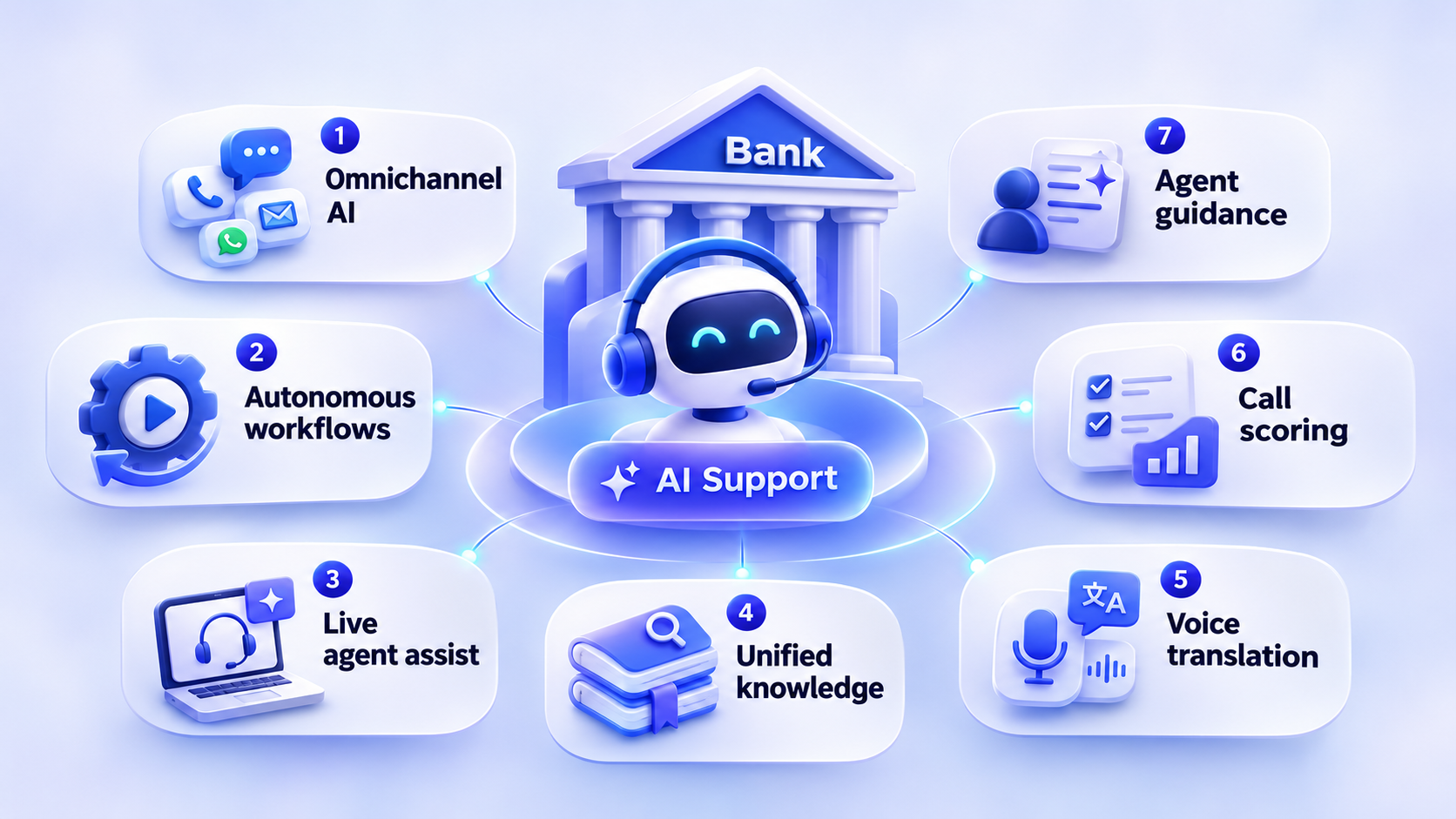
AI generates immediate financial returns by streamlining the entire lifecycle of a customer interaction. Banks use these seven specific levers to drive down costs.
- Handle routine queries before they reach an agent with omnichannel AI agents
Level 1 banking operations are automated by the AI agents, such as checking of balances, transaction verification, and debit card activation through voice, chat, and email. Curious how voice and chat bots handle bank queries? See our blog, Conversational AI in Banking.
Bank of America reported that Erica’s total client interactions have passed 3.2 billion since its 2018 launch. In 2025 alone, Erica had 20.6 million users and nearly 700 million interactions.
Banks benefit from 78-80% autonomous handling capabilities and latency of under 500 milliseconds with voice, saving about $13.50 per diverted call.
- Automate the work behind the conversation with autonomous workflows
The process of creating agentic AI involves the automation of post-call activities such as case summarization, CRM updates, ticket generation, and compliance forms. Also, post-call notes and CRM updates are covered in our piece on AI call summary software.
The process of identifying the customer’s intention through transcription and updating the core system using artificial intelligence makes it possible to automate the process of closing tickets in 0.8 seconds.
- Cut handle time with real-time live agent assistance
AI Agent Assist enables employees to handle difficult queries from customers such as wire disputes and mortgage hardships. Wait! Here's a deeper look at Agentic Agent Assist and how it shortens handle time.
This tool offers relevant information to employees instantly. It saves time and reduces average handle time (AHT) by 42%.
- Answer Hunting and Repeat Contacts with Unified Knowledge Integration
A unified AI knowledge base ensures that there is uniformity in the answers offered by chatbots and human agents.
AI creates a uniform set of answers through the use of manuals for products, pricing charts, and customer relationship management data. Knowledge graphs identify inconsistencies in banking information, which reduces misinformation and hallucination in AI up to 95%.
- Serve more customers without a language-specific hiring bill using multilingual voice translation
Banking institutions operating in multicultural societies typically offer top hourly wages to their bilingual employees.
AI eliminates these costs entirely. Contemporary voice and text AI agents come with inbuilt capability to communicate in more than 150 languages. They can translate the customer's question into their native tongue and solve the problem immediately.
- Audit every single interaction, not a sampling method with call scoring and audit
All quality assurance audits of bank interactions via AI technology, as opposed to conventional technology, which audits 1-2% of interactions, every single interaction in banking interactions.
This technology identifies violations of the regulations, scores calls according to set criteria, and automatically censors any PII and PCI information.
- Shorten ramp-up and lower attrition since the agents receive instructions and make less repetitive calls.
AI eliminates agent fatigue since it facilitates automation of the repetitive calls and simplifies complicated workflows.
Real-time assist technology helps new hires learn through guided instructions and they can become productive in a matter of days rather than months.
How to calculate your own savings
The Two-Price Rule facilitates the computation of ROI in support provided by the AI system. The AI price is associated with automated contacts which generally cost 0.50-3.00 per contact.
The Human Price is the amount charged for human handling of contacts which generally cost $13.50 per contact.
Banks should also consider the Handover Surcharge for instances where the automated system fails and necessitates human handling.
A savings is realized by banks through proper workflow design for intent-based routing. Simple disputes should be routed directly to human agents to avoid handoff costs.
Balance queries should be directly routed to artificial intelligence for capturing of the $1.50 resolution cost. Routing 40% of 100,000 calls per month to automation will bring the cost per call down from $13.50 to $8.70, resulting in over half-a-million dollars in monthly savings.
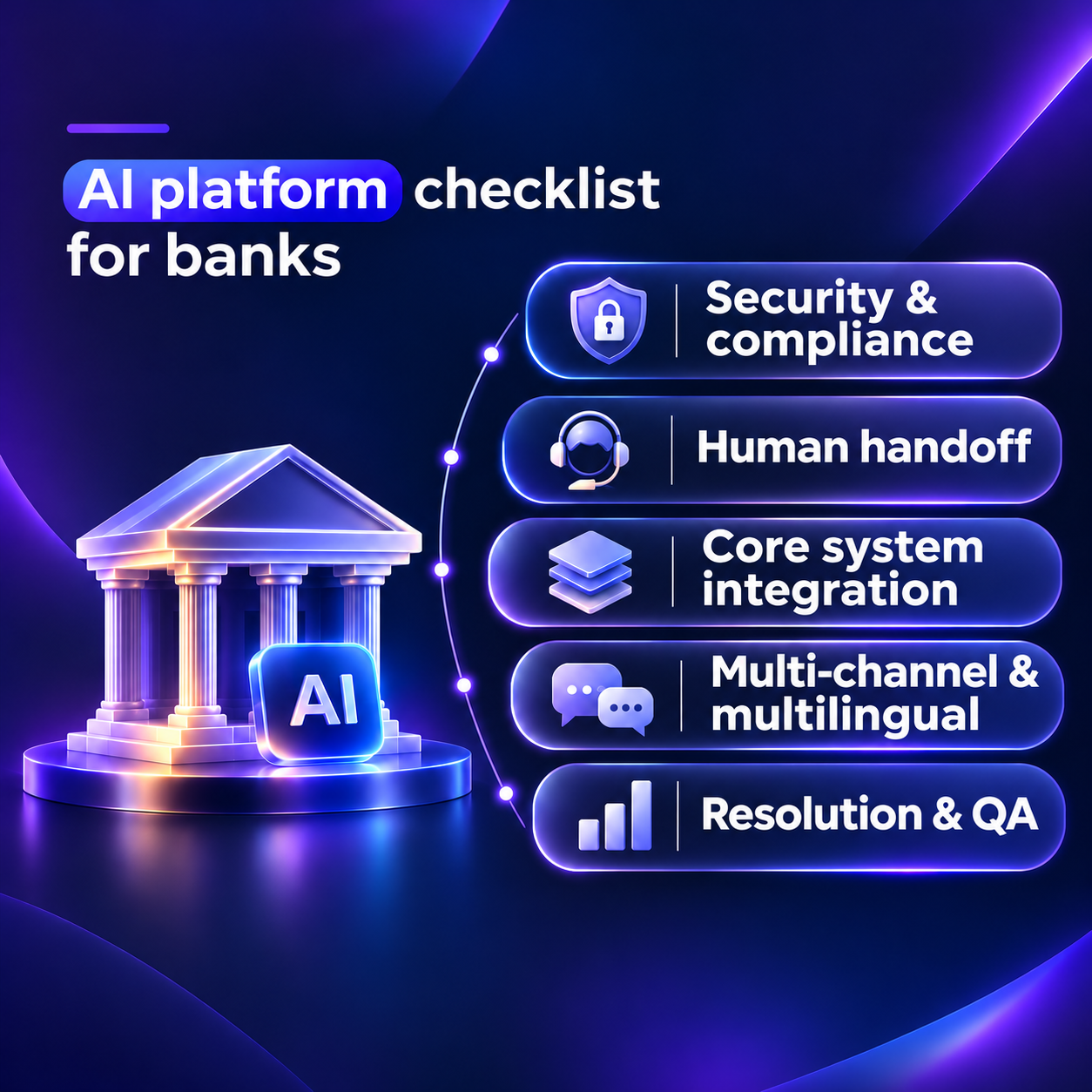
What to check before choosing an AI platform for a bank
Consumer finance requires rigorous technical diligence. A bot built for retail e-commerce will fail inside a regulated bank. Check these five requirements before signing a vendor contract.
Security, data residency, and audit trail
- Banks cannot input customer financial data into publicly available language models. The solution has to be SOC 2 Type II and GDPR compliant. But more importantly, look for ISO 42001 compliance.
- This is the international standard for the Artificial Intelligence Management Systems (AIMS). It confirms that the vendor tests their model for bias, performs risk assessments, and ensures human accountability for all models.
- Moreover, the vendor should provide on-premises or private cloud deployment to ensure the data does not leave the bank’s firewall at any point.
Human handoff with full context
- Banks cannot input customer financial data into publicly available language models. The solution has to be SOC 2 Type II and GDPR compliant. But more importantly, look for ISO 42001 compliance.
- This is the international standard for the Artificial Intelligence Management Systems (AIMS). It confirms that the vendor tests their model for bias, performs risk assessments, and ensures human accountability for all models.
- Moreover, the vendor should provide on-premises or private cloud deployment to ensure the data does not leave the bank’s firewall at any point.
Integration with core banking, CRM, and knowledge sources
- An AI agent requires tight integration into core banking systems such as Fiserv and Jack Henry in order to deal with customers’ queries.
- MCP helps establish the interface which makes it possible to give access to loan information and perform actions through AI.
- MCP is able to restrict the role of an entity accessing the system and keeps sensitive information inside the bank’s infrastructure.
Channel coverage and language
- Fragmentation of channels leads to fragmentation of data. You should not purchase a bot for the mobile application from one vendor, another solution for voice IVR, and yet another for agent assist.
- You need a unified orchestration layer which will cover all channels including voice, e-mail, and chat. The unified layer needs to speak your demographic languages natively.
Reporting on containment and QA
- All the vendors like to boast about their high “deflection” rate. It’s a vanity metric. If a client is angry and disconnects the line, then it is considered a deflection.
- The banks should keep a record of True Autonomous Resolution that will involve those cases which were really resolved independently.
- The platform needs to have live QA dashboards, which will highlight all the policy violations, as well as pinpointing areas in which the AI fails.
A phased rollout that limits risk
Overnight replacement of the legacy contact center stack system can cause an absolute catastrophe. In order to be careful with risks, comply with regulations, and build customer trust, banks adopt AI gradually.
Phase 1:
- Phase One will be the first step to be followed, which involves identifying the contact drivers and selecting one or two query types that generate high volume but involve little risk.
- Possible starting queries can be balance inquiry or debit card activation. This should be done in an authenticated environment such as the mobile chat app.
Phase 2:
- Enter Phase 2 by activating the real-time help provided by the agent and QA auto-scoring for the live agents.
- Let the AI monitor the difficult conversations and provide the employees with suggestions. That’s how the AI will understand your specific situation at the bank while still maintaining human oversight.
Phase 3:
- Deploy Phase 3, scale. Deploy the trained AI agent into voice IVR channel.
- Make sure it’s multi-lingual. Implement complex transaction flows like address change or stop lost credit card.
In all stages, maintain strict human-in-the-loop and escalation policies. The CFPB requires that banks be entirely responsible for any action taken by their automated processes. The CFPB reported that an estimated 37% of Americans engaged with a bank’s chatbot in 2022, and all of the top 10 US commercial banks use chatbots.
Implement the MCP controls such that the AI cannot take any decision independently to deny a claim of fraud, impose penalties, or alter the terms of a loan. Deciding what to automate first? Agentic AI vs. Generative AI helps you choose.
How Thunai supports these cost levers in banking
Thunai is an agentless CX solution designed uniquely for the financial industry. The solution addresses both the challenge of operating costs and the technical barriers that hinder banking artificial intelligence initiatives.
The Thunai solution autonomously resolves 78% to 80% of L1 tickets via voice, chat, and email, and this is done within a second.
As for those challenging questions, Thunai provides an Agent Assist feature in real time and reduces AHT by 42%.
Thunai integrates directly with the existing core systems, like Jack Henry, via the Model Context Protocol (MCP).
It takes less than 48 hours to make the bank operational without having to engage in substantial engineering work. Compliance with all regulations is ensured as Thunai is ISO 42001, SOC 2 Type II, and GDPR certified.
So, what are you waiting for? Schedule a demo to see Thunai's automated banking workflows in action.
FAQs about Reducing Customer Service Costs in Banking
What might be the most efficient way to reduce the cost of providing customer services through AI in a bank?
It may come as implementing a multi-channel artificial intelligent agent that will facilitate automation of large volumes of repeatable L1 transaction operations such as checking the account balances.
Is it possible to save the costs on using AI without reducing the quality of customer experience?
That may only be possible if the AI is embedded in the bank's software and works in real time. In addition, the AI has to make sure there is a smooth transfer of the interaction from the chatbot to the live operator without revealing the customer's identity and their dialogue.
Is the AI customer service safe and compliant for banks?
In this case, AI assistance is entirely safe when it is used in an environment employing Model Context Protocol (MCP) with the ISO 42001 certification. That means that it provides full compliance with strict FFIEC and CFPB guardrails, data redaction, and audit trail of all actions.
Define the AI agent and agent assist technologies.
AI agent assists in solving problems by direct communication between the agent and the customer without any human intervention. Agent assist works silently in the background. It listens to the conversation between the humans and provides a prompt response to the bank representative.
Describe the approach used by the banks to evaluate the ROI of AI in customer service?
The bank evaluates the cost-per-contact ratio. The bank segregates the costs of tickets handled by the AI on its own from those of the tickets handled by the human agents. Reduction in average handle time as a result of AI assist is another factor measured by the bank.
Can AI comprehend multiple languages in bank support?
Yes. The modern conversational AI works for both voice and text-based communication in over 150 languages. Translation occurs automatically. This means that no need to hire bilingual staff will be there in the call center.