



In 2024, Reuters reported that India’s largest health insurer, Star Health, faced a major customer data leak through Telegram chatbots, exposing sensitive policyholder information and highlighting the risks of poorly governed AI systems in insurance.
At the same time, insurers using enterprise AI were cutting claims processing times, reducing support costs, and improving customer satisfaction.
This shift proves one thing: AI in insurance is no longer optional.
In this guide, you’ll discover the real ROI of insurance chatbots, the highest return use cases, and the hidden costs most insurers overlook.
Why Most Insurance Chatbot ROI Projections Fall Short
When I talk to other executives, the most common frustration I hear is: The pilot looked great, but the year one savings didn't hit the target.
The reason is simple: most firms use a flawed chatbot roi calculator that prioritizes deflection over resolution.
Modern AI chatbots for insurance customer service and claims automation are designed to go beyond answering FAQs by integrating directly with policy systems, claims workflows, and customer data platforms.
In the insurance world, a deflection is often just a delayed expense. If a policyholder asks about their deductible and the bot gives a generic link to an FAQ, and that customer eventually calls the support line anyway, the roi of chatbots in insurance is actually negative.
You've added technical overhead without removing the labor cost.
True insurance chatbot cost savings only manifest when the system can execute the work. Most projections fall short because they ignore:
- The Integration Tax: If your bot isn't connected to your Agency Management System (AMS) like AMS360 or Applied Epic, it’s just a fancy search bar.
- Knowledge Decay: Insurance rules change. A bot that isn't pulling from a live, centralized Brain will start providing hallucinated or outdated coverage info within months.
- The Empathy Gap: During a First Notice of Loss (FNOL), customers expect fast, empathetic, and accurate support not scripted responses. Insurers that ignore voice AI best practices for insurance claims often see higher drop off rates and lower chatbot ROI due to poor customer experiences.
.webp)
Key ROI Metrics That Actually Matter in Insurance Customer Service
- If you want to move the needle on your P&L, you have to stop looking at vanity metrics and focus on the chatbot cost per interaction insurance delta.
- Gartner and IBM benchmarks show a massive 7x to 20x difference in cost between human and AI interactions.
- A fully human handled resolution in insurance typically costs between $10 and $15. In contrast, a fully automated AI chatbot for insurance resolution drops that cost to between $0.50 and $2.00.
- When you multiply that by 50,000 monthly interactions, the roi of chatbots in insurance becomes the single largest driver of operational margin.
The Economic Shift (Human vs. AI)
The insurance chatbot CSAT impact is another critical, yet often under monetized, metric. Metrigy found that companies using AI saw a 22.3% leap in customer satisfaction.
For an insurer, this isn't just about happy customers, it's about retention.
A 5% increase in retention can boost profits by up to 95%.
When a bot resolves a claim query at 2 AM, it creates a level of loyalty that no human staffed call center can match. This is a core pillar of the roi of chatbots in insurance.
How to Calculate Chatbot ROI for Your Insurance Operation
To get your CFO’s buy-in, you need a rigorous chatbot roi calculator. You have to baseline your fully loaded agent cost not just the salary, but the benefits, office space, and the 1.5x cost of turnover.
The formula for the roi of chatbots in insurance is:
$$ROI = \frac{(\text{Total Annual Benefits} - \text{Total Annual Costs})}{\text{Total Annual Costs}} \times 100$$
To simplify this process, insurers can use the Thunai CX ROI Calculator to estimate automation savings, staffing reduction, response time improvements, and projected annual ROI based on support volume and operational costs.
Where Benefits include:
- Direct Labor Savings: (Monthly Volume x Automation Rate x Human Cost per Chat).
- Hiring Avoidance: The ability to scale policy count by 20% without adding headcount.
- Revenue Lift: Faster lead response times and cross selling during service interactions.
For example, O'Connor Insurance Associates, an 11 employee agency, achieved an 8X ROI in just 30 days by reclaiming 58 hours of productive staff time every month.
They realized that the roi of chatbots in insurance wasn't just about the software, it was about allowing their high value agents to focus on consulting rather than answering "where is my ID card?".
ROI by Insurance Use Case
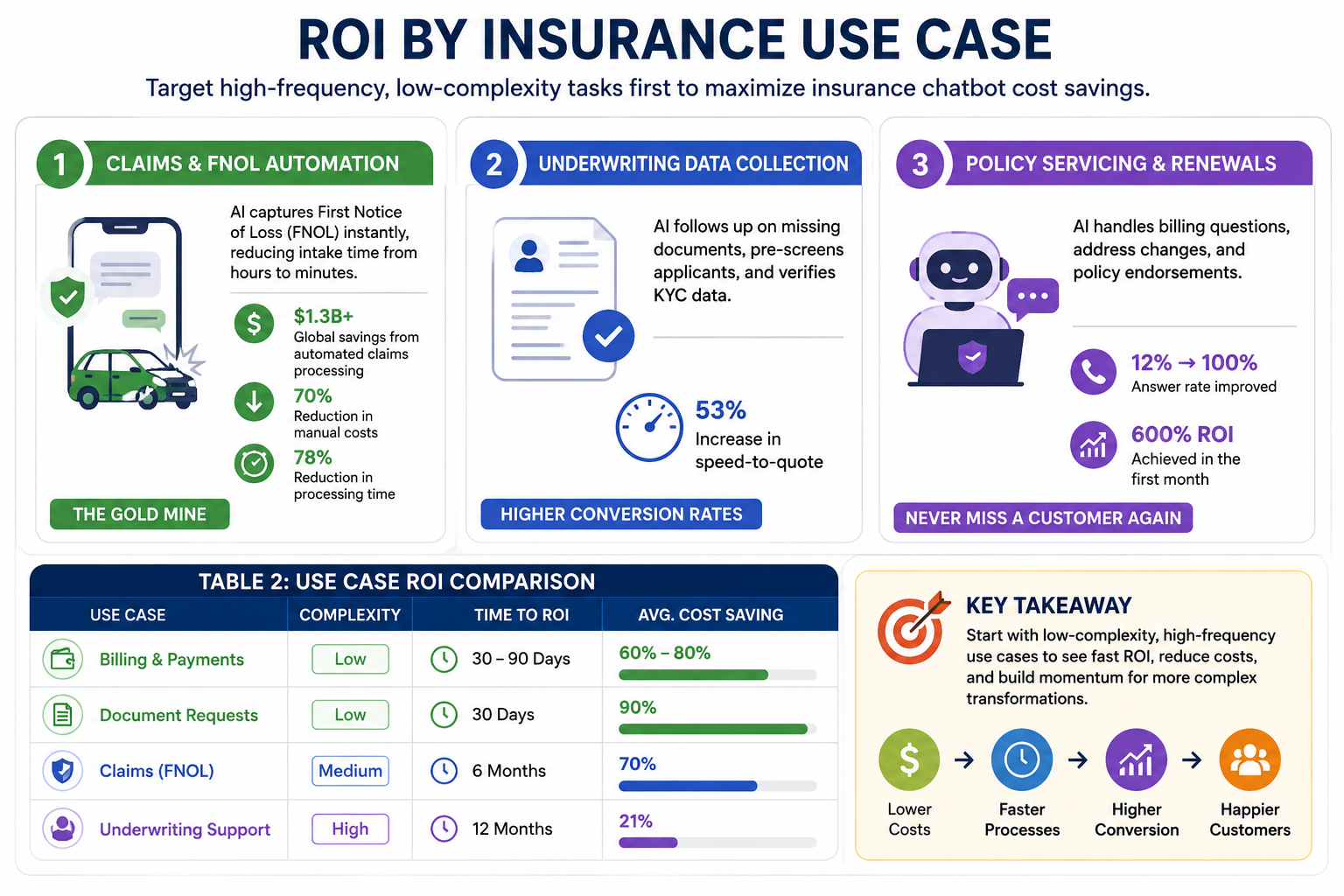
Based on 50+ deployments, the returns are not distributed equally. You need to target the high frequency, low complexity tasks first to maximize insurance chatbot cost savings.
1. Claims and FNOL Automation
- This is the gold mine. Automated claims processing has already delivered $1.3 billion in savings globally.
- By using AI to capture First Notice of Loss, insurers reduce intake times from hours to minutes.
- Firms using AI for FNOL report a 70% reduction in manual costs and a 78% reduction in processing time.
2. Underwriting Data Collection
- We call this the document ping pong.
- AI agents can follow up on missing papers, pre-screen applicants, and verify KYC data.
- This has been shown to increase speed to quote by 53%.
- The roi of chatbots in insurance here is measured in higher conversion rates.
3. Policy Servicing and Renewals
- Handling billing questions, address changes, and policy endorsements.
- Agencies like BIG Pickering Insurance went from a 12% answer rate to a 100% answer rate using AI receptionists, achieving a 600% ROI in their first month.
- When you answer every call, you stop losing business to the competitor who picks up faster.
Use Case ROI Comparison
Hidden Costs That Affect Insurance Chatbot ROI
As a CEO, I have to warn you about the underwater costs. Ai chatbots reduce operational costs only if you manage the TCO (Total Cost of Ownership).
- Model Drift & Hallucinations:
- If your AI gives incorrect policy advice, the compliance and legal fallout can erase cost savings.
- Users in reddit frequently complain about bots providing “confidently wrong” answers that damage trust.
- Cybersecurity Risks:
- Poorly secured AI deployments can increase your attack surface and even impact cyber insurance premiums.
- That’s why insurers increasingly prefer platforms with SOC 2 Type II and ISO 42001 compliance.
- Integration Maintenance Costs:
- AMS, CRM, and carrier APIs constantly change.
- Weak integrations turn chatbot savings into ongoing developer expenses.
- Agix technologies says integration can cost $500–$2,000 monthly to maintain.
- Customer Trust Erosion:
- One failed claim response can hurt retention.
- Many users describe AI support as frustrating when bots fail to escalate complex issues properly.
What Good Chatbot ROI Looks Like at 90 Days, 6 Months, and 1 Year
The roi of chatbots in insurance follows a compounding curve. It is a marathon, not a sprint.
- 90 Days (The Validation Phase): You should see an immediate 100% call answer rate and the elimination of voicemail backlogs. At this stage, the ai chatbot roi enterprise is measured by reclaimed time. For example, O'Connor Insurance saved 58 hours in month one.
- 6 Months (The Optimization Phase): This is where you hit a 55 to 70% First Contact Resolution (FCR) rate. The software system has learned your specific knowledge base and is handling complex queries like claims status updates.
- 1 Year (The Strategic Dividend): This is the window that tells the real story. Successful deployments report an average 340% ROI. At this point, the roi of chatbots in insurance is a permanent structural advantage.
The Thunai Advantage: Why Agentic AI is the Future
If you want to achieve these numbers, you cannot use a generic FAQ bot. You need an agentic platform. In our research of the best tools for 2026, Thunai stands out because it doesn't just chat, it acts.
Specialized Insurance Features:
- Thunai Brain: A self learning knowledge hub that ingests policy documents, claims data, underwriting manuals, and old support transcripts to create a centralized source of truth for insurance teams. It continuously learns from interactions to deliver highly accurate responses, reduce hallucinations, and improve policy related query resolution.
- Avantage: Reduces inaccurate responses and dependency on manual knowledge sharing, improving First Contact Resolution (FCR), lowering escalation rates, and increasing customer trust.
- Thunai Omni: An omnichannel AI layer that maintains full customer context across chat, voice, email, and WhatsApp conversations in real time.
Policyholders never have to repeat claim details, policy information, or previous interactions, creating faster resolutions and smoother support experiences.- Advantage: Improves customer satisfaction, reduces frustration during claims and policy servicing interactions, and enables seamless omnichannel insurance customer service experiences.
- Agent Studio: A low code platform with 30+ AI agents across voice, chat, email, and WhatsApp for FNOL, billing, renewals, underwriting, and policy servicing workflows. Teams can deploy and customize insurance AI agents quickly without complex development cycles or infrastructure overhead.
- Advantage: Helps insurers reduce operational costs, automate high volume customer service tasks, and scale support operations without increasing headcount.
Additional Features:
- Thunai MCP (Multi-Connect Protocol): Enables deep integrations with AMS360, Applied Epic, Salesforce, and policy systems to automate workflows and sync data automatically.
- Thunai Revenue AI: Detects upsell opportunities, renewal risks, and buying signals to turn customer support into a revenue generating channel.
Customer Satisfaction and Feedback:
- On Product Hunt, where Thunai won #1 Product of the Day, one Business Architect noted: "Thunai's Brain feature has been a game-changer—it intelligently connects relevant information... and delivers concise, context rich snippets that make communication faster".
- On G2, users have rated it 5.0 stars, with one customer stating, "What I really like about Thunai is that it genuinely reduces our daily load... it feels like having an extra team member who already knows our projects and our tone". This level of human-like accuracy is what drives the roi of chatbots in insurance.
Boost insurance ROI 10x with Thunai by automating claims, reducing support costs, and delivering faster customer experiences book your demo today.
FAQs
What is a realistic ROI for chatbots in insurance customer service?
Based on 50+ deployments, a realistic first year roi of chatbots in insurance is 150% to 350%. Mature systems that have scaled into multiple departments often see 500%+ as they hit the hiring avoidance threshold.
What percentage of insurance customer service queries can a chatbot handle?
A well configured ai chatbot roi enterprise system can handle up to 90% of routine inquiries. The industry gold standard for full resolution (no human needed) is currently between 55% and 70% for P&C carriers.
What are the biggest risks to chatbot ROI in insurance deployments?
The top risks are Integration Friction, Hallucinations, and Regulatory Compliance. If the bot can’t write to your AMS, the roi of chatbots in insurance will remain low. If it gives wrong advice, the risk is catastrophic. Using a brain first architecture like Thunai mitigates these risks.




.png)
