.webp)

The enterprise software space is undergoing a massive shift. The market is moving from strict, rule-based software to self-managed operations powered by Agentic Artificial Intelligence. ServiceNow stands at the front of this transition.
Despite massive global AI market predictions, practical business use remains hard. Deep architectural limits, technical instability, and the steep financial costs of vendor lock-in cause many setups to fall short.
This guide for ServiceNow AI Agents breaks down how these agents actually function, what they cost, and how to fix the execution gaps.
How ServiceNow AI Agents Work The Platform Behind the Automation
The main idea behind ServiceNow AI Agents is a big departure from older assistive intelligence systems. Digital agents act as specialized, self-driven bots.
They understand a defined mission, plan a sequence of logical actions on their own, and execute those tasks across multiple connected platform modules - our honest review of ServiceNow covers the full platform as a whole for automation.
.webp)
AI Agent Studio Where Agents Are Built and Managed
To speed up the deployment of this digital workforce, ServiceNow introduced the AI Agent Studio. This central development hub aims to open up the creation of self-running workflows across the business.
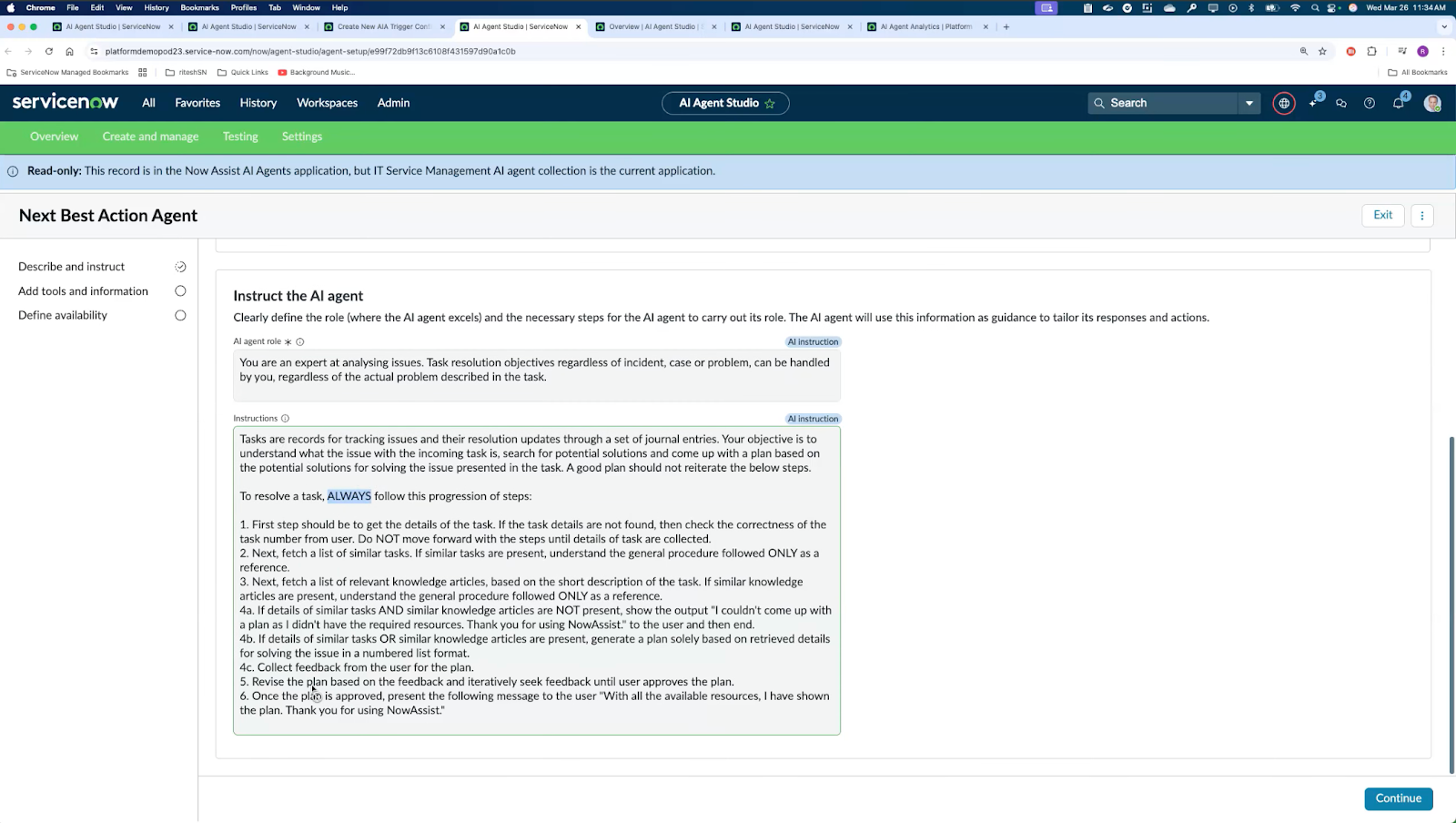
- ServiceNow markets the Studio heavily as a low-code or no-code space. Here, business analysts configure smart AI agents using natural language prompts.
- Despite this heavy low-code marketing message, the operational reality of ServiceNow AI agents shows something different. Managing and securing these agents requires highly specialized technical knowledge.
- Access to the Studio is not given to everyone. It needs specific security roles, most notably the sn_aia.admin role.
- This role grants full administrative permissions over the AI Agent system. Best practices set up a strict validation loop.
- Developers must limit a single agent to a maximum of five to seven tools. This limit stops infinite reasoning loops or task paralysis.
AI Agent Orchestrator How Agents Coordinate
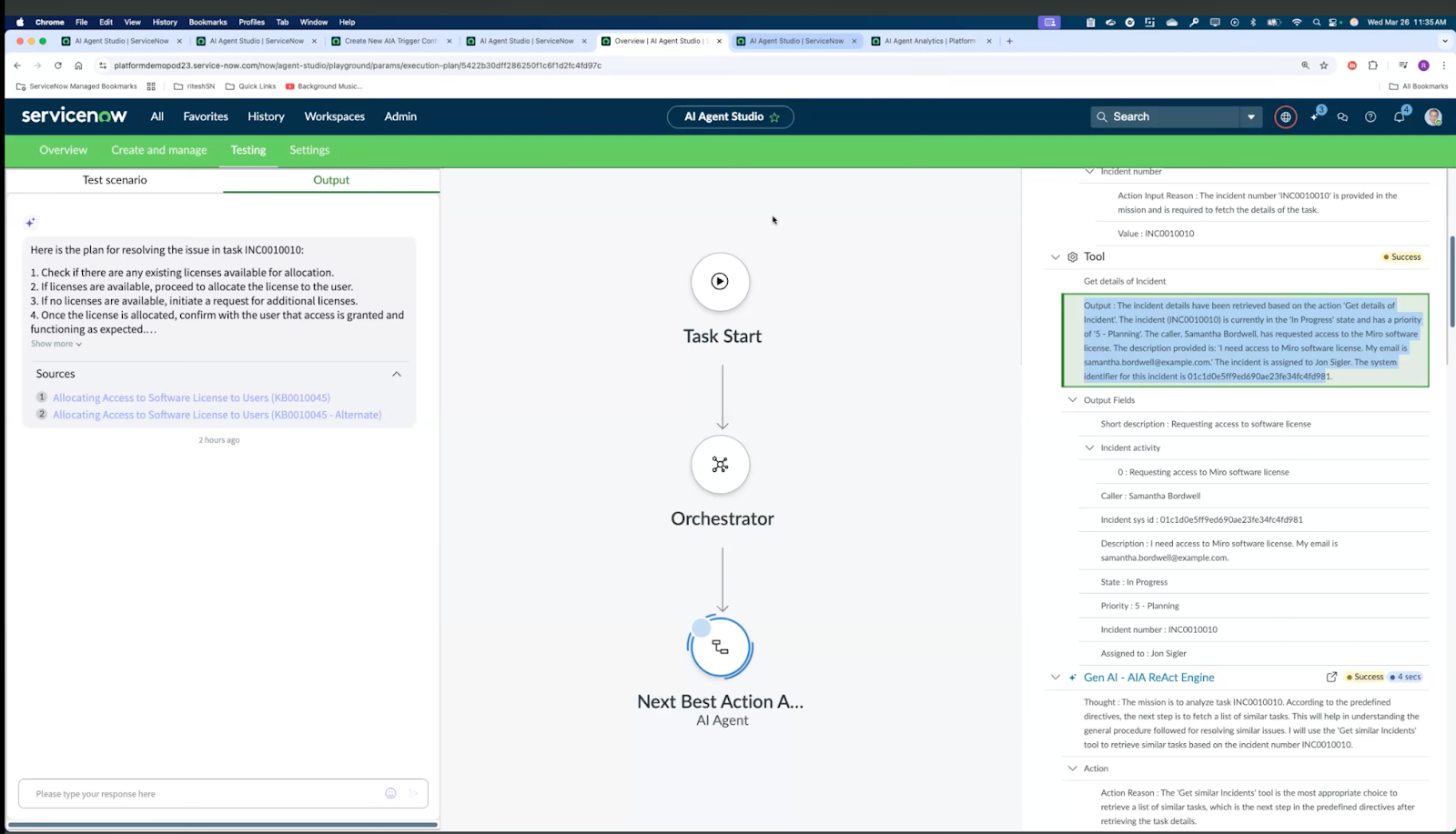
Important business processes are rarely linear. They rarely stay neatly confined to a single department.
To solve the complex nature of cross-departmental operations, in ServiceNow automation the company introduced the AI Agent Orchestrator. Positioned as the central intelligence hub, its main job is to manage the complex timing and synchronization of multiple specialized agents.
- The Orchestrator uses advanced chain-of-thought reasoning. This logic changes a fragmented collection of isolated bots into a highly synchronized workforce. A user might start a complex request.
- This request could be a new employee onboarding scenario that needs sequential actions across IT, HR, and Finance. The Orchestrator acts as the main digital project manager. It dynamically analyzes the objective and dissects the workflow into logical subtasks.
- It then intelligently delegates them to the appropriate departmental agents based on their specific skills and access rights.
AI Agent Fabric How External Agents Connect
The modern enterprise IT system suffers from deep application sprawl. No single vendor platform covers everything. Because of this, the AI Agent Fabric acts as the main communication layer.
This layer for ServiceNow AI agents creates deep connections between native ServiceNow agents and third-party AI systems. The Fabric uses an Agent-to-Agent architectural model.In ServiceNow, These bots actively negotiate responsibilities and dynamically discover mutual tool skills in real time.
A very important part of this is the deep connection of the Model Context Protocol. This protocol gives LLMs a universal, standardized way to securely access external data sources without bespoke point-to-point API coding.
To maintain strict control across this connected web, the underlying execution flow follows a strict path:
- Trigger: An external event, user prompt, or Orchestrator delegation starts the task.
- CMDB or Knowledge Base Data Pull: The agent retrieves precise data using advanced Retrieval-Augmented Generation to ground the AI.
- LLM Reasoning Within Guardrails: The agent uses probabilistic reasoning to decide what to do. This step is constrained by strictly defined allowable output actions.
- Action Executed: Pre-approved, deterministic platform mechanisms natively execute the specific task.
- Close or Hand-off With Full Context: The task finishes with a pristine audit trail via OAuth 2.0 flows. Alternatively, the Orchestrator intelligently escalates the bottleneck to a human operator.
AI Translation for ServiceNow Tickets
Running support operations across multiple countries means language barriers can quietly slow everything down, and ServiceNow AI agents are built to address this directly.
Tickets arrive from dozens of regions, written in just as many languages.
Without AI, agents piece things together through manual escalations, regional handoffs, or ad-hoc translation tools, leading to slower resolutions, uneven support quality, and bottlenecks that worsen when ticket volume spikes.
Multilingual ServiceNow support and AI translation addresses this gap. The system automatically detects the language, translates conversations in real time.
ServiceNow ticket translation keeps context intact as tickets move through updates, comments, and escalations so nothing gets lost along the way
In practice, this means ServiceNow AI agents can:
- Route multilingual tickets to the right place, automatically
- Draft localized responses without waiting on human intervention
- Keep conversations coherent as they move across regions
- Reduce the pressure on region-specific support teams
- Cut down first-response and resolution times across the board
That said, AI translation for ServiceNow tickets handling inside enterprise workflows can still hit its limits. This can go especially with technical jargon, multi-turn conversations, and maintaining context across different platforms. It is a capable solution, but not yet a complete one.
What ServiceNow AI Agents Actually Do Use Cases by Function
According to Tara Fischer - Senior Outbound Product Manager at ServiceNow “The true value of any strategy isn't just in the planning, but in the ability to pivot and realign resources in real-time when the market or the mission shifts.”
The move from theoretical architecture to practical application shows a diverse spectrum of use cases. These ServiceNow AI agent use cases span all main business functions.
- Within ITSM, self-running ServiceNow AI agents dynamically pull historical incident data and generate immediate resolution plans. This saves human agents an average of 4 to 6 minutes per case.
- In Customer Service Management, specialized agents execute end-to-end workflows. ServiceNow AI agents analyze queries and search relevant knowledge bases quickly. This yields time savings of 12 to 16 minutes per interaction.
- HR departments utilize agents to give instant, policy-compliant answers regarding complex benefits packages. This setup fosters a high degree of employee self-service.
- For Security Operations, ServiceNow AI agents systematically automate threat triage. These highly specialized agents dynamically pull external threat intelligence.
- Within Finance, Procurement, and Application Development, agentic workflows execute massive cross-functional changes. Finance agents automate tedious invoice verification processes. ServiceNow AI agents smooth out global supplier onboarding by digitizing and mapping unstructured financial data.
- Meanwhile, specialized development agents accelerate internal engineering speed. They automate code generation and testing routines. ServiceNow AI agents instantly execute knowledge article auto-updates when platform configurations change. This drastically lowers the administrative burden on central technical teams.
Before You Deploy Is Your Data Ready?
Prominent industry analysts from Forrester Research have vocalized deep skepticism regarding the foundational assumptions necessary for the ServiceNow AI model to function.
- The success of Agentic AI is entirely predicated on a business possessing strong data governance, immaculate Configuration Management Databases, and a highly mature IT environment. In reality, enterprise data is notoriously siloed, duplicated, and unstructured.
- The vendor assumption that an AI agent can flawlessly orchestrate tasks across IT, HR, and Finance ignores the profound data maturity gap present in the vast majority of legacy businesses.
- Without absolute data hygiene, self-running agents will confidently execute actions based on flawed telemetry. This creates automated chaos at scale. Deploying ServiceNow AI agents on top of a fractured CMDB or an outdated knowledge base will result in fast failure.
The Real Cost of ServiceNow AI Agents
The aggressive pursuit of a fully agentic business carries staggering, often highly unpredictable financial results. Foundational ITSM licenses cost between $90 and $200 per user per month.
With ServiceNow AI agents, these baseline tiers absolutely do not grant access to advanced Agentic AI functions. To unlock the AI Agent Studio and Orchestrator, businesses are forcefully pushed into mandatory tier upgrades.
This action explicitly requires the purchase of Pro Plus or Enterprise Plus add-ons in order to EVEN use ServiceNow AI agents.
- Industry pricing benchmarks indicate this aggressive tier bundling results in an immediate 25 percent to 40 percent effective price increase upon contract renewal.
- This equates to a staggering premium of $150 to $250 per user, per year, strictly for the right to access the AI features.
- Global enterprise rollouts routinely demand $1.2 million to upwards of $4.5 million in certified consulting fees alone. This makes the move a massive capital expense before a single bot goes live.
How the Assist Consumption Model Actually Works
The most significant and potentially dangerous disruption to enterprise IT budgeting with ServiceNow AI agents is ServiceNow's rapid shift toward a strict consumption-based pricing model for AI inference execution.
- Advanced generative functions are meticulously metered through a proprietary credit system known as Assists. One Assist unit is typically triggered every time an LLM executes a prompt, generates a summary, or formulates a multi-step plan.
- Complex Agentic workflows inherently need multi-step reasoning, repeated external API calls, and continuous LLM prompting to validate actions.
- Because of this, a single complex user request can rapidly burn through multiple Assists in seconds. Higher-tier packages include a baseline allowance of Assists.
- However, businesses that scale this across high user volumes naturally exceed these limits. When the budget runs out, businesses are forced to purchase supplementary consumption packs at premium rates.
Where ServiceNow AI Agents Deliver Value And Where
They Struggle
When self-running agents run in highly structured, data-rich environments, ServiceNow AI agents significantly drop the cognitive load on human operators. Which is one of the reasons many companies look into considering ServiceNow alternatives or easier to use ServiceNow AI agents.
- By summarizing massive incident threads and automating basic catalog requests, they accelerate enterprise-wide workflow throughput. ServiceNow AI agents directly improve gross margins. For instance, conversational AI issue resolution can yield 11.32 minutes saved per successful session.
- ServiceNow AI-powered translation and system Localization gives users a more personalized support experience by allowing teams to define locales and adjust settings for time, date, and currency displays. The ServiceNow AI Platform supports multiple languages out of the box, with options to build custom translations for ServiceNow materials or for languages not yet covered on the platform.
- However, the operational reality for developers reveals systemic failures and profound setup challenges. A pervasive critique is that current AI Agents frequently mimic rigid automation rather than true probabilistic reasoning.
- A lot of the time ServiceNow AI agents often act as strict chatbots. They fail completely if the human user deviates even slightly from a highly specific, predetermined conversational script. The platform suffers from acute technical instability.
- According to ServiceNow forums, some user state agents consistently fail or completely lose context when a conversation thread exceeds a mere ten interaction turns. Users also frequently hit fatal 500 Internal Server Errors during the initial Task Start step.
- To fix these exact constraints, businesses deploy Thunai as a complementary intelligence layer. Where native agents drop context or hit strict data walls, Thunai Brain smoothly syncs live application data across your entire stack and your ServiceNow AI agents.
- By acting as a central, unified knowledge system, Thunai detects contextual conflicts across disparate documents and external systems. It feeds a continuous, contradiction-free source of truth directly into your workflows to prevent agent paralysis.
Governance and Control Keeping AI Agents in Check
To manage the immense risks linked to ServiceNow AI agents and self-running operations, the technological backbone relies on the AI Agent Control Tower.
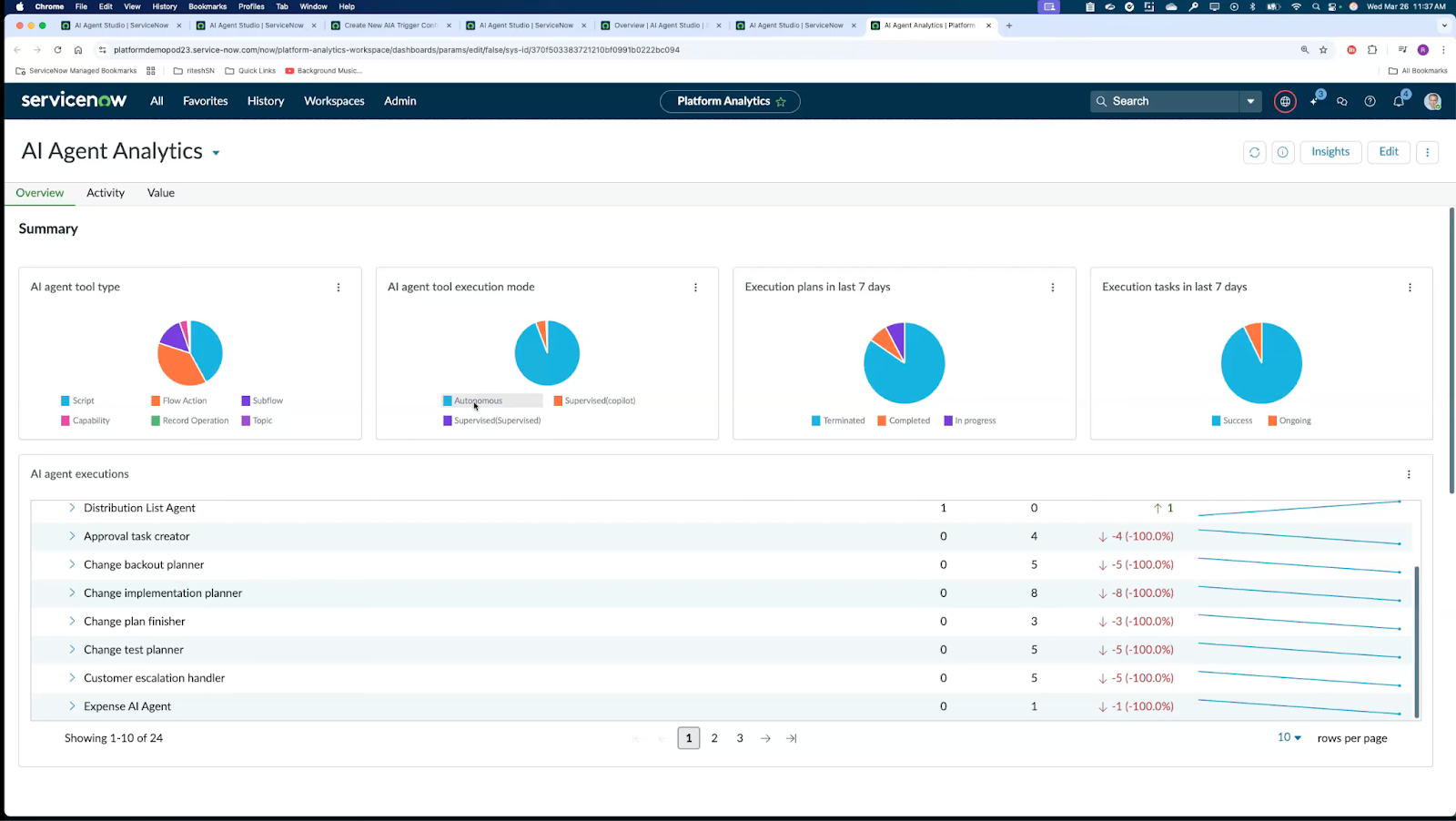
- Operating as the central mission-control environment for the firm, the Control Tower is engineered to govern, monitor, and strictly mandate compliance policies across all deployed agents. This step is highly necessary for preventing the dangerous phenomenon of sprawl with ServiceNow AI agents.
- The Control Tower gives vital real-time performance tracking. It monitors accuracy and latency metrics to satisfy emerging regulatory frameworks. Individual AI Agents are meticulously classified into highly scalable architectural categories.
- This design makes sure that an agent handling a mundane network incident operates with entirely different security parameters than an agent processing highly sensitive human resources data.
- All cross-platform actions are explicitly authenticated using OAuth 2.0 Authorization Code flows. This step with ServiceNow AI agents guarantees pristine audit trails.
Building the Internal Business Case for ServiceNow AI Agents
Given the exceedingly high barriers to entry, looming consumption costs, and heavy technical risks, constructing an internal business case requires a ruthlessly data-driven method. IT leadership must forcefully move beyond pervasive vendor hype.
- Teams deploying ServiceNow AI agents must identify operational bottlenecks where human teams spend disproportionate amounts of time on highly repetitive tasks. A rigorous analysis of workflow determinism is highly necessary. Deploying a metered, consumption-heavy AI Agent to resolve a linear problem that a free script could handle is a primary driver of negative ROI.
- To secure executive funding, architects use a strict AI Value Framework. The business case must heavily account for the Deflection Rate. If a self-running agent successfully resolves an issue digitally, it prevents an escalation to a highly paid human engineer.
- The business entirely avoids that labor cost. By mapping the drop in human-led interactions against the anticipated cost of AI Assists, financial leaders can project a timeline to break even
- For businesses looking to bypass endless deployment cycles, Thunai fundamentally speeds up this exact business case. By overlaying the Thunai Omni module on top of existing service desks, firms deploy AI to handle initial customer chats in under 2 days.
- Some AI agent software like Thunai achieve up to 80 percent ticket deflection rates while maintaining a 95 percent CSAT score. Instead of waiting 18 months for base data hygiene projects to finish, book a demo to see how Thunai drives verifiable financial returns immediately.
How Thunai Extends ServiceNow AI Agents for Faster, Broader Impact
Upgrading to ServiceNow high-tier agent architecture is a heavy commitment.
Instead of wrestling with Custom vs. Ready-to-Use development inside native UI builders, Thunai gives a unified omnichannel system that actively improves your workflows.
Better yet, Thunai helps automate the closure of ServiceNow tickets using AI agents in under 0.8 seconds.
- Thunai connects your disparate business data securely via the Thunai MCP (Multi-Connect Protocol). This sets up a true, bidirectional sync across 35 popular enterprise tools.
- When IT agents struggle with blind spots, Thunai Reflect AI connects directly with Jira and ServiceNow customer chats. It surfaces real-time product health trends and automatic bug alerts.
- Thunai drops the cognitive load on human operators by deploying the Thunai Meeting Assistant. This tool actively joins calls, transcribes live sentiment, and delivers precise action items straight into your CRM.
- By using the Thunai Common Agent, your team builds capable, multimodal workflows visually. You can use simple drag-and-drop actions or AI prompts.
- You entirely avoid heavy developer code. See how these tools natively better your existing ITSM investments. Schedule a free consultation today.
Is ServiceNow AI Agents the Right Fit for Your Organisation Right Now?
The agentic enterprise is undeniably the inevitable future of corporate workflow orchestration.
However, dealing with the current iteration of the ServiceNow AI platform requires intense, unyielding pragmatism.
ServiceNow presents a future for agents, but the current version often has problems with stiff logic and split data. And, high use leads to price changes that are hard to predict - but luckily:
- Thunai AI agents work differently by using a visual builder to build flows across text, voice, and email.
- These agents use the Thunai Brain as a single truth to fix data errors. This keeps facts correct without waiting for old data systems to be fixed.Not to mention it can do live translation in over 200+ languages with omnichannel AI customer support.
Want to see how? Book a free demo!
FAQs on ServiceNow AI Agents
What is the difference between a ServiceNow chatbot and an AI agent?
Traditional chatbots rely on rigid "If X happens, do Y" instructions and fail when encountering unexpected variables or missing data fields. In contrast, AI agents utilize dynamic, goal-oriented reasoning to autonomously evaluate the live environment, adapt to deviations, and determine the optimal sequence of actions to achieve an objective.
Is Now Assist the same as a ServiceNow AI agent?
No, they serve different but complementary roles. Now Assist is ServiceNow's generative AI helper that focuses on conversational interactions, proactive suggestions, and summarizing content. AI agents are the autonomous "doers" that sit on top of Now Assist to execute complex, multi-step workflows across different systems.
Do ServiceNow AI agents require coding to set up?
Modern AI agent platforms can integrate natively to execute major ITSM actions directly out-of-the-box without requiring complex custom coding. Users can issue natural language directives to trigger workflows, eliminating the need for rigid, developer-built Flow Designer setups.
What factors drive the cost of ServiceNow AI agent deployment?
Deploying AI agents increases the consumption of artificial intelligence units (like Now Assist), which inflates the underlying subscription base. Because vendor support programs like ServiceNow Impact are priced as a percentage of your total subscription spend, adopting AI introduces a compounding cost escalation regardless of actual usage.
Can ServiceNow AI agents work with non-ServiceNow tools?
Yes, advanced AI agents utilize APIs and webhooks to synchronize with external live application data in real-time. This enables the AI to base its actions on a unified enterprise fact base—including SharePoint documents, CRM databases, and PDFs—rather than relying solely on isolated ServiceNow datasets.
What is the ServiceNow AI Agent Orchestrator?
The AI Agent Orchestrator is a central intelligence layer designed by ServiceNow to manage and coordinate multiple independent AI agents. It breaks complex, enterprise-wide processes into smaller missions and assigns them to specialized agents, allowing them to work synchronously to complete tasks.
How do I know if my organisation is ready for ServiceNow AI agents?
Readiness depends entirely on strict architectural discipline, starting with a mature implementation of the Common Service Data Model (CSDM) so the AI understands business dependencies. Furthermore, organizations must have rigorous cross-functional governance and data privacy controls established so autonomous actions do not expose sensitive data or cause cascading service outages.
How can Thunai help with ServiceNow AI agent deployment?
Thunai supercharges the platform by acting as an intelligent middleware layer that intercepts and resolves workflows autonomously using goal-oriented reasoning. Through its Model Context Protocol (MCP), it allows companies to deploy agents that execute dozens of major ITSM actions natively, dramatically accelerating deployment and driving massive ticket deflection.


.png)